Showing posts with label Albrecht Dürer. Show all posts

Thursday, April 30, 2026

Beltane, 2026 (Revised May 11, 2026)


(May 2, 2026 - I always associate Beltane with the symbol of the rose pentacle now. I would've liked to post a photo of a cast piece of my own design here, and I would have, if one existed. Alas, no. That project has been stalled for, at least, 2 years.

However, I did find the GIF above - with a pentagram inside a circle, accented with a spray of five roses - which we can consider an interpretation of the more traditional rose pentacle symbol.

It was found in this collection. I am unsure of it's maker but, it goes without saying, it's very nice!)

(5/15: Note the tension between the pentagram and the roughly pentagonal spray of flowers. Doesn't it feel like they're straining to come together?)

•

"Also known as Cétshamhain ('first of summer'), it marked the beginning of summer and was when cattle were driven out to the summer pastures. Rituals were performed to protect cattle, people and crops, and to encourage growth. Special bonfires were kindled, whose flames, smoke and ashes were believed to have protective powers."

- From the Wiki entry for Beltane, it would seem that for the early Celts and Germanic people, the first of May and the beginning of summer was a very beautiful and, yet, vulnerable time of the year. The world had come back to life and rituals were performed, not only to celebrate that life but to nourish and protect that life from harm.

•

“In the face of so much destruction of the natural world and so much disregard for life, Beltane is also an act of rebellion against the status quo. It says about us–as simple people, as a growing community–that we don’t give in to the death cycles imposed on us from Away, not in this season. We plant and know that the harvest comes – not in the stately march from Lughnasadh to Samhain but bit by bit and day by day."

- Byron Ballard, from Summer is Come, sourced from the wonderful Beltane page at Wild Hunt, as is the following quote and the Walter Crane illustration below, inset left.

•

"The flesh is understood to be the place where evil resides and from which torment wreaks havoc upon the mind. The flesh is temporary, so it must be trivial. The flesh will not remain, so we must not give it credence. The flesh will pass unto the earth, rot in the ground, turn into dust. We are told again and again to dismiss the flesh. But Whitman says, ‘And your very flesh shall be a great poem.’ Yes. Our very flesh shall be a great poem. That is the message I’d like to offer on Beltane.”

- From Beltane 2013: The Great Poetry of Flesh by Teo Bishop (Matthew Morris).

***

A very nice Wheel of the Year found (for sale) at Maine Corner.


(May 3, 2026)

I enjoy the Sabbats. There's, undeniably, a special energy in the air on those days; a kind of clarity. Time seems to savor these days; it moves more slowly, stretching just a fraction, but, enough to experience a sense of unity... with the Earth, with your past, and with the very long past we know as "tradition."

Maybe all holidays do that; act as milestones.

April 30th (May Eve) - May 1st (May Day) is a holiday that emerged in Celtic and Germanic Europe: the Celtic Beltane or the Germanic Walpurgisnacht. Apart from it's pagan, Earth-religion elements the holiday is, in the Christian tradition, marked by May devotions to the Virgin Mary and the Saint Walpurga.**

It is also an official holiday in Europe; similar to the American Labor Day. International Worker's Day in the States is celebrated by rallies held across the nation for working class Americans. As you might expect, the gatherings were massive this year. Inset left is a May Day tribute to "the workers" by English illustrator Walter Crane. Crane's work often is orchestrated with the movement of the pentagonal Golden Spiral. Can you find it in this image? (Hint: start with the triangle.)

The full "Flower" moon rose over the Sandias on the evening of May Day. It was a pale, lemony rose color... crisp and bright, before it was made spooky by a transparent plume of clouds. A second full moon will rise May 31st. The month of May is virtually bracketed by full moons. I think there's a message here: the time is ripe to banish our bogeymen and truly come back to life.*** We've got the whole month. Get moving. ;-)

Here's to a merry month of May! 💮

(Footnotes appear below the jump.)


Thursday, August 29, 2024

The Dürer Files: 1b. Hendrick Goltzius & The Gods of the Golden Egg (Completed 9/14/24)


Sine Cerere et Libero friget Venus (Without Ceres and Bacchus, Venus Would Freeze),
1600-1603, Hendrick Goltzius. Geometry: 2024, DS.


"When Goltzius created this so-called "pen painting," which combines pen and ink and brush with oil color, it caused a sensation in Europe and was immediately purchased by Emperor Rudolf II for his collection in Prague. Without Ceres and Bacchus, Venus Would Freeze, c. 1600-1603, marks the critical moment when Goltzius, the most famous draftsman and printmaker in Europe, turned to large-scale painting."

- Via the Philadelphia Museum of Art page: A Masterpiece in Focus, a short article describing the unusual painting featured above and inset left which the museum acquired in 1992. Apparently, after the Dutch artist, Hendrick Goltzius (1558-1617), completed it - and Goltzius was so secretive about his methods he never allowed anyone to see his work at an incomplete stage - it was snatched up by Emperor Rudolph, the "Mad Alchemist" of Prague. There's more to add to this post regarding Rudolph, but, suffice to say, he was also an avid collector of works by Albrecht Dürer. Meanwhile, Dürer was an artist that Goltzius felt motivated to "surpass," with the same competitive enthusiasm the old Master, himself, expressed regarding the Masters of his own time. 

So, did Goltzius surpass Dürer? Well, we shall investigate. But, before we go much further, allow me to mention that my first golden egg was found in Goltzius's odd Venus painting. Of the four golden eggs I've found, this appears to have the most perfect - albeit static - form. Interestingly, it is configured with the same arrangement of pentagrams as the former golden egg found in my previous file. But, note the star's differing orientation  (inset right).

The two ovoids are very similar; in some images they are almost interchangeable. The difference is shown inset right and below with phi-shells. I favor Ovoid 1 as superior in the Venus... image, but Ovoid 2 has a few things going for it, too.

So, which is the true ovoid in this painting?

Ovoids 1 & 2


In the last analysis, it doesn't matter. For Europeans living at the turn of the 16th/17th centuries, Without Ceres and Bacchus, Venus Would Freeze caused "a sensation." It seemed to possess a kind of mojo. And one thing I'm going to be asking throughout this post - the bottom line - is whether or not the presence of phi in art, specifically via the pentagram, lends the work in question a certain kind of indelible magic... and why that might be. Keep in mind Dürer's iconic Melencolia I, Botticelli's Venus, Caravaggio's Amor, or that mysterious Italian lady painted by Leonardo da Vinci.*

Without Ceres and Bacchus, Venus Would Freeze is a weird (but charming) image, but it might be helpful to know something about the gods involved in this oddly luminous, intimate scene... thereby, learning a few things about Goltzius (& Dürer) as well...

Friday, August 9, 2024

The Dürer Files: 1. "Melencolia I" & The Golden Egg (Updated 8/11/2024)


"For the alchemists the vessel is something truly marvelous: a vas mirabile. Maria Prophetissa says that the whole secret lies in knowing about the Hermetic vessel. “Unum est vas” (the vessel is one) is emphasized again and again. It must be completely round, in imitation of the spherical cosmos, so that the influence of the stars may contribute to the success of the operation. It is a kind of matrix or uterus from which the filius philosophorum, the miraculous Stone, is to be born. Hence it is required that the vessel be not only round but egg-shaped."

- Sourced from a quote found here, we are introduced to the ancient alchemist Maria Prophetissa, also known as Maria the Jewess,* who had a thing or two to say about the golden egg, as did I in a Samhain post (featuring Leonora Carrington's eggs) a year or two ago!

Prescience? At that time, apart from this fundamental (Easter egg) relationship, I didn't realize that there was actually a phi configuration - using two identical spirals - which, when combined, form a perfect ovoid. But, in the past month I have found two perfect varieties of phi ovoids - both varieties discovered in paintings - which comprise a new phi spiral category: the Golden Eggs.

If anyone knew about Golden Eggs, you might suppose it'd be Albrecht Dürer. And, it goes without saying, that if a golden egg was to be found in any of his major works, Melencolia I - one of his most iconic images... and an image saturated with phi - would be the logical place to search. I've previously devoted 2 posts to the spirals found in this melancholy baby (1 & 2). But, until this past week, I had not incorporated the corresponding pentagram... and, when I did, I was astounded. The big surprise (the easter egg) was the perfect relationship between the ladder and his famous, enigmatic polyhedron. Can't touch that!

As for the golden egg? Well, observe...


Tuesday, June 25, 2024

The Dürer Files: A Series Introduction

Nemesis or The Great Fortuna, Albrecht Dürer - copper-plate engraving - 1502.
Geometry: 2024, DS.


"Precariously balanced on an unsteady sphere, Albrecht Dürer’s nude female figure of Fortuna conveys a sense of the instability and unpredictability of fortune. The artist’s treatment of the subject derives from a Latin poem by the Italian Renaissance poet and humanist Angelo Poliziano (1454–1494), who describes fortune as the “power to crush the arrogant minds and triumphs of men and to confound their too ambitious plans.” With her bridle and cup, Dürer’s figure—in contrast to misogynistic portrayals of her by a later generation of artists—also embodies the virtues and rewards of temperance."

- A nice assessment of Albrecht Dürer’s Nemesis image (inset left & above) via this NY Public Library page. It seems cynical that Dürer should symbolically combine the word nemesis - meaning rival, enemy or punisher - with the idea of fortune (fortuna) together in one image. Was he referring to the idea of fate as karma? In reality, the goddess Nemesis and the goddess Fortuna are mythologically and symbolically connected and it is more than likely he created his own hybrid.

It actually took me several days to see the spiral in Nemesis, the Greater Fortuna... which is astounding considering what an awesome spiral it is. It's a dialing spiral but of a slightly different kind than the one I'm familiar with. You can create a small animation with it growing in size and spreading over the image as it revolves around one central point (in the vicinity of her elbow). In the fuller image - shown above with the phi-shell - the spiral continues into the landscape.

As for the image itself, the figure of Nemesis/Fortuna exhibits a female body type humanity rarely sees anymore. We probably stopped seeing her around the same time Dürer created her, at the turn of the 16th century. She is an older woman; you can tell by her diminishing face and thinning hair... unlike Durer's (1496) Little (or Lesser) Fortuna - inset right - the younger Fortuna (with a lesser spiral) and an enigmatic image the size (and dimensions) of a Tarot card.*

But, the older Fortuna - who has in her maturity taken on the role of Nemesis, a "formidable and usually victorious rival or opponent" - reveals a body with contours which, while not aesthetically correct in our times, has retained its hard-bodied youthfulness. She has powerful wings and holds a large chalice. Traditionally, Fortuna, is shown holding a cornucopia but, as mentioned, Dürer has created his own Fortuna hybrid. But, then, it seems he rarely sticks with the "tried and true," preferring his own innovations. In any case, Nemesis/Fortuna is a force to be reckoned with. She may be offering the chalice - the cup of plenty - but, we are reminded that she is also carrying a horse's bridle. In other words, while we may succeed  above and beyond our wildest dreams, our egotistical aspirations are kept in check by this goddess. Either that, or she represents a stereotypical negative female archetype.

Incidentally, Nemesis is much more massive figure than she appears at first glance. An enlargement of the little Italian town which she overlooks (as she balances upon her sphere) can be found here.

___________________________________________________


By now, I should know better than to make promises regarding the future I can't keep... but, in regards to my previous projections made in my last post, when and where I envisioned one more addition to the Dürer series, I am now here to report that my plans have had to change.

Yes, while in the midst of feverishly writing the proposed post (Dürer Part III)  I initially had in mind, I was suddenly presented with far more bits of information than I could possibly process in one post.  An example would be the Nemesis image with it's astounding spiral (above). But, there were other images found as well, deserving some special consideration... such as Dürer's diagram of his 'Schneckenlinie' ('snail-line') or Logarithmic spiral - (inset left) - a spiral which, oddly, almost appears as if it's in perspective. Sadly, I cannot translate the text. (If you can, please inform us!)

In any case, after the shock wore off and my first attempts were put aside, I decided the new information required a new series... The Dürer Files, a new testament of sorts. Moreover, it would have to be broken up into bits... thereby requiring shorter posts and less time, or, seriously, I would never get any of it online. So, this is the Introduction. The series contents will (tentatively) include  the following sections:


The Dürer Files: 2. Soli Deo Gloria (Glory only to God)

The Dürer Files: 3. Maximillian & The Bauhütte

The Dürer Files: 4. Dürer & the Phi Goddess

The Dürer Files: 5. Dürer & the Black Madonna

The Dürer Files: 6. Dürer & the Whale


(Note: This Intro will also serve as the Dürer Files series Table of Contents page with links becoming active as the posts appear. The links will also appear in the Golden Series content post (click the Golden Snail on the sidebar.) (Know, however, that the titles and order in which they appear may change.)

(Note 2: I have already added an extra section... and 2 more - regarding phi ovoids - are likely to follow.)

___________________________________________________


(More below the jump break...)

Wednesday, January 10, 2024

A Belated Christmas Spiral: The Annunciation by "Juan de Flandes" (Revised 1/19/24)


The Annunciation, 1508, Juan de Flandes. Geometry: 2024, DS.


"Juan de Flandes ("John of Flanders") was a Flemish painter active in Spain from 1496 to 1519. His actual name is unknown, although an inscription Juan Astrat on the back of one work suggests a name such as "Jan van der Straat". Jan Sallaert, who became a master in Ghent in 1480, has also been suggested. He worked in the Early Netherlandish style.

He may have been born around 1460 somewhere in Flanders, Flandes in Spanish, which encompassed modern Belgium, Netherlands, Luxembourg and bordering regions of France. He evidently trained in his home country, most likely in Ghent, as his work shows similarities to that of Joos van Wassenhove, Hugo van der Goes and other Ghent artists. He is only documented after he became an artist at the court of Queen Isabella I of Castile, where he is first mentioned in the accounts in October 1496. He is described as "court painter" by 1498 and continued in the queen's service until her death in 1504..."

- Via Wiki's entry for Juan de Flandes.

"In a list of 23 February 1505, thirty-two of them, including the Last Supper, were acquired by Margaret of Austria, Regent of the Netherlands and sister of Isabella’s son-in-law (in whose collection they were seen by Albrecht Dürer). Dürer noted in his diary: ‘And on Friday Lady Margaret showed me all her beautiful things, and among them I saw about forty small pictures in oils, the like of which for cleanness and excellence I have never seen’."

- Although not applicable to The Annunciation,  the quote was sourced from this page in which a full account of Juan de Flandes' mysterious collection of small paintings is given.

(Update:1/19/2024) I'm adding a new spiral to the mix (inset left). While not the "magic act" posted above it still has 2 things going for it: it terminates on the "holy spirit," and it begins to form a pentagram over Mary. There's a third thing. Gabriel conjures up an important golden relationship with his wand. What is it?

(Correction: Gabriel conjures up (at least) 3 golden relationships with his wand. What are they?)

***

I had a different post in mind for the first post of the year, but, as it happened I had the image (above) on file as a possible Christmas alternative, but, it needed research and I didn't have the time for it last year.

As it was, the trail grew cold fairly early on in my search for information, and there doesn't seem to be any clear cyberspace description of who the artist actually was, although we do know he was fairly successful, especially in Spain. (See: Juan de Flandes and His Financial Success in Castile.)

But, Juan de Flandes' Annunciation is possibly one of the most unique of all the many paintings in that genre produced in the late Renaissance, another being Botticelli's Cestello Annunciation (1489), the first spiral painting I documented on this blog... and, still, to this day, one of the best spiral paintings.

The spiral in this somewhat odder Annunciation painted by the Flemish painter, however, has one special feature. It's spiral presents us with a little conjuring effect, a magic act. (Why, it even has a dove!)

I've inset the unembellished original so you can witness it for yourself. Click on the image, and when the "slideshow" pops up, click on the spiral version. Jockey back and forth.  Do you see it?

Abracadabra! the angel performs a magic-trick with his staff... as if it was (an overly long) wand. (Presto! Mary is now with child.)

(Now, there's a mixed metaphor...)

Wednesday, July 20, 2022

Albrecht Dürer and the Divine Ratio (Part II) - Dürer Reconsidered

Melencolia I - copper engraving - Albrecht Dürer. Geometry: 2022, DS.


"Since this knowledge is very useful to workers, and since (it) has been kept hidden and in great secret by the erudite, I propose to bring it in the open and teach it."

- A quote from Albrecht Dürer found in this interesting article by Karel Vereycken: Albrecht Dürer’s fight against “neoplatonic” melancholy.

***

"...but, after reviewing the two other prints involved, it seemed all three might have what I (now) refer to as hidden, occulted, or passive GTS. Unlike the more outrageously active spirals - e.g., those of Caravaggio, which seem as if they were deliberately designed - the passive spirals almost seem to creep into an image with the artist unaware. The thing is, it is logical to assume Albrecht Dürer did know about the golden ratio. Alas, the jury is still out."

The quote above is my own - via my first Dürer post. As it happened, the "jury" eventually just walked through the door, and informed me I was wrong on two counts: Dürer's spiral is unlikely passive... and passive spirals are never occulted (deliberately hidden)... they merely occur without conscious intention.

And, what brought me to these conclusions? Well, the story went something like this:

The night after I (finally) finished Albrecht Dürer and the Divine Ratio (Part I), I fell into one of those peculiar, delirious dream-states which, after a day of continuous and repetitious physical and/or mental activity, seem to reflect and extend a similar activity into your sleep. In this case, after spending the day pondering over Dürer, I dreamt of having a chance to speak with the man himself (!) who, I was informed, was not merely alive, but in my general vicinity. But, of course, Albrecht Dürer has been dead for hundreds of years, so, it couldn't have been a corporeal Dürer... but, apparently, this did not make a difference to my dreaming mind. Now, what is especially weird about these labor-induced dreams is that one can wake up numerous times and, yet, each and every time fall back to sleep and return to the very same dream... continuing ones "labor" in a place of no-space and no-time.

And, so it was. But, did I ever actually communicate with the incorporeal artist? Not that I remember. However, when I awoke, this much was apparent to me: I had missed something in the Dürer "dig" and it was something important; my Dürer work was not yet done. 

Now, this could've proved to be a research mine-field but, as it turned out, later that day, I had an epiphany: yes, that ladder in Melencolia is golden, but, it isn't a one-trick-pony; there might be (at least) 2 more triangles tucked inside of it. And, of course, there were. The drawing of the ladder is actually composed of 4 main diagonals (6 if you're a stickler). And, coiling around the diagonal on the inside of the ladder (see above, and inset right) were spirals orientated in the opposite direction of my first (inside left below). Each spiral initially intercepts the comet, then, coils around the polyhedron before passing under the dog's snout, around the edge of the robe, and, finally, over the angel's knee and elbow before terminating around the end of one of the large compasses. (Yes, technically a "compass" is actually composed of a pair of compasses.)

Which is, certainly, quite a different story from the first spiral... (again, inset left) which (ingloriously) terminated somewhere up the dog's... posterior.(!)

Or is it a different story? Maybe its the same one... which begins from the creative point of a compass... but ends up... well, we know where it eventually ends up; hence, melancholy.

Then again, maybe Albrecht was just having his little joke...or, maybe just having a bad day. But, whatever his motives were, I think we can conclude that Dürer consciously knew what he was doing... and that all three spirals are (very likely) active ones... i.e., deliberate.


So, regarding the "Divine" ratio and its GTS, does this mean Dürer was finally informed by the Italian painters and/or Pacioli ?  No, actually, I don't think that was the case. The Italian painters and mathematicians were notoriously secretive and unlikely to hand over their knowledge to a foreign rival. Ultimately, he figured it out all by himself...

...because that's how great a geometer he was.

Note the drawing directly above. It is a detail of one of the diagrams from his book on human proportions, although I'm at a loss to explain exactly how and what he was measuring. But, here's a description from the British Museum page (on which it was found):

 "There is also a foreshortened section of a circle on the recto, with Dürer's notes on its construction written alongside. The drawing on the verso is accompanied by manuscript notes, in which Dürer gives extensive details of his method of construction with the use of compasses. This is based on the system of human proportion, with the body made up of eight head lengths, outlined by Vitruvius in his treatise 'On Architecture', whereby architects of antiquity were encouraged to follow an ideal human proportion in their planning of temples."

 The numerically-sectioned ellipse around the figure's uplifted arm is interesting... an example of Dürer's unusual and innovative techniques. (Below the jump) is the full figure upon which I've positioned a GTS...

Monday, June 27, 2022

Albrecht Dürer and the Divine Ratio (Part I)

Melencolia I - copper engraving - 1514, Albrecht Dürer. Geometry: 2022, DS


"Melencolia I is a large 1514 engraving by the German Renaissance artist Albrecht Dürer. The print's central subject is an enigmatic and gloomy winged female figure thought to be a personification of melancholia – melancholy. Holding her head in her hand, she stares past the busy scene in front of her. The area is strewn with symbols and tools associated with craft and carpentry, including an hourglass, weighing scales, a hand plane, a claw hammer, and a saw. Other objects relate to alchemy, geometry or numerology. Behind the figure is a structure with an embedded magic square, and a ladder leading beyond the frame. The sky contains a rainbow, a comet or planet, and a bat-like creature bearing the text that has become the print's title.

The art historian Erwin Panofsky... wrote that 'the influence of Dürer's Melencolia I—the first representation in which the concept of melancholy was transplanted from the plane of scientific and pseudo-scientific folklore to the level of art—extended all over the European continent and lasted for more than three centuries.'"

- Excerpt from Wiki's entry for Dürer's Melencolia 1 (shown above). While many art historians seem to unanimously assume the robed, angelic figure is of the female gender, the figure is most assuredly male, and, judging by its facial expression, Dürer himself. Inset right: an early self-portrait (executed in 1498 at age 26) of the fashionable - but seriously introspective - young dude.

Regarding the central "ladder leading beyond the frame," note that it forms the apex of a large golden triangle.

Note: To give an example of how deeply this image continues to resonate over the years, Wiki mentions Peter-Klaus Schuster's 1991 publication, Melencolia I: Dürers Denkbild, an exhaustive history of the print's interpretation in two volumes.


"It should be noted that even Leonardo was unable to apply his own proportion and anatomical studies to his work given he painted little, or not at all, during the last decade of his life. Hence, the applicability of the study of proportion to practicing artists was still unclear. Dürer would spend nearly three decades working to remedy this ambiguity. He completed two treatises that would be the dominant basis for art theory in Renaissance Germany; their popularity and influence spreading with their subsequent translations. In 1525, Underweysung der Messung, or Four Books on Measurement, was published as a practical guide to geometric perspective for students of the arts; and, in 1528, Vier Bücher von Menschlicher, or Four Books on Human Proportion, appeared a few months after his death. Taken together, the studies illustrated the Renaissance belief that mathematics formed the firm basis and grounding for the arts."

- Excerpt from an commentary regarding Dürer's Vier Bücher von Menschlicher by Giovanni Paolo Gallucci found here. Inset left is one of Dürer's diagrams - a construction of a spiral - found in his Four Books on Measurement.


"There is much speculation as to why Dürer chose this construction rather than Euclid's construction which uses the 'golden ratio' proportion. The speculation stems from the fact that Dürer makes no mention of the golden ratio, although he was no doubt aware of its use in Italian art. It may be that Dürer simply did not feel comfortable with the precepts of the 'divine' ratio. The German architects had their own 'divine' ratio which was the vesica piscis ratio of  √ 1:3. In addition Ptolemy's construction is simpler than Euclid's and these constructions were just a preliminary step in his program."

- Excerpt - along with Dürer's diagram (inset left) - from The Polygons of Albrecht Dürer by G.H. Hughes. (.pdf)

Regarding the diagram, the pentagon is constructed within the mason's "Sacred" tradition utilizing the Vesica Piscis as its generative source.


"Divine truth alone, and no other, contains the secret of what the most beautiful form and measure may be."

- Albrecht Dürer, from his essay Discourse on A
esthetics
 published as a conclusion to the Third Book of his proportion studies. (See the Giovanni Paolo Gallucci link for the full quote.)


"The greatest miracle that I have seen in all my days, happened in the year 1503, when crosses fell on many people, especially on children more than on other people. Among them all, I once saw one in the shape which I have drawn here; it fell on the linen blouse of Eyer's maid, who was in the Pirckheimer's back-house. And she was so upset about it that she cried and wailed; for she thought she was going to die of it.

Also, I saw a comet in the heavens."

 - Albrecht Dürer from the last page of his 1503 Gedenkbuch regarding an episode of a phenomenon known as Red (or Blood) Rain. Dürer's drawing can be found on this page.

***

(Note: Originally, the title of this post and the title of the URL were one and the same. That is, till I realized that Melancolia I was one of three designated Master Prints. I am not quite sure who did the designation, but, after reviewing the two other prints involved, it seemed all three might have what I (now) refer to as hidden, occulted, or passive GTS. Unlike the more outrageously active spirals - e.g., those of Caravaggio, which seem as if they were deliberately designed - the passive spirals almost seem to creep into an image with the artist unaware. The thing is, it is logical to assume Albrecht Dürer did know about the golden ratio. Alas, the jury is still out.)

Albrecht Dürer (May 21,1471 - April 6 1528) is, in his own quiet way, possibly one of the most popular artists of the Renaissance period; certainly one of the most prominent. (You know you've arrived when there's a conspiracy blog written about your life!) After all, unlike many other artists, he kept a meticulously written record of his daily affairs. And, then, there were those self portraits... even while he was ill and nearing the end of his life, he sketched his ravaged body for posterity. Perhaps, he just desperately needed to be remembered. But, why is it that all of his self-exposure seems, in the end, superficial? Because, regardless of what we learn, Dürer remains as firmly screwed into his shell as the most resistant of mollusks; he is an enigma even unto himself. In fact, his vital nature seems very much like another cryptic element found in one of his most popular images: Melencolia I (below the jump). Observe...

Tuesday, June 21, 2022

The Golden Series - Contents (Updated 10/3/24)


 The Golden Series

Phi, the Pentagram & the Golden Spiral

(An informal investigation regarding the role of the pentagonal golden spiral in art history from the ancient, classical period till the present day... observations and discoveries recorded in real time.)


Posts are listed from earliest to most recent.


Reflections on Water

Fractal Unit 5

Botticelli & the Spiral

2022 - A Tentative New Year

The Power of Love

Nicolaes Lachtropius & the Golden Spiral

Five of One, One of Five

Judith Leyster and a Double Golden Spiral

Carlo Crivelli and the "Queen of Heaven"

Caravaggio's "Golden" Boy(s)

The Golden Egg

"Da Vinci" and Other Codes - Part 1

"Da Vinci" and Other Codes - Part 2

A Virtual "Can of Worms"

Albrecht Dürer and the Divine Ratio (Part I)

Albrecht Dürer and the Divine Ratio (Part II) - Dürer Reconsidered

In the Shadows of a Golden Age: the Bentvueghels (Part I)

In the Shadows of a Golden Age: the Bentvueghels (Part II)

Judith Leyster Saves the Day (An Addendum of Sorts)

In the Shadows of a Golden Age: the Bentvueghels - Part III

The Gentileschi Spirals... and a series Afterword

Chasing Ancient Pentagrams: the Roman Dodecahedrons

Samhain, 2022; Leonora Carrington and the Philosophic Egg

Chasing Ancient Pentagrams Part II: The Quintessence: The Egyptian Duat

Chasing Ancient Pentagrams Part III: The Quintessence -The Fellowship of Pentalpha

Hygeia & the Pentalpha (post abandoned)

Venus in the Dovecote (Part I)

Venus in the Dovecote (Part II): The Ancient Sanctuary

Pentagonal Venus: the φ (phi) in Αφροδίτη (Aphrodite)

Gustave Moreau's Golden Venus

Five Spirals for December - #1 "Night Flight" by Michael Parkes

Five Spirals for December - #2   "Princenza Hyacinta" by Alphonse Mucha

Five Spirals for December - #3 One Winter's Night... by Erté

Five Spirals for December - #4 The Vision of St. Cecelia by Orazio Gentileschi

Five Spirals for December - #5 Song of the Morning by Nicholas Roerich

A Belated Christmas Spiral: The Annunciation by "Juan de Flandes"

The Heart Nebula & the Flaming Heart of Venus

The Universe in a Phi Shell

The Paisley Pattern & the Golden Meme

An Auspicious Day

The First of May

The Mirror of Venus: 5 Keys

The Dürer Files: A Series Introduction

The Dürer Files: 1. "Melencolia I" & The Golden Egg

Interlude with a Fallen Angel

The Dürer Files: 1b. Hendrick Goltzius & The Gods of the Golden Egg

The Dürer Files: 1c. The Bees & Keys of House Barberini


The above list is ever-changing... updated with live links as the intended posts are published.


Sunday, January 3, 2016

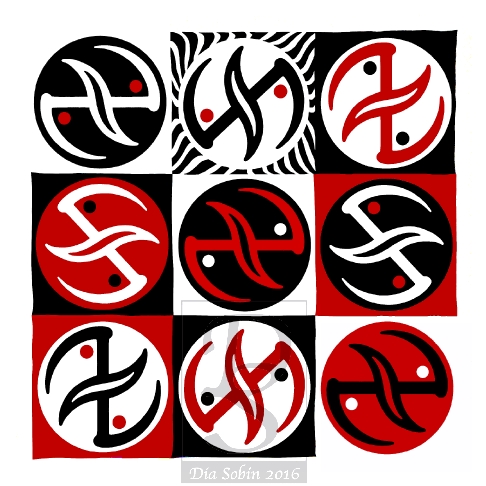
A Mojo Magic Square (with update)


Mojo Magic Square - digital - © 1981, 2014, DS
(click to enlarge)


"Mojo is magic, magical ability, and the power to get things done. "Mojo" first appeared in the 1920s in the southern United States from the Gullah word "moco" (magic), Gullah being Creole spoken by some groups of African-Americans.  The ultimate root of "mojo" was the word "moco'o," which means "shaman or medicine man" in the African language Fulani.  "Mojo" spread first into mainstream Black English and then general usage primarily through the popularity of jazz and blues music.  Muddy Waters got his 'Mojo working' and Jim Morrison of The Doors called for the Mojo Risin'."
- Quote found here.

"Think joie de vivre, that sense of being alive, joyful, and fully present in the moment. The path to finding your mojo differs for everyone. For some, mojo is a sense of purpose and meaning in your life. For others, it’s reclaiming optimal health or sparking their creativity. Some seekers find mojo by getting in touch with the divine, while others get their mojo by getting in touch with their sexual prowess. For many, it’s all of the above."
- Quote found here.

"So what is a mojo? It is, in short, the staple amulet of African-American hoodoo practice, a flannel bag containing one or more magical items. The word is thought by some to be a corruption of the English word "magic." Others state that it is related to the West African word "mojuba," meaning a prayer of praise and homage, as it is a "prayer in a bag" - a spell you can carry. A third possible derivation is from the Bantu/Kongo word "mooyoo," the magically-charged ashes and ground up bones of an ancestor that are encased in the front of a nkisi ndoki - a fetish-statue made in the form of a human being or animal. This connection with the bones of the dead is interesting, because historically, many mojo hands have indeed contained small bones, either of animals or of humans.

Some root workers top off their mojo bags with parchments upon which are printed medieval European grimoire seals and sigils of talismanic import, particularly the Jewish-derived seals from the Greater Key of Solomon and The 6th and 7th Books of Moses, both of which are sold as sets of seals printed on parchment paper, and are used without reference to the rituals given in the texts of the original grimoire books.

These last items surprise many Caucasians, who are unaware that a strong vein of Germanic and Ashenazi Jewish folklore runs through traditional African-American hoodoo. Still, however strange it may seem to cultural anthropologists in search of "African survivals" in hoodoo practice, it is a fact that John George Hohman's "Pow-Wows or the Long Lost Friend" - first published in America in 1820 and translated into English in 1856 - has long been a staple source of inspiration for conjure-workers in both the African-American and European-American Appalachian traditions, and many a black hoodoo practitioner can cite chapter and verse of "Albertus Magnus," "The Black Pullet," "Secrets of the Psalms," "The 6th and 7th Books of Moses," "8th, 9th, and 10th Books of Moses," and other occult books of European origin."
- From an article found on Lucky Mojo.


A Sator Magic Square in Oppède, France.


"The earliest dateable Sator Square was found in the ruins of Pompeii, which was buried in the ash of Mount Vesuvius in 79 AD. Examples may be found carved on stone tablets or pressed into clay before being fired. Its translation has been the subject of speculation with no clear consensus.

It seems that, in all early examples, it is a Rotas Square that reads "ROTAS OPERA TENET AREPO SATOR" from top to bottom, and from left to right.

The Sator Square is a four-times palindrome, and some people have attributed magical properties to it, considering it one of the broadest magical formulas in the Occident. An article on the square from The Saint Louis Medical and Surgical Journal, vol. 76, reports that palindromes were viewed as being immune to tampering by the devil, who would become confused by the repetition of the letters, and hence their popularity in magical use....

The square has reportedly been used in folk magic for various purposes, including putting out fires (the spell is "TO EXTINGUISH FIRE WITHOUT WATER" in John George Hohman's Long Lost Friend), removing jinxes and fevers, to protect cattle from witchcraft, and against fatigue when traveling. It is sometimes claimed it must be written upon a certain material, or else with a certain type of ink to achieve its magical effect."
- From the Wiki Sator Square entry.


***

Well, it's officially a new year in the western world, but, in the Far East, the lunar new year doesn't occur till February 2nd. (More about that later...) So, it's a relative thing, and if your "mojo" isn't quite working the way you'd like it to, you've got a whole month to get yourself in gear. Now, while "gear" isn't necessarily the operative term when defining the word mojo, dynamo, or dynamic kind of is; so, in the last analysis, you know your mojo is working when your inner world is moving seamlessly in synch with the outer world. My guess is, if one can get that down, then, regardless of all the circumstances beyond one's control, he or she will be A-OK... and as much of a contender in this game of life as anyone else is.

As it happens, mojo is a word that's been used - in various corrupted forms - quite a lot in recent years. Originally it was Hoodoo charm (although not to be confused with this hoodoo) bringing good luck and psychic protection to its bearer. Now, it's a catchword most commonly utilized by motivational speakers, executive coaches, "life" coaches, and self-help gurus when describing formulas for increasing ones productivity*, particularly in the workforce.

But, just exactly what do I mean by the word Mojo?

Mojo is animism... the dynamic energy fluctuation that makes an organism tick. If ones wiring is in top form, ones inner force pulls back and then moves forward in sync with ones conscious desires and motivations. In other words, ones Mojo is "working". On the other hand, if ones wiring has gone awry - for instance, in the case of a series of set-backs, intense trauma or injury of any kind, or just plain chronic disappointment - then ones Mojo is thrown off its game. It isn't as if you've lost it... it's that it's blocked from true expression; in other words, it's broken.

Case in point: the magic square (first image above) is something I've had on my desktop for the past 2 years. Why is this? Well, that's a good question! Before this period, I had just gone through a series of unfortunate events, and was holed up in an unfamiliar town with absolutely no clue - and no hope - for a "brighter future." Without going into details, my mojo was, in fact, at the lowest point of its existence...

Tuesday, July 7, 2015

In the Company of Green Women (III): The Illumined and the Illuminators


Zelus Dei - Illumination from Hildegard von Bingen's Scivias - 1151 or 1152 - found here.
(Note: click on images in this post for enlarged views)

"I looked and behold a head of marvellous form ... of the colour of flame and red as fire, and it had a terrible human face gazing northward in great wrath. From the neck downward I could see no further form, for the body was altogether concealed ... but the head itself I saw, like the bare form of a human head. Nor was it hairy like a man, nor indeed after the manner of a woman, but it was more like to a man than a woman, and very awful to look upon.

It had three wings of marvellous length and breadth, white as a dazzling cloud. They were not raised erect but spread apart one from the other and the head rose slightly above them ... and at times they would beat terribly and again would be still. No word uttered the head, but remained altogether still, yet now and again beating with its extended wings."

*

"From my infancy until now in the seventieth year of my age," she says, "my soul has always beheld this light, and in it my soul soars to the summit of the firmament and into different air... The brightness which I see is not limited by space, and is more brilliant than the radiance around the Sun... I cannot measure its height, length, breadth. Its name, which has been given me, is 'Shade of the Living Light.' ... With that brightness I sometimes see another light for which the name Lux Vivens has been given me. When and how I see this I cannot tell; but sometimes when I see it all sadness and pain is lifted from me, and I seem a simple girl again, and an old woman no more."

- Two quotes from Hildegard von Bingen, via "The Scientific Views and Visions of Saint Hildegard;" from Studies in the History and Method of Science (full text), 1921, edited by Charles Singer


Frontispiece from Scivias depicting Hildegard von Bingen receiving "divine" inspiration.


O virtus Sapientiae

O Wisdom’s energy!
Whirling, you encircle
and everything embrace
in the single way of life.
Three wings you have:
one soars above into the heights,
one from the earth exudes,
and all about now flies the third.
Praise be to you, as is your due, O Wisdom.

- Antiphon for Divine Wisdom by Hildegard von Bingen. This was one of her many musical compositions which are still being performed to this day.


"Therefore the whirlwinds tell me lies in many voices, which rise up within me, saying, 'Who are you? and what are you doing? and what are these battles you are fighting? You are indeed unhappy, for you do not know whether your work is good or bad. Where will you go? and who will save you? and what are these errors that are driving you to madness? Are you doing what delights you? Are you escaping what distresses you?... It would be better for you if you did not exist!' 

And after these whirlwinds have risen up thus within me, I begin to tread another path that is hard for my flesh to bear, for I begin to practice righteousness. But then I doubt as to whether or not the Holy Spirit has given this to me, and I say, 'This is useless.' And I wish to fly above the clouds. How? I wish to fly above the faculties and start things I cannot finish. But when I try to do these things, I only stir up great sadness in myself, so that I do no works, either on the heights of sanctity or on the plains of good will; but I bear within me the disquietude of doubt, desperation, sadness, and oppression in all things."

- Hildegard von Bingen from Book 1, Vision 4, Scivias, (1151/1152).

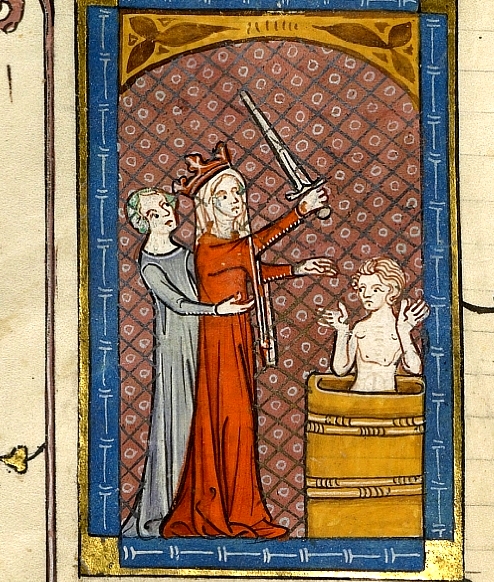
"Claricia was a German illuminator who included a self-portrait in a South German psalter produced circa 1200 CE. In the self-portrait, she depicts herself swinging from the tail of a letter Q with her name inscribed over her head. Her uncovered head, braided hair, and style of dress (close-fitting tunic, long-waisted dress, long flowing sleeves) suggests that she was a lay student at the convent." - via the Wiki article.


"Nuns created artwork that varied in style, function, market, and quality, like all artists everywhere. Some nuns made private devotional drawings, and some crafted products in a variety of media for sale outside the convent. They had opinions about their work, too. In an early sixteenth-century letter to her brother, a nun in Nuremberg asks him if he would show some of her embroidery to his friend Albrecht Dürer, otherwise known as the Elvis of the northern Renaissance. In another letter she says, 'I have no recreation except painting; if I could only have Dürer for a fortnight so that he could instruct [me].'"

- Whitney Burkhalter from “Nuns Can’t Paint”: Sexism, Medieval Art, and Dudes on Mopeds.


Self-portrait -  1493, Albrecht Dürer

(Note: Now, girls - and some boys - wouldn't you, too, wish to have
this man "for a fortnight..." ? I would!)


"To accommodate the demand, book-making, writing, and illustrating expanded out of monasteries and into secular production houses.  These commercial scriptoriums were prevalent in most major cities, but especially Paris, by the 1300s.  Furthermore, a great deal of the actual painting of these manuscripts was done by women.  Yet another female-dominated industry in the middle ages that you might never have guessed."

-  Merry Farmer from: Medieval Monday - Illuminated Manuscripts.


From: La voie de Povreté ou de Richesse (The Way of Poverty or of Wealth) -1400s, France
Previously attributed to "a follower of the Bedford Master", it is now attributed to the "Fastolf Master". 

“I know a woman today, named Anastasia, who is so learned and skilled in painting manuscript borders and miniature backgrounds that one cannot find an artisan in all the city of Paris – where the best in the world are found – who can surpass her, nor who can paint flowers and details as delicately as she does, nor whose work is more highly esteemed, no matter how rich or precious the book is. People cannot stop talking about her. And I know this from experience, for she has executed several things for me, which stand out among the ornamental borders of the great masters.”

- Christine de Pizan, from The Book of The City of Ladies, (1405), via Mary French's article: Lady Truth and the Author: Female Networking in Medieval Manuscripts.


***

As you may have noticed, I've a new ploy for getting myself to post these days; I put up the images first - which is half the battle anyway - and this forces me to add my "narrative glue" sooner than I would have otherwise. Unfortunately, sometimes even this maneuver back-fires, and I drum up additional information, and more links, and so many bits of disorganized data, that the whole task becomes hopeless.  And, in the case of medieval women, this has been true from the first and second posts in this series - plus the post that started it all - straight through to this one. And why is this? In four words: it's those rabbits again. I can now pronounce, from deepest experience, that whatever else the Sign of the Three Hares may mean, it - without one single doubt or hesitation on my part - is a magical symbol. It is a symbol of increase. Period. And, as Elmer Fudd might've said, when confronted with three Bugs Bunnies (!): Be vewy careful.

And, so, we come to the medieval scribes, mystics, and illuminators - specifically the invisible feminine side of the medieval equation. And, like myself, you were probably under the impression that this was primarily an empty set, containing one or two obscure female anomalies of little import. In which case you - like myself - would be wrong. And, really, if you follow this blog at all, it should come as no surprise... considering that even very contemporary women of artistic achievement have already seemingly fallen through the cracks of History (emphasis on "His")...