Showing posts with label live scans. Show all posts

Friday, March 1, 2019

Reflections on a Chinese Sewing Basket (an Interlude post)

Lid of a Chinese Sewing Basket -
live scans/digital - 2019, DS
(Click to enlarge.)

"Collected baskets have survived for decades, some for a century or more, each one having a diverse history. Countless baskets no longer belong to their original owners... Put simply, the old Chinese sewing baskets have traveled and experienced long, varied and in most cases, tough roads throughout the years."

- From the definitive book: Chinese sewing baskets by Betty-Lou Mukerji.

"Gu embroidery is rather a family style than a local style originated from Gu Mingshi's family during the Ming Dynasty in Shanghai. Gu embroidery is also named Lu Xiang Yuan embroidery after the place where the Gu family lived. Gu embroidery is different from other styles as it specialized in painting and calligraphy. The inventor of Gu embroidery was a concubine of Gu Mingshi's first son, Gu Huihai. Later, Han Ximeng, the wife of the second grandson of Gu Mingshi developed the skill and was reputed as "Needle Saint" (针圣). Some of her masterpieces are kept in the Forbidden City. Today Gu embroidery has become a special local product in Shanghai."

- Quote and photograph (inset left) via the Wiki entry for Chinese Embroidery.  (Feminist alert! Note that the woman who invented Gu embroidery - a concubine - remains anonymous.)

"By the T'ang Dynasty, considered the Golden Age of China, thousands of women were employed as seamstresses and embroideresses, and Chang An, then capitol of China, became a trade center for woven and embroidered textiles. By the Song Dynasty, embroidery embellished parasols, fans and shoes, as well as household items such as screens and bed coverlets were being produced. The Ming Dynasty saw the development of the ranking badges, worn on the front and back of robes by military and civilian officials and by their wives. Many of the Imperial Dragon Robes that you see in museums also date from the late Ming Dynasty."

- Excerpt from an article about Chinese textiles found here.

"My new wife is clever at embroidering silk;
My old wife was good at plain sewing.
Of silk embroidery one can do an inch a day;
Of plain sewing, more than five feet.
Putting her silks by the side of your sewing,
I see now that the new will not compare with the old."

- Dialogue between a man and his "old" wife from the poem "Old and New" by an anonymous Chinese poet, 1st century BC. Source: A Hundred and Seventy Chinese Poems compiled by Juyi Bai, 1919. (Feminist alert #2: Interesting set of cultural stereotypes here: the "frivolously" artistic New Wife, the industriously productive Old Wife and the man who chooses quantity and economy over beauty!)

"After the initial awe, I felt like one of the blind men on the bridge in the classic Zen drawing -- I had no idea where I was going or how to arrive.  Despite these challenges, the intention to affirm my aspiration to practice persisted. As the teacher led me across the  bridge, stitch-by-stitch, I watched myself reflected in the sewing.

Continuing to practice and learn, I noticed that sewing and wearing Buddha's Robe  deepened my understanding... Buddha's Robe began to express for me the essence of compassionate bodhisattva practice.  First came the effort of offering stitches without thought of gaining anything -- even finishing.  Then, in treating the robe with gentle respect as if we were  one, not two, the robe became tangibly steeped in the caring stillness and openness cultivated by practice..."

- Drawing parallels between Zen and sewing; specifically the practice of sewing a replica of
Buddha's RobeInset right (above) is an antique Chinese table apron. Below (inset left) is another. Both were sourced here.

***

It's been spring-like in New Mexico for the past three days... which - if nothing else - informs me that winter's on its way out and it's time for a change. Oh yeah, and it feels really nice, too... puts a little "spring" into your step... makes you think like: "Hey, maybe things aren't so bad, after all."

And maybe they're not.

Then again, I haven't posted an Interlude in some time and this blog is due for one.  You know, the slice-of-life kind of thing. For the (virtual) record, the last "slice" I blogged about was in January of last year... when I was still living in my car, photographing Sandia Crest. (See here and here.) Despite how harrowing the word "homeless" sounds, the situation was not unbearable. I was surviving; I had a self-appointed mission. And, the winter was unusually mild.

Which was okay... till my car was broken into one night (as I slept in a motel) and my camera was stolen. Although I did trying utilizing my phone's camera, the truth was the magic was gone and my mission over.

Cutting to the chase - and I always do - shortly thereafter I was to come across the star of this post: a Chinese Sewing Basket I picked up in a thrift store for one dollar and fifty cents ($1.50 USD). Apparently, those who sold it placed no great value on it. This is commonly referred to as "Buyer's Luck"; in this case, mine.

Every old artifact has a story, wouldn't you say? I can't help but wonder what this basket's was. But, I think I know. It's kind of like when two vagabonds meet or two wild entities cross each other's path. While actual words might never be spoken, a certain recognition, an insight exists. If boundaries are respected, sometimes the strangers fall in together... like this basket and I. Although technically without a home, we share an indoor space together at night. And, maybe even something more: some encoded shreds of cellular-history or a narrative... or a sub-cellular impression of movement and color.

Or, whatever dreams are made of. (Perhaps, nothing, nothing at all.)

Inset right (above) is an example of antique Chinese embroidery sourced from this site. Directly inset left is another lovely piece found here. More about Chinese embroidery can be found here. There are also Chinese Minority textiles, and an interesting, somewhat-related article here.

BTW, I sometimes have some newly-acquired quality time with my computer these days, and have begun to really work again. The image of the Chinese Sewing Basket lid was my first image this year... and, is basically a manipulation of several "live scans." Well, it's a start... just in time for the first month of the Chinese New Year.

***

Addition (April 15, 2019)

Joy - digital - 2019, DS


Well, the news around the world is sad today. Tears came to my eyes when I read about the fire at the cathedral of Notre Dame de Paris. (See the BBC report). Oddly enough, I had only learned last year that the Hunchback of Notre Dame was Victor Hugo's literary attempt to prevent the demolition of Notre Dame during the 19th century (see this blogpost). But, meanwhile, I just finished a reworking of the Chinese Sewing Basket - the last of my detours - and I was in a dead heat to put it up.

Which is not say I didn't like my original graphic... (nor is this to say I didn't keep the original file). It has a mandala-like effect that (I swear) informed a series of my dreams, embellishing them with delicate, Asian-like symbols.

But, the basket lid seemed lonely... so, I gave it an audience... a trio of brass frogs! (See The Significance of Frogs in Chinese Culture.)

Incidentally, the Chinese characters on the tag translate into the word "Joy"... something the world can never have enough of.


Friday, June 20, 2014

Creatura - The Sentient Seaweed (the Extended Version)


Live scan of an unidentified seaweed - 2014, DS
Note: This scan is a product of a new flatbed scanner... which, apparently had difficulties
reading the black background, hence the weird color artifacts (unfortunately intensified online).
I've tried - and failed - to correct it. Sorry.
(click to enlarge)


creature |ˈkrē ch ər|
noun
an animal, as distinct from a human being : night sounds of birds and other creatures.
• an animal or person : as fellow creatures on this planet, animals deserve respect.
• a fictional or imaginary being, typically a frightening one : a creature from outer space.
• archaic anything living or existing : dress, jewels, and other transitory creatures.
• a person of a specified kind, typically one viewed with pity, contempt, or desire : you heartless creature!
• a person or organization considered to be under the complete control of another : the village teacher was expected to be the creature of his employer.

ORIGIN Middle English (in the sense [something created] ): via Old French from late Latin creatura, from the verb creare (see create).


"In the philosophy of consciousness, sentience can refer to the ability of any entity to have subjective perceptual experiences, or as some philosophers refer to them, "qualia". This is distinct from other aspects of the mind and consciousness, such as creativity, intelligence, sapience, self-awareness, and intentionality (the ability to have thoughts "about" something). Sentience is a minimalistic way of defining consciousness, which is otherwise commonly used to collectively describe sentience plus other characteristics of the mind.

Some philosophers, notably Colin McGinn, believe that sentience will never be understood, a position known as "new mysterianism". They do not deny that most other aspects of consciousness are subject to scientific investigation but they argue that subjective experiences will never be explained; i.e., sentience is the only aspect of consciousness that can't be explained. Other philosophers (such as Daniel Dennett) disagree, arguing that all aspects of consciousness will eventually be explained by science."

- Excerpt from the Wiki entry on sentience.


***

The summer solstice (the pagan holiday of Litha) approaches, and with it, my inevitable trips to the shore. Sometimes there's an agenda; mostly there isn't. But, when the ocean calls, it never needs to leave a message; I just get in my car - sans towels and sunblock lotion... sans beach blankets, beach balls,  beverage coolers and lounge chairs. I'm there for meditative purposes, investigative purposes, or, more generally, no purpose at all. The ocean calls, and that's enough.

Last week, however, there was a method to my madness as I plodded along the sandbars. My mission was to gather bits of seaweed for an image I was trying to rework and, hopefully, finish. Normally sea plants hold no interest for me, but, for the image, I needed the seaweed's specific organic contours...

Wednesday, March 5, 2014

The Merkabah and a Sixth Sense - A Practical View (Annotated)


"The idea or reality of the esoteric chakra system may or may not be relevant to the phenomena I am referring to - from what I gather, the chakra centers are considered symbolic and psycho-spiritual and have no apparent physiological manifestation - but, as I am not aware of any other "maps" at my disposal, contemporary "subtle energy" diagrams provide one place to begin the inquiry.

In the tradition of the Eastern mystics - and Western alternative healers - the chakras (Sanskrit for "wheels") are basically 7 main energy vortices or focal points that lie along the spinal column and skull. The uppermost point, and the one that concerns us here, is generally known as Sahasrara, the seventh, or "crown chakra". In some systems, the seventh chakra lies directly at the top of the head, but in others it lies above. In some systems there are a number of energy centers above the head - the uppermost, and the one that corresponds to my sensory zone is sometimes referred to as the "transpersonal point". In all chakra literature, the crown chakra's primary function seems to serve as a conduit for consciousness, generally of the "cosmic" or collective variety."

- From a web article "Non-Local" Causes and Effects on the Human Body (Tactile Sensations from a distance), Dia Sobin, uploaded 2007 (see: .pdf).


(Added June 9th 2020):

"I can't explain the science behind it, but I just tried it for myself - raised my hand to above the top of my head, and I could feel a sensation like the hairs standing on end - only in a small spot, nothing dramatic, but a definite tingling. I don't think I was imagining it because I can still feel the tingling now."

- A comment left on Posthuman Blues post in 2007 by "Bumble," a female reader of Mac's. His post links to the original web article mentioned above, although the link is now broken. I just found this comment recently and it made me smile. From her description, It seems the woman did, indeed, find the epicranial occult locus.


***


No, it's true, I wasn't lying. I am "exiting the blogosphere." Unfortunately, I spent so much time laying Post-Mac Blues to rest, I haven't had time to deal with Trans-D at all. Meanwhile March has arrived. It still looks like January where I am, mind you, and, yet, it could always be worse... it could look like war. But, as is apparent (and not out-of-character), I was a bit premature when designating "Imbolc" as the "last post". There will be this post and one more to come. I'm aiming for exactly 90 posts. It's a matter of symmetry and symbolism.  Esoterically, the number 9 is the perfect place to tie up loose ends and let loose the finished "product" - ones little spaceship careening towards the galaxy's edge.


How poetic.

But then, my muses - and/or my unconscious self - have/has an agenda... and, generally one I can't figure out till the last phase of a project. The agenda of this post started innocently enough. My urge was to post another scan. On a whim I had scanned into this machine a small crystal Merkabah - a recent birthday gift from my friend, Moo. As we know, I love minerals, and scanning them sometimes provides startling results. So, allow me to explain the scans above and to your left.

First off, Merkabah is an esoteric name given to a certain polyhedron - essentially a triakis octahedron and/or a stella octangula... It has a kind of weird shape that combines both the cubic and the hexagonal - in other words, viewed from one angle it looks square, from the other it resembles a 6-pointed star (hence the "stella"); this is a result of the fact that it is comprised of two interlocking tetrahedrons. Kind of like physical reality. My aim was to capture both angles via my flatbed scanner. To this end I taped my Merkabah - with packing tape - to the inside of a shallow box. Posted above are the results. Posted below (and below the jump) are the same scans with the tape digitally removed.

But, it's the light artifacts in the tape which interest me. While its true that cellophane material will create some cool image scans, I was a little startled by the weird effects produced in conjunction with the crystal polyhedron. Let's just say that, optically, light had a field day. One might also be inclined to consider certain myths concerning the Merkabah in a more sympathetic light.

Originally, the word "Merkabah" arose from early Judaic mysticism and referred to the "chariot of God", specifically that envisioned by the prophet Ezekial.  Of course, nothing is so sacred that it can't fall under the auspices of New Age jargon (or, for that matter, Ancient Alien lore). But, kernals of truth are found in the strangest of places.

Sunday, December 22, 2013

The Sun Stands Still


Winter Solstice, 2013 - digital - 2013, DS 


Well, I'm a little late with this post; technically the sun "stood still" yesterday, the day of the winter solstice, but I spent the day working on the image above. This all came about when I rediscovered a little rock in the glove compartment of my car - one of my beach finds, probably picked up off a sandbar around the time of this year's summer solstice.

It's an enigmatic little rock... which looks as if its flat surface has lines carved into it. But, if that's actually the case, then it's only a small portion of something much larger. Who knows? But, in its own understated way, it kind of brings to mind the larger - and more celebrated - mysterious rocks that cover the globe, which are thought to be directly related to the winter solstice; Newgrange in Ireland, for instance.

Known to the druids as Alban Arthan, and the beginning of Yule, the winter solstice marks the time of the year when the sun returns, and the daylight hours slowly begin to grow longer... which is a good thing to know as we drag ourselves through the ice and snow!

Anyway, my little rock wanted to be a star... and so, I made it one... scanning it into this machine, and positioning it with an old scan of some ice I had on hand. (Yes, you can scan ice on a flatbed scanner... but, be quick about it!)

So, take heart... the winter has just begun, but, the "darkest hour" is already history!


(Additionally: 6 Ancient Tributes to the Winter Solstice.)


Sunday, July 7, 2013

Flatbed Scan of a Summer Flower


Begonia blossom scan - 2013, DS
(click to enlarge)


As an artist, despite all the scientifically-documented neurological, psychological & pathologlogical excuses for my existence, isn't the need for beauty the real bottom line?

And, in the event that every living organism has consciousness and sentience to some degree, isn't it possible that the expression of beauty - and the appreciation thereof - is as innate, inherent and essential to life, as any scientifically-accepted, well-documented mechanism to survive?

I scanned this begonia into the computer today, because I wanted to record it exactly as it was. I suppose that's what my scanning exercises amount to lately... along with a sort of subliminal attempt to understand transdimensionalism, albeit in reverse... that is, translating higher (3) dimensions into lower (2).

But, that's not the reason I posted it.

I posted it because it's beautiful.

Enjoy your summer.


***


Tech Note: Concerning flatbed scans of 3-D objects (also referred to, on this blog, as "live scans"). There's a plethora of info on the web describing the ways and means to perfect this type of image document, if you're interested. The most important factor in taking a good scan is having a scanner capable of copying 3-D objects... not all of them can. The ones which can, generally indicate this on the box description. Also, they often have a fluorescent light bar, which captures a greater depth of field than LEDs. And, by "scanner" I'm not referring to expensive equipment or anything having to do with the new 3-D printing technology. A dedicated scanner is imperative, however - forget "all-in-one's"!


Tech Note 2: To avoid a "pressed flower" look to a scanned flower image, leave a stem on your flower, and then try constructing a truncated cone around the flower head that will separate the flatbed glass from the flower petals. I used black paper for this - black is generally the best ground - with some degree of success. But, the contours of the cone are key, as well as the depth. The flower has to fit exactly and its petals should just brush the glass. Best bet? A fairly flat, rigid flower.


Tech Note 3: Except in the instance of a very flat object (like a house key, for example), you will either be leaving the scanner cover open, or taking it off altogether. Back-lighting may be an interesting effect on occasion, but I find it helpful to have a several boxes - lined in black - of various depths on hand to cover the scanner bed while shooting. Another possibility is a blanket of fabric, normally cut to the dimensions of the scanner bed, unless the "draped fabric" effect is a desirable background. Fabric, incidentally, scans fabulously!


Begonia blossom - 2016, 2013, DS


Thursday, July 4, 2013

Anthracite Coal & Graphite


2 scans of a small slab of anthracite - 2013, DS
(click to enlarge)


I guess I feel obligated to finish my "Black Rock" series (started here & continued here). So, here's the "big reveal".

Well, it's like this: one can't write on a hard, granulated surface with obsidian... however, with anthracite coal you can. Which is how I now know that all my mysterious black rocks - despite how iridescent and pretty they may be - are, in the last analysis, anthracite coal. The ones with a more silvery sheen, however, make finer, more pencil-like lines, which sent me on a google search for graphite; apart from being pencil lead, I never did know exactly what it was.

Actually, the game was really given away when I found the anthracite slab above... which is glassy in the center, but, the surface of which is similar to a shimmery black poster board. Whatever it was, it wasn't obsidian.

(Note: It was also easy to pry apart in layers... and, though I still hadn't concluded it was coal, I still half-expected to find a fossil. In reality, one can find fossils in slabs of coal... and, two things on my "bucket-list" are: finding a meteorite, and finding a fossil!)

Anyway, I now know that anthracite coal is a mineral and the high-carbon metamorphic state of bituminous - ordinary household - coal. Interestingly, anthracite may be considered to be a transitional stage between ordinary bituminous coal and graphite, the latter often considered to be meta-anthracite and/or the last - and purist - metamorphic stage of coal.


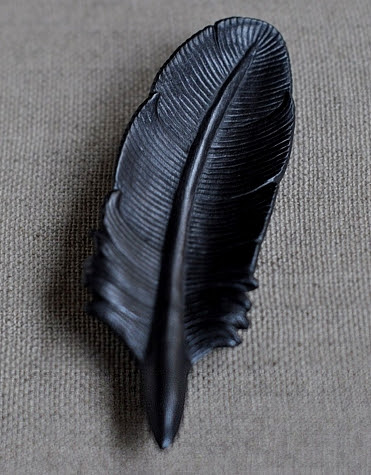
Well, yeah, I guess I had hoped my mystery rocks were obsidian... but, anthracite and graphite are not the lowly, mere utilitarian minerals one might expect. Anthracite was a common replacement for jet in all that wonderful Victorian mourning jewelry... and it's been carved into sculptures as well. And, the same goes for graphite! The two beautiful figures above - the hand and shell (above, left) - were carved from graphite by Angelio Batle, found here, along with a number of others. And the graphite quill (above, right) is just one example of a whole series of really cool, carved graphite pencils (one can write with!) for sale here.

And, so ends the tale of the mysterious black rocks... ;-)


***


Restore the 4th (& steal this banner!)


Monday, July 1, 2013

Obsidian Glass (& a "moon rock") (?)


2 scans of the latest found object - 2013, DS
(click to enlarge)


"Seek and ye shall find"! 

Actually, this is rarely true in my experience... but, I did find what I was looking for at the beach yesterday (see previous post): obsidian glass. Of course, it's so glass-like, it's practically impossible to scan, but, this should give you some idea. It has a slight rainbow flash, but nothing like in the scan - more like the colors one sees in a crow's feather.

And, I also found a lunar rock! Okay, so, it's not really a lunar rock - just another specimen of volcanic rock with a lot of obsidian. It's blacker than it appears in the scan, though; it also has a very silvery sheen to it... 


Scan of the "moon rock" - 2013, DS
(click to enlarge)


Later note: Actually, the true identity of these rocks is still in doubt. I suppose virtually anything can be found on a shoreline, but, we are talking about a Connecticut shoreline... (see the comment section of this post). So, ladies & gentlemen, the jury is still out.


The jury's in... see: Anthracite & Graphite.


Wednesday, June 26, 2013

Hungry Mouths To Feed: The Mesembs from Little Karoo


Today's scan - a nest of Gibbaeum Heathii - 2013, DS
(click to enlarge)


They resemble a nest of baby parrots... or, maybe, something from the Pac-Man family, but, as a fan of weird plants - and weird things in general - this little pot of succulents, Gibbaeum Heathii, always makes me smile. But, I'm not alone in my fascination for mesembs, also known as mimicry plants, living stones, or Lithops (a pretty example is shown here); there are whole blogs devoted to them, organizations developed around them, and, regarding our featured specimen, it's even been YouTubed.

And, yes, Little Karoo is a real place in South Africa... where wild Gibbaeum Heathii is exclusively found, growing amid patches of quartz. Apart from being an amazingly beautiful part of the world, Karoo might also be considered the home of the first humans, the San people.

By the way, the little plant actually seemed to enjoy being scanned - a feat managed by dropping the potted plant in a snug styrofoam cup before placing it upside-down on the scanner bed. My guess? Gibbaeum Heathii loves light so much, it positively devours it... (hence, the voracious, gaping jaws). ;-)

(Note: Don't bother trying this at home -  better results would probably be obtained with your garden variety digital camera.)

And, oh yeah, members of the Gibbaeum tribe bloom!


Friday, June 7, 2013

A Day at the Beach


3 scans of a found object - 2013, DS (click to enlarge)


"Shinto teaches that everything contains a kami (神 "spiritual essence"),
commonly translated as god or spirit).

The kami reside in all things, but certain places are designated for the interface of people and kami (the common world and the sacred): sacred nature, shrines, and kamidana. There are natural places considered to have an unusually sacred spirit about them, and are objects of worship. They are frequently mountains, trees, unusual rocks, rivers, waterfalls, and other natural edifices. In most cases they are on or near a shrine grounds. The shrine is a building built in which to house the kami, with a separation from the "ordinary" world through sacred space with defined features based on the age and lineage of the shrine."

- excerpt from the Wiki entry for Shinto


High-tide is not the most excellent time for beachcombing, but, neither is the blistering heat of mid-day. So, for my first visit to the shore in a very long time, I chose the hour just before sunset for my foray by the water's edge. There were a few people milling about on the sand, but, like any dedicated beachcomber, I ignored them completely, aware only of their voices drifting around me in the air, in that peculiar way sound is both muffled, amplified and scattered by the ocean's waves.

I saw only one other person by the water - a woman, perhaps Muslim, swathed in black veils, hunched down in the encroaching waves. She was staring at the horizon, her hands folded under her chin in a way that may have been praying. But, as I approached, she stood up and slid off in the opposite direction.

Communing with the ocean is often - and needfully - a very private thing.

I found very little... the beach isn't what it used to be, or, maybe I'm not what I used to be, lacking the awe and raw enthusiasm I had as child, when everything still seemed new and mysterious.

But, I did find one thing... it was sitting in the sand in the path as I was leaving... a rock, but a special rock, in that it was a chunk of beach marble, my favorite sort of rock, and one that I had collected in the past; a collection I had to part with during the course of moving a few months ago. It was like greeting an old friend, but, before snatching it up, I looked around to make sure I wasn't stealing someone else's treasure.

Anyway, above are scans of three faces of the found object. It isn't as silky-textured as the specimens I've found in the past, those of which have been smoothed and sanded by the salt-water for a longer period of time... (and, an example of which is posted below... my only remaining touchstone of that species). But, it's easy to understand why marble is so often the choice of sculptors. Maybe it has something to do with metamorphic process that marble has to go through, it's physiological history, that speaks to the artist. Or, maybe some rocks just happen to "speak" a little more eloquently.

Interestingly, the grey, striated beach marble I find, tends to have one or more roughly pentagonal faces; the pentagon - along with the hexagon - being a favored shape in the organic world, and for the sacred geometer and mason, a symbol of sentient life.

In the Disneyland world of a child's mind and the "primitive", everything is alive, has consciousness, and is sentient to some degree, even inanimate objects. In other words, all is "animated". But, this is still true in many worldviews, up to and including that of Shintoism, an ancient set of spiritual beliefs and practices of which a large portion of the Japanese population, essentially, still adhere to.

Animism is defined as the worldview in which "natural physical entities - including animals, plants, and often even inanimate objects or phenomena - possess a spiritual essence". I suppose, how one defines "spiritual essence" is where a lot of people get tripped up.

But, to the child, the primitive, the artist, the naturalist, the mystic, and even a quantum physicist or two, that quality we call "life" permeates existence... either it's everywhere... or nowhere.

When in doubt, listen to an eloquent rock.


2 faces of an old friend - 2009, DS (click to enlarge)


***


Bonus link (re: how to house a kami): the shrines of friend and art shaman, B. G. Dodson. Guess which one I own? :-)

(Hint: Ever notice how the Shinto symbol, the Torii Gate, resembles a modified giant Pi symbol?)


Friday, January 4, 2013

Labradorescence... Though the Eye of a Flatbed Scanner


4 separate scans - shot from 4 different angles - of a labradorite pendant cabochon
(click to enlarge)

"An Inuit legend says that long ago the Northern Lights fell from the sky and were trapped inside some rocks off the coast of Labrador. One day, an Inuit warrior came upon these rocks and tried to set the Northern Lights free. With blows from his spear, he was able to release most of the lights, but some still remained to be permanently imprisoned within the rocks. The trapped Northern Lights are what give the stone we know today as labradorite its brilliant flashes of light and color."

- Labradorite lore via this web page


"Labradorescence is a side-effect of the molecular change which occurs in large crystal masses of anorthosite, producing an iridescent play of colors. This labradorescence, or schiller effect, is the result of light diffraction within the lamellar intergrowths – fine, adjacent layers of the separate materials (lamellae) comprising the whole rock phase – created when conditions do not allow for sufficient diffusion to the materials' equilibrium composition.

The cause of this optical phenomenon is phase exsolution, or phase (state) instability, occurring in the Bøggild miscibility gap (An48-An58); under the appropriate heat and pressure conditions the separate molecular components will coexist but not mix to a solution, producing the phenomenon."

- Via Wiki's labradorite entry


"Labradorite is said to represent the "temple of the stars"... It brings the light of the other planetary beings to the soul of the user. The labradorescence is a luminescence, derived from extraterrestrial origin, which is enclosed in the mineral to bring the galactic evolved energies from other worlds to the Earth plane."

- Via this web page

***

Originally this post was going to welcome in the new year and feature a long-standing work in progress, "Labradorite Window". Well, that was the plan, at any rate. But, as it so happened, and so often happens, neither the image (nor the order of the day) really cooperated, while, at the same time, something new was added to the mix. That is, the above scan - of a favorite pendant of mine - representing yet another facet of a mysterious gem, known as labradorite.

Labradorite is named for the area it was "discovered" in 1770: Labrador, Canada. In reality, however, it has been found in numerous places, and traced as far back in time as the ancient Greeks, who knew it as "Black Moonstone".

I've only known about labradorite for around 15 years, finding my first piece - a sphere - in a metaphysical book shop here in CT. I stared at it for a long time initially, thinking I must be hallucinating, it was that unearthly beautiful. I felt a similar awe when I encountered my first comb jelly years before (see here). Maybe it's just something about flashes of electric blue light found in unlikely places that mesmerizes me. In any case, I learned the mineral's name and bought the sphere, which was astoundingly inexpensive, all things considered.

But, even a few years later, I could find very little about it online. Today, on the other hand, there's hundreds of links and images extolling its virtues; though often the memes being shared are repeated and distorted along the way. The information you might find is sometimes technical, but, far more often, overwhelmingly esoteric, and not always accurate.

I had scanned my labradorite pendant in the past, but never from different angles... and the one anomaly I missed, and one point of this post, was just how inaccurate a scanner can be. It doesn't, after all, faithfully record a 3D object. It interprets the object, and, when confronted with transparent or translucent objects, the scanner compensates for its disability by creating a new object altogether! (By the way, when scanning the labradorite, the scanner cover was left open, and nothing was placed on top of the pendant.)

If you looked at the above image, for instance - which is actually 4 separate scans combined - you might imagine the labradorite cabochon is solid and opaque in places. While the scan is, in a sense, describing how labradorescence actually works - possibly similar to recent scientific efforts to produce an invisibility cloak (?) - the image is hopelessly wrong. Looking at it, we might safely assume the schiller effect is floating across the surface of a chunk of brownish substrate. Looking at the images below, however - courtesy of my monitor's camera - the reality is something else again. In these three shots I am shining a small flashlight through the pendant. Though one can see the inclusions that may have created the overall pattern, the "substrate" does not exist. There is nothing remotely opaque in the cabochon. It is, for the most part, transparent.


Or is it? Wiki's description of labradorescence is muddied with technical terms. ("Extra-terrestrial" in the third quote is actually preferable... and, it might not be be all fantasy; apparently labradorite is found in meteors...) A simpler explanation is given by Merriam-Webster:  "A play of colors or colored reflections exhibited esp. by labradorite and caused by internal structures that selectively reflect only certain colors." (Other descriptions, in laymen's terms, may be found here or here.) But, I'm not sure any definition of labradorescence really describes the situation with the scan. Perhaps there's something about labradorescence that is, as of yet, unknown. After all, the rough gem is often found attached to just such a substrate as we see in the scan. Is the scanner actually showing us a residual image of the gem's past recorded in the labradorite's many layers, or is it a holographic-like mirage created by the scanner's deficiencies?

If you've ever witnessed labradorite in the flesh, you can attest to its innate mystery. And, if you, like a number of other people - including myself - are utterly transfixed by the sight of it, you, too, might attribute your fascination to some "unknown" factor.

As for my labradorite window, well, it's got a long way to go. Meanwhile, feast your eyes on some gorgeous specimens of the stone (which can be found as shown below: in the rough, as spheres, and as jewelry. But, also in sculpture: see here and here)... and have a happy new year!


Note on the above images (click to enlarge): The link to the first, on your left, can no longer be found. The sphere in the center, however, is sold here... and the beautiful pendant on your right can be found (as of this writing) in this Etsy shop. Incidentally, the morpho-butterfly-wing-under-glass effect found in this pendant is similar to my own.

A later added note: For all you alien lovers out there, there's actually several connections between this post and my last, "The Doors of Perception"... Funny how one can forget their own personal mythology consciously, but, on an unconscious level, the same roads are travelled again and again!


Monday, October 8, 2012

Autumn Leaf Eye Candy


Apart from the size - blown-up 200% - these scans are the real deal - no color enhancement was employed. With their amazing colors - blood reds, acid yellows, and florescent greens - the dying maple leaf can rival those of the more exotic, tropical plants.

Re: scanning. In the last analysis, it's a type of photography... with the major exception being that the subject is placed/designed/arranged from behind, with no clue as to what the obverse result will be. It's kind of like a crap-shoot.  But, when it works, it works!


Note: even lighting is a factor in the scanned image. The first was positioned poorly on the scanner bed, and faced the scanner light in a less-than-ideal direction. You can see how much the surface detail is improved in the second scan (directly above), which was shot on a different angle.

(Click images for original size.)


Wednesday, July 18, 2012

Cicada 7/17/12


... found by the side of the road, during one of my walkabouts.... Cars were driving by, and I felt weird stooping down to pick it up it's lifeless body, but I couldn't just leave it there. Cicadas are one of my personal totems... dead ones appearing at significant times.

I guess the Dog Days of Summer are almost upon us... already? 

Meanwhile, there's shortly to be a "For Sale" sign going up in front of my house. This means, I will probably have little time for blogging. Wish me luck, and enjoy what remains of this summer!

Till next time...
D


(Later note: A future - 2013 - post in which the cicada, once again, emerges: The Jewel - Image and Premonition)


Sunday, July 15, 2012

Queen Anne's Lace


Queen Anne's Lace flower - "live' scan


"Her body is not so white as
anemony petals nor so smooth—nor
so remote a thing. It is a field
of the wild carrot taking
the field by force; the grass
does not raise above it."

- excerpt from William Carlos William's "Queen Anne's Lace"


Trans-D is not generally a "how-to" digital art site, but every now and then I get the urge to document my methods of madness as they present themselves. Todays foray into digital technique was inspired by a common roadside wild-flower I come across frequently in my weekly walkabouts - Queen Anne's Lace, also known as the "wild carrot". Like the starlings in my last post, Queen Anne's Lace also has the dubious distinction of being an "invasive species"... which pretty much just means it's a survivor... give it an inch and it takes a mile. That's okay by me... I'm a "plant person". Which pretty much means I have more of a rapport with plants than I do mammals. But, make no mistake - and even Science is coming round to this opinion - plants do have a kind of sentience... an alien one in many respects, but a kind of consciousness none-the-less.

That being said, for all of it's notorious robustness, Queen Anne's Lace, which got its name from a tiny red floret that sometimes appears in its center - I've yet to see one - said to represent a drop of blood from Queen Annes finger which she pricked whilst tatting lace - also has its selling points. It's seeds, for instance, are often used by women for contraceptive purposes. It is also the host food for the larvae of the Black Swallowtail butterfly. Apart from it's other medicinal properties, it is also used by Blue Jays to line their nests - apparently its foliage contains a natural insecticide. Oddly enough, in organic gardening, it's recommended to plant Queen Anne's Lace - along with chrysanthemums and marigolds, etc. - as a "companion plant" in your garden, for the opposite reason; it attracts beneficial, aphid-eating insects like ladybugs.

My sudden interest in the plant, however, has nothing to do with any of that. Basically, I've been inspired to create a new image which insinuated itself into my middle eye last week... another of my humanoids... this time an ancient (possibly) Martian woman who wears a singular veil partially obscuring her face. I'm not here to argue about the reality of Mars - for an artist, if something emerges from the creative unconscious, one just runs with it... or perishes. That simple.

So, the veil is key in this illustration, but how to create it? My mind's eye rested on the Queen Anne's Lace growing by the roadside. On impulse, I plucked one - apologizing and thanking the plant first (silently), I might add - placed it on the scanner bed, and took my best shot. Above is my scanned image of the flower. Lovely as it may be, I still didn't quite see how it'd be useful, so, I did what any artist should do - I blew it up. Musing, I snipped out a fragment and began rearranging it  (via cut & paste) - organic geometric patterns are, to a great degree, my forte. Experimenting with this arrangement, I finally cleaned up a version, tiled it and - presto - Queen Anne's Lace created with Queen Anne's Lace! It's not what I intend to use for my Martian veil, but I thought I'd share it anyway.  I also realize there's plenty of fractally, computational ways of creating patterns digitally - but, this is my preferred way!

So, here are three steps to virtual "lace-making". Click on images for larger views.


the blow-up

the pattern


the tile

And this is why I went digital! :-)