Showing posts with label gender bias. Show all posts

Wednesday, August 14, 2019

No, this isn't only "racism."

A blatantly racist and sexist billboard in North Carolina which reads:
"The 4 Horseman Cometh are Idiots - Signed, the Deplorables (sic)
CHEROKEE GUNS - 1 MILE ON RIGHT"

The Chosen One.
"In a tweet on Wednesday evening, Tlaib asked how the billboard could not be considered an aggressive inducement.

'How the hell is this not inciting violence?' she wrote.

Pressley tweeted: '#Racist rhetoric from the occupant of the @WhiteHouse has made hate our new normal. We are still vulnerable.'

But appeals for civility appear to be falling on deaf ears. Wacholz amped up his attack when the store posted a statement on Facebook that said it planned to produce clothing with the billboard’s image.

'Alright my fellow Infidels for Trump … due to OVERWHELMING demand … you may come by the shop (next week) and get your very own FOUR HORSEMEN COMETH STICKER … simple … eat a piece of bacon … tell us you’re voting for Trump in 2020 … then get your limited edition bumper sticker! (While supplies last!) Snowflakes and Liberals are not eligible … sorry ...'"

- Quote sourced from this Guardian article.

(Update - added August 21/22, 2019) Inset left (above and below) is the current "occupant of the White House" who now refers to himself as the "Chosen One." The graphics were inspired by a photo found at The Daily Beast; I make no copyright claims on either version. Also see: 'I am the Chosen One': with boasts and insults, Trump sets new benchmark for incoherence. BTW, isn't this whole Trump thing beginning to remind you of that old Christopher Walken movie: "The Dead Zone"? Seriously.

"An advertising company has announced it will take down a billboard in Murphy, North Carolina, calling Reps. Ilhan Omar, Alexandria Ocasio-Cortez, Rashida Tlaib and Ayanna Pressley "idiots." The billboard was promoting a local gun shop, and the shop's owner said he wants to go to court to keep it up.

The billboard received national attention after Cherokee Guns posted a picture of it on Facebook. Cherokee Guns stood by its ad and even sold bumper stickers of it for those who wanted to show support...

...The president tweeted earlier this month that the "'Progressive' Democratic Congresswomen" should "go back" to where they came from, even though three of them were born in the U.S. and the fourth has been a citizen for two decades. Since then, they've been singled out repeatedly by opponents on the right.

On Tuesday, the owner of Cherokee Guns spoke to WTVC-TV. He said the billboard had only been up for a few days, but it had already brought him more business."

- Excerpt from this CBS online news report.

"A shattering weekend in which two mass shootings left at least 29 people dead and injured dozens put Donald Trump at the center of a storm of outrage over racism and the failure on gun control in America.

Even as the president said “hate has no place in our country” and blamed the shootings on mental illness, investigators in El Paso confirmed that a massacre at a Walmart superstore on Saturday that left at least 20 people dead in the Texas border city had been preceded by the suspected gunman publishing an anti-immigration screed via the darker recesses of the internet.

And in a mass shooting in the early hours of Sunday, just 13 hours later, a gunman in Dayton, Ohio, was wearing body armor and carrying 100-bullet magazines to arm his high-powered rifle, with law enforcement warning he could have killed many dozens of people if he had not been shot by police within 30 seconds of opening fire.

The shootings were carried out just a week after a 19-year-old, also armed with a high-caliber rifle, opened fire at a popular annual food festival in Gilroy, northern California, killing three and wounding others."

- Sourced from this August 4, 2019 Guardian report. Also see CNN's Another weekend, two more mass shootings in America. Actually there were 4 mass-shootings in the States this weekend: 2 were in Chicago.

"Gun Violence Archive, frequently cited by the press, defines a mass shooting as firearm violence resulting in at least four people being shot at roughly the same time and location, excluding the perpetrator. Using this definition, there have been 2,128 mass shootings since 2013, roughly one per day.

The United States has had more mass shootings than any other country. Shooters generally either die by suicide afterwards or are restrained or killed by law enforcement officers or civilians. Studies indicate that the rate at which public mass shootings occur has tripled since 2011. Between 1982 and 2011, a mass shooting occurred roughly once every 200 days. However, between 2011 and 2014, that rate has accelerated greatly with at least one mass shooting occurring every 64 days in the United States. According to the non-profit Gun Violence Archive, there were 250 mass shootings between January 1 and August 3, 2019 - the 215th day of the year.

The majority of perpetrators are white males who act alone. According to most analyses and studies however, the proportion of mass shooters in the United States who are white and male is not considerably greater than the proportion of white males in the general population of the US."

- From the Wiki entry for Mass Shootings in the United States. I'm not exactly sure what that last line in the quote proves, but, well, whatever. Another article addressing the mass murderer is this NY Times offering from 2018: "Mass Shooters Are All Different. Except for One Thing: Most Are Men". There is also a short listing of mass shootings in the U.S. found here.

***

"In Ancient Rome, the Dog Days extended from July 24 through August 24 (or, alternatively July 23-August 23). In many European cultures (German, French, Italian) this period is still said to be the time of the Dog Days.

Dog Days were popularly believed to be an evil time "when the seas boiled, wine turned sour, Quinto raged in anger, dogs grew mad, and all creatures became languid, causing to man burning fevers, hysterics, and frenzies" according to Brady’s Clavis Calendarium, 1813."

- "Dog Days" entry via Wiki.


(Note: I began writing this post Monday, August 6. The Sunday I'm referring to fell on August 5th.)

I woke up in a weird, crappy mood Sunday. Not that this is or was front page news... but,  then again, for some individuals, waking up in a crappy mood means they have to go out and shoot a few people before breakfast, thereby creating the day's Top Story. And, as it worked out, competition was fierce for the top spot this past Sunday with the exploits of four psychopaths clamoring for our attention. I grew more upset than usual, over the sort of "news" which has become so common these days it's like, well, no news at all. But, something about the 4 shootings occurring so close together was oddly familiar... bringing me back to September of 2001, and the utter horror and disbelief I felt while helplessly watching the TV screen as one of the massive Twin Towers began to collapse while, at the same time a plane was surrealistically flying straight into the other (inset right). (BBC video.) While the tragedy of 2001 differed in many ways, the tragedies of this past weekend somehow had a similar effect on me.

Terrorism is, after all, terrorism. One doesn't need to qualify it; its effects are the same regardless of the weapons involved, the perpetrators responsible, or the number of casualties. Presently, in the U.SA., terrorism is an existential scourge brought directly from hell to earth by an emotionally-dead, sociopathic minority: primarily young men who are so out-of-touch with reality that death might be no more than the temporary handicap it is in their virtual worlds. But, is this the whole picture?

Of course, we can always blame recent insanity on the folklore effects of the Dog Days of summer. I have in the past. But, as it was, just as I was following up on the various massacres via the internet that same morning, I came across the billboard (introducing this post). More incredulousness on my part... because on the billboard were the faces of 4 women... 4 members of Congress who were recently disrespected by possibly the most disrespectful President this country has ever seen. Moreover, the billboard seemed to be an odd advertisement for CHEROKEE GUNS (those words beneath "idiots" and "deplorables" in big block letters). Alarmingly, the billboard's purpose seemed to imply that CHEROKEE GUNS had just the solution for removing the four problematic "horsemen"... forever.

The thing is, I was always under the impression that publicly advocating the murder of members of Congress was, in fact, a felony, or, at the very least, a form of sedition. Certainly, I can't recall ever seeing anything like it before. Had there been four male members of Congress on that sign, we can rest assured that the reaction would've been a bit more extreme... and CHEROKEE GUNS wouldn't have gotten as far as the T-shirt/bumper sticker phase. So, what gives? Boys will be boys... eh, Meryl?*

You do realize, of course, that singling out four women in this way is not very far from the "Burn witch, burn!" mindset of the not-too-distant past. So, for those who feel women have made immense, unassailable strides across the board and need fight no further... well, the billboard informs us that this is not the case... certainly not in the States. In global terms a recent World Bank study concluded that there are only 6 countries which have equal rights for men and women: Belgium, Denmark, France, Latvia, Luxembourg and Sweden. But, I'm not convinced that any country is a truly safe haven for women. And, obviously, in the States, nobody is safe, regardless of gender. And this malaise increases exponentially if your skin isn't white enough, your gender is ambiguous, and/or your path through life diverges in any way from the mainstream.

But, it wasn't always like this. There was a time - and it truly wasn't all that long ago - when, at the very least, kids could go to school in most places without the threat of being shot and killed. As late as the early 1980s women could walk alone in downtown Manhattan at night without being raped... or knifed on the subway when they went home. A family outing wasn't necessarily an invitation to the Grim Reaper. A trip to a department store to buy curtains was not a suicidal proposition. Mass shootings had yet to become the norm...

Monday, December 3, 2018

Qualifying Feminism: Empowerment and the Arts (Part III)

"You've come a long way, baby." But, no, this is not a vintage ad for
Virginia Slims. It's a (1896) self-portrait by New Woman photographer
Frances Benjamin Johnston (1864 -1952). Then again, for a woman of that period,
blatantly smoking a cigarette in public was a radical feminist statement...
that is, when it wasn't illegal (see quote below).

"Though men could, and did, smoke with abandon anywhere they wished, a woman with a cigarette was regarded as dangerously sexual, immoral and not to be trusted. That the government tried to ban only women from smoking says a lot about how society responded as women claimed new rights at the turn of the 20th century."


(Update as of August 3, 2019Originally this article was referred to as "Part 3a" of what I had intended to be a 3 part series. This has changed. It is now Part 3 of a 7 part series. My apologies for any confusion - DS.)

____________________________________________________

The New Woman

"As educational opportunities were made more available in the 19th-century, women artists became part of professional enterprises, including founding their own art associations. Artwork made by women was considered to be inferior, and to help overcome that stereotype women became "increasingly vocal and confident" in promoting women's work, and thus became part of the emerging image of the educated, modern and freer "New Woman". Artists then, "played crucial roles in representing the New Woman, both by drawing images of the icon and exemplifying this emerging type through their own lives," including Abbéma who created androgynous self-portraits to "link intellectual life through emphasis on ocularity". Many other portraits included androgynously dressed women, and women participating in intellectual and other pastimes traditionally associated with men."

- Reference to the New Woman via the Wiki entry for New Woman painter, Louise Abbéma (1853 -1927). Inset right is one of her self-portraits. Below is an example of her work: La dame avec les fleurs (1883). More of her work can be found here.


"At the age of 18, Abbéma painted her first portrait of the 'Divine Sarah,' which she showed at the Paris Salon of 1876. It was an instant success, and the work propelled the young painter into the limelight alongside her famous subject. From that moment, Abbéma became Bernhardt’s official portraitist; she also received a flood of commissions from wealthy and fashionable clientele. Her works hung in the homes of the French elite, as well as on the walls of the Paris Town Hall and Opera House.

Yet, it was not just her famous subject that brought her success – Abbéma possessed, like Bernhardt, a certain je ne sais quoi. She was brash, smoked cigars, and dressed in men’s clothing, and the attention she attracted brought her much public acclaim. Favored almost as much for her flamboyant behavior as for her popular paintings, it is no wonder that Abbéma became fast, lifelong friends with the equally eccentric Bernhardt. Throughout their fifty-year-long friendship, Abbéma would paint Bernhardt’s portrait numerous times, and would serve as her companion and confidante until Bernhardt’s death in 1823."

- Excerpt from the article: Bernhardt and Abbéma: Leading Ladies of the Belle Époque. Primarily known as an actress and muse to a number of artists and writers (including the equally flamboyant Oscar Wilde, who referred to her as the "Divine Sarah" or the "Incomparable One"), Sarah Bernhardt (1844 -1923) (in costume, inset left above) was also an accomplished sculptress.*

"The Woman's Building was designed and built for the World's Columbian Exposition held in Chicago in 1893. It had exhibition space as well as an assembly room, a library, and a Hall of Honor. The History of the World's Fair states 'It will be a long time before such an aggregation of woman's work, as may now be seen in the Woman's Building, can be gathered from all parts of the world again.'

14 women architects submitted designs for the Women's Building. The Board of Architects selected Sophia Hayden's design. Alice Rideout was chosen as the official sculptor for the Women's Building. She created the exterior sculpture groups and the pediment. Enid Yandell designed and created the caryatid that supported the roof garden.


The Women's Building contained exhibits of works by women across a variety of fields from fine art, applied art, literature and music, to science, and home economics. There were also exhibits about women in American History and other cultures and places in the world.

... Buildings at world's fairs are often demolished when the event ends, and finding another home for them is rarely practical. (The exception was The Crystal Palace after the Great Exhibition of 1851.) The Woman's Building was destroyed as part of the general demolition after the Fair. Sadly, after the exposition, Cassatt's mural and many other artworks by many women were placed in storage and subsequently lost.

Eighty years later, the Woman's Building had been almost lost to history. With the flourishing of second-wave feminism, women went searching for what had gone before. Feminist artist Judy Chicago and her team of students, in the midst of creating The Dinner Party, discovered a copy of the Woman’s Building catalog in a second-hand bookstore. When the Los Angeles Woman's Building was opened in 1973, the founders decided to name the organization after the 1893 Woman's Building."

- Excerpts from the Wiki entry for The Women's Building (inset left is a photo of the interior): a segregated exhibition space made by women for women at the World's Columbian Exposition held in Chicago in 1893. Inset right and left above are photographs of sculptress Enid Yandell (1869 -1934) standing beside her massive caryatid of the goddess Athena. Interestingly, Yandell maintained a studio in Paris where the 40-foot statue was sculpted, and finally shipped to the states. Allegedly, while in Paris, Yandell also "worked with" Auguste Rodin. As for the fate of her Athena: it was never cast in a permanent material and deteriorated within a year. (Note:There seems to be no evidence of the finished piece online.) In reference to the Woman's Building founded by Judy Chicago, Sheila de Bretteville and Arlene Raven in 1973: it was formally designated a historic cultural monument during the summer of this year.

"In the dread art of war the male element of the race asserts itself alone. In its antithesis, the art of peace, woman is paramount... A generation ago the seers of our race foretold two great things: a material growth and prosperity, the like of which the world has never seen; a mastery of electricity, that most potent of man's friendly genii, and a great city through which the traffic of the world should roll, one of the strongholds of the earth–all this the voice of the male seer foretold from his tower, and much more.

A clearer, sweeter prophecy went forth from the tower where the wise women watched the signs of the times: "Woman the acknowledged equal of man; his true helpmate, honored and beloved, honoring and loving as never before since Adam cried, 'The woman tempted me and I did eat.'"

We have eaten of the fruit of the tree of knowledge and the Eden of idleness is hateful to us.

- Excerpt from Maude Howe Elliot's The Building and its Decoration, a chapter from the 1894 publication: Art and Handicraft in the Woman's Building of the World's Columbian Exposition, 1893, edited by Maud Howe Elliott. Insert left is the official poster for the Woman's Building created by French painter, Madeleine Lemaire (1845 –1928).**

"What started as a playful game in woman's fashion is gradually becoming a distressing aberration... It is high time that sound male judgement takes a stand against these odious fashions... the excesses which have been transplanted here from America... the look of a sickeningly sweet little boy is detested by every real boy."

- Quote taken from a vintage Berliner Illustrirte Zeitung's 1925 article: "Enough is enough! Against the Masculinization of Woman."  Found in Marsha Meskimmon's We Weren't Modern Enough: Women artists and the Limits of German Modernism. Inset right is the lovely actress, Louise Brooks... and her "sickening, sweet little boy" look...?

Note: challenge for the day: substantiate the phrase "sound male judgement." ;-)

“The chief obstacle to a woman's success is that she can never have a wife. Just reflect what a wife does for an artist: Darns the stockings; keeps his house; writes his letters; visits for his benefit; wards off intruders; is personally suggestive of beautiful pictures; always an encouraging and partial critic. It is exceedingly difficult to be an artist without this time-saving help. A husband would be quite useless."

-  A quote from the New Woman painter, Anna Lea Merritt (1844 –1930). Inset left is her 1885 painting Eve.

"In 1907, the French filmmaker, playwright, journalist, feminist, and political activist Germaine Dulac (1882-1942) gave a lecture on the “international task of French Women.” She urged her audience to “create things anew and according to your own spirit” and to organize into cooperatives and unions. Tami Williams’s in-depth historical study and critical biography Germaine Dulac: A Cinema of Sensations reveals the breathtaking extent to which Dulac followed her own advice. Among the most prolific and influential figures in early French cinema, Dulac is today virtually forgotten."

-  An excerpt from Jenny Mcphee's 2014 article: The "Pure Cinema" of Germaine Dulac. Inset right is the cover of an early French cinema review featuring a photo of Germaine Dulac (1882-1942) a pioneer filmmaker whose 1928 Surrealist film La Coquille et le Clergyman (The Seashell and the Clergyman) predated  Buñuel's  and Dalí's Un Chien Andalou. She was also on the editorial staff of the radical feminist newspaper La Fronde (The Sling).

“Do you really believe ... that everything historians tell us about men – or about women – is actually true? You ought to consider the fact that these histories have been written by men, who never tell the truth except by accident.”

- Quote from Il merito delle donne, oue chiaramente si scuopre quanto siano elle degne e più perfette de gli huomini (On the Merit of Women, Wherein Is Clearly Revealed Their Nobility and Their Superiority to Men) by 16th century Italian writer and poet Moderata Fonte (inset left). An additional article (in English) can be found here. More quotes can be found here. Other Italian poets of the period: Vittoria Colonna, Veronica Gambara, Chiara Matraini.

***

Impressionist painter,
Berthe Morisot.
Well, it took long enough, but finally I've the presence of mind (and quality time) to tend to the last Feminist Art and Empowerment post - which, incidentally has already fragmented into Part 3a and Part 3b (no, it never ends) - but, first, allow me to back up a bit and clear up an oversight.

In "A Day for the Little Ladies," which mostly focused on the political aspect of first-wave feminism in relation to International Women's Day, we witnessed a solidarity of assertive, empowered, formidable women who, outraged by their second-class citizen status, literally fought "tooth and nail" for emancipation. In some countries, such as Russia, they also helped ignite actual revolutions; in Spain, they led them.


Après le déjeuner - oil painting - 1881, Berthe Morisot.

Pre-Raphaelite
Marie Spartali
Yet, this was merely a portion of a much larger picture. Underlying the political strides of the feminist movement during the latter decades of the 19th century and the early decades of the 20th there emerged a different form of feminist insurgence (and/or resurgence); equally as liberating and, perhaps, even more radical. A creative New Woman was finding her voice and autonomy under the auspices of what was, in effect, a new cultural renaissance across the globe. While the New Women's contributions may have been undervalued at the time, or lost in subsequent years - as were those of women who flourished in the initial Renaissance (see here) - the New Woman reopened the door for all future generations of women and her existence was the crucial, empowering force which lay dormant in the contemporary woman's psyche until the next wave of feminism was established.


Madonna Pietra degli Scrovigni.
1884, Marie Spartali.
And, who were these New Women? They were the artists, writers, poets and performers of the late Victorian era, the Belle Époque, the Fin de Siècle, the Naughty Nineties, the Roaring Twenties and the beginning of the Jazz Age. Talk about an exciting, multi-faceted time! Within this period (covering approximately 40 years) the art world would explode with new forms, innovations, and a multitude of new genres: Romanticism, Symbolism, Impressionism, Expressionism, Cubism, Fauvism, Constructivism, Futurism and early Modernism. The Pre-Raphaelite Brotherhood and Arts & Crafts movement were established earlier during this period. Art Nouveau (Jungendstil) and, later, Art Deco emerged. Surrealism was born. Poster art flourished. It was the Golden Age of Illustration. Photography became an art form and the first motion picture was shot in 1888; by 1896, movie theatres had opened in France, Italy and Great Britain.

And, as for the New Woman, she was a player in all of these arenas... and, very often the star...

Saturday, November 25, 2017

Inolvidables Mariposas (Unforgettable Butterflies)


Three of the four Mirabal sisters (Patria, Dedé, Minerva, María Teresa)
who opposed the dictatorship of Rafael Trujillo of the Dominican Republic
and were assassinated in 1961. Painting found here.

"The United Nations Honors the Butterflies:

After their death the United Nations declared November 25th as the International Day for the Elimination of Violence against Women.  The official document states the following "The date was chosen to commemorate the lives of the Mirabal sisters. It originally marked the day that the three Mirabal sisters from the Dominican Republic were violently assassinated in 1960 during the Trujillo dictatorship (Rafael Trujillo 1930-1961). The day was used to pay tribute to the Mirabal sisters, as well as global recognition of gender violence.  The sisters, referred to as the "Inolvidables Mariposas", the "Unforgettable Butterflies" have become a symbol against victimization of women. They have become the symbol of both popular and feminist resistance. They have been commemorated in poems, songs and books. The memory of the Mirabal sisters and their struggle for freedom and respect for human rights for all has transformed them into symbols of dignity and inspiration. They are symbols against prejudice and stereotypes, and their lives raised the spirits of all those they encountered and later, after their death, not only those in the Dominican Republic but others around the world."

- Regarding the International Day for the Elimination of Violence against Women (November 25th) and the related Sixteen Days of Activism Against Gender Violence Campaign (November 25 - December 10).

***

I had planned to post about another subject this past weekend... that is,  until I discovered that the United Nation's International Day for the Elimination of Violence against Women was Saturday (the 25th). Of course, here in the states, we are presently inundated with a spate of celebrity sexual harassment "news-breaks" on a daily basis, but I think these just tend to numb us to the more serious atrocities that women face in other locations around the world. While I can understand how sexual harassment is certainly part of the equation, somehow - barring rape - it strikes me as a lesser evil than, lets say, murder, mutilation and disfigurement. Tragically, the latter comprise the (daily) "news-breaks" in other countries. The Dominican Republic is a prime example; sadly, the Mirabal sisters were not its last female victims. Related to its absolute ban on abortion for any reason (up to and including the health of the mother) 90,000 illegal abortions are performed every year and, consequently, botched abortions are the third leading cause of maternal death in that country. Inset right is a photo of a suitcase... one which, unfortunately, contains the remains of  a 16 year old (pregnant) girl, Emely Piguero. The suitcase was found this past October on a roadside in the Dominican Republic (see here). It is unclear whether she was the victim of her boyfriend, the system, or a combination of the two, but, it goes without saying that she is, yet, another "unforgettable butterfly"... one amongst (too) many across the globe...

Monday, June 27, 2016

For the Love of Old Books (Part 2) - The Poètes Maudits & an Artiste Maudit


(From left to right) Das törichte Herz - Vier Erzählungen (The Foolish Heart - A Collection of Essays) by Paul Zech, paperback,1925; Une Saison en Enfer  (A Season in Hell) by Arthur Rimbaud - galley proof (uncut), 1944; Les Fleurs Du Mal - Les Épaves (The Flowers of Evil - The Scraps) by Charles Baudelaire - galley proof (uncut), illustrated by Maurice Mixi-Bérel, 1945.
(All images in this post can be clicked-on for enlarged views.)

"Symbolism was a late nineteenth-century art movement of French, Russian and Belgian origin in poetry and other arts. In literature, the style originates with the 1857 publication of Charles Baudelaire's Les Fleurs du mal. The works of Edgar Allan Poe, which Baudelaire admired greatly and translated into French, were a significant influence and the source of many stock tropes and images. The aesthetic was developed by Stéphane Mallarmé and Paul Verlaine during the 1860s and 1870s. In the 1880s, the aesthetic was articulated by a series of manifestos and attracted a generation of writers. The name "symbolist" itself was first applied by the critic Jean Moréas, who invented the term to distinguish the symbolists from the related decadents of literature and of art.

Distinct from, but related to, the style of literature, symbolism of art is related to the gothic component of Romanticism."

- Introduction for the Wiki entry regarding the Symbolists.


"If there is one central tenet held by Symbolist artists, it is that life is fundamentally mysterious, and the artist must respect and preserve this mystery. Thus they insisted on suggestion rather than explicitness, symbols or equivalents rather than description, in both painting and poetry. Choosing music as their model, Symbolists found the creation of a mood to be as important as the transmission of information, and sought to engage the entire mind and personality of the viewer by appealing to the viewer's emotions and unconscious mind as well as intellect. The recognition that there was a major portion of mental activity that is closed to the conscious mind confirmed the Symbolists conviction that there was more to life than could be explained through positivist science."

- Excerpt from the New World Encyclopedia regarding the Symbolist philosophy.


"In terms of specific subject matter, the Symbolists combined religious mysticism, the perverse, the erotic, and the decadent. Symbolist subject matter is typically characterized by an interest in the occult, the morbid, the dream world, melancholy, evil, and death."

- Excerpt found on the following Art Story "Symbolist" page. For information about Symbolist literature in Spain, Germany and America try here (in English only).


"My originality consists in bringing to life, in a human way, improbable beings and making them live according to the laws of probability, by putting - as far as possible - the logic of the visible world at the service of the invisible."

- Quote attributed to French Symbolist painter, Odilon Redon.

Coquille - pastel - 1912, Odilon Redon (Musée d'Orsay)


***

It's been hot and humid in New Mexico for over a week now, but without a drop of rain in my general vicinity. While there may have been flooding elsewhere on the planet in recent months (including the States), in the American southwest the threat is fire - uncontrollable fires. Happily, my neighborhood has not had to evacuate, but if the dryness continues... well.

But, I can clearly remember the summer's day I bought the three paperbacks shown above. It was a sunny day, possibly in June, but much cooler. I was, after all, still living in New England at the time, and had just been bitten by the antiquated-book-collecting bug. So, when I heard about a book sale being sponsored by a nearby retirement community, well, it was a no-brainer; off I went. 

The books were sitting in a small box on the ground under a tent with other books in foreign languages... dejectedly, as if they were considered less desirable than the American titles lined up on the folding tables above them. I think the first title I saw was Les Fleurs Du Mal, and my heart skipped a beat; Baudelaire (inset, right), Godfather of the Symbolist poètes maudits! And, lying right beside the work of the master, was an inconspicuous (and fragile) little paperback by Rimbaud - the younger of the "accursed" poets - who would have been honored to have his Une Saison en Enfer side by side with Les Fleurs Du Mal. It was too magical; I couldn't believe my luck.  Because, as it was, my first, and most sacred influences as a young artist (and, secretly, a poet) were the Symbolist artists and writers of the turn of the (last) century.

I was yet to realize the books were galley proofs; I just grabbed them, along with a few others - including a German paperback with a bold red and black graphic on the jacket - paid for my treasures, and left. Cradling the books in my arms as I walked to my car was an almost religious experience. Imagine finding such foreign treasures under a tent in Connecticut on a summer day! I drove home in a daze...

Sunday, August 23, 2015

Rejection Letter from Walt Disney Studios, 1938


Rejection letter to an aspiring young artist, 1938
(click to enlarge)

June 7, 1938

Dear Miss Ford:

Your letter of recent date has been received in the Inking and Painting Department for reply.
Women do not do any of the creative work in connection with preparing the cartoons for the screen, as that work is performed entirely by young men. For this reason girls are not considered for training school.

The only work open to women consists of tracing the characters on clear celluloid sheets with India ink and filling in the tracings on the reverse side with paint according to directions.

In order to apply for a position as "Inker" or "Painter" it is necessary that one appear at the Studio bringing samples of pen and ink and watercolor work. It would not be advisable to come to Hollywood with the above specifically in view, as there are really very few openings in comparison with the number of girls who apply.

Yours very truly,
WALT DISNEY PRODUCTIONS, LTD.

By:
Mary Chase


Tuesday, August 18, 2015

In the Company of Green Women (V): The Renaissance & Baroque Painters


Susanna and the Elders - oil painting - 1610, Artemisia Gentileschi

(Apart from this image, which has been posted in full, the remainder of the images of this post
 can be clicked to enlarge.)

"If Artemisia had not been a virgin before Tassi raped her, the Gentileschis would not have been able to press charges. During the ensuing seven-month trial, it was discovered that Tassi had planned to murder his wife, had engaged in adultery with his sister-in-law, and planned to steal some of Orazio’s paintings. During the trial, Artemisia was subjected to a gynecological examination and torture using thumbscrews to verify her testimony. At the end of the trial Tassi was sentenced to imprisonment for one year, although he never served the time..."
- Via the Wiki entry for Artemisia Gentileschi. (Note: Ah, but do not cry for Artemisia; as we will see, she, indeed, has her metaphorical revenge!)

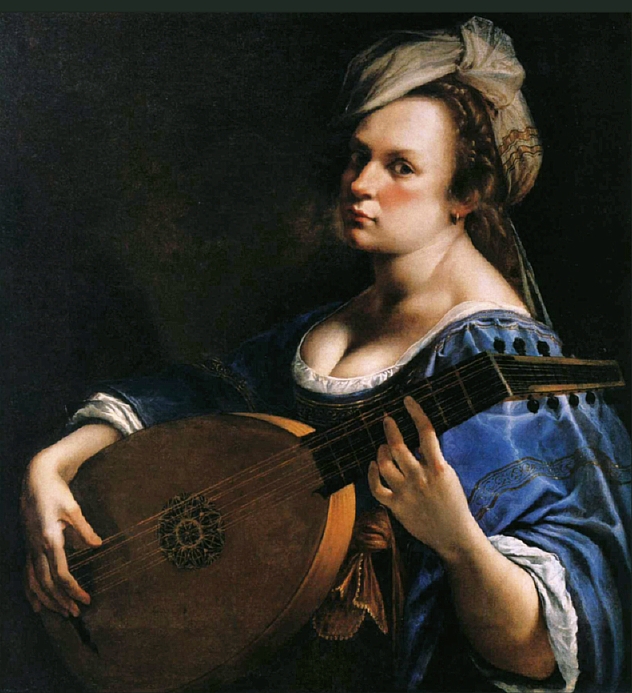
Self Portrait as a Lute Player - oil on canvas - 1615-1617, Artemisia Gentileschi

"It is not easy to explain why the Italian towns and universities gave so much encouragement to the higher aspirations of girls. In poetry, in art, in learning, that encouragement was equally remarkable, and I am tempted to assign its origin to the martial temper of the Middle Ages, which drew many young men from the universities to take part in the exercises of the tilt-yard or in the perils of the battlefield, leaving the fields of learning in need of zealous labourers. Women, on the other hand, exposed their hearts, but not their lives, to the hazards of duels, tournaments and wars; they lived longer than men, as a rule, and hence it was worth while to encourage publicly those gifts of the female mind and spirit which had long been cultivated privately for the benefit of peaceful nunneries."
- Walter Shaw Sparrow from Women Painters of the World, 1905. (Full text)


"A number of obstacles stood in the way of contemporary women who wished to become painters. Their training would involve both the dissection of cadavers and the study of the nude male form, while the system of apprenticeship meant that the aspiring artist would need to live with an older artist for 4–5 years, often beginning from the age of 9-15. For these reasons, female artists were extremely rare, and those that did make it through were typically trained by a close relative..."
- Via the Wiki entry for Flemish artist Caterina van Henessen (1528 – after 1587).


Self Portrait Seated at an Easel - oil on wood panel - 1548, Caterina van Hemessen 

"Occasional doubt has been raised as to the authenticity and provenance of the work. Some have speculated that it was created by her father Jan Sanders van Hemessen (1500–c 1566); he tended to portray women with the same large round, dark, eyes and reduced chin. However these theories are not given much weight by art historians, and the prominence of the signature is taken as evidence of Caterina's intention to mark the work as by her own hand."
- Via the Wiki entry for Caterina van Henessen. (Note: The actual inscription on the painting is: "I Caterina van Hemessen have painted myself / 1548 / Her aged 20.") (!)

***

(Note: As of this post, all links will now open up in new pages.)

Well, finally, after following the exploits of medieval women who, despite their unfortunate invisibility, we now know were active in many fields of visual art, we come to the end of our medieval journey.  We are now entering the High Renaissance and Baroque periods, and, somehow, with no prior evidence or warning, a most curious thing occurs: women artists have suddenly multiplied like rabbits! Not only that, we now have names, faces, and dates to conjure with; yes, actual flesh & blood people. In short, there's enough official data to utterly dispel the falsehood that women have no artistic legacy. Because, yes, there most certainly were great woman artists in the long past, whether certain small, indoctrinated, and biased minds recognize this or not.

But, if any or all of the woman painters I feature (or mention) in this post - an incomplete listing of about thirty-five* - come as a surprise to you, do not feel alone. You and I are sharing the same process of discovery. I can attest to the fact that, as recent as thirty-five years ago, little was known - or, at least shared with the general public - about any of these women outside of Europe, and (possibly) only marginally there, with few exceptions. Moreover, they were known mainly amongst scholars and academics who, for whatever reason, couldn't estimate the importance of the work these dedicated women had produced. And, let's face it, the women had to be dedicated, considering the immense obstacles that stood before them...

Friday, March 22, 2013

HerStory: The Legacy of Judy Chicago


Driving the World to Destruction - Acrylic and oil on Belgian Linen - Judy Chicago, 1986
(Click on images for larger view.)

"I knew that I didn’t want to keep perpetuating the use of the female body as the repository of so many emotions; it seemed as if everything - love, dread, longing, loathing, desire, and terror - was projected onto the female by both male and female artists, albeit with often differing perspectives. I wondered what feelings the male body might be made to express. Also, I wanted to understand why men acted so violently.”
- Judy Chicago, describing her Power Play series (examples above & below)


"The “PowerPlay” series allowed Chicago to exploit and improve upon the cartoonish neo-expressionism of Schnabel, Kostabi, the German Neue Wilde, and other heroes of the moment, turning their pretense at angst and anomie into actual sociopolitical statements, rife with actual anger and confusion. In depicting man’s struggle to manifest aggression and maintain dominance over woman, Chicago was able to convey, even in the cruelest and most violent images, a sense of universal tragedy. Everybody loses, the “PowerPlay” paintings and studies insist, and men are as trapped in and diminished by their roles as women in and by theirs."

- Peter Frank, Huffington Post, via this David Richard Gallery blog page 


"... I found out that many women before me had broken through female roles and made themselves into successful, independent and creative people. Yet the struggles and successes of one generation did not necessarily guarantee greater ease to the women of the next. Instead of the work of one woman attesting to the potential of all women, the work was ripped out of its natural context by male historians. One historical period would allow women more freedom... Then male dominance would assert itself again. The women's achievements would be left out of recorded history, and young women could not model themselves upon the struggles and accomplishments of their mothers."
- Judy Chicago, 1973, 1977


"H. W. Janson, author of the best-selling art history textbook, History of Art (1962), was often quoted as saying that a survey necessarily included only the high points of Western art and that no women artists met that standard."
- excerpt from the .pdf file: Stepping out of the Beaten Path: Reassessing the Feminist Art Movement  by Judith Brodsky and Ferris Olin


***


Last month, I added a new section of links on Trans-D's sidebar devoted to women artists throughout history entitled: Women in Art: HerStory. I've included links which cover female artists from the manuscript illuminators of the Medieval period to the Guerrilla Girls of today, in hopes of partially filling the chasms that exist in what is generally referred to as "art history" - specifically that being taught in the latter half of the twentieth century, and, to some degree, into the 21st - and, a more comprehensive view.

In the 70s, as a young artist, I possessed two books which, to this day, have held honored positions on my shelves. The first was the biography of Georgia O'Keefe, (who will eventually be included in my Patron Sainthood series). The other is a signed paperback entitled "Through the Flower; my struggle as a woman artist" by Judy Chicago, whom I was fortunate to meet in 1994 at one of her lectures held in Connecticut. Happily, Judy Chicago is a living treasure - therefore, no "sainthood" yet!

But, that was it. Apart from Marie Cassatt, O'Keefe and Chicago (before I'd read her book) there had been no other female artists I'd been introduced to... certainly not in art school. If I judged the world situation by what I gleaned from textbooks at the time - and Janson's tome, referenced above, was required art school reading - there were no female artists of note... ever!


To some degree, the absence of women in art history textbooks has been remedied. But, are the fates of women vastly improved? It depends on who you ask.*

Then again, there seems to be a subliminal movement these days to undermine and devalue historical context across the board... as if nothing before the advent of present-day technology has any validity or viability, nor any meaningful relationship to the events of the present day. But, this is a crippling form of tunnel vision, which endows the more unfortunate aspects of our collective past a regenerative power.

Many younger women might be reminded that women in the western world weren't able to vote until 1918, and then, only over 30 years of age. And it wasn't until 1967 - less than 40 years ago - that the Declaration on the Elimination of Discrimination Against Women was proclaimed. The subsequent - and legally binding document - the United Nations' 1981 Convention on the Elimination of All Forms of Discrimination Against Women, though signed by the United States, was never ratified, and, worldwide, in the countries in which it is recognized, is rarely enforced.


The Dinner Party - installation - mixed media - 1974-1979, Judy Chicago


Regarding Chicago, however, while "sainthood" can wait, there's never any time like the present to give credit where it's due... and, in terms of women in art history and herstory in general, no artist has contributed as much as Judy Chicago

Back in the 60's and 70's she was the proverbial fly in the ointment. Born July, 20, 1939, she was the first woman to singlehandedly fight the gender bias in the male-dominated art establishment that surrounded her, and she pulled no punches. In regards to her own art, she ignored the gender-imposed limitations of her time and sought instruction outside the traditional venues; she learned to spray paint in an auto body shop, learned to work in plastics, and trained in pyrotechnics for her own displays. In1970, in Fresno, California, she founded and taught the first feminist art program, and, in the following year, a program at CalArts in Los Angeles. In 1971, she - along with Miriam Schapiro, and, initially, Paula Hays - opened the first female-centered art installation, Womanhouse.

Around the same time, Chicago began questioning documented history, specifically searching for women's contributions to the arts and the sciences which, up till that time, was an obscure, "underground" line of inquiry - a parallel "herstory" desperately in need of rescue and redemption. She began ferreting out the stories of those uncelebrated women, which, in 1974, inspired one of her most notorious, timeless, and critically-acclaimed installations: The Dinner Party, ultimately a collaborative work that would take 6 years to complete.

Detail of The Dinner Party installation: Elizabeth Blackwell's setting - 1974-1979, Judy Chicago
Elizabeth A. Sackler Center for Feminist Art, Brooklyn Museum

The Dinner Party is described on the Brooklyn Museum site, where the installation is now a permanent exhibit, as: "an icon of feminist art, which represents 1,038 women in history; 39 women are represented by place settings and another 999 names are inscribed in the Heritage Floor on which the table rests. This monumental work of art is comprised of a triangular table divided by three wings, each 48 feet long."

Above and below are several details of The Dinner Party, with their corresponding links.


Dinner plates From The Dinner Party installation (Left to right):
Georgia O'Keefe, Petronilla de Meath, HypatiaTrotula.
1974-1979, Judy Chicago


Since the time of The Dinner Party, Chicago has been prolific as an artist, committed as teacher, and, as an activist, remains a perennial force to be reckoned with. Combining her broad understanding of the human condition and an intimate relationship with her own personal, visionary process, Judy Chicago is as vital and relevant today as she was at any point in the past.

She now resides in New Mexico with her husband, photographer Donald Woodman, teaching and working under the auspices of her non-profit feminist art organization, Through the Flower.


The Three Faces of Man - Sprayed acrylic and oil on Belgian Linen - Judy Chicago, 1985

Above is another of Chicago's paintings from her Power Play series: The Three Faces of Man. Metaphorically concise, to the point of being grotesque, it's pretty powerful stuff. But, hey, wait a minute, wasn't this cat in the news not too long ago? Life imitating art seems to be the order of the millennium!

Below is a 2010 YouTube video of Judy Chicago discussing feminist art. Another video - as the recipient of the 2011 Governor's Award, can be found here. Also, a recent (March 1, 2013) PBS special featuring an interview with Chicago - "Makers: Women Who Make America" - can be found here.


By the way, I recently learned it's "Women's History Month", so, despite the fact that this post has been sitting in draft-mode since January, now seems like a fine time to post it.

Well, sort of. That is, if "history" months - be they women's history month, black history month or national dog history month - weren't just so much patronizing BS. You'll note, for instance, there seems to be no cause for a designated "White Male History" month...

Anyway, it gets worse. I learned today that "International Women's Day" was held on March 8. Oh, you missed it, too? Well, look at it this way: if you were fully human, or, maybe just male, every day, in the official world, would be your day.

***

In regards to woman in the sciences, they are perhaps in need of redemption more than women in the arts. Nature, the international journal of science, has several articles addressing the subject, found herehere, and here... with a more optimistic viewpoint found here.


Judy Chicago's quotes and images have been posted here with permission from the artist.

Judy Chicago:
Website: http://www.judychicago.com/
Through the Flower: http://www.throughtheflower.org/
Facebook: https://www.facebook.com/ThroughtheFlower


Update 6/24/13: Two members of the Russian Punk band, Pussy Riot, become special guests at the Dinner Party.  Also: the NY Times article, and a New Statesman article: Pussy Riot: "People fear us because we're feminists".