Showing posts with label Judy Chicago. Show all posts

Wednesday, July 17, 2019

A Fine, Vintage Wine - Happy Birthday, Judy Chicago!


Judy Chicago. Photo credit:Martin Godwin. (Source: this interview.)

Judy Chicago turns 80 this month... but, don't imagine for a moment she's going to let the day slip by with merely a sigh and a whimper; she's celebrating it with a bang!

First up, she's launching her new, designer wine - Judy Chicago (inset right) - inspired by her feminist art organization's Through the Flower motif - just in time for the Grand Opening of her new Art Space this Saturday, July 20, 2019, for which she's giving tours all weekend.

She's also showing a film, having a wine release party, having a Pop-Up exhibition AND a special firework's performance: A Birthday Bouquet for Belen.

All these events are open to the public, so if you just happen to be in New Mexico, well, drop by! More info can be found here and here.


By the way, here's a little more info regarding Chicago's new Art Space. As it happened, she recieved a proposal late last year by the (dirt-poor) city of Belen's mayor and town councilor: the creation of a museum in Belen dedicated to one of the most notorious feminist artists in America... Chicago, herself!

Alas, it seems as if a group of religious-right fanatics opposed the museum. I quote Alisa Valdes from her Alibi article appearing earlier this year:

"Speaking to the Times, a member of the Calvary Chapel, located in Belen's old WalMart (of course it is) 19 year old Lacey Greet, explained her opposition to the museum thus:

'As Christians, we are for order, justice, security and protection. I'm for protecting the eyes of children.'"

Oh, yes, we see... NOT!

As it was, Valdes had the sneaky suspicion that Chicago's "Jewishness" might have been at the root of all this "righteousness," but, then, racism and sexism are symptoms of the same malady that has infected America for some time now: Trumpism and the empowerment of the evil far-right.

Inset left is a tapestry banner from Chicago's 1974 Dinner Party (for discerning eyes only). It reads: "And then all that divided them merged."

Anyway, not to worry; Judy declined the original offer and took the matter into her own capable hands. She set up a Go-Fund-Me page to pay for the new Through the Flower Art Space... and the rest is herstory! (More here.)

As for the Grand Opening, well, I'm hoping to be there... although the present state of my car might thwart my efforts. In any case, from all of us to all of her:


HAPPY BIRTHDAY, JUDY!

________________________________

Note: Ironically, the New Mexico town of Belen - apparently a hot-bed of Christian righteousness - shares its name with a pagan sun-god! His name is Belenus, which is the Romanized version of Bel or Belen. Beltane is his fire festival. Sourced from this article, we have:

"Based on surviving inscriptions and archaeological remains, Belenus was among the most widely venerated and beloved deities of the Celtic world. The center of his venerations seems to have been in France, where the most artifacts have been uncovered, but inscriptions dedicated to him have been found from the British Isles to Slovenia.

Belenus’ shrines often incorporated therapeutic springs. He may have dominion over the healing power of the sun. An erotic spirit, he may be a spirit of reproductive fertility for people and livestock. He is sometimes called the Lord of Flocks."


For more info about Belen see here, and - if you're on Facebook  - check out Hecate's Haven.

And, you know, the town of Belen might think about having its own Beltane fire festival. Judy Chicago could do one of her fireworks displays. Inset right: remember this guy?

Tuesday, February 5, 2019

Qualifying Feminism: Empowerment and the Arts (Part IV)

The late, great sculptress Louise Bourgeois (1911-2010) and her sculpture Fillette in
a 1982 portrait by the brilliant (and often-censored) photographer Robert Mapplethorpe.
(Click-on post images for actual sizes.)

(Update as of August 3, 2019Originally this article was referred to as "Part 3b" of what I had intended to be a 3 part series. This has changed. It is now Part 4 of a 7 part series. My apologies for any confusion - DS.)

“'I am lucky to have been brought up by a mother who was a feminist and fortunate enough to have married a husband who was a feminist, and I have raised sons who are feminists,' Germaine Greer quoted her as saying in The Guardian, not long after Bourgeois’ death in 2010. The artist, famous for her mammoth sculptures of spiders, pointedly leaves herself out of the list, insinuating not a rejection of the -ism, necessarily, but perhaps a bit of condescension toward critics eager to associate her with the term, no matter her opinions.

Bourgeois does owe a lot to the feminist movement. Born in Paris in 1911, she spent many of her early years known merely as the wife of Robert Goldwater, the American art historian with whom she moved to New York in the late 1930s. Though she drew, painted, sculpted and printed throughout the 1940s and ‘50s, Bourgeois didn’t receive real art world attention until her 50s. She had to wait more than a few years before she moved from the periphery of art critics’ minds to somewhere closer to the center. During that time, the feminist movement was blooming."

- Excerpt from a December 25 (Bourgeois' birthday), 2017 Huffington Post article by Katherine Brooks entitled A Love Letter To Louise Bourgeois, A Feminist Icon Whether She Likes It Or Not. Inset right is one of Bourgeois' "mammoth spiders."

"O'Keeffe, whose comfort with her sexuality is evident in the nude photographs taken of her by her husband Alfred Stieglitz, was not comfortable with the way that the paintings were interpreted as erotic images. This may have more to do with the degrading ways that the paintings were discussed. Stieglitz marketed her flower paintings in sexual terms, including quotes from men who were influenced by Stieglitz's viewpoints. She asked her friend, Mabel Dodge Luhan, to write of her work from a feminine perspective to counter interpretations by men.

Judy Chicago gave O'Keeffe a prominent place in her The Dinner Party (1979) in recognition of what many prominent feminist artists considered groundbreaking introduction of sensual and feminist imagery in her works of art, seeing it as a sign of female empowerment."

- From the Wiki entry for Flower Paintings of Georgia O'Keeffe. Inset left is an O'Keeffe orchid found there. Inset right is an element from Judy Chicago's tribute to O'Keeffe: a dinner plate from her ground-breaking, 1979 feminist art installation, The Dinner Party.

"I thought you could write something about me that men can't – What I want written – I do not know – I have no definite idea of what it should be. – but a woman who has lived many things and who sees lines and colors as an expression of living – might say something that a man can't – I feel there is something unexplored about woman that only a woman can explore – Men have done all they can do about it. Does that mean anything to you – or doesn't it?"

- American artist, Georgia O'Keeffe (1887-1986), from a 1925 letter to Mabel Dodge Luhan found in the Wiki entry (linked above). Inset left is a photograph of O'Keefe by her husband, Alfred Stieglitz.

"Louise Nevelson has been a fundamental key in the feminist art movement. Credited with triggering the examination of femininity in art, Nevelson challenged the vision of what type of art women would be creating with her dark, monumental, masculine and totem-like artworks. Nevelson believed that art reflected the individual, not "masculine-feminine labels", and chose to take on her role as an artist, not specifically a female artist. Reviews of Nevelson's works in the 1940s wrote her off as just a woman artist. A reviewer of her 1941 exhibition at Nierendorf Gallery stated: "We learned the artist is a woman, in time to check our enthusiasm. Had it been otherwise, we might have hailed these sculptural expressions as by surely a great figure among moderns." Another review was similar in its sexism: "Nevelson is a sculptor; she comes from Portland, Maine. You'll deny both these facts and you might even insist Nevelson is a man, when you see her Portraits in Paint, showing this month at the Nierendorf Gallery."

Even with her influence upon future generations of feminist artists, Nevelson's opinion of discrimination within the art world bordered on the belief that artists who were not gaining success based on gender suffered from a lack of confidence. When asked by Feminist Art Journal if she suffered from sexism within the art world, Nevelson replied "I am a woman's liberation."

- Sourced from the Wikiwand entry for Louise Nevelson. Inset right above is a portrait of Nevelson by Richard Avedon. Inset left is her 1985 piece, Mirror-Shadow VIII.


"The first act of violence that patriarchy demands of males is not violence toward women. Instead patriarchy demands of all males that they engage in acts of psychic self-mutilation, that they kill off the emotional parts of themselves. If an individual is not successful in emotionally crippling himself, he can count on patriarchal men to enact rituals of power that will assault his self-esteem."

"Patriarchy both creates the rage in boys and then contains it for later use, making it a resource to exploit later on as boys become men. As a national product, this rage can be garnered to further imperialism, hatred and oppression of women and men globally. This rage is needed if boys are to become men willing to travel around the world to fight wars without ever demanding that other ways of solving conflict can be found.”

- A quote from feminist (and wise woman), bell hooks, (found here). Her photograph was sourced here. And, here's her blog (last updated September 29, 2016.)

(Update, April 8, 2019: I've just added a quote from a Vietnam vet that supports hooks' insight. It can be found in a footnote at the end of the post. I've also added another quote by hooks.)
____________________________________________________

The Newer Woman

Well, I guess the operative question is: what became of the New Woman? Did she simply morph into a Newer Woman?

No, not exactly. Two world wars got in the way. And, by the end of the second one, patriarchal society reasserted itself once again. The upshot is (in as few words as possible), after the disastrous effects of toxic-masculinity-in-action (i.e., war and genocide) depleted the world's population by millions (upon millions) of humans; the world's "little ladies" were obligated to return to the confines of the home, and dedicate their lives to what nature (and the state) intended: motherhood. In reality, the war machine needed new blood (literally) and more human fodder, the bloated corporate sector needed fresh regiments of gullible consumers, and the government needed its tax revenue which, in the form of new taxpayers (requiring new Social Security numbers) it was a patriotic citizen's "duty" to provide. Women were expected to push more and more babies out of their wombs (and purchase the latest soap-powder) while men were obliged to finance the whole deal (or die trying).*

Needless to say, the New Woman movement lost much of its momentum during the post-war years of the mid-1900s. But, then, in (almost) Karmic retaliation, the Baby Boomer generation was spawned. And, the Baby Boomers, in turn, beget the 60s... a time when pretty much all the best-laid plans of white mice and white men went straight to hell. Well, at least, for a decade or two. It was as if, suddenly, all the King's horses, vassals and concubines no longer gave a hoot about putting Humpty Dumpty back together again, but, instead, decided to make an omelet (with his remains) which all might share... regardless of race, religion, nationality, gene-pools or gender. And, it was from this mighty upheaval that second-wave feminism was born.

This is not to say that all females of artistic persuasion were driven underground during the post-war period. No, the feminist spirit was kept alive by a number of female artists who had been born later in the time-frame, at the very end of the 19th century. Many of these women also gravitated to Paris, and it is their artwork which illuminates this section.

First in line: the 1939 painting, Rhythm Colour no. 1076,  by Ukrainian-born French artist Sonia Delaunay (1885-1979)  - above, inset left - who co-founded Orphism (a form of cubism) with her more celebrated husband, French artist, Robert Delauney. Wiki tells us that "she was the first living female artist to have a retrospective exhibition at the Louvre in 1964."

As it was, she was one of four female artists initially considered Cubists and one of three who survived the wars to witness the next wave of feminism in bloom. The one Cubist who tragically missed the new resurgence was Spanish artist María Blanchard (1881-1939), whose 1916 painting Composición cubista appears next (above, inset right). Above, inset left, is Composition cubiste by Polish painter Alice (or Alicja) Halicka (1894-1975), while (directly) inset right is a portrait of artist Diego Rivera by Russian-born (Cubist-turned-pointillist) Marie Bronislava Vorobyeva-Stebelska (1892-1984)... also known as Marevna. Of note: in 1919 Marevna gave birth to a daughter fathered by Rivera who, as we know, later married (Patron Saint) Frida Kahlo. More of Marevna's work can be found here.

Speaking of Patron Saints, there was another, German-American visionary and Transcendentalist artist, Agnes Pelton (1881–1961), who can be counted among the women who appear here. Her Patron Saint article is here. Her 1939 painting below, Sea Change, was sourced from a Whitney Museum of American art page. As it was, Pelton was one of two female artists asked to join the Transcendentalist Painting Goup, the other was Florence Miller Pierce (1918-2007). You can find her work here.


And, then, in the latter years of the 19th century, something marvelous occurred... and the 19th century dealt us one of its last cards: an American pioneer, an artist who, living for almost 100 years (1887-1986), would take us into the 20th century and beyond, finally setting the record straight for all female artists while inspiring countless others (myself included). That is, yes, women could be innovators in the art world, and yes, women could be masters at their craft, and, most definitely, women could contribute to the human footprint sans the obligatory "baby-bump." Her name was Georgia Totto O'Keeffe and she broke every rule in the book, besting the men at their own game without batting an eyelash. She is, in fact, Trans-D's missing Patron Saint #12... but, if I never get to her, know that I meant to. Of all her prolific work she is best known for her massive flower paintings (Inset left is Red Canna (1924); another painting is below the jump); organic marvels of which she said: “When you take a flower in your hand and really look at it, it's your world for the moment. I want to give that world to someone else.” 


Monday, April 23, 2018

Can't Keep a Good Woman Down


Our Godmother... feminist artist, Judy Chicago.

"I told Chicago that I was struck that, though she had often struggled in her career — overcoming the disapprobation of critics, the indifference of institutions and overt and tacit misogyny — she had managed to hold onto a sense of her work’s importance. She said, with her usual matter-of-factness, that it was simply a matter of pragmatism."

- Excerpt and photo (above) via the recent NY Times' feature: Judy Chicago, The Godmother.

***

It's pretty much impossible to keep up with Judy Chicago, but never let it be said some of us  don't try! Recently chosen as one of the Times' Top 100 most influential people, and appearing on the cover of NY Times' (February) Women's Fashion issue, Judy is always newsworthy. Don't believe me? Just check out this avalanche of Judy articles appearing within the past year.

Anyway, she isn't our Godmother for nothing... although Our Fearless Leader, or Her Majesty will do...  Which is why I'm here today. I realize it's a little late but at 6:30 PM tonight EST Judy was at Stanford University chatting with art historian, Marci Kwon, at the Bing Concert Hall.

The event was Livestreamed here. When and if archival footage appears, I'll update this post with a link.


Tuesday, August 18, 2015

In the Company of Green Women (V): The Renaissance & Baroque Painters


Susanna and the Elders - oil painting - 1610, Artemisia Gentileschi

(Apart from this image, which has been posted in full, the remainder of the images of this post
 can be clicked to enlarge.)

"If Artemisia had not been a virgin before Tassi raped her, the Gentileschis would not have been able to press charges. During the ensuing seven-month trial, it was discovered that Tassi had planned to murder his wife, had engaged in adultery with his sister-in-law, and planned to steal some of Orazio’s paintings. During the trial, Artemisia was subjected to a gynecological examination and torture using thumbscrews to verify her testimony. At the end of the trial Tassi was sentenced to imprisonment for one year, although he never served the time..."
- Via the Wiki entry for Artemisia Gentileschi. (Note: Ah, but do not cry for Artemisia; as we will see, she, indeed, has her metaphorical revenge!)

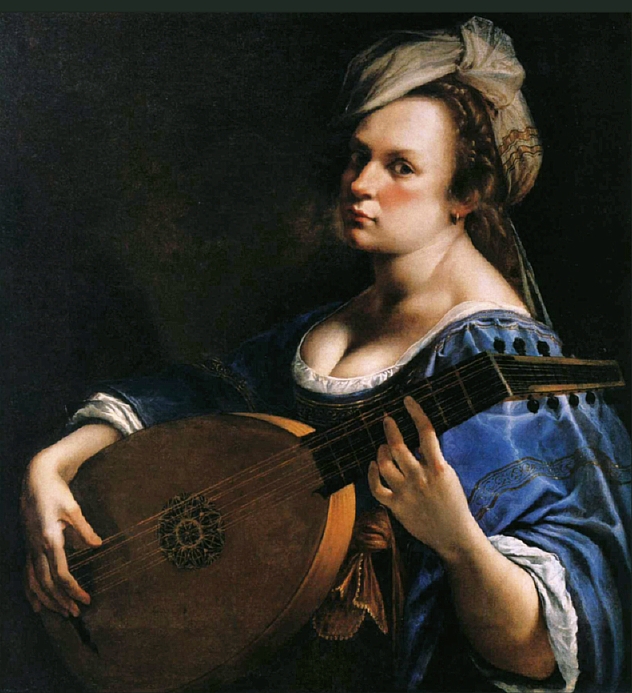
Self Portrait as a Lute Player - oil on canvas - 1615-1617, Artemisia Gentileschi

"It is not easy to explain why the Italian towns and universities gave so much encouragement to the higher aspirations of girls. In poetry, in art, in learning, that encouragement was equally remarkable, and I am tempted to assign its origin to the martial temper of the Middle Ages, which drew many young men from the universities to take part in the exercises of the tilt-yard or in the perils of the battlefield, leaving the fields of learning in need of zealous labourers. Women, on the other hand, exposed their hearts, but not their lives, to the hazards of duels, tournaments and wars; they lived longer than men, as a rule, and hence it was worth while to encourage publicly those gifts of the female mind and spirit which had long been cultivated privately for the benefit of peaceful nunneries."
- Walter Shaw Sparrow from Women Painters of the World, 1905. (Full text)


"A number of obstacles stood in the way of contemporary women who wished to become painters. Their training would involve both the dissection of cadavers and the study of the nude male form, while the system of apprenticeship meant that the aspiring artist would need to live with an older artist for 4–5 years, often beginning from the age of 9-15. For these reasons, female artists were extremely rare, and those that did make it through were typically trained by a close relative..."
- Via the Wiki entry for Flemish artist Caterina van Henessen (1528 – after 1587).


Self Portrait Seated at an Easel - oil on wood panel - 1548, Caterina van Hemessen 

"Occasional doubt has been raised as to the authenticity and provenance of the work. Some have speculated that it was created by her father Jan Sanders van Hemessen (1500–c 1566); he tended to portray women with the same large round, dark, eyes and reduced chin. However these theories are not given much weight by art historians, and the prominence of the signature is taken as evidence of Caterina's intention to mark the work as by her own hand."
- Via the Wiki entry for Caterina van Henessen. (Note: The actual inscription on the painting is: "I Caterina van Hemessen have painted myself / 1548 / Her aged 20.") (!)

***

(Note: As of this post, all links will now open up in new pages.)

Well, finally, after following the exploits of medieval women who, despite their unfortunate invisibility, we now know were active in many fields of visual art, we come to the end of our medieval journey.  We are now entering the High Renaissance and Baroque periods, and, somehow, with no prior evidence or warning, a most curious thing occurs: women artists have suddenly multiplied like rabbits! Not only that, we now have names, faces, and dates to conjure with; yes, actual flesh & blood people. In short, there's enough official data to utterly dispel the falsehood that women have no artistic legacy. Because, yes, there most certainly were great woman artists in the long past, whether certain small, indoctrinated, and biased minds recognize this or not.

But, if any or all of the woman painters I feature (or mention) in this post - an incomplete listing of about thirty-five* - come as a surprise to you, do not feel alone. You and I are sharing the same process of discovery. I can attest to the fact that, as recent as thirty-five years ago, little was known - or, at least shared with the general public - about any of these women outside of Europe, and (possibly) only marginally there, with few exceptions. Moreover, they were known mainly amongst scholars and academics who, for whatever reason, couldn't estimate the importance of the work these dedicated women had produced. And, let's face it, the women had to be dedicated, considering the immense obstacles that stood before them...

Wednesday, July 22, 2015

In the Company of Green Women (IV): Of Lost Creatures & Forgotten Tales (The Textile Artists)


À mon seul désir - one of six in the series of tapestries entitled: The Lady and The Unicorn - Flanders, 1500s - currently housed in the Musée de Cluny - National Museum of the Middle Ages, Paris, France.

"In the nineteenth century Prosper Merimé the French Inspector of Historic Monuments drew the attention of authorities to the beauty and importance of the tapestries after finding them hanging on damp walls in the rat ridden decaying Château Boussac in 1835. They were still there in 1844 when the renowned author of her day George Sand mentioned them in her novel Jeanne. She endeavoured to use her celebrity status to have them removed to safety, but to no avail.They were still there in 1853 when Baron Aucapitaine drew the attention of Edmond du Sommerard, the Curator of the Cluny Museum at Paris to them and he subsequently negotiated long and hard to secure them.Two important details still elude researchers; the personality of the artist who designed the tapestries for Jean le Viste and the place where they were woven."

- Carolyn McDowall, from The Lady and The Unicorn and ‘Millefleurs’ Style Tapestries.


The Unicorn is Found - one of a series of seven tapestries entitled: The Hunt of the Unicorn - 1490-1505, Brussels - currently housed in The Cloisters, NYC, New York.


"I was so excited to see the tapestries, I think I almost cried.  They are so amazing and the colors are still so vivid.  The tapestries are believed to have been created in the Netherlands, between 1495 and 1515.  The first known record of their existence is from 1680 when they were part of the inventory of the belongings of a French Duke...

...During the Revolution, populist mobs looted the chateau and took the tapestries where they remained out of sight for several generations. It was rumored that they were used to cover espaliered trees and protect potatoes. In the early 1850’s a peasant’s wife came forward with news of some “old curtains” that were covering vegetables in the barn. Can you imagine? It’s amazing that they have managed to retain their pretty, bright colors."

- Thimbleanna, from The Unicorn Tapestries

Salone dei Mesi (Month of March) - Francesco del Cossa - 1470

"The most famous remaining medieval tapestry cartoons were the ones painted by Raphael for "The Acts of the Apostles", a series of tapestries commissioned from a Brussels tapestry shop by Pope Leo X in 1515 for the lower level of Rome's Sistine Chapel. We remember Raphael's name... he's a very famous artist. No one remembers the names of those countless Belgian weavers."

-  Found on this Unicorn page.


"Today it is said that the unicorn never existed. However, it is marvelously clear that when the unicorn was first described and centuries later when the tapestries were woven, everyone believed in unicorns."

- From Marianna Mayer, The Unicorn and the Lake.

***

Whenever a medieval or Renaissance work of art is found hosting a colony of mold, plugging up a fireplace, or "protectively" wrapping a bin of potatoes, it almost goes without saying that it must have been "women's work" (the art, that is). At least, that's the impression I got as I vainly pursued and attempted to identify medieval women artists and artisans. It seems to have been a trend... and, one we'll revisit, when we've arrive at the topic of Renaissance paintings (note: despite my best efforts, this will not be achieved in the present post).

Which is why I believe the two sets of Unicorn tapestries (examples shown above; also below the jump) - most especially "The Lady and the Unicorn" - were most likely the work of women. This is not to say that men were not involved in the production of textiles in the late Middle Ages. They most certainly were. Weavers were often members of all-male guilds, because - apart from the work emerging from convents and monasteries - women were supposedly banned from the loom. By the late 1400s and early 1500s, however, when the Unicorn tapestries were created, the situation had reversed, and female weavers began to predominate; especially in the Low Countries, where the Unicorn tapestries - both sets - originated.

Moreover, both the "Lady and the Unicorn" tapestries, and those comprising "The Hunt of the Unicorn," employed the Millefleur(s) - thousand flowers - technique; a style which (I'd hazard to guess) even the most genteel of men would find hard to swallow, let alone spend countless hours over its execution. I think, too, that it's significant that the French feminist writer, George Sand (French Wiki link) , made a point of championing "The Lady's" recovery (from the no-longer-rat-infested Château Boussac). She sensed there was something "curious" about them.*

But, when both sets of tapestries were finally "saved," it didn't take art historians long to realize that the textiles were artistic masterpieces. As it presently stands, the Unicorn tapestries (of both groups) are officially considered to be the most outstanding examples of medieval art and craftsmanship the world possesses...

Thursday, April 9, 2015

Judy Chicago - Live Feed Update!

(click to enlarge)

I just found this in my inbox.  If you catch this post on time, some of you should still be able to view the live feed via the link below.

If not, the same link will take you to the video of the show:


Thursday, April 17, 2014

Judy Chicago - A Butterfly for Brooklyn - 2015 UPDATE!


A Butterfly for Pomona - Pyrotechnical display - 2012, Judy Chicago
Photo: Donald Woodman 


Noted previously on the sidebar of this blog, fans & followers of Judy Chicago have been doing a lot of celebrating lately... in honor of her 75th birthday (July 20) this year. 

As part of an ongoing tribute to Judy (April 4- September 28, 2014), the Elizabeth A. Sackler Center for Feminist Art at the Brooklyn Museum is presenting a A Butterfly for Brooklyn; an elaboration of her original 1974 pyrotechnic art performance, A Butterfly for Oakland, and an encore performance of A Butterfly for Pomona (pictured above) which was created in California in 2012 (...a great video of which can be found here).


The event is free and open to the public!


***


2015 UPDATE!


Video premiere: A Butterfly for Brooklyn
April 9, 2015, 7:00 PM


The Brooklyn Museum and the Museum of Arts and Design (MAD) will collaborate to host                 Judy Chicago: On Fire, a special two-night event exploring Judy Chicago's works in pyrotechnics.

The April 9th event at the Brooklyn Museum marks the premiere of A Butterfly for Brooklyn, a 20-minute documentary overseen by award-winning film editor Kate Amend and documentary filmmaker Joan Churchill that explores the creation of Chicago's spectacular 2014 fireworks piece in Prospect Park, which was seen and applauded by more than 12,000 viewers.

The following evening, April 10th, MAD will host a conversation with Chicago and MAD curator, Elissa Auther, highlighting some of the artist's earlier fireworks and exploring her long history of creating art with pyrotechnics.

For more info, see Judy's Corner!


Friday, September 6, 2013

Patron Saint #10: Deborah Remington - The Future Looks Back


Ackia -  color screenprint - 1975, Deborah Remington


“My work concerns the paradoxes of visual perception, the enigmas and quirks, and how it all forms the basis for our realities. The impact, excitement, and energies created by incongruity, juxtaposition and opposites all interest me.

The images are couched in paradoxical terms and must challenge the mind’s eye, must invoke opposites and hold them in tension. The work at times seems to refer to something in reality, but then the reference is denied. Identity; the fusion of so many experiences, so many inquiries, so many intuitions is also a primary issue.”

- Deborah Remington, from a quote found here.

"...Drawing doesn’t have to have color for me. The Japanese would always say, ‘Can’t you see the color there in the black and white?’ It’s implied, and if you’re a really good artist and if the paintings are wonderful enough and if they really sing, then the viewer gets a sense of color. That influenced my work a lot, mostly the philosophy of calligraphy.”
(via a 2008 interview with Nancy M. Grace)

"Anyway I followed the whole gang of howling poets to the reading at Gallery Six that night, which was, among other important things, the night of the birth of the San Francisco Poetry Renaissance. Everyone was there. It was a mad night. And I was the one who got things jumping by going around collecting dimes and quarters from the rather stiff audience standing around in the gallery and coming back with three huge gallon jugs of California Burgundy and getting them all piffed so that by eleven o'clock when Alvah Goldbook was reading his, wailing his poem "Wail" drunk with arms outspread everybody was yelling "Go! Go! Go!" (like a jam session) and old Rheinhold Cacoethes the father of the Frisco poetry scene was wiping his tears in gladness."

- Excerpt from The Dharma Bums by Jack Kerouac, 1958


"I saw the best minds of my generation destroyed by 
              madness, starving hysterical naked, 
       dragging themselves through the negro streets at dawn 
              looking for an angry fix, 
       angelheaded hipsters burning for the ancient heavenly 
              connection to the starry dynamo in the
machinery of night, 
       who poverty and tatters and hollow-eyed and high sat 
              up smoking in the supernatural darkness of 
              cold-water flats floating across the tops of cities 
              contemplating jazz, 
       who bared their brains to Heaven under the El and 
              saw Mohammedan angels staggering on
tenement roofs illuminated, 
       who passed through universities with radiant cool eyes 
              hallucinating Arkansas and Blake-light tragedy 
              among the scholars of war..."

- The initial lines of Howl by Allen Ginsberg, 1955, found here (with audio).

“This was the time of the Rosenbergs and the [Estes] Kefauver hearings, the Hollywood blacklisting. It was horrible. The police were everywhere, and it was kind of a fascist country. This was the climate within which and against which we were working. We were trying to break all the rules. It didn’t matter: you just broke the rules. You rarely got anything substantial out of it, but by hit and miss we did.”

Deborah Remington, from Inside and Around the 6 Gallery with Co-Founder Deborah Remington (via a 2008 interview with Nancy M. Grace)


***

"It was a great night, a historic night in more ways than one..." wrote Jack Kerouac in 1958, for his semi-autobiographical Beat novel, "The Dharma Bums." He was referring to an actual event, a poetry reading that took place in a San Francisco art gallery - the 6 Gallery - October 7, 1955. 

In his thinly veiled account, Kerouac mentions a number of Beat luminaries on the scene that night.  Alvah Goldbook was, of course, the poet, Allen Ginsberg, who astounded the crowd with an impassioned reading of his definitive poem "Howl". "Old Rheinhold Cacoethes", on the other hand, was Kenneth Rexroth, while Kerouac's close friend friend, Gary Snyder, appears as Japhy Ryder. Earlier, he mentions a "delicate pale handsome" poet, Ike O'Shay, referring to a very young Michael McClure*. Of that night, McClure would later write: "Ginsberg read on to the end of the poem, which left us standing in wonder, or cheering and wondering, but knowing at the deepest level that a barrier had been broken, that a human voice and body had been hurled against the harsh wall of America..."


Deborah Remington as an art student in the 1950s - Photo credit: unknown
Currently found: Remington's NYT (2010) obituary (click to enlarge)

Oddly enough, one figure who does not enter into Kerouac's fictional account - although, certainly worthy of a mention - was a six-foot tall, redheaded woman** - and one of the six Beats who owned the gallery - artist, Deborah Remington. (Her co-owners were artists, Wally Hedrick, Hayward King and David Simpson, and the poets, John Ryan and Jack Spicer.) Granted, Kerouac was loaded on California Burgundy - Dionysus being the god of lost histories - and focused on the Beat literati, but, it's hard to imagine that such a strikingly beautiful young woman would've fallen outside his radar. Then again, judging by her own brief account (via an interview excerpt included in this .pdf file), Remington fails to recall the presence of Kerouac and several members of his poetic posse that night. Go figure.

Friday, March 22, 2013

HerStory: The Legacy of Judy Chicago


Driving the World to Destruction - Acrylic and oil on Belgian Linen - Judy Chicago, 1986
(Click on images for larger view.)

"I knew that I didn’t want to keep perpetuating the use of the female body as the repository of so many emotions; it seemed as if everything - love, dread, longing, loathing, desire, and terror - was projected onto the female by both male and female artists, albeit with often differing perspectives. I wondered what feelings the male body might be made to express. Also, I wanted to understand why men acted so violently.”
- Judy Chicago, describing her Power Play series (examples above & below)


"The “PowerPlay” series allowed Chicago to exploit and improve upon the cartoonish neo-expressionism of Schnabel, Kostabi, the German Neue Wilde, and other heroes of the moment, turning their pretense at angst and anomie into actual sociopolitical statements, rife with actual anger and confusion. In depicting man’s struggle to manifest aggression and maintain dominance over woman, Chicago was able to convey, even in the cruelest and most violent images, a sense of universal tragedy. Everybody loses, the “PowerPlay” paintings and studies insist, and men are as trapped in and diminished by their roles as women in and by theirs."

- Peter Frank, Huffington Post, via this David Richard Gallery blog page 


"... I found out that many women before me had broken through female roles and made themselves into successful, independent and creative people. Yet the struggles and successes of one generation did not necessarily guarantee greater ease to the women of the next. Instead of the work of one woman attesting to the potential of all women, the work was ripped out of its natural context by male historians. One historical period would allow women more freedom... Then male dominance would assert itself again. The women's achievements would be left out of recorded history, and young women could not model themselves upon the struggles and accomplishments of their mothers."
- Judy Chicago, 1973, 1977


"H. W. Janson, author of the best-selling art history textbook, History of Art (1962), was often quoted as saying that a survey necessarily included only the high points of Western art and that no women artists met that standard."
- excerpt from the .pdf file: Stepping out of the Beaten Path: Reassessing the Feminist Art Movement  by Judith Brodsky and Ferris Olin


***


Last month, I added a new section of links on Trans-D's sidebar devoted to women artists throughout history entitled: Women in Art: HerStory. I've included links which cover female artists from the manuscript illuminators of the Medieval period to the Guerrilla Girls of today, in hopes of partially filling the chasms that exist in what is generally referred to as "art history" - specifically that being taught in the latter half of the twentieth century, and, to some degree, into the 21st - and, a more comprehensive view.

In the 70s, as a young artist, I possessed two books which, to this day, have held honored positions on my shelves. The first was the biography of Georgia O'Keefe, (who will eventually be included in my Patron Sainthood series). The other is a signed paperback entitled "Through the Flower; my struggle as a woman artist" by Judy Chicago, whom I was fortunate to meet in 1994 at one of her lectures held in Connecticut. Happily, Judy Chicago is a living treasure - therefore, no "sainthood" yet!

But, that was it. Apart from Marie Cassatt, O'Keefe and Chicago (before I'd read her book) there had been no other female artists I'd been introduced to... certainly not in art school. If I judged the world situation by what I gleaned from textbooks at the time - and Janson's tome, referenced above, was required art school reading - there were no female artists of note... ever!


To some degree, the absence of women in art history textbooks has been remedied. But, are the fates of women vastly improved? It depends on who you ask.*

Then again, there seems to be a subliminal movement these days to undermine and devalue historical context across the board... as if nothing before the advent of present-day technology has any validity or viability, nor any meaningful relationship to the events of the present day. But, this is a crippling form of tunnel vision, which endows the more unfortunate aspects of our collective past a regenerative power.

Many younger women might be reminded that women in the western world weren't able to vote until 1918, and then, only over 30 years of age. And it wasn't until 1967 - less than 40 years ago - that the Declaration on the Elimination of Discrimination Against Women was proclaimed. The subsequent - and legally binding document - the United Nations' 1981 Convention on the Elimination of All Forms of Discrimination Against Women, though signed by the United States, was never ratified, and, worldwide, in the countries in which it is recognized, is rarely enforced.


The Dinner Party - installation - mixed media - 1974-1979, Judy Chicago


Regarding Chicago, however, while "sainthood" can wait, there's never any time like the present to give credit where it's due... and, in terms of women in art history and herstory in general, no artist has contributed as much as Judy Chicago

Back in the 60's and 70's she was the proverbial fly in the ointment. Born July, 20, 1939, she was the first woman to singlehandedly fight the gender bias in the male-dominated art establishment that surrounded her, and she pulled no punches. In regards to her own art, she ignored the gender-imposed limitations of her time and sought instruction outside the traditional venues; she learned to spray paint in an auto body shop, learned to work in plastics, and trained in pyrotechnics for her own displays. In1970, in Fresno, California, she founded and taught the first feminist art program, and, in the following year, a program at CalArts in Los Angeles. In 1971, she - along with Miriam Schapiro, and, initially, Paula Hays - opened the first female-centered art installation, Womanhouse.

Around the same time, Chicago began questioning documented history, specifically searching for women's contributions to the arts and the sciences which, up till that time, was an obscure, "underground" line of inquiry - a parallel "herstory" desperately in need of rescue and redemption. She began ferreting out the stories of those uncelebrated women, which, in 1974, inspired one of her most notorious, timeless, and critically-acclaimed installations: The Dinner Party, ultimately a collaborative work that would take 6 years to complete.

Detail of The Dinner Party installation: Elizabeth Blackwell's setting - 1974-1979, Judy Chicago
Elizabeth A. Sackler Center for Feminist Art, Brooklyn Museum

The Dinner Party is described on the Brooklyn Museum site, where the installation is now a permanent exhibit, as: "an icon of feminist art, which represents 1,038 women in history; 39 women are represented by place settings and another 999 names are inscribed in the Heritage Floor on which the table rests. This monumental work of art is comprised of a triangular table divided by three wings, each 48 feet long."

Above and below are several details of The Dinner Party, with their corresponding links.


Dinner plates From The Dinner Party installation (Left to right):
Georgia O'Keefe, Petronilla de Meath, HypatiaTrotula.
1974-1979, Judy Chicago


Since the time of The Dinner Party, Chicago has been prolific as an artist, committed as teacher, and, as an activist, remains a perennial force to be reckoned with. Combining her broad understanding of the human condition and an intimate relationship with her own personal, visionary process, Judy Chicago is as vital and relevant today as she was at any point in the past.

She now resides in New Mexico with her husband, photographer Donald Woodman, teaching and working under the auspices of her non-profit feminist art organization, Through the Flower.


The Three Faces of Man - Sprayed acrylic and oil on Belgian Linen - Judy Chicago, 1985

Above is another of Chicago's paintings from her Power Play series: The Three Faces of Man. Metaphorically concise, to the point of being grotesque, it's pretty powerful stuff. But, hey, wait a minute, wasn't this cat in the news not too long ago? Life imitating art seems to be the order of the millennium!

Below is a 2010 YouTube video of Judy Chicago discussing feminist art. Another video - as the recipient of the 2011 Governor's Award, can be found here. Also, a recent (March 1, 2013) PBS special featuring an interview with Chicago - "Makers: Women Who Make America" - can be found here.


By the way, I recently learned it's "Women's History Month", so, despite the fact that this post has been sitting in draft-mode since January, now seems like a fine time to post it.

Well, sort of. That is, if "history" months - be they women's history month, black history month or national dog history month - weren't just so much patronizing BS. You'll note, for instance, there seems to be no cause for a designated "White Male History" month...

Anyway, it gets worse. I learned today that "International Women's Day" was held on March 8. Oh, you missed it, too? Well, look at it this way: if you were fully human, or, maybe just male, every day, in the official world, would be your day.

***

In regards to woman in the sciences, they are perhaps in need of redemption more than women in the arts. Nature, the international journal of science, has several articles addressing the subject, found herehere, and here... with a more optimistic viewpoint found here.


Judy Chicago's quotes and images have been posted here with permission from the artist.

Judy Chicago:
Website: http://www.judychicago.com/
Through the Flower: http://www.throughtheflower.org/
Facebook: https://www.facebook.com/ThroughtheFlower


Update 6/24/13: Two members of the Russian Punk band, Pussy Riot, become special guests at the Dinner Party.  Also: the NY Times article, and a New Statesman article: Pussy Riot: "People fear us because we're feminists".