Showing posts with label symbolism. Show all posts

Monday, June 15, 2026

Valentine's Day of the Dead (Part II) (Completed 6/16/26)


A rosy Ace of Spades playing card with a 3 pence royal duty stamp - c. 1868 (?) -
possibly designed by artist and architect Owen Jones; printed and distributed by Thomas De La Rue & Co., London.


"With this in mind, I had an epiphany. I envisioned a white rose opening in the center of the spade symbol... so clearly that I was sure I had seen it before. And, it began to haunt me the way the Rose Pentacle haunted me in the early days."

- Quoting myself from Part I of this series in which I intuited a symbol representing the weird synergy presented by Friday the 13th, normally an ominous day, transitioning into Valentine's Day, the official day of love and friendship; a rare occurrence and an odd conjunction... the spade as an inverted heart, and vice versa.

Of course, my first inclination at the time was to interpret it in a darkly romantic way... a deathless (or clandestine) love kind of way. And, while I wasn't exactly wrong, I found clues to inform me that, relative to our Kafkaesque times, I was missing the greater picture. I was overlooking the shadows.

In any case, I did eventually find an image of a white rose in the center of an Ace of Spades. (See  above). This occurred in the midst of a constellation of synchronicities, a few of which I discuss on PMB in the post Hidden Synchronicities (of the Memetic Kind).

The image wasn't quite what I envisioned - the rose was much too large and clearly it's context was strictly an official one. But, it was intriguing nonetheless... a rosy spade surrounded by thistles and clover. Only later did I find that this trinity of plants is a reference to the British Flower badge, a heraldic device which symbolizes the union of England (Tudor rose), Ireland (shamrock) and Scotland (thistle). Sometimes Wales is also represented... by a leek, or a daffodil. Inset left is the Badge of the Yeoman of the Guard.

But, there's more. Because I found the coveted white rose/Ace of Spades symbol quite unexpectedly... in the Wiki entry for a 19th century British card maker, Richard Harding, in spite of the fact that the image was first printed by Thomas de la Rue long after Harding's death. That beng said, it was within the tale of Richard Harding that I found The Shadow.

Harding's was a rather strange, gothic story. It began in eighteenth century England with a tax levied on playing cards.

"Initially duty was paid and a random card in the pack was hand stamped to show it had been paid, but in 1765 the Ace of Spades was given a special design and designated as the card on which duty would be shown as paid.

The Ace of Spades was stamped using a metal plate and designed to be hard to copy – hence it’s detailed features."

But, apparently it was not too hard to copy... and Richard Harding got away with it for quite awhile.

He rented some space in a building owned by a certain Mr. Skeleton in order to carry out his "nefarious business." And, really, if this were a spooky movie, you might consider yourself forewarned.

While Mr. Skeleton did initially claim ignorance of Harding's forgery operation, "this, however, was cast into doubt when 2,000 aces of spades were found in his home." 

Harding also had a daughter. More cards were found at the bottom of her laundry basket... "money laundering" ? Anyway, this is all we know about Ms. Harding... and ditto for Mr Skelton. It's a very short story.

Suffice to say, Harding was tried and found guilty of a capital offense at London's Old Bailey, and on November 13, 1805, he - “a genteel looking man, powdered and dressed in black” - was executed by hanging, very possibly at the notorious Newgate Prison. He was 35 years old.

"His remains were at St George Hanover Square Burial Ground in Bayswater until 12 March 1969, when he - and others - were removed to Lambeth and cremated."

The upshot being that less than 30 years later (1832) the Forgery, Abolition of Punishment of Death Act was enacted, abolishing the death penalty for all offences of forgery, except for forging wills and certain powers of attorney.

This, however, did not remove the stain from the Ace of Spades, and to this day it maintains a sinister reputation.

Source material for this section was also found in Death by Hanging, and the BBC's The man hanged for printing his own ace of spades.

Inset left: A tarot card depicting the Hanged Man (Le Pendu), the 12th key of the Major Arcana from the "Gringonneur" deck.

(This post continues below the break...)

Saturday, May 18, 2024

The Mirror of Venus: 5 Keys

The Mirror of Venus: The 5 Keys - 2023, DS.


"Moving now from the decad to its half - we meet one of the most brilliant personalities of the 'society of numbers;' the pentad and the characteristics of the number five. In arithmology or number mysticism the number five partially pertains to the essence and importance of the decad as being its half and its condensed image, but it is also the
gamos, Aphrodite's number as goddess of the fruitful union, the generatrix of love, and the abstract archetype of reproduction."

- From the 1931 investigation of phi and the pentagram: The Golden Number: Pythagorean Rites and Rhythms in the Development of Western Civilization, written by Matila Ghyka, a book I've just read recently. The above quote is the first of five similar brief references to Aphrodite and the pentagram found throughout the book; three of which combine Aphrodite with the Egyptian goddess Hathor.*

But, while Ghyka acknowledges an ancient connection between Venus/Aphrodite and the pentagram, it seems to rest upon the idea of marriage, a "fruitful" union... conjugal bliss. He calls this incarnation of Aphrodite "Gamelia," that is, "of the wedding." But, Gamelia was a name given to many, if not all the Olympian gods; specifically Hera, wife of Zeus; it wasn't amongst Aphrodite's major titles, and, regarding the pentagram, is too literal a translation of the "love goddess" and is, ultimately, a red herring.
__________________________________________

Inset left, above: the contemplative Venus of Arles... (seemingly) holding an apple up to her broken-off, handheld mirror. Inset right,  is an actual bronze mirror (Greek, circa 460 BC) supported by the figure of Aphrodite who is holding a dove, while 2 winged erotes stretch their hands towards a point centered above her head. If you connect the point at the top of the goddess's head with the two doves perched above on the mirror, you'll have an inverted golden triangle. Below, inset left, is another similar bronze mirror from the same period, currently in the Met Museum. This one features dogs chasing hares; the hare is another Aphrodite symbol. Hint: we've seen the dogs and the hares before.**
__________________________________________

So, mythologically speaking, marriage was never known to be Aphrodite's strong point... although love, both carnal and celestial, was. The Venus of the pentagram, however, is significantly more complex, and we have to approach her from a higher ground, so to speak. From Theoi we have:

"According to the cosmogonic views of the nature of Aphrodite, she was the personification of the generative powers of nature, and the mother of all living beings. A trace of this notion seems to be contained in the tradition that in the contest of Typhon with the gods, Aphrodite metamorphosed herself into a fish, which animal was considered to possess the greatest generative powers." 

And, there is so much more. One might say, Ghyka was trivializing the Venus/Aphrodite connection. While he inserts the word gamos in his brief comment, he neglects the word heiros (sacred). Nor does he infer in any way that the "wedding" is, in essence, chymical. So, my strongest impression of the book is that the deliberate omissions Ghyka (amusingly) accused other writers of making - including Vitruvius - might've been tip-offs to those of his own. That being said, he probably connects more esoteric "dots" in the pentagram's long journey within the pages of this book than you'll find anywhere else. But, keep in mind, the author may be sticking to traditional "fraternal" codes of secrecy all the while... something also mentioned quite often in his book.

"The mirror also, in turn, symbolizes revelation and truth: the mirror often shows the face, and the eyes, as shown in the painting Venus At Her Mirror or Rokeby Venus or Venus-Aphrodite by Diego Rodriguez de Silva y Velazquez, in which the goddess gazes into the mirror with only her face revealed. The eyes, in turn, are the paths to truth: they are the “window to the soul”, or, ever-more interestingly, the “mirror of the soul.” Aphrodite, in gazing into the mirror, is therefore not merely enjoying the sight of her own beauty, but is acknowledging the truth of all that resides within her – for, as Aphrodite Ourania, she is that which keeps together the entire cosmos and continues the survival of all."

- A quote found here, introducing us to to the most important facet of Aphrodite: Aphrodite Ourania or Urania, the celestial Aphrodite, and the Venus/Aphrodite who will concern us most in upcoming posts. She shares some of the attributes of Urania, the Greek muse of astronomy and the stars, in some cases mistakenly,  but, in others, possibly an indication of the evolution of Pentagonal Venus and the golden meme.

***

The diagram above, a sort of gateway into the Venus subset of the golden meme, is already somewhat obsolete regarding the pentagonal journey I unintentionally began taking around Thursday, April 4, 2019, after my vision of the rose pentacle. I wrote at the time that I anticipated something "larger." But, really, I had no idea of the many roads left to travel. Needless to say, Venus/Aphrodite had her foot in the door from Day 1.

I have since learned that the Venus pentagram, in its entirety, is not merely one arrangement of five symbols but, possibly, an arrangement of 10. Moreover, each of first five symbols composing the "mirror" represent metaphorical hallways with numerous doors. In other words, the Venus pentagram remains true to the pentagram's nature - it's a fractal - very possibly as colorfully layered as (what appears to be) a phi-based Julia set, inset right. Additionally, Venus/Aphrodite is not merely 2 goddesses in one... she's worn many hats over the course of her very long career and has several hybrid forms as well, so, it's a very tangled web, indeed. 

In spite of all of the above, the first five symbols I'd originally chosen for the diagram still stand, but, while I had hoped to address each of them briefly here, I've come to realize it isn't presently feasible. There is no "brief" in this discussion. 

As for now, I will include in this post some bits which have already been written regarding several symbols in the diagram.

(Note: I was originally going to conclude this post with one more bit of information via Prince Ghyka which might interest us, and it concerns Albrecht Dürer. This "bit of information" was eventually accompanied by other bits of information to necessitate adding a dedicated Part III to Albrecht Dürer and the Divine Ratio Parts 1 & II. As I said, there is no "brief" in this discussion. Stay tuned.)

(Continued after the jump...)

Sunday, March 31, 2024

Apple Blossoms

Apple Blossoms in Hopewell's Orchard - Photo credit: NPS/A. Kane.

"It is remarkable how closely the history of the Apple-tree is connected with that of man. The geologist tells us that the order of the Rosaceæ, which includes the Apple, also the true Grasses, and the Labiatæ, or Mints, were introduced only a short time previous to the appearance of man on the globe.

...Pliny, adopting the distinction of Theophrastus, says, “Of trees there are some which are altogether wild, some more civilized.” Theophrastus includes the apple among the last; and, indeed, it is in this sense the most civilized of all trees. It is as harmless as a dove, as beautiful as a rose, and as valuable as flocks and herds. It has been longer cultivated than any other, and so is more humanized; and who knows but, like the dog, it will at length be no longer traceable to its wild original? It migrates with man, like the dog and horse and cow; first, perchance, from Greece to Italy, thence to England, thence to America; and our Western emigrant is still marching steadily toward the setting sun with the seeds of the apple in his pocket, or perhaps a few young trees strapped to his load.

...Men could afford then to stick a tree by every wall-side and let it take its chance. I see nobody planting trees to-day in such out-of-the-way places, along the lonely roads and lanes, and at the bottom of dells in the wood. Now that they have grafted trees, and pay a price for them, they collect them into a plat by their houses, and fence them in,—and the end of it all will be that we shall be compelled to look for our apples in a barrel."

- Via the entertaining 1862 essay, Wild Apples, by American naturalist, Henry David Thoreau, available for free on Project Guttenberg. Note his Venus/Aphrodite-related description of the apple tree: "It is as harmless as a dove, as beautiful as a rose..."*  Biologically, the apple and the rose belong to the same family.**

Thoreau concludes his essay with the biblical quote (JOEL, Chapter I, Verse 12): “The vine is dried up, and the fig-tree languisheth; the pomegranate-tree, the palm tree also, and the apple-tree, even all the trees of the field, are withered: because joy is withered away from the sons of men.”


"But the first verdict seemed the worst verdict
When Adam and Eve were expelled from Eden;
Yet when the bitter gates clanged to
The sky beyond was just as blue.

For the next ocean is the first ocean
And the last ocean is the first ocean
And, however often the sun may rise,
A new thing dawns upon our eyes.

For the last blossom is the first blossom
And the first blossom is the best blossom
And when from Eden we take our way
The morning after is the first day."

- An excerpt from the poem Apple Blossom, by Belfast poet, Louis MacNeice. For another poem by MacNeice, see my latest post on PMB, A Lost History Retrieved.

***

I'm not a terribly nostalgic person, but as the years go by, holidays are increasingly becoming "remembered" things... belonging to experiences in the past-tense; belonging to childhood only; a time of wonder.

My earliest memory of Easter is posing with my little brother in front of an immense apple tree, one of two, in our - or, rather, the landlord's - backyard, while my dad snapped B/W photographs of us decked out in our annual Easter outfits. We both wore coats or jackets and "bonnets"; spring was very chilly in New England in those days. My coat had a lavender and white checkered pattern. My brother's jacket had a black and white pattern known as houndstooth.

Funny, the things you remember... while the rest you'd' rather forget. But, today I will go no further down memory lane beyond the grandeur of those two immense apple trees in the landlord's backyard, the like of which I'll probably never see again. The like of which only a few of us will ever see at all. Privilege is a relative thing.

The apple tree is an icon; it is also a meme and/or an element of a meme. It speaks of the beginning of new things and the continuous cycles of life - a "tree of life" - and the processes of growth. On an apparent (logical) level, living things grow and eventually decay. But, on a mythical (mythos) level, the life force is in perpetual expression; it can be transformed or modified, but never annihilated.***

But, I am no sage. I merely observe.

And, what I presently observe is that it's a rabbit, egg and apple sort of holiday for some of us - even if only in memory. And, yet, at its core (pun intended) it is a celebration of spring and a renewal of vitality.

Coincidentally, it just happens to be a beautiful spring day in NM. I hope it is wherever you are, too.

____________________________________________________

* "Harmless as a dove" is not exactly an accurate phrase and, as a naturalist, Thoreau would've known this. He was quite possibly referring to domesticated doves, which we might expect to be more submissive. Wild doves, however, in spite of their elegant appearance, will gladly take out any creature threatening their nests. I once saw a mourning dove throttle a blue jay - a more belligerent bird - holding it by it's neck.

** Interestingly, in our eventual (future) back yard, we had a small apple tree which grew close by a wild rose bush with clusters of small, 5-petaled blossoms, resembling those of the apple tree. The apple tree eventually withered, but the rosebush retained an apple-like fragrance.

As it happens, cherries are also part of the Rosaceae family... and, like the apple and the rose, are celebrated with parades and festivals in the states and abroad.

*** (Regarding the revision): my original statement here was, for the most part, unintelligible. I must've dropped the thread and then, unsuccessfully, attempted to patch it up. I've since revised the statement, but, I'm afraid the original "thread" was lost. And, it's probably just as well!


Sunday, March 17, 2024

The Paisley Pattern & the Golden Meme


Phi shells served up on a modern paisley fabric (sourced here).
Geometry: 2024, DS.


"memen. a unit of practice or belief through which a society or culture evolves and that passes from one generation (or even one person) to the next. In this sense, the term — coined in 1976 by British  biologist Richard Dawkins (1941–  ) and derived from the Greek word for “imitation”— is a kind of metaphorical parallel to the term gene."

-  An interesting definition of "meme" found in the online American Psychological Association's Dictionary. As a "metaphorical" gene, in lieu of its lack of actual physicality, we can expect a meme to operate in a manner similar to the gene: subconsciously and/or subliminally. Unlike the gene, it is transferred from one mind to the other... often in the form of a symbol, although not necessarily a visual symbol.

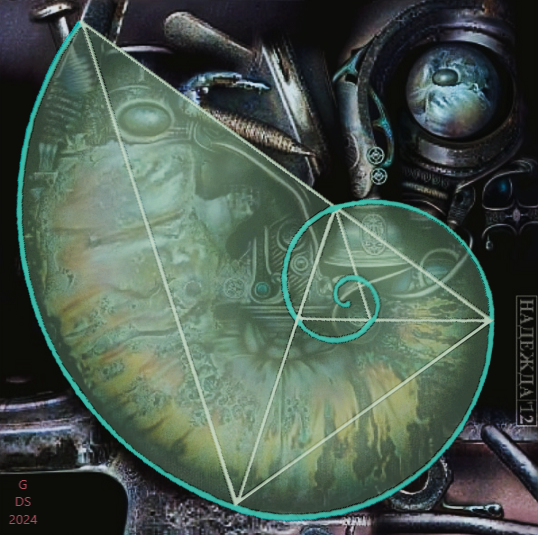
The images posted above, and inset right, and inset left and right below are the result of a new 2-dimensional toy I developed last year and introduced in The Universe in a Phi Shell: phi shells. I can't remember what inspired me to make phi spirals into phi shells, but it was probably pretty elementary. However, once I saw the effect the shells produced on some images, I was astounded. In so many cases the phi shell was like an envelope - die-cut to fit a golden spiral - or a custom-made template... with maybe a little wiggle room.

Sometimes, working with a phi shell leads to repositioning the original spiral. Inset right is a prime example: Boy Blowing Soap Bubbles by 17th century Dutch painter (and Bentvueghel), Karel Dujardin. (See the post for the former spirals.) As concise as this spiral appears, it could be larger and better... but, As we see time and time again, some portion of the necessary image area is missing. What sold me on the orientation of this spiral, however, is the way the boy's right arm - holding the bubble pipe - falls so neatly into the small triangle. It's as if the boy is drawing the spiral in the air.

"Proponents theorize that memes are a viral phenomenon that may evolve by natural selection in a manner analogous to that of biological evolution. Memes do this through the processes of variation, mutation, competition, and inheritance, each of which influences a meme's reproductive success. Memes spread through the behavior that they generate in their hosts. Memes that propagate less prolifically may become extinct, while others may survive, spread, and (for better or for worse) mutate. Memes that replicate most effectively enjoy more success, and some may replicate effectively even when they prove to be detrimental to the welfare of their hosts."

- A cautionary quote from the Wiki entry for "meme," and one that might make a certain amount of sense to those acquainted with what I've come to refer to as the "Golden Meme." I could even go so far as to says this might be reflected in my own experience... including the "detrimental to their hosts" bit, but, I try not to entertain fantastical innuendos that accelerate my level of paranoia.

"When Pacioli (the Renaissance mathematician) wrote in his Divina Proportione: '.. just like God cannot be properly defined, nor can be understood through words, likewise this proportion of ours cannot ever be designated through intelligible numbers, nor can it be expressed through any rational quantity, but always remains occult and secret, and is called irrational by the mathematicians'... he seemed to be equating the golden ratio with a variety of magical formula. That is, through his recognition and understanding of "this proportion of ours" he was attempting a marriage between several disciplines: science, art and mysticism. And, this wasn't unusual for the early Western scientists, many who dabbled in astrology, numerology and alchemy side by side with astronomy, mathematics, botany... and the arts. The scientific field was wide open - the hard lines were still blurred...

The "new scientists" were seeking enlightenment, autonomy, discovery, truth. And, it was into this slowly reawakening world that the pentagonal spiral made its appearance... and not necessarily for the first time. Similar to the sign of the pentagram - by which the followers of Pythagoras "knew each other" - perhaps, the "sign" of the pentagonal spiral enabled the Baroque artists to identify like-minded artists... kindred spirits in a world in which freedom did not, yet, ring."

"Keep in mind that the spiral was also present in Baroque ornamentation... and possibly somewhere in Baroque music, too.  So, were the artists, artisans, and musicians completely aware of its proportions and using it as a measure of perfection and beauty? Or, was the proliferation of golden spirals (at that time) an almost paranormal thing... or a variety of subliminal meme... an unconsciously recognized icon which was possibly a symbolic presentiment on the part of an artistic community who were, without noticing it, heralding an evolutionary phase of a whole society?"

A Baroque flourish (w/ phi shells). G-DS-2024.

- Two quotes via my blogpost: The Gentilischi Spirals and a Series Afterword. One painting appearing in that post is the image reposted (inset right) above the flourish: Orazio Gentileschi's Young Woman with a Violin. It's phi shell is looser than the original spiral I gave it, which, resting on her lap like a humongous sea shell, gives the image a somewhat comical appeal... but the spiral and triangle intercepts the young woman's bow perfectly, so, we have to admire its cleverness.

The flower painting, inset left, above her, however, was the work of Dutch Baroque artist, Willem Van Aelst and can be found in Part III of the Bentvueghel series, where we become acquainted with the curious appearance of the garden snail in flower paintings. And, really, if the Dutch flower painters used the snail as a clue indicating that a larger spiral was deliberately embedded in their paintings, well, all I can say is, what a brilliant idea!

Directly above is a portion of a Baroque ornament recently found (now decorated with phi shells). Not all Baroque flourishes were as golden as this one, but, considering the quantity of spirals appearing on furniture, architecture and textiles, the golden meme was alive and well.

***


For the past few years, I've spent a lot of quality time pondering the meaning of the appearance of the pentagonal golden ratio in works of art, artifacts and in architecture. I can't say for sure why this is so anymore, but, once upon a time, there seemed to be a point. I had a plan. Nowadays, I have to ask myself, why in the world would anyone actually sit down and spend a great deal of quality time blogging about obscure topics to an evaporating audience while everything in the surrounding area (the world, that is) seems to be either rapidly going down the tubes, or up in flames?

And, this isn't the first time I've asked myself this question!

On the other hand, blogging about obscure topics to an evaporating audience - in view of the tubes and flames - presently encourages my survival. Perhaps, blogging is kind of a therapy after all. Or, perhaps, in an absurd world, doing nonsensical things in response to Armageddon is appropriate.

And, it is in this state of mind I will reveal my latest pentagonal phi epiphany... which just happens to regard a description I've used previously: subliminal meme. The kind of meme that just might slip into an image while the artist was totally unaware of it, as it did in 2012, when I created Metamorphosis Interrupted, reposted (inset left), with a phi shell that fits the unfortunate worm like a chrysalis! (See: A Virtual Can of Worms.) 

Generally speaking, the unconsciously produced spirals in the images referred to in the Worms post were not all that strong. However, the worm's proportions in Metamorphosis is very close to perfect. But, while I was aware that I was being very finicky about the shape of the worm's body while creating it, in reality, at the time of its creation, I had never even heard of the pentagonal golden spiral!
 
So, is this an indication of phi "on the brain"? Are our brains somehow wired to its aesthetic or does it go deeper than that? Is this why the ratio was referred to as "divine" - in that it is embedded so deeply in our consciousness we assume it is an outer force? Or, when we find it in organic life, is it merely the imprinted diagram of actual physical forces science is already aware of?

Or, taking into consideration the nature of a meme, can you actually "catch it" like the common cold?*

Speaking of brains, I was delighted to find an image of one that seamlessly fits into a phi shell (inset right). Of course, humans tend to have rounded skulls, so it should come as no total surprise. But, then again, the image is an illustration and not an MRI, so, this is an artistic interpretation (and a very nice one) by Hank Grebe.

I didn't notice this till I was adding my geometry "stamp" to the image, but what lies at (a very important) 3-cornered junction of the spiral nearest to the coil - technically, the apex of the smallest golden triangle (and its spiral) - is that notorious pine-cone-shaped brain element, the mysterious pineal gland or "third eye." Oddly enough, it is depicted here as another tiny golden triangle (click for enlargement.)

(Continued below the jump...)

Monday, September 18, 2023

For the Birds: "Coco," Martha, Chér Ami, GI Joe, Irish Paddy & all the unsung others...


Pigeons Passing By (detail) - Thomas Bennet. A beautiful rendering of passenger pigeons in the wild.


"In 1760 an extraordinary Occurrence happened about the Centre of the Wachovia Tract, on a Creek to this day called the Pidgeon Branch, which has the Appearance of an Improbability, yet actually happened, to the great Amazement of the Beholders, viz. an incredible Number of wild Pidgeons assembled there every Night for a Month together, in a small District, perching manyfold upon one another, so as by their Weight to break down the largest Limbs of Oaks, bending the Tops of others to the Ground … The Noise was so terrible that a Man speaking to his next Neighbor could not be heard without bawling loud, and Waggonloads of Pidgeons killed with Sticks were carried off."

- Both the vintage quote and Bennet's image were found in the essay Pigeons Passing By written by T. Edward Nickens, describing what was purportedly a common occurrence across parts of North America in the 18th and 19th centuries: clouds of nomad passenger pigeons settling upon tree branches which broke beneath the weight of their great numbers. In some respects, it may have been this "plague of locusts"-like behavior which sealed their fate... especially when they sometimes settled on a farmer's crops.

"...And then, within a few decades, it all came crashing down. One of the planet's most successful birds went from billions to one, dwindling down to a final survivor named Martha who lived her entire life in captivity. She was found dead in her cage at the Cincinnati Zoo around 1 p.m. on Sept. 1, 1914, completing one of the fastest and most dramatic extinctions ever witnessed by humans.

...People used all kinds of maniacal tactics to kill pigeons, including burning down nest trees, baiting the birds with alcohol-soaked grain, trapping them in huge nets and even luring them with captive pigeons on small perches — the origin of the term "stool pigeon."

'There were 600 to 3,000 professional hunters who did nothing but chase the birds all year long,' Greenberg says. 'The people hunting them knew they were decreasing, but instead of saying 'let's hold off,' they hunted them more intensely. Toward the end, they just started raiding all the nests. They wanted to get every last bird, squeeze every last penny out of them before they were gone.'

For anyone who had seen torrents of passenger pigeons in the 1860s and 1870s, it was hard to believe they were nearly extinct in the 1890s. After the final holdouts in Michigan vanished, many people assumed the birds moved farther west, maybe to Arizona or Puget Sound. Henry Ford even suggested the entire species had made a break for Asia. Eventually, though, denial gave way to grim acceptance. The last-known wild passenger pigeon was shot April 3, 1902, in Laurel, Indiana."

- Quoted text is from the article: 100 Years Later, the Passenger Pigeon Still Haunts Us, recounting the sad tale of the extinction of the passenger pigeon, the wild North American bird which, in ways, resembled American wild doves (see painting above) more than the standard pigeon. Inset right is a vintage photograph of a juvenile of the species found here.


Illustration from Emil Schachtzabel’s Pigeon Prachtwerk (1906).


"This year marks the centenary of the death of the last Passenger Pigeon, the most numerous bird ever known, but one that did not survive the colonization of North America. I am willing to mourn that last captive voyager, a miracle of evolution, a postcard for extreme biodiversity, a bird more appreciated now than it ever was in life, except as a meal.

Many people, at least in cities where Rock Pigeons are common, think of them as “flying rats"... Perhaps the critics have forgotten a guy called Charles Darwin, who, despite his social position as a member of the country gentry, was interested enough to attend pigeon shows, buy birds, and bore dinner guests such as Charles Lyell with his obsessive table talk about them."

- Via this marvelous page Unnatural Selection: Emil Schachtzabel’s Pigeon Prachtwerk (1906), which reminds us that it was through Darwin's "obsessive" study of domesticated pigeons that he developed his ideas of "unnatural selection" regarding the evolution of a species. One pigeon fancier who was inspired by Darwin's theories was Emil Schachtzabel, who published Pigeon Prachtwerk in 1906 featuring numerous examples of exotic breeds illustrated by the German artist and critic, Anton Schöner (1866–1930) inset left. Directly above and below are two amazing illustrations from the book; many more can be found in the article.


Another strange breed of pigeons via the Pigeon Prachtwerk collection.

(Continued after the jump)

Tuesday, July 18, 2023

"Coco is Dead" - The Language of a Bird

A Eurasian collared dove.


"That all my life I have listened to the calls
of mourning doves, have heard them hidden far back
under the eaves, or perched among sycamore branches—
their five still notes sometimes lost in the wind—
and not known how to answer: this I confess,
lying here now, on a summer morning, in a dark room
no less lit by the sound of their soft calling..."

- From the poem Mourning Doves by American poet, Jared Carter,
found along with the quote which follows (below), on this Mythic Living page.

"The mourning dove of North America is, as its name suggests, sometimes connected to the notion of the soul’s passing from this life to the next.  Thus, the appearance of the bird has been associated with visitation from the “other side”.  This is not a new metaphor, nor is it only North American. It is usually understood to be a reassuring representation that life goes on, albeit separated from the still-living."


(If there's one thing I've learned about Camus during the course of our dance is that the man is infectious. He makes a writer want - actually need - to write. So, to all of you who write - not necessarily to make a living, but because you need to bring some kind of order and meaning to your life - when blocked, read Camus. There's something to be said for a writer who - without saying so - encourages you to just open up and spit it out.

That being said, I think I can safely report: I've come back to this blog for a bit, and my heart seems to be in it. So, that's good. As to why I suddenly need to blog so much  - and I do not really consciously know - well, it's a slightly unsettling question... which need not be addressed presently. We'll just run with it.

Today's story is about a bird. A bird who can, potentially, talk. A bird who is hunted... perhaps haunted. A familiar bird to many humans as it has emigrated to numerous locations across the globe. It is a refugee, and, this is why it is, perhaps, more unbound than other species of birds. It might also be more intelligent than some of them... it has, after all, learned to adapt to many different countries and has seen many nationalities and races of people. It has heard snatches of human conversation in many diverse languages - gathering them into its memory banks - by, what we can assume to be, a brain's osmotic processes - as it sat quietly, sometimes invisibly, on its high perch overlooking its adopted land.

But, I wasn't aware of any of that when this story first began... a true story, regardless of my interpretation.

Above, inset right, the Watcher, a dove parked outside my bedroom window... as it often is every day.)

***

The star(s)s of my story - the Eurasian collared dove, is related to the mourning dove, unique birds when you think about it. On the eastern coast of the US the mourning dove (inset left & inset right belowis such a common sight and its song is so instantly identifiable, one never fully grasps it's oddness. It is considered a songbird but it's song is short, wistful and slightly melancholy, often described as "a lament". Think: graveyards, willow trees and grey gardens... (Listen to it here.)

But, NM is a different sort of place. It is not near the ocean - the land is trapped... and its ghosts know it. The birds, however, do not. Many of them migrate. Even seagulls, ocean birds who will find no large bodies of water here, fly into NM's dry interior. There is, no doubt, a scientific explanation for this, but, I'd rather imagine the seagulls can sense the ancient oceans which once flowed here thousands of years ago, and are following deeply embedded biological markers in the landscape and atmosphere.

Then again, there is something about birds which demands we endow them with magical powers... whether they possess them or not. However, we must consider: their bodies are flying vehicles. Can't touch that.

Anyway, the story begins in a vague sort of way... that is I began hearing some mysterious bird every morning when I woke up. It had a strange vocalization; not a song really. In an eerie way, it seemed to be saying something. Now, I could go into the general setting in which I live, but, for the sake of economy, I'll skip all that. The fact is, that I heard a bird calling outside of my window every day... and sometimes on the launchpad (my dedicated smoking room). And, it's "song" began to bother me. Abrasive, the bird's vocalizations were not patterns of musical notes. They uncannily resembled human speech, but I couldn't make it out.

Then, one day, it suddenly came to me that I could understand what the bird seemed to be saying. I cannot identify what had changed enabling this to happen. It just did. In fact, it seemed obvious; in it's weird, hollow, bird-voice - which seemed to originate somewhere in its belly - it seemed to be repeating the same phrase over and over again:
 "Coco is dead."

During this same period I had a weird bird encounter. What looked like a mourning dove flew onto the fence surrounding the launchpad (see: Dancing with the Ghost...). It startled me because it came quite close to my face, peering at me with one large dark eye. Then it lifted off and flew away. For anyone familiar with mourning doves, this was unusual; they're timid birds. But, I noticed the band around its neck, and wondered if it might be a slightly different variety of dove, maybe an exclusively southwestern variety. At this stage of the game, I didn't know.

Meanwhile, my bird with its grave announcement had somewhat changed its message. In fact, it was changing its message every other day. I now alternately heard: "Coco is dead," "Coco escaped," "Coco has escaped," and one day, "Coco is ALIVE! Sometimes different names replaced "Coco." There were three different names but I wrote down (and remember) only 2 of them: Yahghol and Jockarelle. (I've spelled them the way they sounded and  would be pronounced - in English - with the accent on the first syllable.) I think it was at this point that I finally took my experience more seriously. I was beginning to imagine I was listening to an official avian town crier...

Wednesday, July 12, 2023

The Master's House and The Tower Card


The Master's House

(In memory of A. Lorde)


The Master's house is in disrepair;

the seals have been broken.

Rats are in the walls.

Pigeons shit on the front stoop.


There's a hole in the roof

bats fly through...

Windows with glass teeth

where weeds wind through.


Echoes of screams

in the living room.


Grey ash fills the corners;

 all four:

riders on horseback,

all dead.


- 2023, DS 


- My poem owes a nod to Audre Lorde's 1984 essay: The Master's Tools Will Never Dismantle the Master's House. Another line from that article:

"Only within a patriarchal structure is maternity the only social power open to women."

- Image: Les Quatre Chevaliers de l'Apocalypse - ink on paper - 1937, André Fougeron. Tate Museum, UK.


***


“Empires and churches are born under the sun of death.”

- A line from Albert Camus', The Fall.


"Whereas the Death card is usually the card people are terrified of, out of all of the cards in the deck, The Tower is the one you really need to brace yourself for. The Tower Tarot card represents chaos and destruction. It is the Major Arcana card of sudden upheaval and unexpected change. This change usually is scary, life changing and often unavoidable. A negative Tower event can be akin to a bomb going off in your life. You don’t know how you will survive but somehow you will and later you will realize that while it was a tremendously difficult thing to go through and you wouldn’t wish it on your worst enemy, it has made you into the person you are. One positive aspect of The Tower is that the destruction it brings is usually directed at something that was built on a false beliefs and foundations or unrealistic goals and dreams. Also on the bright side, the destruction The Tower brings is always followed by renewal and creation."

- Excerpt from a tarot page found here.

"So what does it mean to call the tower card "The Foundation of Beauty?" Simply put, those possessing true inner beauty will reach the crown, Kether, and their spiritual goals. Here is the realm of creative fantasy, a place of refuge from the harsh "realities" of the earth sphere. Through the Tower, the seeker casts aside false ideas and thoughts about herself or her world. The seeker will discover her true path, the path leading to emotional and spiritual fulfillment. However, like the pictures on the Tower card, the way to the path can be violent and chaotic. Reed likens the experience of the Tower card to having the top of your head lifted and a lightning bolt striking through your brain and down to your toes. It is a searing light that burns into your deepest heart and shows you the imperfections there. It shows how much you have to learn, and by comparison, how little you have learned. It goes through your feet and makes a hole in the ground that you very much want to crawl into."

- Excerpt from this Llewellyn "Tower" page.

***

This post is, more or less, an addendum to my previous post: Dancing with the Ghost of Albert Camus wherein I describe my own "Tower moment" using the image above (inset right).

It is one of the earliest "Tower" cards - from The Tarot of Marseille deck - but, as we can see, it's actual name is "La Maison Dieu" or God House, which was, in the Middle Ages a hospital-monastery intended to accommodate pilgrims. (See this tarot forum page.) Perhaps the original symbolism of the card was, likewise, somewhat different.

Needless to say, there are towers... and, then, there are towers... and there are masters... and, then, there are masters.


Saturday, August 11, 2018

Farewell to a Free Spirit (with 8/17/18 update and Addendum)

Oksana Shachko (January 31, 1987- July 23, 2018)

"... I was deeply inside the religious world and very concentrated on my craft. It started to take off for me. At ten years old I had already started painting in churches and exhibiting my art. I was deeply inside all these institutional bodies, and because of it, I started believing in God. I always went to Church to pray. When I was twelve years old I decided to go live in the church, to paint icons and spend my life praying. I wanted to stop living a normal life and become a monk.

... (but) I started to think that I didn’t want to overwhelm my parents with stress, so I decided to stay. At that moment, I started to think about the meaning of believing. It was a big paradox for me. My parents are religious, they believe in God, they go the Church… But they refuse that I become a monk. I didn’t understand. I continued living with my parents and started searching for an answer to my questions. I continued painting icons but started engaging in more conversations with the people surrounding me. I wanted to know why they came and prayed in front of these icons. I also starting becoming critical of the Church. When I was fourteen, I found a group of young people from fifteen to twenty years old who organized philosophical clubs out of school... They were very critical of religion. I found them very interesting. I started to come more and more and read their books. I discussed religion with them and continued to say, “God exists,” wanting to prove it to them. One year passed, two years passed, and I became a total atheist...

Oxana and Sasha Shevchenko,
Kiev, 2013
... At this time, I met with Anna Hustol and Sasha Shevchenko with whom I created Femen. I never thought about feminism before. In Ukraine, feminism is never talked about. We had a lot of meetings with professors, the University director, the mayor, and some businessmen to gather money for the students. When I went to see those people, I was accompanied by a guy and they only listened to him. That was not normal. When I was seventeen, I started to get very angry about this with the other girls. That’s when we decided to create a girl movement, to prove to everybody that we are able to create, to do things, and to work."

- Excerpt from: A Meeting with Oksana Shachko,  a November, 2017 interview with Armelle Leturcq for Crash magazine from which the photograph of Oxana (inset left) was taken. The icon in the background - featuring the Virgin Mary wearing a burqa while breast-feeding the infant Christ - is her own work; a detail of which is shown later in this post. Inset right is a detail of a photograph found here.

"During the five years she was in Femen, Shachko was arrested dozens of times, interrogated, allegedly abused by police and spent almost a year in jail. She was also one of the members who was allegedly kidnapped in Belarus in 2011 after protesting the Belarusian president Alexander Lukashenko during a topless rally. Shachko and other members said they were forced to strip naked in the woods, were beaten, had oil poured on them and were threatened to be set on fire." 

- From Oxana's Huffington Post obituary.

***

Oksana Shachko (or Oxana, as she preferred) was an almost fragile young woman... slightly built and diminutive, but, at the same time, striking enough to have been a model, and fierce enough to have been a prize-fighter. She showed great skill as an artist at a very early age, and was groomed as a painter of religious icons: a highly traditional and stylized genre of image-making that left little room for personal expression. As a prepubescent girl, she was spiritual to such a degree that she came very close to entering a monastery.

However, by the latter half of her teens all this would change. She would question the validity of religion and turn to atheism. She would question her position as the subordinate female of the species and turn to feminism. She would question her own convictions in relation to the apathy she found in her native Ukraine and turn to activism. Ultimately, in 2008, she would help organize a small band of Ukrainian feminists. They called themselves "FEMEN" and set in motion a series of outrageous, theatrical demonstrations in response to the political, patriarchal and demoralizing injustices to women they observed in both Western and Middle Eastern societies. Inset right below: Oxana at work.

Unfortunately, FEMEN was not an entirely successful experiment. The women were often berated, humiliated, beaten and imprisoned. And, although they gained enough notoriety to make headlines worldwide - consistently photographed by male members of the press - they failed to make a favorable impression on a number of their fellow feminists who - with a few exceptions - managed to miss the point.

And, it got worse. In a 2016 interview, Oxana reflected: "After our protest against the elections in Russia, I was detained for two weeks. In the police department, I was blamed for everything and deported. From then on, I was denied entry to Russia, for life. We were arrested after every action in Ukraine but never were deported of course, because we were the citizens of the country. Yet our activism became physically impossible. In the end, we were accused of preparing a terrorist attack against Putin and the Patriarch Cyrill. They planted weapons, bombs, and also the portraits of these two beauties. Within one day... we managed to escape from Ukraine."

Saturday, October 21, 2017

The Starman and the Swan People (Part III): The Second Dream


The lid of a second (smaller) music box... (virtually) composed
of mother-of-pearl fragments inlaid into black stone, 2017, DS.
(Click to enlarge)

"I was visiting a strange city... and although I can't recollect having been there before, it wasn't totally unfamiliar to me. I was looking out a hotel window at the city lights and making plans to go out a bit later. David Bowie would be performing at a venue nearby and I planned on being there. The thing is, I was aware he had died the previous year, but somehow seeing him "live" in the present didn't seem unusual to me... it's as if it wasn't merely possible in this place I had come, but, to be expected.

The next thing I remember is that I was at an airport again... walking down a long sort of corridor from which passengers either board a plane or disembark. Suddenly, I thought I saw someone who looked like David Bowie moving towards me, but, he wasn't alone. Although I have no recollection of his companions, they seemed to be walking on either side of him and supporting him as he walked. He seemed unsteady and appeared to be in pain. His face - which was red as if sunburnt  - seemed somewhat distorted. In fact, my impression now is that he may possibly have been in the process shape-shifting, but, this didn't occur to me then, and, by the time we came face to face, he looked younger - in his thirties (?) - but perfectly normal.

We had a conversation then. I don't remember what it was about but DB was very charming and endearing, He came across as a kindred spirit but, ultimately, I felt somewhat sad and remorseful. I impulsively kissed and embraced him, saying "I'm so sorry I never met you while you were still alive."

At which point he looked at me and said: 'There are other lives.'

This so astounded me I woke up."

- The second dream recollection, February 10, 2017, DS. The lovely man with sax (inset left) can be found here.

“Being imbued with a vividly active imagination still, I have brilliantly Technicolor dreams. They’re very, very strong. The ‘what if?’ approach to life has always been such a part of my personal mythology, and it’s always been easy for me to fantasise a parallel existence with whatever’s going on. I suspect that dreams are an integral part of existence, with far more use for us than we’ve made of them, really. I’m quite Jungian about that. The dream state is a strong, active, potent force in our lives.

The fine line between the dream state and reality is at times, for me, quite grey. Combining the two, the place where the two worlds come together, has been important in some of the things I’ve written, yes.

That other life, that doppelganger life, is actually a dark thing for me. I don’t find a sense of freedom in dreams; they’re not an escape mechanism. In there, I’m usually, ‘Oh, I gotta get outta this place!’ The darker place. So that’s why I much, much prefer to stay awake.”

- David Bowie, from a 4-part 2013 interview: "I'm Hungry for Reality".
Inset left is Leonora Carrington's And Then We Saw the Daughter of the Minotaur, 1953. Note: All Carrington paintings used in the body of this post can be found on this page.

"Another dream-determinent that deserves mention is telepathy. The authenticity of this phenomenon can no longer be disputed today. It is of course, very simple to deny its existence without examining the evidence, but that is an unscientific procedure which is unworthy of notice. I have found by experience that telepathy does in fact influence dreams, as has been asserted since ancient times. Certain people are particularly sensitive in this respect and often have telepathically influenced dreams."

- Carl Jung from his 1974 publication: Dreams.

"The Chinese also developed interesting theories regarding how mental and psychic functioning depends upon different energy forms. They considered the dreamer's soul to be one of the principle agencies of dream production but made a distinction between the material soul or p'o, which regulated body functioning and ceased with its death, and the spiritual soul or hun, which left the body at death and carried the appearance of the body with it. It was the hun that was involved in dreams, because it could separate temporarily from the body for nighttime excursions to the land of the dead. There it would communicate with spirits or souls of the dead and return to the body with impressions from these visits."

- Excerpt from Our Dreaming Mind by Robert L. Van de Castle, Ph.D. (1927-2014). Inset right is the painting Dervault by Leonora Carrington.

"Reveal thyself to me
and let me behold a favorable dream.
May the dream that I dream be favorable;
may the dream that I dream be true.
May Makhir, the goddess of dreams, stand at my head;
let me enter the temple of the gods and the house of life."

- Prayer of a Mesopotamian "incubant" or dream-seeker.* Note: Dream incubation is the ancient ritual of going to sleep in a sacred place in anticipation of receiving a helpful or precognitive dream from a divine benefactor. It was common in ancient Mesopotamia, Egypt, Greece, Rome and amongst the earliest Christians.

***

Well, finally, after stalling for so long, I decided to cut-to-the-chase and post both the second dream and the new music box lid right at the beginning of Part III (the last part) of this series. I can only hope they were worth waiting for.

It's funny, but when I read over my dream recollection above, a track from Bowie's LowA New Career in a New Town - started going through my head. Which was kind of appropriate. One (unmentioned) element of Bowie's performance in the strange city of my dream is that it was to take place in a small, intimate venue. And, you might say, that for Bowie to be performing in small, intimate venues would (indeed) be a "new career"...