Showing posts with label Creatura. Show all posts

Sunday, July 20, 2025

Leonardo's Cloud & the Shrine of Venus


A massive storm cloud touching down over the Sandia's, Albuquerque - June 10, 2025, 6:19 pm, DS.

(Note: While the memory of this cloud immediately came to my mind after reading Da Vinci's passage it is in no way representative of Leonardo's cloud.) (For more about my cloud see "The Cloud Matrix" at the end of the post.)

"Landscape with cloud effect

I have long had the opportunity of observing many different [atmospheric effects], and once, above Milan, over in the direction of Lake Maggiore, I saw a cloud shaped like a huge mountain made up of banks of fire, because the rays of the sun which was then setting red on the horizon had dyed it with their colour. This great cloud drew to itself all the little clouds which were round about it. And the great cloud remained stationary and retained the light of the sun on its apex for an hour and a half after sunset, so enormous was its size. And about two hours after night had fallen there arose a stupendous and phenomenal wind storm."

- Leonardo da Vinci via Leonardo da Vinci's Note-Books Arranged And Rendered Into English by Edward Mccurdy, 1923. (Book 2, Nature, p. 125).

Inset left is a chalk drawing by Leonardo - A Storm Over an Alpine Valley, 1480. A facsimile of this drawing accompanies the artist's text in Mccurdy's translation. There appears to be a few versions of this odd image on the web, mostly in red chalk. For example, this one was dated circa 1509.

I don't think that this drawing represents the mountain-shaped cloud Leonardo describes in his notebook. The cloud in the drawing seems to have the anvil-shape of a certain variety of cumulonimbus: the incus.

Admittedly, the drawing is difficult to make out. But, if you click on the image, you might find what is possibly the image of the artist with his beard and hat on the upper left side of the cloud - portrait, inset left - Leonardo's cameo appearance in the clouds!
(Correction. Actually, this bit of cloud looks most like him from a distance and not at all like any sort of face close up.)

_____________________________________________

The Temple of Venus featured in one of a series of illustrations by Walter Crane
for Edmund Spenser's epic poem The Faerie Queene, 1590.


"For the Shrine of Venus

You should make steps on four sides by which to ascend to a plateau formed by nature on the summit of a rock; and let this rock be hollowed out, and supported with pillars in front, and pierced beneath by a great portico, wherein water should be falling into various basins of granite and

porphyry and serpentine, within recesses shaped like a half-circle ; and let the water in these be continually flowing over; and facing this portico towards the north, let there be a lake with a small island in the centre, and on this have a thick and shady wood. Let the waters at the top of the pillars be poured down into vases standing at their bases, and from these let there be flowing tiny rivulets."

-  This passage from Leonardo's notebooks appears several pages later in Nature; The Earth an Organism - on page 131. It is then followed by The Realm of Venus. (Both are discussed below the jump.)(Photo source.)


(Continued below the jump...)


Monday, April 18, 2016

Hare Interlude...


The Curiosity of Lurices - sculpture - clay - Ellen Jewett
(click to enlarge)


"Caught up in a mass of abstractions," writes David Abram, "our attention hypnotized by a host of human-made technologies that only reflect us back to ourselves, it is all too easy for us to forget our carnal inherence in a more-than-human matrix of sensations and sensibilities. Our bodies have formed themselves in delicate reciprocity with the manifold textures, sounds, and shapes of an animate earth -- our eyes have evolved in subtle interaction with other eyes, as our ears are attuned by their very structure to the howling of wolves and the honking of geese. To shut ourselves off from these other voices, to continue by our lifestyles to condemn these other sensibilities to the oblivion of extinction, is to rob our own senses of their integrity, and to rob our minds of their coherence. We are human only in contact, and conviviality, with what is not human."

- David Abram... quote (and photo above) found in the Myth & Moor entry, Relationship and reciprocity.

***

I have a strange dichotomy in my own nature that, on one hand, I've never quite felt wholly of this world, but, at the same time, on a more cellular level, deeply enmeshed in the natural world - the wild world - from which I've always drawn sustenance. And, when I found the beautifully organic clay sculptures by Ellen Jewett (example above) on Terri Windling's (always elegantly eloquent) Myth & Moor blog today, the reality of my present situation sort of came home to me in the same way hearing the video of the thrush's song did a few days ago. In other words, I may be living near the deserts and plains of the American Southwest now - and, that was my choice - but my roots are still in the forests and seashores of New England... where the world outside my door was somehow more intimate, intricate, dense... and magical.

Very much like the entanglement of Ellen Jewett's hare - and really, its expression is a masterpiece in itself - a tribute to the wild women and men in all of us. (Note, too, the moths and/or butterflies on the hare's back!)

Anyway, this is today's (unpremeditated) post. Another "interlude" entry because I'm not really back to blogging yet. You might say I'm just dropping a line as I wander thru the wilds of the most recent interstitial realm I've fallen into.

Oh, you know: Greetings - from the rabbit hole! ;-)

___________________________________________


April 28, 2016

Hares are called jackrabbits here in the southwest, and I just saw what looked like the "antelope" variety on the dirt road behind my house yesterday in the early evening. They're incredibly lean, long-legged hares and do have a strangely deer-like quality about them when you see them in action. Very cool! Meanwhile, I just found a YouTube video of a gentle jackrabbit in someone's backyard... and just had to add it to this post.


Monday, August 4, 2014

Revitalizing Vitalism; A Thought Experiment


"Aura" - digital/fractal - 2012, Renate S.
(Click on all images to enlarge)

Vitalism
1. a doctrine that the functions of a living organism are due to a vital principle distinct from physicochemical forces
2. a doctrine that the processes of life are not explicable by the laws of physics and chemistry alone and that life is in some part self-determining

 - Definition of Vitalism


"He goes on to show how the particular properties of consciousness might arise from the physical laws that govern our universe. And he explains how these properties allow physicists to reason about the conditions under which consciousness arises and how we might exploit it to better understand why the world around us appears as it does.

For Tegmark, this paradox suggests that his mathematical formulation of consciousness is missing a vital ingredient. “This strongly implies that the integration principle must be supplemented by at least one additional principle,” he says.

- From the article: "Why Physicists Are Saying Consciousness Is A State Of Matter..."


"Barušs wrote: "Scientific materialism assures us that reality is a meaningless, incidental, mechanistic, collocation of improbable events."

He summarized some of the ways in which the materialist interpretation of reality has already broken down: quantum events are seen to be non-deterministic; time is no longer linear, as effects have been shown to precede their causes; particles change position depending on where one looks or what one decides to measure.

Finally, he said, “Materialism cannot explain … the sense of existence that people have for themselves.”

- From an August 20 article: 8 Scientists Contemplate Place of Human Consciousness in Science  (New quote just found, August 22; hat-tip to Bruce Duensing!)


***

"Throughout the ages men have been intuitively aware of such a center. The Greeks called it a man's inner Daimon, in Egypt, it was expressed by the concept of Ba-soul; and the Romans worshipped it as the "Genius" native to each individual..."


"Is the earth dead or alive? The ancient cultures of east and west and the native peoples of America saw the earth as a mother, alive, active, and responsive to human action. Greeks and Renaissance Europeans conceptualized the cosmos as a living organism, with a body, soul, and Spirit, and the earth as a nurturing mother with respiratory, circulatory, reproductive, and elimination systems. The relationship between most peoples and the earth was an I-thou ethic of propitiation to be made before damming a brook, cutting a tree, or sinking a mine shaft. Yet for the past three hundred years, western mechanistic science and capitalism have viewed the earth as dead and inert, manipulable from outside, and exploitable for profits. The death of nature legitimated its domination. Colonial extractions of resources combined with industrial pollution and depletion have today pushed the whole earth to the brink of ecological destruction."

- From "Radical Ecology: The Search for a Livable World" - 1992, Carolyn Merchant.


"But what is it that shamans 'see' or 'know'? Shamanism is a kind of spiritual technology. It is a technology that is based on the animistic worldview much in the way that physical technology is based on the modern scientific worldview. Unlike modern science, however, which is based on the search for uniform laws that work the same way for everyone, shamanism has literally infinite forms of expression -- just as art, inspired creation, can take literally infinite forms and there are infinite cultural styles of art, yet the word "artist," like the word "shaman," has a cross-cultural meaning. (Indeed, art itself originated as a tool and expression of the shaman. Shamans are a kind of inspired artist, channeling a common source of spiritual energy in their own unique ways. Art as merely decorative is a modern, desacralized echo of the real purposes of art.) "

- from an article: Indigenous Shamanism, Animism, and the Spirits (by "Gayle") found here.


***

"Without an active agent, an ordering center, or an Intelligence, "consciousness" becomes a rather hollow proposition; another one of those phenomena which, if merely viewed as another mechanical quality arising from matter, has no intrinsic meaning. It has no "cause" and is no cause. It will not build a ship, invent a car, nor drive it. It will simply exist in a somnambulistic manner as a sort of passive, unspecified awareness. Consciousness, alone, does not create; and, by itself, cannot evolve. Consciousness alone, is not the answer to the existential quandary."

- Paragraph from a post file which never materialized, The Shamans of Spirit & The Shamans of Matter; Dia Sobin, June 12, 2014


"Because, who knows, but, hiding among those four famous "forces of nature" (recently renamed the "Fundamental Interaction") is an undiscovered ordering force, a "shadow" component permeating the matrix: intelligence, but wholly unspecific intelligence - without genre or gender - which, although diversified and expressed relative to the matter which interprets it, is also the architect of the matter it unfolds. I call it: Creatura... (most emphatically) not to be confused with religionist myths and its corresponding characters - example: "the man upstairs."

If "god is dead" religionists (specifically Western and Middle-Eastern varieties) killed it. They gave it limits; limits imposed by their own fears, politics and pathologies."

- Paragraphs deleted from a previous post, and added to a collection of notes; DS, June 28, 2014


"Creatura (singular and plural) - A creative Intelligence: the integrated ordering agent and organizing, self-referential noumenon present in all living organisms."

- A working definition of Creatura from a collection of notes; DS, July 1, 2014, posted July 28.


***

I was kind of on the fence about posting this "thought experiment"... I originally attempted to allude to it with a post containing a brief definition of Creatura. That didn't cut it for me, so I pulled it down (deleted post, July, 28, 2014)

For the past few months however, this concept - admittedly a "Vitalist" concept (or, more appropriately, Revitalist), and not even a terribly original one - has been stirring around in my psyche, coloring just about all of my thoughts. I've drafted (and destroyed) a number of posts, but they all seem to have the same general theme; a theme I was planning to slowly build up to, but now I find I'm not going to have the time (I'm about to take an extended hiatus from the blogosphere). So, it's now or never... 

Tuesday, July 22, 2014

The Pet Store - Creatures as Commodities - (featuring murals by "Phlegm")


"Cat" - urban mural - Sheffield, England - "Phlegm" (found here)
(Click on all images to enlarge)


"The more we exile ourselves from nature, the more we crave its miracle waters. Just as our ancient ancestors drew animals on cave walls and carved animals from wood and bone, we decorate our homes with animal prints and motifs, give our children stuffed animals to clutch, cartoon animals to watch, animal stories to read. We call one another by “pet” names, wear animal-print clothes. We ogle plants and animals up close on television, the Internet and in the movies. We may not worship the animals we see, but we still regard them as necessary physical and spiritual companions. Technological nature can’t completely satisfy that yearning.

But what if, through novelty and convenience, digital nature replaces biological nature? Studies show that we’ll suffer. Richard Louv writes of widespread “nature-deficit disorder” among children who mainly play indoors — something new in the history of humankind. He sees it leading to attention problems, obesity, depression and lack of creativity. Adults suffer equally. Patients with a view of trees heal faster than those forced to stare at city buildings. In studies conducted by Peter H. Kahn and his colleagues at the University of Washington, workers in windowless offices were given flat screen views of nature. They reaped the benefits of greater health, happiness and efficiency than those without virtual windows. But, importantly, they weren’t as happy, healthy or creative as people given real windows with real views of nature."

- From the 2012 NYT article, Nature: Now Showing on TV, by Diane Ackerman *


***

It was a fairly nondescript summer day... hot and hazy, glazed over with that white-gold cast that defines a predominately cloudy sky. I was in my car with no particular destination, but, as is usual, found myself gravitating towards the coast, as if the ocean was some huge magnet and neither myself (nor my car) had any choice in the matter.

Lying between myself and the shore, however, is Route 1, which, in part, is just one long, extended strip mall, punctuated by an endless repetition of shoe-box shaped buildings, identified only by their corresponding rectangular signs. These advertise everything from food to furniture, service stations, beauty salons, craft stores, consignment shops, and the occasional "Psychic Reading". On impulse I drove into the black-topped parking lot belonging to one block of buildings, featuring an outlet of a popular pet store franchise. I'd been there before... I liked to look at the small, exotic fish in the marine-life aquariums, so, I went in...

Monday, July 7, 2014

The Anatomy of a Dream (Intus Natura, Vita Eternus*) (Notice, 8/6/14)


Cast-stone box-lid, taken from a carved plaster original - app. 3" X 5"- 1993, DS
(click on all images to enlarge)


“There is an ecstasy that marks the summit of life, and beyond which life cannot rise. And such is the paradox of living; this ecstasy comes when one is most alive, and it comes as a complete forgetfulness that one is alive.

This ecstasy, this forgetfulness of living, comes to the artist, caught up and out of himself in a sheet of flame; it comes to the soldier, war-mad in a stricken field and refusing quarter; and it came to Buck, leading the pack, sounding the old wolf-cry, straining after the food that was alive and that fled swiftly before him through the moonlight.”


“But especially he loved to run in the dim twilight of the summer midnights, listening to the subdued and sleepy murmurs of the forest, reading signs and sounds as a man may read a book, and seeking for the mysterious something that called -- called, waking or sleeping, at all times, for him to come.”


“He was sounding the deeps of his nature, and of the parts of his nature that were deeper than he, going back into the womb of Time.”

- Three quotes from: Call of the Wild, the 1903 novel by Jack London.


***


I generally try to avoid recounting dreams on blogs, because, for anybody but the dreamer, they're generally boring. But, in the case of this morning's (July 6th) dream, I actually tried a different technique of dream interpretation and searched its elements online. So, while anyone reading this may or may not find the dream itself terribly exciting, this method of unravelling dream symbols might intrigue.

The Dream:

I was living with my friend, Moo, or, possibly just visiting, but, due to the weirdly circuitous nature of dreams in general, I only became conscious of the dream at the point I'm about to describe.

At this point, someone (?) inquired about the disappearance of Mindy, Moo's family dog. Horrified, I suddenly realized that I had let Mindy out the previous night, but had forgotten all about her! I immediately ran to the door I'd let her out of... it was huge white door, filling one wall of the tall, but narrow, white room it opened from. Oddly enough, I found that it was open and slightly ajar, so, I had never actually closed the door at all. I still felt guilty, but I surmised that the dog could've come back indoors if it wanted to.

At this point the dream convolutes in such a way, that I realized that Mindy has gone far off into the surrounding woods. I can see her. But, the dog I actually see in the woods is a large St. Bernard. Mindy is not, in reality, that breed of dog (although there is a St. Bernard in Moo's son's family), but this didn't occur to me till I woke up. It also came to me in the dream that, perhaps, Mindy had gone up in the woods to die. But, while this upset me, I was suddenly struck by the rightness of such a choice. That is, it occurred to me in the dream, that the most ideal setting for any creature to die is near the earth with nature surrounding them.

In the last segment of the dream, I was proposing to Moo that we establish some variety of fund or fellowship - related in some way to death and nature -  which had for It's symbol (and would be given or carried by its members) a small, leafy twig tied with a bit of fabric.

And then I woke up.

Thursday, July 3, 2014

Creatura - What You Can't See, Can Kill You (Update 7/18/14)


Typhoid bacteria found here.

The post - under construction - which originally appeared here: "Creatura - Metamorphosis, Myth & Mirrors," has fallen back into the implicate fold.

Sorry to say, but it's time has not yet come... and may not come. It's the sort of philosophically extravagant blog post I'm avoiding these days, because, in reality, I haven't the time for intensive, online explorations of overwhelmingly dense subjects. In any event, any form of "Creatura Hypothesis" - which, tentatively, was on my agenda - would be premature at this point, and I've decided to parcel out the quotes and images that appeared here into a succession of pared-down future posts.

Blame it on bacteria... that Creatura from the microscopic realm. I am on my second run of antibiotics to rid myself of an upper-respiratory infection, and am hardly in "top form". In a virtual "Battle of Creatura" which one will win?

Hopefully, the one writing this, but don't put your money down just yet! ;-)

***


"Some intrepid biologists at the University of Southern California (USC) have discovered bacteria that survives on nothing but electricity — rather than food, they eat and excrete pure electrons. These bacteria yet again prove the almost miraculous tenacity of life — but, from a technology standpoint, they might also prove to be useful in enabling the creation of self-powered nanoscale devices that clean up pollution. Some of these bacteria also have the curious ability to form into ‘biocables,’ microbial nanowires that are centimeters long and conduct electricity as well as copper wires — a capability that might one day be tapped to build long, self-assembling subsurface networks for human use."

- From an ExtremeTech article - July 18, 2014: "Biologists Discover Electric Bacteria..."


I bring to you the latest in weird biology news... although it appears a Danish group made a similar discovery a couple of years ago. George Dvorsky, meanwhile, reflects on the alien life angle...

As for me... well, electric bacteria might have been exciting news at some point in the past... in the days when biological discoveries added to ones sense of wonder, and an overall respect for the natural world, without necessarily providing support and/or tools ("biocables" and "nanoscale devices") for the Techno-Mechanistic agenda. 

Instead it's just beginning to deeply depress me. As does articles like this one: "Should We Deliberately Edit The Genes Of Wild Animals?"

Should a bear not shit in the woods?


Sunday, June 29, 2014

Creatura - Songs From the Oyster Bed


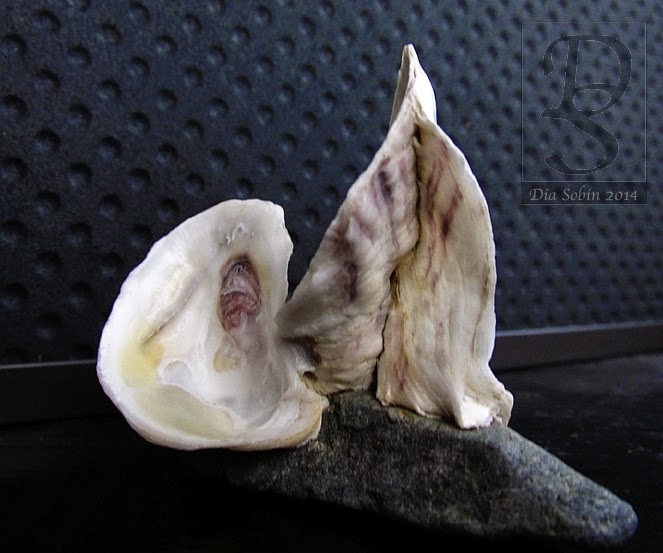
Oysters on a desk-top - Digital Photo - 2014, DS


"The co-evolutionary story between rocks and life began 4 billion years or so ago, when the planet had only rocks, air and oceans to work with. The origins researchers that followed Miller and Urey’s heady success soon realised that air and oceans aren’t enough to create life, no matter how lightning-filled the sky. Only with the addition of carefully selected minerals will simple, nonliving biomolecules concentrate and combine in complex biologically useful ways.

Life arose from minerals; then minerals arose from life. The geosphere and biosphere have become complexly intertwined, with numerous feedback loops driving myriad critical natural processes in ways that are only now coming into focus."

- from an 2014 article by Robert Hazen, found at Aeon magazine.


"Mr. Gerard further states: 'Just before crossing the boundary of Ludak into Bussalier, I was exceedingly gratified by the discovery of a bed of fossil oysters, clinging to a rock as if they had been alive.'

In whatever point of view we are to consider the subject, it is sublime to think of organic remains lying at such an extraordinary altitude, and of vast cliffs of rocks formed out of them, frowning over the illimitable and desolate waters, where oceans once rolled."

- from Shells on the Snowy Mountains of Tibet, Asiatic Register,  found here.


"... the great power and human destinies are couched in the virtues of Stones and Herbs. But to know from whence these come, a higher speculation is required. Alexander the peripatetic, not going any further than his senses and qualities, is of the opinion that these proceed from Elements, and their qualities, which haply might be supposed to be true, if those were of the same species; but many of the operations of the Stones agree neither in genere nor specie. Therefore Plato and his scholars attribute these virtues to Ideas, the formers of things. But Avicen reduceth these kinds of operations to Intelligence, Hermes to the Stars, Albertus to the specifical forms of things.

...Now consequently we must discourse of Intelligences, spirits and Angels. An Intelligence is an intelligible substance, free from all gross and putrifying mass of a body, immortall, insensible, assisting all, having Influence over all; and the nature of all intelligences, spirits and Angels is the same. But I call Angels here, not those whom we usually call Devils, but spirits so called from the propriety of the word, as it were, knowing, understanding and wise."

- from De occulta philosophia libri tres (Three Books Concerning Occult Philosophy), 1530s, Heinrich Cornelius Agrippa


As readers of this blog know, the moment summer arrives, one can often find a peculiar, solitary woman (me) roaming the sandbars on the Connecticut shoreline; every now and then bending down to pick up an object or two... possibly even talking to herself (or the objects) before placing them back down, or, resuming her search (if that's what it is), possibly still holding one prized object (carefully) in her sweaty little paw.

There are no "ordinary" objects at the shore... and some, like the one above (shown from various angles - click to enlarge) are to be celebrated. When I first found these three shells cemented* to a fragment of rock, however, I wasn't even sure what I'd found. Were they some form of barnacle? Had a human glued some shells onto a rock in such a pretty array?

Friday, June 20, 2014

Creatura - The Sentient Seaweed (the Extended Version)


Live scan of an unidentified seaweed - 2014, DS
Note: This scan is a product of a new flatbed scanner... which, apparently had difficulties
reading the black background, hence the weird color artifacts (unfortunately intensified online).
I've tried - and failed - to correct it. Sorry.
(click to enlarge)


creature |ˈkrē ch ər|
noun
an animal, as distinct from a human being : night sounds of birds and other creatures.
• an animal or person : as fellow creatures on this planet, animals deserve respect.
• a fictional or imaginary being, typically a frightening one : a creature from outer space.
• archaic anything living or existing : dress, jewels, and other transitory creatures.
• a person of a specified kind, typically one viewed with pity, contempt, or desire : you heartless creature!
• a person or organization considered to be under the complete control of another : the village teacher was expected to be the creature of his employer.

ORIGIN Middle English (in the sense [something created] ): via Old French from late Latin creatura, from the verb creare (see create).


"In the philosophy of consciousness, sentience can refer to the ability of any entity to have subjective perceptual experiences, or as some philosophers refer to them, "qualia". This is distinct from other aspects of the mind and consciousness, such as creativity, intelligence, sapience, self-awareness, and intentionality (the ability to have thoughts "about" something). Sentience is a minimalistic way of defining consciousness, which is otherwise commonly used to collectively describe sentience plus other characteristics of the mind.

Some philosophers, notably Colin McGinn, believe that sentience will never be understood, a position known as "new mysterianism". They do not deny that most other aspects of consciousness are subject to scientific investigation but they argue that subjective experiences will never be explained; i.e., sentience is the only aspect of consciousness that can't be explained. Other philosophers (such as Daniel Dennett) disagree, arguing that all aspects of consciousness will eventually be explained by science."

- Excerpt from the Wiki entry on sentience.


***

The summer solstice (the pagan holiday of Litha) approaches, and with it, my inevitable trips to the shore. Sometimes there's an agenda; mostly there isn't. But, when the ocean calls, it never needs to leave a message; I just get in my car - sans towels and sunblock lotion... sans beach blankets, beach balls,  beverage coolers and lounge chairs. I'm there for meditative purposes, investigative purposes, or, more generally, no purpose at all. The ocean calls, and that's enough.

Last week, however, there was a method to my madness as I plodded along the sandbars. My mission was to gather bits of seaweed for an image I was trying to rework and, hopefully, finish. Normally sea plants hold no interest for me, but, for the image, I needed the seaweed's specific organic contours...