Showing posts with label patterns. Show all posts

Sunday, January 3, 2016

A Mojo Magic Square (with update)


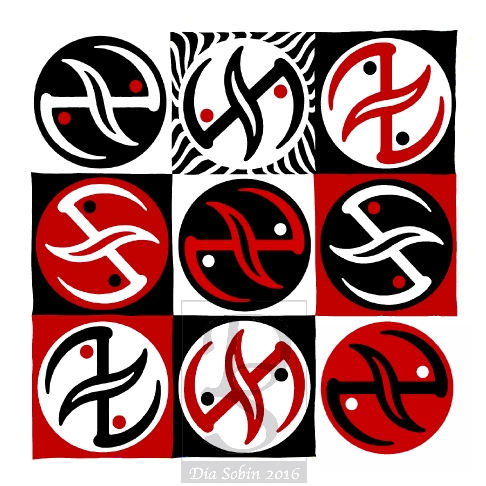
Mojo Magic Square - digital - © 1981, 2014, DS
(click to enlarge)


"Mojo is magic, magical ability, and the power to get things done. "Mojo" first appeared in the 1920s in the southern United States from the Gullah word "moco" (magic), Gullah being Creole spoken by some groups of African-Americans.  The ultimate root of "mojo" was the word "moco'o," which means "shaman or medicine man" in the African language Fulani.  "Mojo" spread first into mainstream Black English and then general usage primarily through the popularity of jazz and blues music.  Muddy Waters got his 'Mojo working' and Jim Morrison of The Doors called for the Mojo Risin'."
- Quote found here.

"Think joie de vivre, that sense of being alive, joyful, and fully present in the moment. The path to finding your mojo differs for everyone. For some, mojo is a sense of purpose and meaning in your life. For others, it’s reclaiming optimal health or sparking their creativity. Some seekers find mojo by getting in touch with the divine, while others get their mojo by getting in touch with their sexual prowess. For many, it’s all of the above."
- Quote found here.

"So what is a mojo? It is, in short, the staple amulet of African-American hoodoo practice, a flannel bag containing one or more magical items. The word is thought by some to be a corruption of the English word "magic." Others state that it is related to the West African word "mojuba," meaning a prayer of praise and homage, as it is a "prayer in a bag" - a spell you can carry. A third possible derivation is from the Bantu/Kongo word "mooyoo," the magically-charged ashes and ground up bones of an ancestor that are encased in the front of a nkisi ndoki - a fetish-statue made in the form of a human being or animal. This connection with the bones of the dead is interesting, because historically, many mojo hands have indeed contained small bones, either of animals or of humans.

Some root workers top off their mojo bags with parchments upon which are printed medieval European grimoire seals and sigils of talismanic import, particularly the Jewish-derived seals from the Greater Key of Solomon and The 6th and 7th Books of Moses, both of which are sold as sets of seals printed on parchment paper, and are used without reference to the rituals given in the texts of the original grimoire books.

These last items surprise many Caucasians, who are unaware that a strong vein of Germanic and Ashenazi Jewish folklore runs through traditional African-American hoodoo. Still, however strange it may seem to cultural anthropologists in search of "African survivals" in hoodoo practice, it is a fact that John George Hohman's "Pow-Wows or the Long Lost Friend" - first published in America in 1820 and translated into English in 1856 - has long been a staple source of inspiration for conjure-workers in both the African-American and European-American Appalachian traditions, and many a black hoodoo practitioner can cite chapter and verse of "Albertus Magnus," "The Black Pullet," "Secrets of the Psalms," "The 6th and 7th Books of Moses," "8th, 9th, and 10th Books of Moses," and other occult books of European origin."
- From an article found on Lucky Mojo.


A Sator Magic Square in Oppède, France.


"The earliest dateable Sator Square was found in the ruins of Pompeii, which was buried in the ash of Mount Vesuvius in 79 AD. Examples may be found carved on stone tablets or pressed into clay before being fired. Its translation has been the subject of speculation with no clear consensus.

It seems that, in all early examples, it is a Rotas Square that reads "ROTAS OPERA TENET AREPO SATOR" from top to bottom, and from left to right.

The Sator Square is a four-times palindrome, and some people have attributed magical properties to it, considering it one of the broadest magical formulas in the Occident. An article on the square from The Saint Louis Medical and Surgical Journal, vol. 76, reports that palindromes were viewed as being immune to tampering by the devil, who would become confused by the repetition of the letters, and hence their popularity in magical use....

The square has reportedly been used in folk magic for various purposes, including putting out fires (the spell is "TO EXTINGUISH FIRE WITHOUT WATER" in John George Hohman's Long Lost Friend), removing jinxes and fevers, to protect cattle from witchcraft, and against fatigue when traveling. It is sometimes claimed it must be written upon a certain material, or else with a certain type of ink to achieve its magical effect."
- From the Wiki Sator Square entry.


***

Well, it's officially a new year in the western world, but, in the Far East, the lunar new year doesn't occur till February 2nd. (More about that later...) So, it's a relative thing, and if your "mojo" isn't quite working the way you'd like it to, you've got a whole month to get yourself in gear. Now, while "gear" isn't necessarily the operative term when defining the word mojo, dynamo, or dynamic kind of is; so, in the last analysis, you know your mojo is working when your inner world is moving seamlessly in synch with the outer world. My guess is, if one can get that down, then, regardless of all the circumstances beyond one's control, he or she will be A-OK... and as much of a contender in this game of life as anyone else is.

As it happens, mojo is a word that's been used - in various corrupted forms - quite a lot in recent years. Originally it was Hoodoo charm (although not to be confused with this hoodoo) bringing good luck and psychic protection to its bearer. Now, it's a catchword most commonly utilized by motivational speakers, executive coaches, "life" coaches, and self-help gurus when describing formulas for increasing ones productivity*, particularly in the workforce.

But, just exactly what do I mean by the word Mojo?

Mojo is animism... the dynamic energy fluctuation that makes an organism tick. If ones wiring is in top form, ones inner force pulls back and then moves forward in sync with ones conscious desires and motivations. In other words, ones Mojo is "working". On the other hand, if ones wiring has gone awry - for instance, in the case of a series of set-backs, intense trauma or injury of any kind, or just plain chronic disappointment - then ones Mojo is thrown off its game. It isn't as if you've lost it... it's that it's blocked from true expression; in other words, it's broken.

Case in point: the magic square (first image above) is something I've had on my desktop for the past 2 years. Why is this? Well, that's a good question! Before this period, I had just gone through a series of unfortunate events, and was holed up in an unfamiliar town with absolutely no clue - and no hope - for a "brighter future." Without going into details, my mojo was, in fact, at the lowest point of its existence...

Monday, March 2, 2015

The Mysterious Caves of Fontainebleau


From the caves of Fontainebleau... (click to enlarge)

The Forest of Fontainebleau

"This forest which is now a popular recreation area, was an isolated region for thousands of years. It was a haunt of robbers, fringe dwellers and fugitives who sheltered in its caves and carved the walls with inscriptions, designs, and abstract signs. More than 2,300 square yards of rock are decorated in this way.

Among the carvings are human figures with rectangular bodies, neck-less heads with sunken eyes and U-shaped noses. Their arms are outstretched, with the fingers spread like a fan, and often the legs are missing. A second group, in bas-relief, have their arms close to their bodies, In a third, the figures are dressed in skirts and have only three fingers on each hand.

The crosses, circles and hopscotch-like designs are almost impossible to date. They may be from prehistoric time, or they could have been drawn yesterday. All have been indexed and some are similar to designs which specialists located elsewhere. However, there are some designs which are found only at Fontainebleau. These are the irregular latticed designs which have been deeply incised into the rock. They have been found in the most inaccessible places, in cavities where only an arm can reach. Why were these engravings made under such obviously difficult conditions? They were certainly not made recently, but how old are they? What message did their engravers wish to leave, and who were they?"

- Text and photo (above) found in some older files; source currently unidentified.


***

Chances are, whenever the topic of prehistoric art crops up, the first examples that spring to mind are the stylized beasts (in shades of black, brown and red ochre) found on cave walls in France, notably those of Lascaux and Chauvet. Or, maybe, those enigmatic Paleolithic handprints which created a minor sensation in 2013; the handprints which, upon closer inspection, were tentatively judged to be the work of primarily female artists. On the other hand, the more informed Fortean mind is likely to turn to the stone carvings found at Göbekli Tepe (also, here), or the Nazca Lines.

But, my fellow fans of weird archaeology, here's another place to add to your files: the mysterious abstract carvings found in the caves of Fontainebleau Forest, located 30 miles south of Paris. While some of the designs were wrought in the late Middle Ages, others have been dated back 15,000 years to the Upper Paleolithic or Magdalenian period; and, still others may have arisen as early as the Neolithic period. So strange and sophisticated are some of the carvings - along with the nearby presence of unusual rock formations, and what appears to be a bestiary of boulders - that it's been proposed the forest of Fontainebleau may contain the artifacts of an unknown civilization...

Saturday, June 14, 2014

To Decode The Living Matrix... Featuring the Work of Cristóbal Vila


From the video: Isfahan - 3D digital still - 2005, Cristóbal Vila


matrix |ˈmātriks|
noun ( pl. -trices |ˈmātrisēz| or -trixes )
1 an environment or material in which something develops; a surrounding medium or structure : free choices become the matrix of human life.
• a mass of fine-grained rock in which gems, crystals, or fossils are embedded.
• Biology the substance between cells or in which structures are embedded.
• fine material : the matrix of gravel paths is raked regularly.
2 a mold in which something, such as printing type or a phonograph record, is cast or shaped.
3 Mathematics a rectangular array of quantities or expressions in rows and columns that is treated as a single entity and manipulated according to particular rules.
• an organizational structure in which two or more lines of command, responsibility, or communication may run through the same individual.

ORIGIN late Middle English (in the sense [womb] ): from Latin, ‘breeding female,’ later ‘womb,’ from mater, matr - ‘mother.’


North American Wood Thrush

“As we listen we lose the sense of time—it links us with eternity…Its tones…seem like the vocal expression of the mystery of the universe, clothed in a melody so pure and ethereal that the soul still bound to its earthly tenement can neither imitate nor describe it.”
- Anonymous Twentieth Century naturalist describing the Wood Thrush


"It was dawn and as I lay there listening to the birds w/ my eyes shut I began to see a weird pattern emerging from the darkness... an almost graphic pattern similar to computer graphics... It looked like chopped meat being criss-crossed (sic) by a rapidly moving concentric ring pattern... similar to my cyclocentric* patterns but more intricate. From this emerged what seemed like another darker dimension - again filled with cyclocentric patterns but these were made of various colors of light... and some were large and whirlpooling (sic) while smaller brighter patterns emerged... all of them moving and vibrant and living and all of them revolving and forming harmonics by which even tinier glowing patterns emerged. It was as if I was delving into a series of many dimensions... but I could only glance at certain aspects (of the patterns) for milliseconds at a time (as they were) far too complex and enmeshed for human resolution...

Tuesday, June 11, 2013

Sand & Cymatics: The Patterns of Sound


Apparently, the video above has gone viral since it was posted a few days ago (according to an article found here), but I didn't see it till today (Thanks, Moo!). I've seen photographs of resonance patterns in the past - patterns which emerge when metal plates containing various substances are vibrated with sound frequencies - but, this video is pretty cool. So, for those of you who have an interest in pattern, form and structure - and my discussions of them, and/or their esoteric aspects - you might find this video illuminating.

Cymatics - the study of wave or modal phenomena - is a word that was coined by Hans Jenny in 1967. Regarding the discovery of the ability of sound frequencies to produce patterns, however, in the West, Galileo first mentions the phenomena in "Dialogue Concerning the Two Chief World Systems" in 1632. (Then again, in the Far East, the ancient Chinese had already developed sound-frequency toys!) Next in line came Robert Hooke, although it is through the repetitions of his experiments with sound, and the subsequent publication of "Discoveries in the Theory of Sound", that Ernst Chladni emerged as the name most identified with resonance imagery - specifically in the term "Chladni plates".

According to the Smithsonian page (linked to above): "Chladni patterns are still of scientific interest, although their analytical uses have been mostly replaced by other technologies. Today these figures are more likely to be produced by a virtual imaging program than by an actual vibrating plate."

Yeah, but I guess they never heard of Meara O'Reilly and her Chladni song, or, her work with Bjork... or, for that matter, the experiments of Alexander Lauterwasser!

For more cymatic info and images, try here and here.

Credit: The creator of the today's featured video is Brusspup at Illusions and Science.


Saturday, December 15, 2012

The Doors of Perception (9/1/25: video repaired)


Doors of Perception - digital - Copyright, 2011, Dia Sobin


"If the doors of perception were cleansed everything would appear to man as it is, infinite."

- William Blake, from The Marriage of Heaven and Hell, 1793

***

“There are things known and there are things unknown, and in between are the doors of perception.”

"To be shaken out of the ruts of ordinary perception, to be shown for a few timeless hours the outer and the inner world, not as they appear to an animal obsessed with survival or to a human being obsessed with words and notions, but as they are apprehended, directly and unconditionally, by Mind at Large - this is an experience of inestimable value... The man who comes back through the Door in the Wall will never be quite the same as the man who went out. He will be wiser but less cocksure, happier but less self-satisfied, humbler in acknowledging his ignorance yet better equipped to understand the relationship of words to things, of systematic reasoning to the unfathomable Mystery which it tries, forever vainly, to comprehend."

"The various “other worlds,” with which human beings erratically make contact are so many elements in the totality of the awareness belonging to Mind at Large. Most people, most of the time, know only what comes through the reducing valve and is consecrated as genuinely real by the local language. Certain persons, however, seem to be born with a kind of by-pass that circumvents the reducing valve. In others temporary by-passes may be acquired either spontaneously, or as the result of deliberate “spiritual exercises,” or through hypnosis, or by means of drugs. Through these permanent or temporary by-passes there flows, not indeed the perception “of everything that is happening everywhere in the universe” (for the by-pass does not abolish the reducing valve, which still excludes the total content of Mind at Large), but something more than, and above all something different from, the carefully selected utilitarian material which our narrowed, individual minds regard as a complete, or at least sufficient, picture of reality.”

- three excerpts from The Doors of Perception, Aldous Huxley, 1954

***

Trade winds find Galleons lost in the sea 
I know where treasure is waiting for me 
Silver and gold in the mountains of Spain 
I have to see you again and again 
Take me, Spanish Caravan 
Yes, I know you can."

- Spanish Caravan - The Doors*, 1968, from Waiting for the Sun 

***


I had a semi-eureka moment the other night. I was reading the posthumously published book of a friend (mentioned in previously posts), Mac Tonnies - the first volume of an edited transcription of his Posthuman Blues blog - when I came across a 2003 discussion of anomalous arial phenomena (UFOs), and his speculative proposition (inspired by Rudy Rucker's Spaceland) suggesting they may be cross-sections of 4-dimensional objects moving through 3-dimensional space. He compares this hypothetical 4-D world with the idea of a vast "multiverse", but its phenomena would only be visible to we 3-D "Flatlanders" at points of intersection... sort of a complex version of the "tip of the iceberg" appearing on the surface of the ocean - it's what we can't see that defines it in totality.

He goes on to say that, it stands to reason, we might theoretically coexist with the generators of these "aerial phenomena" - assuming some variety of intelligence is involved. 

As it happened, I had recently posted a quotation from Michio Kaku, a String-Theory physicist, on my memorial blog, Post-Mac Blues, which intimated a similar idea in the form of possible parallel worlds, in which we theoretically might co-exist with a range of probable realities populated with a whole host of "others", up to and including loved ones who have died, and other versions of ourselves, as well. And, keep in mind, String Theory proposes as many as eleven dimensions to play with!

Seemingly, transdimensional reality comes off like science fiction, but, in a sense, we experience a form of it on a continual basis; co-existing with the seemingly dimension-less phenomena of our own unconscious minds. Dreams, for instance, fall into this arena, They, too, may intimate experiences we are forced to translate using the limited language of three dimensions, with our equally as limited "official" set of senses. The experience of levitating or flying, for example, which, in my own dreams, initially entails allowing oneself to fall - albeit at an oblique angle - into space, might be describing a more complex manifestation on another plane, or, for that matter, the vestiges of a race memory wholly outside of the conventional range of spacetime... you might say, an inner-dimensional** reality. Some dreams, then, may represent those same "tips of the iceberg", with their true breadth extending in a whole range of enfolded directions.

Ghosts, and other anomalous visual phenomena might also find their origin in a transdimensional reality whereas, once again, our experience is partially obscured by the nuts and bolts of our 3-dimensional range. We see what (to some of us) is apparently visible... but only to a certain degree... and possibly only at certain angles in what one can reluctantly refer to as a moment in spacetime. True perception is thereby incremental... like tuning in a station on a radio; our window for experiencing certain phenomena is, apparently, extremely small.


Of course, in the light of the brick wall effect of corporeal reality, all of this seems fairly moot. Which is probably what I meant when I created "Doors of Perception". Look, but don't see. On the other hand, I sense an underlying mystery about this image... as if its facade was created by an extra-terrestrial race. At the same time, during the process of its creation, a key phrase emerged in my mind -"false doors" - possibly referring to those which decorated Egyptian tombs. The "Ka" doors (an example is pictured above, left) were more than embellishments, however, they were the means by which the dead might re-enter the earthly plane and communicate with the living. The enigmatic Nabatean race included similar doors, and windows - referred to as "god blocks" - on the surface of their tombs at Petra (above, right). When you think about it, these solid, physically impenetrable "openings" are very strange. Obviously, their dead could walk through walls - and our enterprising ancients designated exactly where these portals should exist.

For Aldous Huxley, (July 26,1894 – November 22,1963), the "doors of perception" were thrown open via certain altered states of consciousness, either natural and spontaneous, or artificially "manufactured". His 1954 extended essay, The Doors of Perception was a chronicle of his experience with mescaline. He, in turn, borrowed that title from the inspired ravings of William Blake, a visionary artist and poet who was born in the previous century (November 28, 1757 – August 12, 1827).

Huxley's doors were the doors of inner-dimensions, the "Mind at Large", but one suspects the doors might swing both ways, from microcosmic to macrocosmic, from personal to transpersonal, from universal to multiversal.

It was Huxley's doors, in turn, which inspired the name of the 1960's rock band, The Doors. They, according to legend, were no strangers to psychedelic enhancement. As a teenager, it was the latter Doors who introduced me to both Blake and Huxley. Pop culture does have it's beneficial side-effects. Which, I suppose, is my excuse for indulging myself with the Doors video at the bottom of the post.

"Spanish Caravan" does relate in a weird way though... in that. it initially seems like no more than a beguiling, substance-drenched ditty - or an ode to a favorite vacation spot - set to the Doors' standard Disneyland-in-Hell - or, better even, Carnival of Souls - orchestral sound. But, to the discerning traveller, "Spain" and "Andalusia" are not corporeal destinations. Translated by the sultry voice of Jim Morrison,  (December 8, 1943 – July 3, 1971) - the Sidewinder Shaman, and self-proclaimed Lizard King - the lyrics transform into an alchemical cryptogram, intimating a subliminal dimension which houses the proverbial philosopher's stone - the mystical El Dorado of the spiritual realm - which must be experienced "again and again". In the grainy "Live in Europe" clip below, this song takes no prisoners.

What is the "Spanish Caravan"? A "Magic Bus" ? The mother of all mother-ships? Death? Who cares. Morrison assured us that it could "take" him. We assumed we were welcome to come along for the ride... if we dared.


* The lyrics to Spanish Caravan were actually penned by Doors guitarist, Robby Krieger.

** "Interdimensional" is a word in use, coined by Jacques Vallee, which he used to describe UFO phenomena, but is not exactly what I'm referring to here. On the other hand, these cosmic portals might be the macrocosmic expression of what I'm attempting to describe.

Note: For those interested in a mash-up of ideas referred to in this post plus, you might try familiarizing yourself with the writings of Clifford Pickover, his website or blog.

(Another note: For those of you familiar with this blog, you actually have seen a portion of my image "Doors of Perception" in a past post.)


Monday, August 6, 2012

More Artifice: "The Flower of Life" (Updated)


I was digging through some old files today when I came across the "fabric swatch" above. I thought it might be a good addition to my other posts regarding faux items created digitally.

It's an optical illusion, of course. The "folds" in the fabric are not really there at all. I simply "airbrushed" a static pattern of mine over a solid black ground to create an illusion of rippling fabric.

(That "static pattern" incidentally, is based on the geometric pattern referred to as "The Flower of Life". For more information on this pattern - and the graphic below - see this Trans-D post.)

Hint: the simpler your initial tile is, the better it flows. Avoid rectilinear, "cubic" designs, such as my faux lace pattern. Circles and hexagons fill space far more seamlessly!


A graphic created for "The Circle Zone" - 2008 - DS 


Sunday, July 15, 2012

Queen Anne's Lace


Queen Anne's Lace flower - "live' scan


"Her body is not so white as
anemony petals nor so smooth—nor
so remote a thing. It is a field
of the wild carrot taking
the field by force; the grass
does not raise above it."

- excerpt from William Carlos William's "Queen Anne's Lace"


Trans-D is not generally a "how-to" digital art site, but every now and then I get the urge to document my methods of madness as they present themselves. Todays foray into digital technique was inspired by a common roadside wild-flower I come across frequently in my weekly walkabouts - Queen Anne's Lace, also known as the "wild carrot". Like the starlings in my last post, Queen Anne's Lace also has the dubious distinction of being an "invasive species"... which pretty much just means it's a survivor... give it an inch and it takes a mile. That's okay by me... I'm a "plant person". Which pretty much means I have more of a rapport with plants than I do mammals. But, make no mistake - and even Science is coming round to this opinion - plants do have a kind of sentience... an alien one in many respects, but a kind of consciousness none-the-less.

That being said, for all of it's notorious robustness, Queen Anne's Lace, which got its name from a tiny red floret that sometimes appears in its center - I've yet to see one - said to represent a drop of blood from Queen Annes finger which she pricked whilst tatting lace - also has its selling points. It's seeds, for instance, are often used by women for contraceptive purposes. It is also the host food for the larvae of the Black Swallowtail butterfly. Apart from it's other medicinal properties, it is also used by Blue Jays to line their nests - apparently its foliage contains a natural insecticide. Oddly enough, in organic gardening, it's recommended to plant Queen Anne's Lace - along with chrysanthemums and marigolds, etc. - as a "companion plant" in your garden, for the opposite reason; it attracts beneficial, aphid-eating insects like ladybugs.

My sudden interest in the plant, however, has nothing to do with any of that. Basically, I've been inspired to create a new image which insinuated itself into my middle eye last week... another of my humanoids... this time an ancient (possibly) Martian woman who wears a singular veil partially obscuring her face. I'm not here to argue about the reality of Mars - for an artist, if something emerges from the creative unconscious, one just runs with it... or perishes. That simple.

So, the veil is key in this illustration, but how to create it? My mind's eye rested on the Queen Anne's Lace growing by the roadside. On impulse, I plucked one - apologizing and thanking the plant first (silently), I might add - placed it on the scanner bed, and took my best shot. Above is my scanned image of the flower. Lovely as it may be, I still didn't quite see how it'd be useful, so, I did what any artist should do - I blew it up. Musing, I snipped out a fragment and began rearranging it  (via cut & paste) - organic geometric patterns are, to a great degree, my forte. Experimenting with this arrangement, I finally cleaned up a version, tiled it and - presto - Queen Anne's Lace created with Queen Anne's Lace! It's not what I intend to use for my Martian veil, but I thought I'd share it anyway.  I also realize there's plenty of fractally, computational ways of creating patterns digitally - but, this is my preferred way!

So, here are three steps to virtual "lace-making". Click on images for larger views.


the blow-up

the pattern


the tile

And this is why I went digital! :-)


Monday, July 4, 2011

The Language of Form - Part 2

Fractal, Form and Field - the Inevitable Symmetries


The interesting thing about fractals (example shown above) is that they illustrate more than just pretty patterns. They, too, employ the same language of form we're discussing, as well as mathematical equations and/or sequences. A new science - the Science of Chaos - is gradually emerging. and fractal theories have been absorbed within that paradigm. But don't be deceived. "Chaos" in this sense, is really the intimations of a higher order, specifically the orders of symmetry, and the fractal nature of the physical world at large. Fractals, in other words, bridge the micro to the macro, and do so by the marriage of mathematics to the language of form. Symmetry, on the other hand, has become the catch-word across the board; in all areas of science, as well as art, music, history and societal analysis. Symmetry, in other words, is a very transdimensional term. It describes both the singular entity and the encompassing field. It can take us from a simple geometric figure to a parallel universe. We can follow it from the atomic to the galactic, from the child's "cat's cradle" to the Super-string universe and beyond.


Artists, of course, generally take both the fractals, the strange geometry, and the form language for granted in their work - for them it is an instinct - and this has been the case since pre-history. Whether it was a lattice or spiral drawn on a cave wall or the crystalline structures tiled onto the walls of the great mosques, artists, intuitively, have generally "been there first" on an unconscious level.


For another intimation of the modern "fractal" for instance, we need only look at some of the illustrations of German naturalist, Ernst Haeckel, (1834-1919). Consciously, he was "drawing from life"... but, observing his work (an example is shown above), I can't help but feel that, once again, on a more unconscious and metaphysical level he was trying to intuitively connect the dots, so to speak, to a larger, more profound picture... the organization of the organism, if you will, its inherent symmetry, and its relation to all phenomenal form.


When it comes to attempting to define a form language, however, it is a mistake to take any form too literally and so superficially that one overlooks the primary source - and/or the larger picture. I'm afraid that those in scientific fields and mathematical fields often have a habit of doing just this. For example, take the Sierpinski "gasket" (my version) shown above. It needs no explanation for the mathematician, but for an artist, myself in particular, the complexity in which it's presented and the way in which it's developed and described is rather daunting and off-putting. In actuality, this triangle describes a portion of a very simple grid, the very same grid from which the Platonic solids emerge. This grid, in turn, is created from a very simple field of inter-penetrating circles, the very same field from which my geometrical figures - the "Platonic" cyclohedra - arose and/or emerged (in 1984). (A graphic of these figures is shown below. Sorry, I no longer have my documentation of these figures online, as there was a decided lack of interest previously shown; in the U.S.A., that is. Interestingly, some of my related diagrams were published in China in 2007, with my permission.) 


The Cyclohedra


The point I'm trying to make, using simple geometrical observations, is that the language of form is inherently transdimensional. Both figuratively and demonstratively it is an emergent - and yes, I am referring to the theories of David Bohm - and, as such, describe form as both a singular entity and the component of a field. In other words, there is symmetry, and then again there is field symmetry. There is the stratum of one dimension as the component of higher dimensions, and what we "see" and cannot "see" is relative to our placement in that stratum... a sort of "Flatland" fable.


Fractals, and geometric observations aside, the interesting thing about more transfigurative forms in artwork - Dali and H. R. Giger come to mind - alchemical symbols and drawings, even the illustrative work (like Haeckel's) often have a "dirtiness" about them. This type of "dirtiness", I think, is the type of "dirtiness" Matta refers to when he speaks of "hallucinations" - that is, inspired images which are inseparable from the unconscious repertoire from which they arise. That symbols from unconscious and imaginal origins ultimately obey the same "laws", the same unwritten code that is used to represent the actual, phenomenal world, is our "cause for pause", so to speak. In my opinion, it intimates one way in which we might someday come to understand the Transdimensional quality of the form language, whereby shapes, patterns, fractals, and "diagrams of forces" become the keys to unlock perceptional doors to a more profound concept of space - and its hidden symmetries - that is, as a tissue, a fabric, a synchronistic and living connective.


Credits:


Fractal form: found here.
Mosque photo: found here.
Ernst Haeckel illustration: found here.


Also: another Fractal link.


"Language of Form" post links: Part I, Part 3