Showing posts with label literature. Show all posts

Friday, July 7, 2023

Dancing With the Ghost of Albert Camus

Dancing with Ghosts - cell phone photo - 2023, DS.


“At that time, I often thought that if I had had to live in the trunk of a dead tree, with nothing to do but look up at the sky flowing overhead, little by little I would have gotten used to it.”
- Albert Camus, The Stranger


(I am being inundated with politics these days... and politics is not my place. My place is culture. My place is my artist's meditative Zone... where politics with its conflict, chaos, ignorance, violence, tyranny, & lies are, in general, not welcome.

Unfortunately, politics are as inescapable as the current heat wave this summer.

 I am now staying in Albuquerque. It appears to be a strangely unpopulated place... or, rather, a thinly populated ghost town. There are rarely people on the streets unless they're homeless. And, yet, there are lines and lines of cars on its dusty roads... passing through? I don't know. I'm still a stranger in New Mexico... a refugee although I've lived here for 8 years. There are places in the world in which you can never be anything but a stranger, but, there are people who can never be anything but strangers, too.

On the other hand, 3 nights ago, the 4th of July (Independence Day), I couldn't get to any official pyrotechnic events, but the locals put on their own unofficial fireworks display - the People's Display - with some fairly sophisticated rockets... which lasted for hours. I watched from a window over the patio as they shot up across the horizon... and I felt quite patriotic; a feeling I rarely have...especially these days... that is, unless disgust and anger are symptoms of patriotism. Maybe, in a sense they are. It means you care. 

My current "backyard" - which really isn't mine - consists of a small fenced-in patio with very little green to be seen... but, upon closer inspection, enough green to support a small colony of grasshoppers! It's these little bits of natural life which anchor me to the corporeal world. Like the juvenile grasshopper - inset left - they bring me joy and, unlike everything else clamoring for my time and effort, they're refreshingly tangible and real. And, if you pay attention to them, they'll reward you in many ways. For instance, you can learn things. I learned that grasshoppers grow in a similar way to caterpillars. That is, they shed their skins to become much larger creatures... which somehow were illogically enfolded inside their former selves; a magic trick more interesting, more satisfying than you might imagine.

(7/24/23 Note: After a number of moults, the grasshopper became large, brown... and developed wings. While not as attractive as a butterfly it, too, transforms into a flying creature.)

In the photo, posted above, I am standing in the center of the patio on what is fondly referred to as the "launch pad." I appear to be dancing with myself. In reality I'm dancing with ghosts. Perhaps, I, too, have become a ghost... unconsciously haunting my own past...)

In this (brief) dream  I am in the house of my childhood... but, it is not not exactly the place I lived, for it has changed. Or, I should say, it has changed again. The first time it changed - in a long ago dream - a hidden room was revealed... positioned between my old bedroom and what was (in reality) a fairly unusual hallway featuring an array of closets, recesses, drawers and other enclosures. It was a phantom room but, in my sleeping mind, seemed both valid and logical.

I dreamt about this phantom room several times over the years. Its dimensions became an actual memory, as if it had always existed... somehow tucked away... enfolded in the recesses of a closet or at the bottom of a cluttered drawer.

In the latest dream, however, a screened-in porch had been added to the second floor of the family house...  in the front and, once again, where my bedroom was once located. It was accessed indoors from a newly created hallway... call it an Escher hallway, because it's position in the corporeal house was not (logically) possible. It was a phantom hallway... with another phantom construction nearby: the previously-mentioned "hidden room." I vaguely remember passing what may have been its potential doorway as I walked down the phantom hallway towards the phantom porch.

Now, the actual house was surrounded by tall trees: silver beech along the back, two enormous red maples in the front and a wall of massive pines. In the dream, they still existed. But, through the floor-to-ceiling screened apertures which composed the new porch, the trees were now fully visible, as if viewed from a treehouse.

The dream ended just as I entered the bright doorway and stepped into the screened enclosure. This, too, had a door, with stairs leading down to the ground below... a feature I may have consciously added in the process of waking up.

- From a note file created in May of this year. The addition of the porch was a fine dream-construction; an economical plan to let the outdoors in while also providing a third door - the house had two already - from which to escape. When I awoke from the dream, I felt refreshed. Perhaps, it was a metaphor for a new unconscious development and it felt like a positive one.

Which, is to say, it represented no part of my present-day physical reality but, rather, a vacation from it.

***

“Find meaning. Distinguish melancholy from sadness. Go out for a walk. It doesn’t have to be a romantic walk in the park, spring at its most spectacular moment, flowers and smells and outstanding poetical imagery smoothly transferring you into another world. It doesn’t have to be a walk during which you’ll have multiple life epiphanies and discover meanings no other brain ever managed to encounter. Do not be afraid of spending quality time by yourself. Find meaning or don’t find meaning but 'steal' some time and give it freely and exclusively to your own self. Opt for privacy and solitude. That doesn’t make you antisocial or cause you to reject the rest of the world. But you need to breathe. And you need to be.”

- Albert Camus (1913-1960), Notebooks 1951-1959. Camus was a French-Algerian writer, journalist, playwright, and philosopher and is most often considered an Absurdist. He was awarded the Nobel Prize for literature in 1957.

My first introduction to Camus was in my art school days. I read The Stranger and it depressed me. Maybe I glimpsed my own future. Recently I read an online article regarding absurdist philosophy and in it I rediscovered Camus. I spent that night reading pages and pages of his quotes which exhilarated me; astoundingly, I could relate to just about everything he said. Via the Wiki entry for Absurdism:

"Absurdists, following Camus' formulation, hesitantly allow the possibility for some meaning or value in life, but are neither as certain as existentialists are about the value of one's own constructed meaning nor as nihilists are about the total inability to create meaning. Absurdists following Camus also devalue or outright reject free will, encouraging merely that the individual live defiantly and authentically in spite of the psychological tension of the Absurd."

The odd thing is, while I feel sympathetic towards Absurdism, my personal experience would require something a bit beyond it... Uber-Absurdism? I'm not sure.

"The modern mind is in complete disarray. Knowledge has stretched itself to the point
where neither the world nor our intelligence can find any foot-hold.
It is a fact that we are suffering from nihilism." - Albert Camus

Tuesday, September 18, 2018

An André Breton Kind of Day

A portrait of André Breton by Victor Brauner.
(Click-on images to enlarge.)

"I believe in the future resolution of these two states, dream and reality, which are seemingly so contradictory, into a kind of absolute reality, a surreality."

- Quote by André Breton found here.

"Who am I? If this once I were to rely on a proverb, then perhaps everything would amount to knowing whom I 'haunt.' I must admit that this last word is misleading,tending to establish between certain beings and myself relations that are stranger, more inescapable, more disturbing than I intended. Such a word means much more than it says, makes me, still alive, play a ghostly part, evidently referring to what I must have ceased to be in order to be who I am. Hardly distorted in this sense, the word suggests that what I regard as the objective, more or less de liberate manifestations of my existence are merely the premises, within the limits of this existence, of an activity whose true extent is quite unknown to me."

- The first paragraph from Nadja, 1928, André Breton sourced here.

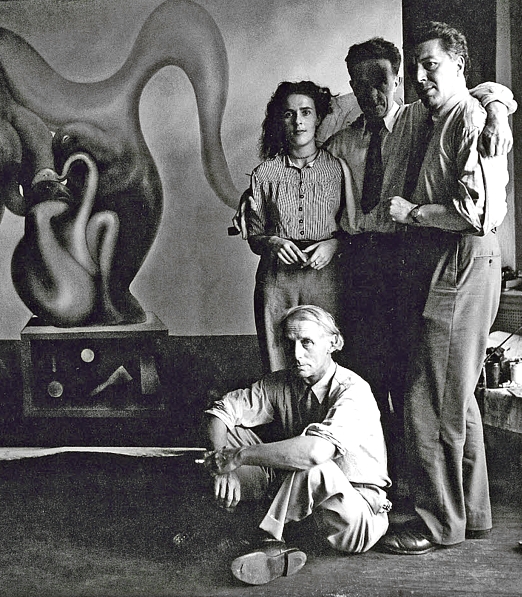
From left to right: Max Ernst, Leonora Carrington, Marcel Duchamp
and André Breton, New York 1942. (Source). The painting in the 
background:
Ernst's Le Surréalisme et la peinture (Surrealism and Painting), 1942.

"Always for the first time
Hardly do I know you by sight
You return at some hour of the night to a house at an angle to my window
A wholly imaginary house
It is there that from one second to the next
In the inviolate darkness
I anticipate once more the fascinating rift occuring
The one and only rift
In the facade and in my heart
The closer I come to you
In reality
The more the key sings at the door of the unknown room
Where you appear alone before me
At first you coalesce entirely with the brightness
The elusive angle of a curtain
It’s a field of jasmine I gazed upon at dawn on a road in the vicinity of Grasse
With the diagonal slant of its girls picking
Behind them the dark falling wing of the plants stripped bare
Before them a T-square of dazzling light
The curtain invisibly raised
In a frenzy all the flowers swarm back in
It is you at grips with that too long hour never dim enough until sleep
You as though you could be
The same except that I shall perhaps never meet you
You pretend not to know I am watching you
Marvelously I am no longer sure you know
You idleness brings tears to my eyes
A swarm of interpretations surrounds each of your gestures
It’s a honeydew hunt
There are rocking chairs on a deck there are branches that may well scratch you in the forest
There are in a shop window in the rue Notre-Dame-de-Lorette
Two lovely crossed legs caught in long stockings
Flaring out in the center of a great white clover
There is a silken ladder rolled out over the ivy
There is
By my leaning over the precipice
Of your presence and your absense in hopeless fusion
My finding the secret
Of loving you
Always for the first time"

- A poem by André Breton found here


André Breton by Marcel Duchamp, 1945.

"...Breton began to believe that our everyday encounters and chance findings are actually psychologically pre-ordained by our subconscious.

As such, found objects were direct, already existing embodiments of our inner desires, that just need to be found, in a privileged chance encounters.

To trigger these encounters, the Surrealists would visit flea markets in the hope of being ‘called’ by certain items. Because of this, and also due to the group’s interest in primitive art (which they believed was art straight from the psyche, devoid of social interpretations of norms), the Surrealists are known for having been avid collectors of all sorts of objects.
However, the concept that Dali came up with is slightly different from that of chance objects. Dali’s aim when creating Surrealist Objects was to bring objects from dreams into the real world, whereas Breton understood objects as entities which reveal one’s inner desires. We therefore see two categories of objects used by Surrealists: on the one hand, those created from dream-material, which eventually become symbolically functioning objects – as most of them are twisted enough to not really be functional anymore; and on the other hand, objects revealed through chance encounters, which eventually help the Surrealist to fulfil an existing unconscious obsession, or to complete a piece which was missing a little something."

- From Objective Chance and the Surrealist Object. The Surrealists and their relationships to found objects bring to mind Louise Nevelson and her psychic posse (via this post):

"These helpers of Louise Nevelson would get up very early in the morning. She lived in a town house in Manhattan, I believe; and they would go up and down the alleys, looking for discards. They were all kinds of individuals who were perhaps misfits in the outer world, but she believed them to be tremendously psychic. They all worked for her as her technicians, her helpers, in finding objects and wrapping them up in newspapers and paper bags, bringing them home; and then when they had all these treasures before them, they would let the objects tell them where to use them. And this came from a kind of psychic dialogue with the found object – which, I might add, was very similar to what Carl Jung taught many of his patients, to engage in with many natural things in their own experience."


Breton and some found objects... found here.

"About four o'clock that same day a very tall man was crossing the bridge that joins the separate islands. The bells, or perhaps it was the trees, struck the hour. He thought he heard the voices of his friends speaking: “The office of lazy trips is to the right,” they called to him, “and on Saturday the painter will write to you.”  The neighbors of solitude leaned forward and through the night was heard the whistling of streetlamps. The capricious house loses blood. Everybody loves a fire; when the color of the sky changes it's somebody dying. What can we hope for that would be better?"

- From Les Champs magnétiques (The Magnetic Fields), 1920, André Breton, found here. As for the other Magnetic Fields, try here.


***

What's an André Breton kind of day? Well, let me put it this way, don't drive large vehicles or operate heavy machinery.


Saturday, September 15, 2018

Qualifying Feminism: Empowerment and the Arts (Part II)

A poster in a London bus station featuring an image by the artist Egon Schiele.
The banner, however - strategically plastered over the figure's pubic area -
was not of the artist's device. See here or here.
(All images in this post can be clicked-on to enlarge.)
_______________________________________________

The C-Word: Censorship

“Art cannot be modern. Art is primordially eternal.”

- Egon Schiele, Austrian painter (June 12, 1890 - October 31, 1918).

"The purging wave seems to know no bounds. The poster of an Egon Schiele nude is censored; calls are made for the removal of a Balthus painting from a museum on grounds that it’s an apology for pedophilia; unable to distinguish between the man and his work, Cinémathèque Française is told not to hold a Roman Polanski retrospective and another for Jean-Claude Brisseau is blocked. A university judges the film Blow-Up, by Michelangelo Antonioni, to be "misogynist" and "unacceptable." In light of this revisionism, even John Ford (The Searchers) and Nicolas Poussin (The Abduction of the Sabine Women) are at risk."

- Via an English translation of one of the more coherent passages from the notorious "#MeToo" backlash letter published in Le Monde earlier this year, written and signed by 100 French women-of-note, up to and including Catherine Deneuve. The original document (in French) can be found here and, in English, here. Inset left is the  painting under scrutiny at that time, Thérèse Dreaming.

"As with previous awareness raising campaigns, it is not unlikely that the backlash will snowball and that the deeply entrenched patriarchal mechanisms that have maintained sexism for centuries will reassert themselves. That is after all how the system has survived to date. It is also all too likely that we will all — men and women — soon grow weary of allegations of sexual harassment as we have done in the past, making #MeToo a distant memory, a bud that did not blossom into long-lasting structural change. As Jessa Crispin writes in her manifesto about why she is not a feminist, popular social movements must, by their very nature, be “banal… non-threatening, and ineffective.” This underscores the problem with movements propelled by hashtags and celebrities."

- Excerpted from the Public Seminar article The Many Faces of the #MeToo Backlash, written by Maryam Omidi.

"In an angry riposte, French feminists described the letter’s signatories as “apologists for rape” and “defenders of paedophiles”, a reference to Deneuve’s vigorous support of the French-Polish film director Roman Polanski, convicted of raping a 13-year-old girl.

'There’s nothing really new in the arguments they use; they’re like the embarrassing colleague or tired uncle who doesn’t understand what’s happening,' a group of feminists wrote in an open letter of their own to French radio."

- Regarding a backlash against the former backlash via this article. Inset left is a still from Repulsion, a Roman Polanski film starring Catherine Deneuve (pictured) as a woman who kills two men, one of whom sexually assaulted her. As one might expect, Deneuve's character is portrayed as psychologically deranged (i.e., violence of men is expected and often applauded in a patriarchal society, violence in women - even when justified - is pathological.)

As for Roman Polanski, in 2018: "in light of the #MeToo and Time's Up movements, the Academy of Motion Picture Arts and Sciences voted to expel Polanski from its membership." As for Polanski's relationship with his "victim," Samantha Geimer, apparently they have become friendly... see Samantha Geimer on Roman Polanski: 'We email a little bit'.

"The problem of comprehending Lolita begins with this moral discrepancy and her literary position as a rape victim. It causes us to unravel with Humbert. We question the book, ourselves, our culture, and in the space between our disgust and Humbert’s desire, we obsess over and recreate the story. Spawning two films, several musical adaptions, ballets, plays, a Russian opera spin-off, fashion subcultures, and endless memorabilia, Lolita is a transcendent literary icon. Her ghost lingers in Lana Del Rey, Katy Perry, Britney Spears, Miley Cyrus and many a pop icon seen cradling a teddy bear in skimpy lingerie. The hyper-sexualization of young women is Lolita’s legacy, a cast thrown sixty years into the future: a transition from rape victim to sex icon."


- From Emily Roese's 2016 (Huffington Post) article: The Problematic Idolization of Lolita. Inset right is a detail from a poster for Stanely Kubrick's 1962 film adaption Lolita.

"Violence against women is often against our voices and our stories. It is a refusal of our voices, and what a voice means: the right to self-determination, to participation, to consent or dissent, to live and participate, to interpret and narrate. A husband hits his wife to silence her; a date rapist or acquaintance rapist refuses to let the 'No' of his victim mean what it should, that she alone has jurisdiction over her body; rape culture asserts that a woman's testimony is worthless, untrustworthy... Having a voice is crucial. It's not all there is to human rights, but its central to them, and so you can consider the history of women's rights and lack of rights as a history of silence and breaking silence."

- From Rebecca Solnit's A Short History of Silence, an essay from her (highly recommended) collection: The Mother of All Questions, 2017, Haymarket Books.  Regarding the photo (inset left) - "STILL NOT ASKING FOR IT" - more info can be found here and here.

***

Apparently, the poster which introduces this section is one of several which appeared in London bus stations this year announcing an exhibit of artwork by Egon Schiele, a Viennese artist and painter, known for his oddly contorted human figures, both nude and otherwise (inset right and sourced here). I don't know that any feminists were involved in the censorship of his work - and, possibly, the exhibition of his nudes in a bus station wasn't the most brilliant of plans to begin with - but, in terms of censorship "100 years old and still too daring" makes a significant point. In terms of culture, are we as a species moving forwards, backwards, or remaining stationary? More importantly, will the censorship of art and/or the artist - either contemporary or from the distant past - solve anything? Lastly, is the sensual and/or sexual content of art - regardless of the variety explored or intimated - a feminist issue? And, if so, should art fall under the jurisdiction of any and/or all other political and societal movements as well?

While I can both sympathize with and applaud the #MeToo
(and subsequent Times Up) movements - which marked the historical moment when women finally broke their silence and dragged a few "rape culture" enthusiasts out from under their proverbial rocks (where they'd been congregating for a very long time) - the infamous backlash letter signed by 100 French female luminaries was correct in one respect: suppressing a work of art due to its sexual content or the sexual behavior of its makers - even when said content or behavior is presently considered taboo - is antithetical to the nature of art, human creativity and human expression. But, most importantly, for a feminist, fanning the flames of censorship can also backfire.

Then again, history tells us that in almost every case of censorship or prohibition - across the board - the eradication of the offending behavior was not achieved... neither in the short term and, most certainly, not in the long term. Case in point: Lolita, the 1955 novel written by Russian American novelist Vladimir Nabokov (1899-1977). Basically, it's a feminist's nightmare - and a hebephile's wet dream - following the obsessional musings of a middle-aged man directed towards his manipulative, sexually precocious 12-year-old stepdaughter whom he eventually rapes. Banned in Great Britain and France for a period of two years, it was then banned in Australia from 1958 to 1965. Meanwhile, when it arrived in America, 100,000 copies were sold in its first three weeks. After all, nothing says "Must Read" like the word: "Banned"...

Sunday, January 14, 2018

Back to the Mountain


It snowed in the Sandias the other day for the first time this season - you might say my third "saison en enfer" - and, although I had just shot some mountain photos over the weekend (above and after the jump) well, I had to drive back. It is, after all, both my mission and my pleasure (emphasis on pleasure).

Speaking of which, and for the record, I'm holed up in a motel again... attempting to recuperate from a respiratory infection that's been going around as of late. It's one of the hazards of the road. More human contact = more human contagions. Can't get around it. 

The good news is that I'm sleeping in a real bed again. (Ah, the luxury!) And, for this brief respite, I have a benevolent cousin and her husband to thank, who (graciously) contributed to the "cause" (i.e., my survival) this Christmas; thereby prompting me to amend this statement from my previous post: "because, quite literally, it is my friends, and only my friends, who are currently keeping me alive." In reality, family members, too, are a portion of our human equation. You'll have to forgive me; no longer having an immediate family, I forget this at times.


On the other hand, for the sake of accuracy, perfect strangers sometimes arrive out of the blue, too, lending a helping hand when least expected. For instance, at one of my lowest points earlier in the survival game, a man I never met nor even saw before suddenly approached me while I sat in my vehicle in a department store parking lot, handing me $40 (!) and saying: "Homelessness can happen to anybody." I wouldn't take his money at first, but he wouldn't take no for an answer, briskly getting in his car and driving away before any of this could register. Later, I wondered, could this have been an angelic encounter? But, no, I'm fairly certain now - despite his timely (but unwarranted) generosity - he was, indeed, a human. It took some time for me to process the information, but, well, there you have it. Humans can be unbelievably kind with no ulterior motives at all. File that in your memory banks for a rainy day...

Thursday, September 29, 2016

Jerusalem - a Follow-up


Just published this year: Alan Moore's Jerusalem.
The slipcase edition above was found here.


"The geographic focus of Jerusalem is the Boroughs, a half-mile square area that was the original kernel of Northampton, but by the early 2000s is “gutted,” a squalid waste with “the shoebox stack of ‘Sixties housing where the feudal corridors of Moat Street, Fort Street and the rest once stood.” The chronological focus is on a few days in early May 2006, when Alma Warren, an artist and “mad witch who lived in a rubbish tip” is about to unveil a new exhibition of paintings inspired by her brother Michael’s recalled memories of visions he had a half century earlier as he choked on a 'cough-sweet.'"

- A description of Alan Moore's Jerusalem via this article: Alan Moore’s long-anticipated Jerusalem is a thousand-page doorstop that you can’t stop reading.


“'This planet has a physical geography with which we have already familiarised ourselves,” Moore is telling me, for a feature in The Times. “But since the dawn of the first stories, there is a fictional geography, where the gods and demons live. We have created this big imaginary planet that is a counterpart to our own; and in some cases these places are more familiar to us than the real ones.”

“But science cannot measure the bit that isn’t material. Science is a brilliant tool for analysing our material universe, but science cannot talk about what is inside the human mind: it’s beyond the realm of proof, it’s beyond the realm of science. So I say they should be left to art and magic, which are pretty much the same thing.”

 “We’ll march on ugliness and stupidity, we’ll make loveliness compulsory, and the roar of our orchestra engines will soar evermore in a glorious, annihilating symphony, for the tyranny of beauty is our god-given duty: every child at birth is to be issued with a ukulele, given their own flag and granted absolute and utter sovereignty, and as long as it’s coloured in nicely and has an old woman on it, make their own currency. Turn every urban address into a dripping Rousseau wilderness. We’ll keep advancing until there’s nobody not dancing. We’ll put politics in the pillory, put the art back in artillery; we can weaponise wonder, and our voice shall be as thunder… Cometh the moment, cometh the Mandrill.”

- Three wonderful Alan Moore quotes from this (September 22, 2016) article: If you read only one Alan Moore Jerusalem interview, make it this one.

***

(This post is a follow-up to the 2014 post: Alan Moore & Jerusalem.)

Writer Alan Moore (of V for Vendetta fame) has a soft spot for women. And, any man who has a soft spot for women is a Great Man in my estimation. While I had known (and mentioned) previously that he characterized himself in his latest book, Jerusalem, as a female artist, I didn't know that the book itself was actually dedicated to a another female: a young girl - and distant relative - by the name of Audrey. Audrey suffered the unfortunate fate of having been institutionalized by her parents for the sole purposes of silencing any allusions she might make to her father's incestuous relations with her.

“The book is dedicated to Audrey,” he says. “The whole book was an attempt… an attempt to rescue her? A particularly futile and belated attempt, but the best I could do. The only way that I could rescue her was in a fiction.” 

I'm assuming Audrey was declared mad around the same time that it was quite the trend to declare women "mad" (as is described in the Camille Claudel section - Into the Madhouse - of this post). It's to Moore's credit that Audrey's story moved him enough to unearth her remains from his family closet; this is so rarely the case. 

For those interested, I've just listened to the first part of a podcast interview with Moore found here. (And here's the second part.) (Thanks, Tam B!) In it he describes some of women in his family, specifically his grandmother - a deathmonger (undertaker) - and the relationship between the midwives, "witches" and the "gilded barber surgeons" of her time.

Fascinating. And, I suspect this is also true of Jerusalem.


Friday, July 8, 2016

For the Love of Old Books (Part 3): Wuthering Heights (updated September 16, 2016)


Title page of Wuthering Heights, (1847) by Emily Brontë - 1943 American Edition with woodcuts by Fritz Eichenberg. (All images can be clicked on to enlarge.)

Wuthering Heights

"At noon, Emily was worse; she could only whisper in gasps. With her last audible words she said to Charlotte, "If you will send for a doctor, I will see him now" but it was too late. She died that same day at about two in the afternoon while sitting on the sofa at Haworth Parsonage. It was less than three months since Branwell's death, which led a housemaid to declare that "Miss Emily died of a broken heart for love of her brother". Emily had grown so thin that her coffin measured only 16 inches wide. The carpenter said he had never made a narrower one for an adult. She was interred in the Church of St Michael and All Angels family capsule, Haworth, West Yorkshire, England. Emily Brontë never knew the extent of fame she achieved with her one and only novel, Wuthering Heights, as she died a year after its publication, aged 30."

- Quote found in the Wiki entry for Emily Brontë, (July 31, 1818 - December 19, 1848).  


"The first reviewers were mystified and puzzled by the strangeness and savagery of Wuthering Heights, although nearly all recognized the seductive power of the novel and the original vision of its author...  However, the critic who perhaps most perceptively synthesized the poetic and fictional halves of Emily's creative aptitude wrote at the end of the nineteenth century. A fellow poet, Algernon Swinburne, referred to Wuthering Heights in a 16 June 1883 article as "essentially and definitely a poem in the fullest and most positive sense of the term."

- From the Poetry Foundation's Emily Brontë page.


"An overwhelming sense of the presence of a larger reality moved Rudolph Otto to call Wutheirng Heights a supreme example of "the daemonic" in literature. Otto was concerned with identifying the non-rational mystery behind all religion and all religious experiences; he called this basic element or mystery the numinous. The numinous grips or stirs the mind so powerfully that one of the responses it produces is numinous dread, which consists of awe or awe-fullness. Numinous dread implies three qualities of the numinous: its absolute unapproachability, its power, and. its urgency or energy.

... It has been suggested that Gothic fiction originated primarily as a quest for numinous dread, which Otto also calls the mysterium tremendum."

- Excerpt from a CUNY (City University of New York) article about Wuthering Heights.
(Note: Mysterium tremendum et fascinans is a metaphysical mystery which is regarded with both fear and fascination.)


"The love which devours life itself, which devastates the present and desolates the future with unquenchable and raging fire, has nothing less pure in it than flame or sunlight... As was the author's life, so is her book in all things; troubled and taintless, with little of rest in it, and nothing of reproach. It may be true that not many will ever take it to their hearts; it is certain that those who do like it will like nothing very much better in the whole world of poetry or prose."

- Algernon Charles Swinburne in reference to Wuthering Heights, from his essay "Emily Brontë" (1883). A link to Swinburne's poetry.


"Emily Brontë died in 1848, aged 30, leaving only one published book and some poems. That book, of course, is "Wuthering Heights" (recently issued in new editions, by Penguin and HarperCollins), a novel so strange and powerful that it sinks into the reader's DNA."

- Quote from Richard Raynor, found here.

***


For my last "interlude" post (featuring bits of my book collection), I couldn't resist posting an edition of one of my favorite novels of all time: Wuthering Heights by Emily Brontë. I think the first time I read it was around the age of 13, an age when the mind is most open to new experiences, and when experience itself has its most indelible impact. I've forgotten a lot of novels I've read in the intervening years, but the effect of Wuthering Heights stayed with me, and as Swineburne so wisely predicted: I never once met its match.

He was wrong about one thing though; it seems that a very great many people took it to their hearts and continue to do so. If you google it, or Emily Brontë, you'll find masses of people still have something to say about the young woman's singular novel written over 150 years ago. As recently as 2007, in a British (UKTV Drama) poll, it was voted the number 1 love story of all time. Imagine that. Or, maybe this article: Copy of Wuthering Heights sells for six figures.

So, just exactly what is it about the novel that moves men and women to such a degree? To this very day, critics and academics still discuss it as if it only recently hit the best seller list. You would think that somewhere along the line someone would've finally solved the mystery of the novel's tremendous popularity, its symbolism, and its peculiar author's life. Happily, for Emily Brontë at least, the particulars of her private life will never be revealed. She left no diaries or records... and what little survives of her memory amounts to no more than the second-hand recollections of those who professed to know her, up to and including those accounts offered by her older sister Charlotte...

Monday, June 27, 2016

For the Love of Old Books (Part 2) - The Poètes Maudits & an Artiste Maudit


(From left to right) Das törichte Herz - Vier Erzählungen (The Foolish Heart - A Collection of Essays) by Paul Zech, paperback,1925; Une Saison en Enfer  (A Season in Hell) by Arthur Rimbaud - galley proof (uncut), 1944; Les Fleurs Du Mal - Les Épaves (The Flowers of Evil - The Scraps) by Charles Baudelaire - galley proof (uncut), illustrated by Maurice Mixi-Bérel, 1945.
(All images in this post can be clicked-on for enlarged views.)

"Symbolism was a late nineteenth-century art movement of French, Russian and Belgian origin in poetry and other arts. In literature, the style originates with the 1857 publication of Charles Baudelaire's Les Fleurs du mal. The works of Edgar Allan Poe, which Baudelaire admired greatly and translated into French, were a significant influence and the source of many stock tropes and images. The aesthetic was developed by Stéphane Mallarmé and Paul Verlaine during the 1860s and 1870s. In the 1880s, the aesthetic was articulated by a series of manifestos and attracted a generation of writers. The name "symbolist" itself was first applied by the critic Jean Moréas, who invented the term to distinguish the symbolists from the related decadents of literature and of art.

Distinct from, but related to, the style of literature, symbolism of art is related to the gothic component of Romanticism."

- Introduction for the Wiki entry regarding the Symbolists.


"If there is one central tenet held by Symbolist artists, it is that life is fundamentally mysterious, and the artist must respect and preserve this mystery. Thus they insisted on suggestion rather than explicitness, symbols or equivalents rather than description, in both painting and poetry. Choosing music as their model, Symbolists found the creation of a mood to be as important as the transmission of information, and sought to engage the entire mind and personality of the viewer by appealing to the viewer's emotions and unconscious mind as well as intellect. The recognition that there was a major portion of mental activity that is closed to the conscious mind confirmed the Symbolists conviction that there was more to life than could be explained through positivist science."

- Excerpt from the New World Encyclopedia regarding the Symbolist philosophy.


"In terms of specific subject matter, the Symbolists combined religious mysticism, the perverse, the erotic, and the decadent. Symbolist subject matter is typically characterized by an interest in the occult, the morbid, the dream world, melancholy, evil, and death."

- Excerpt found on the following Art Story "Symbolist" page. For information about Symbolist literature in Spain, Germany and America try here (in English only).


"My originality consists in bringing to life, in a human way, improbable beings and making them live according to the laws of probability, by putting - as far as possible - the logic of the visible world at the service of the invisible."

- Quote attributed to French Symbolist painter, Odilon Redon.

Coquille - pastel - 1912, Odilon Redon (Musée d'Orsay)


***

It's been hot and humid in New Mexico for over a week now, but without a drop of rain in my general vicinity. While there may have been flooding elsewhere on the planet in recent months (including the States), in the American southwest the threat is fire - uncontrollable fires. Happily, my neighborhood has not had to evacuate, but if the dryness continues... well.

But, I can clearly remember the summer's day I bought the three paperbacks shown above. It was a sunny day, possibly in June, but much cooler. I was, after all, still living in New England at the time, and had just been bitten by the antiquated-book-collecting bug. So, when I heard about a book sale being sponsored by a nearby retirement community, well, it was a no-brainer; off I went. 

The books were sitting in a small box on the ground under a tent with other books in foreign languages... dejectedly, as if they were considered less desirable than the American titles lined up on the folding tables above them. I think the first title I saw was Les Fleurs Du Mal, and my heart skipped a beat; Baudelaire (inset, right), Godfather of the Symbolist poètes maudits! And, lying right beside the work of the master, was an inconspicuous (and fragile) little paperback by Rimbaud - the younger of the "accursed" poets - who would have been honored to have his Une Saison en Enfer side by side with Les Fleurs Du Mal. It was too magical; I couldn't believe my luck.  Because, as it was, my first, and most sacred influences as a young artist (and, secretly, a poet) were the Symbolist artists and writers of the turn of the (last) century.

I was yet to realize the books were galley proofs; I just grabbed them, along with a few others - including a German paperback with a bold red and black graphic on the jacket - paid for my treasures, and left. Cradling the books in my arms as I walked to my car was an almost religious experience. Imagine finding such foreign treasures under a tent in Connecticut on a summer day! I drove home in a daze...

Sunday, June 12, 2016

For the Love of Old Books (Part 1) (with text correction 1/10/18)


(Left to right) A Window in Thrums by J.M. Barrie, no date; The Origin of Freemasonry: The 1717 Theory Exploded by Brother Chalmers Izett Paton, 1871; La Sœur De Gribouille by La Comtesse De Ségur, Illustrated by H. Castelli, 1914 (French); The Scarlet Letter by Nathaniel Hawthorne, 1906.
(All photographs can be clicked for enlarged views)

"When the English publishers read "A Window in Thrums" in manuscript they thought it unbearably sad and begged me to alter the end. They warned me that the public do not like sad books. Well, the older I grow and the sadder the things I see, the more do I wish my books to be bright and hopeful, but an author may not always interfere with his story, and if I had altered the end of "A Window in Thrums" I think I should never have had any more respect for myself..."
- Excerpt from the introduction to A Window in Thrums, by J.M. Barrie (included in the photo above).

***

It's already summer here in New Mexico; most days are dry and dusty, the others oppressively humid. But, I'm not complaining really. Considering all the recent flooding in Europe and all the freak meteorological occurrences elsewhere - and all the misfortune and mayhem "natural disasters" entail -  the weather here is the least of my concerns. (Blessed Be, however, to those of you who have struggled and are still struggling with the effects of Mother Nature. Try to remember that our Mother is sick now; she can't help it.)

And, so it's summer... I've yet to see any (beloved) hummingbirds, but, every now and then I see a lizard darting across the wall out back. I've also recently detected a certain singular high-pitched, drill-like sound in the air outside my window: one lone cicada calling out in its weird, mysterious language; like some tiny ambassador from another planet attempting to arouse its extraterrestrial brethren who still lie submerged underground... as they have been for many years! Now, there's a seed for a science fiction story in search of an author.

Well, okay, it's probably already been written... as have so very many other things; written down and published, in some way or another, only to be irretrievably lost or discarded, burnt or buried... left rotting in some basement... or (even) sunken and dissolving at the bottom of a salty sea. Those are the less fortunate fates of many of the world's books. But, there are happier tales; that is, there are some unsung humans who passionately strive to save them. No, we're not bona fide Book Collectors with a regiment of criteria regarding what is deemed "valuable" or not-so-valuable... we're just people who love the look, feel, and smell of an old book between our paws... love the magic of an antiquated embellishment or illustration... and the history inherent in each and every printed word, regardless of its foreign origin.


(Left to right) Frankenstein or The Modern Prometheus by "Mrs. Shelley" (in one volume), 
no dates apart from the October 15,1831 preface; Gartenlaube Kalender (Garden Arbor Calendar) 1910, illustrated with graphics, engravings & photographs, (German);
Little Folks Astray by Sophie May, illustrated,1871. 

As it happens - and the reason this post appears here - I've spent the last week or so reacquainting myself with my own humble collection; a collection which has spent the last few years secreted away in stacks of boxes. In reality, I have nowhere else to put them. And, finally, It occurred to me - and, no, this was not a pleasant realization - I may never have a place to put them. Moreover, they are presently my only "assets." All (misfortunate) things considered - and, trust me, I will spare you all of that - it likewise occurred to me that the time has come, perhaps, to "liquidate."

No, I've not, as of yet, made any decisions. But, as I haven't had the presence of mind to mentally do much else these days - apart from ruminate (i.e., worry) - I decided I might fill the gap with another "interlude" post, which, at the same time, might serve as a visual - and personal - record...