(Update: September, 9, 2025. A new, and even better video from Jinikal. This one features amusing little pentagrams! See: Cosmic Joy: The Infinite Playgrounds.)
It occured to me recently that in the earlier days of blogging, I made a point of trying to feature new digital artists on Trans-D, a habit I somewhat abandoned after the genre grew to such a degree I could no longer keep track of it. And, I can only marginally keep track of the burgeoning AI video artists; new artists seem to appear literally every day.* But, every now and then, a video makes an appearance that resonates on a personal level - call it kismet - and, well, Jinik's In a World Where Time and Space are Distorted is one of those videos.
Don't be fooled by the title. Time and space are not "distorted." In terms of spatial effects, they are either intentionally (or intuitively) orchestrated and organized around the laws of pentagonal phi and/or the Fibonacci series,** and best of all, Jinik created some fantastic spiraling clouds! Regarding time, spiral clocks (also here) and time spirals are all the rage in cyberspace, everywhere from scientific circles to Fantasy Fandom worlds.
As it happens, spiraling clouds are not unusual in the real world. I see them every day, albeit on a smaller scale. Inset left (above) is an example I shot earlier this summer but often the golden spiral's signature paisley shape can be found on a much larger scale. (Below is a detail of a photo found in a previous cloud post.)
Clouds and spirals? Can't get any better! Thank you, Jinik Renatus, your video made my day!
(My apologies for all the typos and delays with the text... hopefully, now corrected!)
______________________________________________
* I have been featuring them on Mac's memorial, with the latest appearing on this post... and his birthday post.
** I want to be perfectly clear about my use of mathematical terms regarding art here. That is, while phi may, indeed, be mathematically present in a work of art, the exact math is not required for it to fit the criteria of possessing the Golden Meme; best described as a shape, sound, or movement based on a mathematical ratio present in the geometry of the pentagram - in itself, a fractal - that is so perfect in its mysterious beauty and/or powerful efficiency that it might be described as Divine, or Golden. Regarding space-time, the Golden Meme represents a key to understanding the eternal.
(Note: The Golden Meme as a theory and an artistic investigation is mine alone and is not currently recognized as valid by any accredited source. It is also in its infancy. In any case, for me, it serves as an organizing center for the pentagonal phi material I've been amassing for 6 years. See: Reflections on Water, or the golden snail shell on the sidebar.)
"Moving now from the decad to its half - we meet one of the most brilliant personalities of the 'society of numbers;' the pentad and the characteristics of the number five. In arithmology or number mysticism the number five partially pertains to the essence and importance of the decad as being its half and its condensed image, but it is also the gamos, Aphrodite's number as goddess of the fruitful union, the generatrix of love, and the abstract archetype of reproduction."
But, while Ghyka acknowledges an ancient connection between Venus/Aphrodite and the pentagram, it seems to rest upon the idea of marriage, a "fruitful" union... conjugal bliss. He calls this incarnation of Aphrodite "Gamelia," that is, "of the wedding." But, Gamelia was a name given to many, if not all the Olympian gods; specifically Hera, wife of Zeus; it wasn't amongst Aphrodite's major titles, and, regarding the pentagram, is too literal a translation of the "love goddess" and is, ultimately, a red herring.
__________________________________________
Inset left, above: the contemplative Venus of Arles... (seemingly) holding an apple up to her broken-off, handheld mirror. Inset right, is an actual bronze mirror (Greek, circa 460 BC) supported by the figure of Aphrodite who is holding a dove, while 2 winged erotes stretch their hands towards a point centered above her head. If you connect the point at the top of the goddess's head with the two doves perched above on the mirror, you'll have an inverted golden triangle. Below, inset left, is another similar bronze mirror from the same period, currently in the Met Museum. This one features dogs chasing hares; the hare is another Aphrodite symbol. Hint: we've seen the dogs and the hares before.**
__________________________________________
So, mythologically speaking, marriage was never known to be Aphrodite's strong point... although love, both carnal and celestial, was. The Venus of the pentagram, however, is significantly more complex, and we have to approach her from a higher ground, so to speak. From Theoi we have:
"According to the cosmogonic views of the nature of Aphrodite, she was the personification of the generative powers of nature, and the mother of all living beings. A trace of this notion seems to be contained in the tradition that in the contest of Typhon with the gods, Aphrodite metamorphosed herself into a fish, which animal was considered to possess the greatest generative powers."
And, there is so much more. One might say, Ghyka was trivializing the Venus/Aphrodite connection. While he inserts the word gamos in his brief comment, he neglects the word heiros (sacred). Nor does he infer in any way that the "wedding" is, in essence, chymical. So, my strongest impression of the book is that the deliberate omissions Ghyka (amusingly) accused other writers of making - including Vitruvius - might've been tip-offs to those of his own. That being said, he probably connects more esoteric "dots" in the pentagram's long journey within the pages of this book than you'll find anywhere else. But, keep in mind, the author may be sticking to traditional "fraternal" codes of secrecy all the while... something also mentioned quite often in his book.
"The mirror also, in turn, symbolizes revelation and truth: the mirror often shows the face, and the eyes, as shown in the painting Venus At Her Mirror or Rokeby Venus or Venus-Aphrodite by Diego Rodriguez de Silva y Velazquez, in which the goddess gazes into the mirror with only her face revealed. The eyes, in turn, are the paths to truth: they are the “window to the soul”, or, ever-more interestingly, the “mirror of the soul.” Aphrodite, in gazing into the mirror, is therefore not merely enjoying the sight of her own beauty, but is acknowledging the truth of all that resides within her – for, as Aphrodite Ourania, she is that which keeps together the entire cosmos and continues the survival of all."
- A quote found here, introducing us to to the most important facet of Aphrodite: Aphrodite Ourania or Urania, the celestial Aphrodite, and the Venus/Aphrodite who will concern us most in upcoming posts. She shares some of the attributes of Urania, the Greek muse of astronomy and the stars, in some cases mistakenly, but, in others, possibly an indication of the evolution of Pentagonal Venus and the golden meme.
***
The diagram above, a sort of gateway into the Venus subset of the golden meme, is already somewhat obsolete regarding the pentagonal journey I unintentionally began taking around Thursday, April 4, 2019, after my vision of the rose pentacle. I wrote at the time that I anticipated something "larger." But, really, I had no idea of the many roads left to travel. Needless to say, Venus/Aphrodite had her foot in the door from Day 1.
I have since learned that the Venus pentagram, in its entirety, is not merely one arrangement of five symbols but, possibly, an arrangement of 10. Moreover, each of first five symbols composing the "mirror" represent metaphorical hallways with numerous doors. In other words, the Venus pentagram remains true to the pentagram's nature - it's a fractal - very possibly as colorfully layered as (what appears to be) a phi-based Julia set, inset right. Additionally, Venus/Aphrodite is not merely 2 goddesses in one... she's worn many hats over the course of her very long career and has several hybrid forms as well, so, it's a very tangled web, indeed.
In spite of all of the above, the first five symbols I'd originally chosen for the diagram still stand, but, while I had hoped to address each of them briefly here, I've come to realize it isn't presently feasible. There is no "brief" in this discussion.
As for now, I will include in this post some bits which have already been written regarding several symbols in the diagram.
(Note: I was originally going to conclude this post with one more bit of information via Prince Ghyka which might interest us, and it concerns Albrecht Dürer. This "bit of information" was eventually accompanied by other bits of information to necessitate adding a dedicated Part III to Albrecht Dürer and the Divine Ratio Parts 1 & II. As I said, there is no "brief" in this discussion. Stay tuned.)
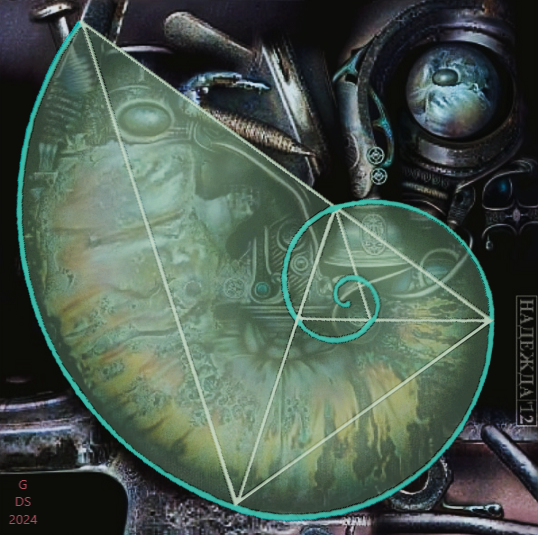
Phi shells served up on a modern paisley fabric (sourced here). Geometry: 2024, DS.
"meme - n. a unit of practice or belief through which a society or culture evolves and that passes from one generation (or even one person) to the next. In this sense, the term — coined in 1976 by British biologist Richard Dawkins (1941– ) and derived from the Greek word for “imitation”— is a kind of metaphorical parallel to the term gene."
- An interesting definition of "meme" found in the online American Psychological Association's Dictionary. As a "metaphorical" gene, in lieu of its lack of actual physicality, we can expect a meme to operate in a manner similar to the gene: subconsciously and/or subliminally. Unlike the gene, it is transferred from one mind to the other... often in the form of a symbol, although not necessarily a visual symbol.
The images posted above, and inset right, and inset left and right below are the result of a new 2-dimensional toy I developed last year and introduced in The Universe in a Phi Shell: phi shells. I can't remember what inspired me to make phi spirals into phi shells, but it was probably pretty elementary. However, once I saw the effect the shells produced on some images, I was astounded. In so many cases the phi shell was like an envelope - die-cut to fit a golden spiral - or a custom-made template... with maybe a little wiggle room.
Sometimes, working with a phi shell leads to repositioning the original spiral. Inset right is a prime example: Boy Blowing Soap Bubbles by 17th century Dutch painter (and Bentvueghel), Karel Dujardin. (See the post for the former spirals.)As concise as this spiral appears, it could be larger and better... but, As we see time and time again, some portion of the necessary image area is missing. What sold me on the orientation of this spiral, however, is the way the boy's right arm - holding the bubble pipe - falls so neatly into the small triangle. It's as if the boy is drawing the spiral in the air.
"Proponents theorize that memes are a viral phenomenon that may evolve by natural selection in a manner analogous to that of biological evolution. Memes do this through the processes of variation, mutation, competition, and inheritance, each of which influences a meme's reproductive success. Memes spread through the behavior that they generate in their hosts. Memes that propagate less prolifically may become extinct, while others may survive, spread, and (for better or for worse) mutate. Memes that replicate most effectively enjoy more success, and some may replicate effectively even when they prove to be detrimental to the welfare of their hosts."- A cautionary quote from the Wiki entry for "meme," and one that might make a certain amount of sense to those acquainted with what I've come to refer to as the "Golden Meme." I could even go so far as to says this might be reflected in my own experience... including the "detrimental to their hosts" bit, but, I try not to entertain fantastical innuendos that accelerate my level of paranoia.
"When Pacioli (the Renaissance mathematician) wrote in his Divina Proportione: '.. just like God cannot be properly defined, nor can be understood through words, likewise this proportion of ours cannot ever be designated through intelligible numbers, nor can it be expressed through any rational quantity, but always remains occult and secret, and is called irrational by the mathematicians'... he seemed to be equating the golden ratio with a variety of magical formula. That is, through his recognition and understanding of "this proportion of ours" he was attempting a marriage between several disciplines: science, art and mysticism. And, this wasn't unusual for the early Western scientists, many who dabbled in astrology, numerology and alchemy side by side with astronomy, mathematics, botany... and the arts. The scientific field was wide open - the hard lines were still blurred...
The "new scientists" were seeking enlightenment, autonomy, discovery, truth. And, it was into this slowly reawakening world that the pentagonal spiral made its appearance... and not necessarily for the first time. Similar to the sign of the pentagram - by which the followers of Pythagoras "knew each other" - perhaps, the "sign" of the pentagonal spiral enabled the Baroque artists to identify like-minded artists... kindred spirits in a world in which freedom did not, yet, ring."
"Keep in mind that the spiral was also present in Baroque ornamentation... and possibly somewhere in Baroque music, too. So, were the artists, artisans, and musicians completely aware of its proportions and using it as a measure of perfection and beauty? Or, was the proliferation of golden spirals (at that time) an almost paranormal thing... or a variety ofsubliminal meme... an unconsciously recognized icon which was possibly a symbolic presentiment on the part of an artistic community who were, without noticing it, heralding an evolutionary phase of a whole society?"
A Baroque flourish (w/ phi shells). G-DS-2024.
- Two quotes via my blogpost: The Gentilischi Spirals and a Series Afterword. One painting appearing in that post is the image reposted (inset right) above the flourish: Orazio Gentileschi's Young Woman with a Violin. It's phi shell is looser than the original spiral I gave it, which, resting on her lap like a humongous sea shell, gives the image a somewhat comical appeal... but the spiral and triangle intercepts the young woman's bow perfectly, so, we have to admire its cleverness.
The flower painting, inset left, above her, however, was the work of Dutch Baroque artist, Willem Van Aelst and can be found in Part III of the Bentvueghel series, where we become acquainted with the curious appearance of the garden snail in flower paintings. And, really, if the Dutch flower painters used the snail as a clue indicating that a larger spiral was deliberately embedded in their paintings, well, all I can say is, what a brilliant idea!
Directly above is a portion of a Baroque ornament recently found (now decorated with phi shells). Not all Baroque flourishes were as golden as this one, but, considering the quantity of spirals appearing on furniture, architecture and textiles, the golden meme was alive and well.
***
For the past few years, I've spent a lot of quality time pondering the meaning of the appearance of the pentagonal golden ratio in works of art, artifacts and in architecture. I can't say for sure why this is so anymore, but, once upon a time, there seemed to be a point. I had a plan. Nowadays, I have to ask myself, why in the world would anyone actually sit down and spend a great deal of quality time blogging about obscure topics to an evaporating audience while everything in the surrounding area (the world, that is) seems to be either rapidly going down the tubes, or up in flames?
And, this isn't the first time I've asked myself this question!
On the other hand, blogging about obscure topics to an evaporating audience - in view of the tubes and flames - presently encourages my survival. Perhaps, blogging is kind of a therapy after all. Or, perhaps, in an absurd world, doing nonsensical things in response to Armageddon is appropriate.
And, it is in this state of mind I will reveal my latest pentagonal phi epiphany... which just happens to regard a description I've used previously: subliminal meme. The kind of meme that just might slip into an image while the artist was totally unaware of it, as it did in 2012, when I created Metamorphosis Interrupted, reposted (inset left), with a phi shell that fits the unfortunate worm like a chrysalis! (See: A Virtual Can of Worms.)
Generally speaking, the unconsciously produced spirals in the images referred to in the Worms post were not all that strong. However, the worm's proportions in Metamorphosis is very close to perfect. But, while I was aware that I was being very finicky about the shape of the worm's body while creating it, in reality, at the time of its creation, I had never even heard of the pentagonal golden spiral!
So, is this an indication of phi "on the brain"? Are our brains somehow wired to its aesthetic or does it go deeper than that? Is this why the ratio was referred to as "divine" - in that it is embedded so deeply in our consciousness we assume it is an outer force? Or, when we find it in organic life, is it merely the imprinted diagram of actual physical forces science is already aware of?
Or, taking into consideration the nature of a meme, can you actually "catch it" like the common cold?*
Speaking of brains, I was delighted to find an image of one that seamlessly fits into a phi shell (inset right). Of course, humans tend to have rounded skulls, so it should come as no total surprise. But, then again, the image is an illustration and not an MRI, so, this is an artistic interpretation (and a very nice one) by Hank Grebe.
I didn't notice this till I was adding my geometry "stamp" to the image, but what lies at (a very important) 3-cornered junction of the spiral nearest to the coil - technically, the apex of the smallest golden triangle (and its spiral) - is that notorious pine-cone-shaped brain element, the mysterious pineal gland or "third eye." Oddly enough, it is depicted here as another tiny golden triangle (click for enlargement.)
M74, or the Phantom galaxy... embellished with a phi shell. (G-DS-2024).
'The most merciful thing in the world, I think, is the inability of the human mind to correlate all its contents. We live on a placid island of ignorance in the midst of black seas of infinity, and it was not meant that we should voyage far. The sciences, each straining in its own direction, have hitherto harmed us little; but some day the piecing together of dissociated knowledge will open up such terrifying vistas of reality, and of our frightful position therein, that we shall either go mad from the revelation or flee from the light into the peace and safety of a new dark age."
"Messier 74, also called NGC 628, is a stunning example of a "grand-design" spiral galaxy that is viewed by Earth observers nearly face-on. Its perfectly symmetrical spiral arms emanate from the central nucleus and are dotted with clusters of young blue stars and glowing pink regions of ionized hydrogen (hydrogen atoms that have lost their electrons). These regions of star formation show an excess of light at ultraviolet wavelengths. Tracing along the spiral arms are winding dust lanes that also begin very near the galaxy's nucleus and follow along the length of the spiral arms.
M74 is located roughly 32 million light-years away in the direction of the constellation Pisces, the Fish... In its entirety, it is estimated that M74 is home to about 100 billion stars, making it slightly smaller than our Milky Way."
- Via this Hubble page, we are introduced to the M74 galaxy discovered by the French astronomer Pierre Méchain in 1780. It is a kind of go-to spiral galaxy for those seeking spiral perfection. Of course, for the golden (pentagonal) spiral hunter, gazing at it's sinuous, twisting, mollusk-like proportions is sheer bliss... as, if there were a God and It had a face, this would be it. (God the mollusk! The Mollusk god. So, burn me at the stake. See if I care.)
"Messier 74 (also known as NGC 628 and Phantom Galaxy) is a large spiral galaxy in the equatorial constellation Pisces. It is about 32 million light-years away from Earth. The galaxy contains two clearly defined spiral arms and is therefore used as an archetypal example of a grand design spiral galaxy. The galaxy's low surface brightness makes it the most difficult Messier object for amateur astronomers to observe. Its relatively large angular (that is, apparent) size and the galaxy's face-on orientation make it an ideal object for professional astronomers who want to study spiral arm structure and spiral density waves. It is estimated that M74 hosts about 100 billion stars."
- This quote was sourced from the Wiki entry for M 74, along with the galaxy image used in this post (inset left). That the Phantom is considered an "archetypal example" of a "grand design spiral galaxy" is kind of interesting... in light of the fact that it is composed of 2 near-perfect pentagonal golden spirals. (And, when discussing massive deep-space objects, "close" is about as good as it gets.)
"This Hubble Space Telescope photo of Messier 74 reminds us that spiral galaxies are some of the most beautiful and photogenic residents of the universe. Nearly 70 percent of the galaxies closest to the Milky Way are spirals. New research finds that spiral arms are self-perpetuating, persistent, and surprisingly long lived."
"How the spiral arms form continues to puzzle scientists. One theory suggests the galaxy arms could be the result of density waves traveling through the outer disk. Encounters between galaxies could cause such waves as the mass of the smaller galaxy could affect the structure of the larger galaxy as the two combine."
- Two quotes from this Space.com article... reminding us of how little is known - and how much there is to know - about our cosmos.
***
I'm a busy woman these days, and I hate it. All it amounts to is more stress. But, tell that to an artist's muse. Time perplexes muses. They simply don't get it.
So, I currently have five posts sitting on the back burner, an unfinished digital image - my first formal digital image since my 2022 car accident - a ceramic project that MUST go into production this month, and a number of tedious life issues to deal with... and deal with, and deal with. But, then, last night I came across this photograph (inset right) of M74, the Phantom galaxy and, within minutes, I found myself absorbed in playing with my latest graphic toy, a phi shell (rhymes with seashell)... trying to decide which color to use from my ever-growing palette. In the end, only the white shell did the Phantom any justice, and even this had to be almost transparent... to endow it with that certain marine life appeal which, for whatever reason, seemed appropriate.
Anyway, I decided to post 2 images to the blog for the (freakish) enjoyment of those who, like myself, delight in this sort of thing. (Yes, in case you haven't noticed it, we constitute a minority.)
Oh, and incidentally, the "phi shell" - my attempt to give the common mathematical diagram a little extra-dimensional pizazz - will be appearing quite often in the coming days. I confess; I'm hooked on phi shells now, and there's no help for it!
Adieu, till next time... :-)
Via the ESA: a multi-observatory view of the Phantom.
The Heart Nebula (detail) - Photo credit: 2022, Ernie-Jacobs. Geometry: 2024, DS.
"What's that inside the Heart Nebula? First, the large emission nebula dubbed IC 1805 looks, in whole, like a human heart. It's shape perhaps fitting of the Valentine's Day, this heart glows brightly in red light emitted by its most prominent element: hydrogen. The red glow and the larger shape are all created by a small group of stars near the nebula's center. In the heart of the Heart Nebula are young stars from the open star cluster Melotte 15 that are eroding away several picturesque dust pillars with their energetic light and winds. The open cluster of stars contains a few bright stars nearly 50 times the mass of our Sun, many dim stars only a fraction of the mass of our Sun, and an absent microquasar that was expelled millions of years ago. The Heart Nebula is located about 7,500 light years away toward the constellation of the mythological Queen of Aethiopia (Cassiopeia)."
- Via this NASA archive page: In the heart of the heart nebula. Basically, the Heart Nebula - in the constellation Cassiopeia, composed of 5 major stars - seems to be an artifact created by gases from the birth processes of new stars, but, well, nothing I've read simplifies it to that degree, so it's merely my guess. In any case, it's very impressive looking... like looking into the innards of an exploded star (nova) or a bubbling cosmic cauldron. Also, see its companion: the Soul Nebula... and an interesting star, φ Cassiopeiae.
Inset right is a cardioid animation, created by Atomic Shoelace, and sourced from the Wiki entry for Heart Symbol. I've never seen this before, but, looking at it now, it appears that the cardioid and the pentagonal golden spiral have something in common.
Pigeons Passing By (detail) - Thomas Bennet. A beautiful rendering of passenger pigeons in the wild.
"In 1760 an extraordinary Occurrence happened about the Centre of the Wachovia Tract, on a Creek to this day called the Pidgeon Branch, which has the Appearance of an Improbability, yet actually happened, to the great Amazement of the Beholders, viz. an incredible Number of wild Pidgeons assembled there every Night for a Month together, in a small District, perching manyfold upon one another, so as by their Weight to break down the largest Limbs of Oaks, bending the Tops of others to the Ground … The Noise was so terrible that a Man speaking to his next Neighbor could not be heard without bawling loud, and Waggonloads of Pidgeons killed with Sticks were carried off."
- Both the vintage quote and Bennet's image were found in the essay Pigeons Passing Bywritten by T. Edward Nickens, describing what was purportedly a common occurrence across parts of North America in the 18th and 19th centuries: clouds of nomad passenger pigeons settling upon tree branches which broke beneath the weight of their great numbers. In some respects, it may have been this "plague of locusts"-like behavior which sealed their fate... especially when they sometimes settled on a farmer's crops.
"...And then, within a few decades, it all came crashing down. One of the planet's most successful birds went from billions to one, dwindling down to a final survivor named Martha who lived her entire life in captivity. She was found dead in her cage at the Cincinnati Zoo around 1 p.m. on Sept. 1, 1914, completing one of the fastest and most dramatic extinctions ever witnessed by humans.
...People used all kinds of maniacal tactics to kill pigeons, including burning down nest trees, baiting the birds with alcohol-soaked grain, trapping them in huge nets and even luring them with captive pigeons on small perches — the origin of the term "stool pigeon."
'There were 600 to 3,000 professional hunters who did nothing but chase the birds all year long,' Greenberg says. 'The people hunting them knew they were decreasing, but instead of saying 'let's hold off,' they hunted them more intensely. Toward the end, they just started raiding all the nests. They wanted to get every last bird, squeeze every last penny out of them before they were gone.'
For anyone who had seen torrents of passenger pigeons in the 1860s and 1870s, it was hard to believe they were nearly extinct in the 1890s. After the final holdouts in Michigan vanished, many people assumed the birds moved farther west, maybe to Arizona or Puget Sound. Henry Ford even suggested the entire species had made a break for Asia. Eventually, though, denial gave way to grim acceptance. The last-known wild passenger pigeon was shot April 3, 1902, in Laurel, Indiana."
- Quoted text is from the article: 100 Years Later, the Passenger Pigeon Still Haunts Us, recounting the sad tale of the extinction of the passenger pigeon, the wild North American bird which, in ways, resembled American wild doves (see painting above) more than the standard pigeon. Inset right is a vintage photograph of a juvenile of the species found here.
Illustration from Emil Schachtzabel’s Pigeon Prachtwerk (1906).
"This year marks the centenary of the death of the last Passenger Pigeon, the most numerous bird ever known, but one that did not survive the colonization of North America. I am willing to mourn that last captive voyager, a miracle of evolution, a postcard for extreme biodiversity, a bird more appreciated now than it ever was in life, except as a meal.
Many people, at least in cities where Rock Pigeons are common, think of them as “flying rats"... Perhaps the critics have forgotten a guy called Charles Darwin, who, despite his social position as a member of the country gentry, was interested enough to attend pigeon shows, buy birds, and bore dinner guests such as Charles Lyell with his obsessive table talk about them."
- Via this marvelous page Unnatural Selection: Emil Schachtzabel’s Pigeon Prachtwerk (1906), which reminds us that it was through Darwin's "obsessive" study of domesticated pigeons that he developed his ideas of "unnatural selection" regarding the evolution of a species. One pigeon fancier who was inspired by Darwin's theories was Emil Schachtzabel, who published Pigeon Prachtwerk in 1906 featuring numerous examples of exotic breeds illustrated by the German artist and critic, Anton Schöner (1866–1930) inset left. Directly above and below are two amazing illustrations from the book; many more can be found in the article.
Another strange breed of pigeons via the Pigeon Prachtwerk collection.
of mourning doves, have heard them hidden far back
under the eaves, or perched among sycamore branches—
their five still notes sometimes lost in the wind—
and not known how to answer: this I confess,
lying here now, on a summer morning, in a dark room
no less lit by the sound of their soft calling..."
- From the poem Mourning Doves by American poet, Jared Carter,
found along with the quote which follows (below), on this Mythic Livingpage.
"The mourning dove of North America is, as its name suggests, sometimes connected to the notion of the soul’s passing from this life to the next. Thus, the appearance of the bird has been associated with visitation from the “other side”. This is not a new metaphor, nor is it only North American. It is usually understood to be a reassuring representation that life goes on, albeit separated from the still-living."
(If there's one thing I've learned about Camus during the course of our dance is that the man is infectious. He makes a writer want - actually need - to write. So, to all of you who write - not necessarily to make a living, but because you need to bring some kind of order and meaning to your life - when blocked, read Camus. There's something to be said for a writer who - without saying so - encourages you to just open up and spit it out.
That being said, I think I can safely report: I've come back to this blog for a bit, and my heart seems to be in it. So, that's good. As to why I suddenly need to blog so much - and I do not really consciously know - well, it's a slightly unsettling question... which need not be addressed presently. We'll just run with it.
Today's story is about a bird. A bird who can, potentially, talk. A bird who is hunted... perhaps haunted. A familiar bird to many humans as it has emigrated to numerous locations across the globe. It is a refugee, and, this is why it is, perhaps, more unbound than other species of birds. It might also be more intelligent than some of them... it has, after all, learned to adapt to many different countries and has seen many nationalities and races of people. It has heard snatches of human conversation in many diverse languages - gathering them into its memory banks - by, what we can assume to be, a brain's osmotic processes - as it sat quietly, sometimes invisibly, on its high perch overlooking its adopted land.
But, I wasn't aware of any of that when this story first began... a true story, regardless of my interpretation.
Above,inset right, the Watcher, a dove parked outside my bedroom window... as it often is every day.)
***
The star(s)s of my story - the Eurasian collared dove, is related to the mourning dove, unique birds when you think about it. On the eastern coast of the US the mourning dove (inset left & inset right below) is such a common sight and its song is so instantly identifiable, one never fully grasps it's oddness. It is considered a songbird but it's song is short, wistful and slightly melancholy, often described as "a lament". Think: graveyards, willow trees and grey gardens... (Listen to it here.)
But, NM is a different sort of place. It is not near the ocean - the land is trapped... and its ghosts know it. The birds, however, do not. Many of them migrate. Even seagulls, ocean birds who will find no large bodies of water here, fly into NM's dry interior. There is, no doubt, a scientific explanation for this, but, I'd rather imagine the seagulls can sense the ancient oceans which once flowed here thousands of years ago, and are following deeply embedded biological markers in the landscape and atmosphere.
Then again, there is something about birds which demands we endow them with magical powers... whether they possess them or not. However, we must consider: their bodies are flying vehicles. Can't touch that.
Anyway, the story begins in a vague sort of way... that is I began hearing some mysterious bird every morning when I woke up. It had a strange vocalization; not a song really. In an eerie way, it seemed to be saying something. Now, I could go into the general setting in which I live, but, for the sake of economy, I'll skip all that. The fact is, that I heard a bird calling outside of my window every day... and sometimes on the launchpad (my dedicated smoking room). And, it's "song" began to bother me. Abrasive, the bird's vocalizations were not patterns of musical notes. They uncannily resembled human speech, but I couldn't make it out.
Then, one day, it suddenly came to me that I could understand what the bird seemed to be saying. I cannot identify what had changed enabling this to happen. It just did. In fact, it seemed obvious; in it's weird, hollow, bird-voice - which seemed to originate somewhere in its belly - it seemed to be repeating the same phrase over and over again:
"Coco is dead."
During this same period I had a weird bird encounter. What looked like a mourning dove flew onto the fence surrounding the launchpad (see: Dancing with the Ghost...). It startled me because it came quite close to my face, peering at me with one large dark eye. Then it lifted off and flew away. For anyone familiar with mourning doves, this was unusual; they're timid birds. But, I noticed the band around its neck, and wondered if it might be a slightly different variety of dove, maybe an exclusively southwestern variety. At this stage of the game, I didn't know.
Meanwhile, my bird with its grave announcement had somewhat changed its message. In fact, it was changing its message every other day. I now alternately heard: "Coco is dead," "Coco escaped," "Coco has escaped," and one day, "Coco is ALIVE! Sometimes different names replaced "Coco." There were three different names but I wrote down (and remember) only 2 of them: Yahghol and Jockarelle. (I've spelled them the way they sounded and would be pronounced - in English - with the accent on the first syllable.) I think it was at this point that I finally took my experience more seriously. I was beginning to imagine I was listening to an official avian town crier...
"Whenever a man hears it he is young, and Nature is in her spring; wherever he hears it, it is a new world and a free country, and the gates of Heaven are not shut against him."
Out here in the west, at least, where I currently reside, there are no wood thrushes... and I miss them. In late spring and early summer, they'd begin singing around twilight in the forest behind my childhood home, and the sound was both haunting and inviting... as in Frost's poem (above).
The thrush's song is also a good antidote for "writer's block". And, I'm afraid, writer's block is a symptom of whatever virus or bug I've been battling for the past few weeks.
And, so, despite having several posts in various stages of completion, I'm taking a break from blogging for a short while. Not really long. Just long enough to go outdoors and remind myself that a.) it's spring, and, b.) I actually live on a planet.
Then again, if you must know, a small, nesting sparrow outside my kitchen window advised me. While a sparrow's song can't hold a candle to the thrush's - it's too repetitious...(although no worse than pop music!) - it still knows how to get its point across. And the sparrow's point was: "Get away from that computer keyboard... now!"
Of course, there are those who would debate whether or not birdsong is even musical... scientists mostly. For instance, you'll note in the quote below that, although scientists have detected certain harmonics in the hermit thrush's song which match human patterns, they are still not convinced that birds "have music"... which is quite the opposite of my own views (see my earlier Language of the Birds post), but, then, no one ever accused scientists of having imaginations! ;-)
_______________________________________________
"Once described as the finest sound in nature, the song of the North American hermit thrush has long captivated the human ear. For centuries, birdwatchers have compared it to human music – and it turns out they were on to something. The bird’s song is beautifully described by the same maths that underlies human harmonies.
... The study shows a natural bias in the thrush towards certain harmonies, similar to those found in humans and some other birds, says Martin Braun of the Swedish organisation Neuroscience of Music in Karlstad, who says the study is an important contribution to the field.
Others remain cautious. Dale Purves of Duke University in North Carolina points out that it concerns just one species, and one component of music – pitch. “What does it all mean? That’s unclear,” he says. The study may explain why the hermit thrush song sounds melodious to our ear, but the debate over whether or not animals have music, and whether theirs is similar to ours, remains very much open."
Well, I'll let you be the judge, but, yes, it sounds like music to me! But, then again, scientists make a living by having such "debates".
On the other hand, I defy them to listen to the Russian canary (below), without becoming at least a tad persuaded. While it's true that the little birds are trained, the point is... well, many human musicians are trained. The important thing is that the birds have the aptitude... and this tiny creature is positively orchestral!
I actually hesitated before posting the above video... I detest the practice of caging birds. But, this amazing bird was actually performing in front of a small crowd - dig on that, if you will - so I caved. Besides which, now that I think of it, isn't chaining oneself to a computer for hours on end kind of like being trapped in a cage?
And, on that note, um... see ya later! :-)
* Interestingly, also from the Wiki entry: "The male (wood thrush) is able to sing two notes at once, which gives its song an ethereal, flute-like quality."
But, naturally, if one scrolls down in the article, we find the creature, like so many animals, is becoming endangered:
"The wood thrush has become a symbol of the decline of Neotropical songbirds of eastern North America, having declined by approximately 50% since 1966. Along with many other species, this thrush faces threats both to its North American breeding grounds and Central American wintering grounds. Forest fragmentation in North American forests has resulted in both increased nest predation and increased cowbird parasitism, significantly reducing their reproductive success."
This reminds me too much of a similar sad story... that of the starlings in my article about the starling's amazing murmurations.
** For another link to a similar article, and more about the wood thrush, see this past post.
The illustration for Michael Maier's 21st alchemical Emblem
from Atalanta Fugiens, by Swiss engraver, Matthäus Merian, 1617.
(All images in this post can be clicked for their original, larger size.)
The Philosopher's Stone
"Make of the man and woman a Circle, of that a Quadrangle, of this a Triangle, of the same a Circle and you will have the Stone of the Philosophers.
...In like manner the Philosophers would have the Quadrangle reduced into a Triangle, that is, into a Body, Spirit and Soul, which three appear in the three previous colours before Rednesse: that is, the Body or earth in the Blacknesse of Saturn, the Spirit in the Lunar whitenesse as water, and the Soul or air in the Solar Citrinity. Then the Triangle will be perfect, but this again must be changed into a Circle; that is, into an invariable rednesse, by which operation the woman is converted into the man and made one with him, and six the first of the perfect numbers is absolved by one, two having returned again to an unity in which there is Rest and eternall peace."
"The theoretical roots outlining the stone’s creation can be traced to Greek philosophy. Alchemists later used the classical elements, the concept of anima mundi, and Creation stories presented in texts like Plato's Timaeus as analogies for their process. According to Plato, the four elements are derived from a common source or prima materia (first matter), associated with chaos. Prima materia is also the name alchemists assign to the starting ingredient for the creation of the philosopher's stone. The importance of this philosophical first matter persisted throughout the history of alchemy. In the seventeenth century, Thomas Vaughan writes, "the first matter of the stone is the very same with the first matter of all things".
"Dr. Sigismund Bacstrom believed that if a physician could establish harmony among the elements of earth, fire, air, and water, and unite them into a stone (the Philosopher's Stone) symbolized by the six-pointed star or two interlaced triangles, he would possess the means of healing all disease. Dr. Bacstrom further stated that there was no doubt in his mind that the universal, omnipresent fire (spirit) of Nature: "does all and is all in all." By attraction, repulsion, motion, heat, sublimation, evaporation, exsiccation, inspissation, coagulation, and fixation, the Universal Fire (Spirit) manipulates matter, and manifests throughout creation. Any individual who can understand these principles and adapt them to the three departments of Nature becomes a true philosopher."
"Associated with spontaneous symmetry breaking is the phenomenon of symmetry restoration. If one heats a system that possesses a broken symmetry it tends to be restored at high temperature. ... Above the critical temperature the system exhibits rotational symmetry. Such a transition from a state of broken symmetry to one where the symmetry is restored is a phase transition. We believe that the same phenomenon occurs in the case of the symmetries of the fundamental forces of nature. Many of these are broken at low temperatures. Very early in the history of the universe, when the temperature was very high, all of these symmetries of nature were presumably restored. The resulting phase transitions, as the universe expanded and cooled, from symmetric states to those of broken symmetry have important cosmological implications."
I suppose the "Restoration of Symmetry" seems like a rather coldly analytical approach to Love, but, for a "geometer moth" - that is, those of us for whom connecting-the-dots, so to speak, is an integral part of our nature - finding the hidden codes which help describe the world in which we live is not so much what we do, but what we are. And, like the geometrid, we do not tenaciously hide this information from view - as if it were knowledge we, alone, had access to - but, instead, wear the information on our metaphorical wings... or the skin of our backs. That is to say, we display information; we are unable to secret it away.
A contemporary glyph for Maier's diagram shown in his 21st emblem (above).*
Symmetry is a word that has tremendous importance in the world of science - in physics, chemistry, mathematics, biology, and, yes, even philosophy - in which its definition varies somewhat, but, ultimately, refers to the similar phenomenon one finds in art and geometrical figures. Basically, it refers to physical parts, properties, or processes which are equivalent in two or more directions. The circle is a figure which, for instance, is geometrically equivalent in all directions, and is thereby described as having rotational symmetry. The Philosopher Stone glyph shown above - a modern interpretation of German alchemist (and counsellor to Emperor Rudolf II) Michael Maier's emblem (circa 1617) (artist unknown) - has bilateral symmetry, in that if a line is down its center, each side is exactly equivalent to the other, although seen in reverse. This can also be referred to as reflective symmetry as one side effectively mirrors the other.




.jpg)
.jpg)


