Showing posts with label Middle East. Show all posts

Wednesday, July 1, 2026

Valentine's Day of the Dead (Part III) - A Country at War (Revised July 16, 2026)


Queen of Spades - screen print - 2022, Mahdieh Farhadkiaei

"In Iranian culture, women have historically cut their hair off in mourning, and over the past week we have seen videos of women snipping their locks at the funerals of loved ones killed by security forces. The act has also become a symbol of bodily autonomy and resistance against the oppressive regime."

- Via the 2022 Guardian article: Something in me sparked’: the Iranian women using art to protest.


"To walk among Iran’s rose gardens in spring is to experience a sensory and cultural journey. The air is thick with the heady scent of blossoms; the early morning sun glints off dew-laden petals; villagers hum songs while harvesting; poets and painters find inspiration in the delicate folds of each bloom. It is a celebration of nature, art, community, and history—a testament to a love affair that has endured for millennia.

In Iran, the rose is more than a flower. It is  memory, passion, spirituality, and identity rolled into a single, fragrant bloom. It embodies the Iranian understanding of beauty and impermanence, connecting the material and the divine, the ordinary and the transcendent. It is, quite simply, the flower of the nation’s heart."

- Excerpted from the online article: Iran’s Enduring Love Affair with the Rose. This information was, believe it or not, new to me and represented yet another thread in the weird web of synchronicities I found myself entangled in.

As it so happens, from mid-May to mid-June in the province of the ancient and beautiful city of Isfahan, Iran, there is the thousand-year old festival of Golab giri, a celebration of rosewater made from the fragrant Damask Rose (inset right), Iran's national flower which grows in abundance there. 
 

"I am like a schoolchild madly

in love with her geometry books.

I am forlorn

and imagine it is possible to take the garden to a hospital.

I imagine I imagine

And the garden’s heart has swollen in the heat

of this sun, its mind slowly drains of its lush memories."

- From I Pity the Garden, a poem written by beloved Iranian poet, film-maker, artist and feminist writer Forugh Farrokhzad (December 29, 1934 - February 13, 1967) and translated by Sholeh Wolpé.

Previously in the poem she mourns: "Our neighbors plant bombs and machine guns, instead of flowers, in their garden soil.
They cover their ponds, hiding bags of gunpowder..."
and, "I fear the age that has lost its heart, the idleness of so many hands
the alienation in so many faces."


Often compared to Sylvia Plath, her poetry has a similar sense of urgency and rebellion. Their lives shared a similar tragic cast. Unlike Plath, however, Farrokhzad's  material can be wildly erotic and, at the same time, in the Persian tradition of Rumi, the Rose & the Nightingale and the Language of the Birds, strangely mystical.*

I am particularly moved by the line "I fear the age that has lost its heart."

I fear that age is now.

(Continued below the jump...)

Tuesday, July 8, 2025

A Face in the Crowd


"A girl looks on among Afghan women lining up to receive relief assistance, during the holy month of Ramadan
in Jalalabad, Afghanistan, June 11, 2017." Photo credit: Parwiz/REUTERS (found here).


ICC issues arrest warrants for Taliban leaders over persecution of women and girls


"THE HAGUE, Netherlands (AP) — The International Criminal Court issued arrest warrants Tuesday for the Taliban’s supreme leader and the head of Afghanistan’s Supreme Court on charges of persecuting women and girls since seizing power nearly four years ago.

The warrants also accuse the leaders of persecuting “other persons nonconforming with the Taliban’s policy on gender, gender identity or expression; and on political grounds against persons perceived as ‘allies of girls and women.’”

***

“I am not free while any woman is unfree, even when her shackles are very different from my own. And I am not free as long as one person of colour remains chained. Nor is any one of you.”

- Poet Audre Lorde via Uses of Anger: Women Responding to Racism.


I think we've all been waiting a long time to hear news like this, but I suspect the women living in Afghan (and other countries in which women are denied full autonomy)  have been waiting far longer... and with an urgency most of us have experienced to a lesser degree. One should keep in mind that all things are relative and this gap is always in danger of closing... and, I don't think there is one woman or feminine person who is not in some way aware of it. It is embedded in the feminine morphic field (along with many other fears). 

But, if there has been any good news this year, this is surely it! Take heart; some good may come of it... keeping in mind that the wheels of justice seem to turn very slowly these days.

Also see: Afghan women face near total social, economic and political exclusion.

Artful Resistance: How Afghan Women are Wielding Art Against the Taliban


New! A thoughtful reader just sent me this sobering link. Think you live in a free world? Guess again. (Thanks Bella!)

What Is Modern Slavery: A Comprehensive Research

"Over 49.6 million people (0.61% of the global population) are subjected to modern slavery, surpassing the populations of around 200 countries."


Monday, October 28, 2024

Higher Ground - A Meme

Devi Vijaya Lakshmi - the Lakshmi of Victory - a colorfully painted statue - G - DS - 2024.


In the Hindu understanding of the cosmos, the female counterpart of Vishnu - Lakshmi - is the Devi, or goddess, of prosperity... "who is the guiding light for the world - who has obtained the sustained (continued, everlasting) glance (Grace) from Brahma."

Also: "She is often depicted sitting upon a lotus and adorned with lotus at her hands and feet. Many of her names, Padmā, Kamalā, Ambujā, refer to the lotus. The lotus has powerful symbolism in Hinduism. While its roots are in the mud, its stalk rises clearly through the murky water, with its petals blossoming above, untouched by the mud. It is a symbol of rising above the material world through divinity, of being good in the midst of negative influences."

You will note how precisely the figure of the Devi fits within the Golden Egg I transposed over it. I have seen this phi configuration often in depictions of Hindu goddesses, reminding us that the pentagonal golden spiral is very prominent in ancient Near & Middle Eastern art. See my Paisley post.


Lakshmi was first introduced on this blog in this post. (Shyamala Gopalan didn't name her daughter Kamala Devi for nothing. She saw the future.)

(For more images of this beautiful Devi, try here.)

***

prosperous (adj.)

synonyms: thriving, doing well, fortunate, successful, lucky, rich, vigorous, roaring, strong, productive, flourishing, booming, opulent, golden...

antonyms: depressed, poor.

- Via Google/Oxford Languages. Prosperous is a word few of us can really wrap our heads around. Why is this?

I see them every day now in southwestern Albuquerque... more of them, and more frequently: the misfortunate nomads - the darker side of the American dream - wheeling their life's belongings in shopping carts down the vacant streets with no destination... no protection, no peace. They appear to be American refugees of every description. While I was never one of them, I, too, was homeless - and, theoretically, still am - but the emergence of the new Traveler or Nomad and the plight of the disenfranchised is not a recent development. I began living in my car the year following Trump's inauguration. And, then, came the Black Hole - the Pandemic. We all know the rest.

It is true: we - none of us - can "go back"; "back" no longer exists as we once knew it.

(Continued below the jump...)

Sunday, March 17, 2024

The Paisley Pattern & the Golden Meme


Phi shells served up on a modern paisley fabric (sourced here).
Geometry: 2024, DS.


"memen. a unit of practice or belief through which a society or culture evolves and that passes from one generation (or even one person) to the next. In this sense, the term — coined in 1976 by British  biologist Richard Dawkins (1941–  ) and derived from the Greek word for “imitation”— is a kind of metaphorical parallel to the term gene."

-  An interesting definition of "meme" found in the online American Psychological Association's Dictionary. As a "metaphorical" gene, in lieu of its lack of actual physicality, we can expect a meme to operate in a manner similar to the gene: subconsciously and/or subliminally. Unlike the gene, it is transferred from one mind to the other... often in the form of a symbol, although not necessarily a visual symbol.

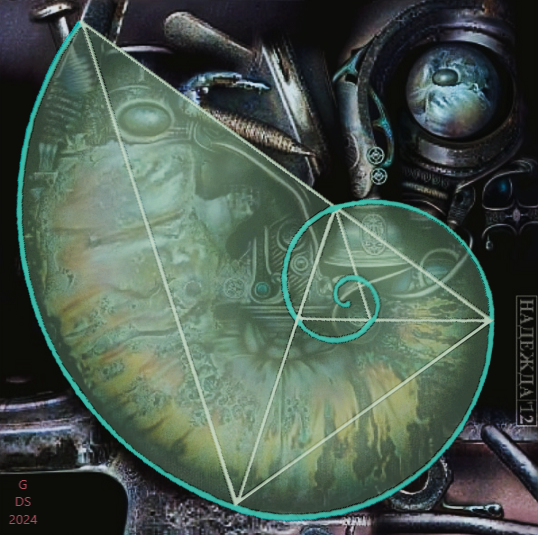
The images posted above, and inset right, and inset left and right below are the result of a new 2-dimensional toy I developed last year and introduced in The Universe in a Phi Shell: phi shells. I can't remember what inspired me to make phi spirals into phi shells, but it was probably pretty elementary. However, once I saw the effect the shells produced on some images, I was astounded. In so many cases the phi shell was like an envelope - die-cut to fit a golden spiral - or a custom-made template... with maybe a little wiggle room.

Sometimes, working with a phi shell leads to repositioning the original spiral. Inset right is a prime example: Boy Blowing Soap Bubbles by 17th century Dutch painter (and Bentvueghel), Karel Dujardin. (See the post for the former spirals.) As concise as this spiral appears, it could be larger and better... but, As we see time and time again, some portion of the necessary image area is missing. What sold me on the orientation of this spiral, however, is the way the boy's right arm - holding the bubble pipe - falls so neatly into the small triangle. It's as if the boy is drawing the spiral in the air.

"Proponents theorize that memes are a viral phenomenon that may evolve by natural selection in a manner analogous to that of biological evolution. Memes do this through the processes of variation, mutation, competition, and inheritance, each of which influences a meme's reproductive success. Memes spread through the behavior that they generate in their hosts. Memes that propagate less prolifically may become extinct, while others may survive, spread, and (for better or for worse) mutate. Memes that replicate most effectively enjoy more success, and some may replicate effectively even when they prove to be detrimental to the welfare of their hosts."

- A cautionary quote from the Wiki entry for "meme," and one that might make a certain amount of sense to those acquainted with what I've come to refer to as the "Golden Meme." I could even go so far as to says this might be reflected in my own experience... including the "detrimental to their hosts" bit, but, I try not to entertain fantastical innuendos that accelerate my level of paranoia.

"When Pacioli (the Renaissance mathematician) wrote in his Divina Proportione: '.. just like God cannot be properly defined, nor can be understood through words, likewise this proportion of ours cannot ever be designated through intelligible numbers, nor can it be expressed through any rational quantity, but always remains occult and secret, and is called irrational by the mathematicians'... he seemed to be equating the golden ratio with a variety of magical formula. That is, through his recognition and understanding of "this proportion of ours" he was attempting a marriage between several disciplines: science, art and mysticism. And, this wasn't unusual for the early Western scientists, many who dabbled in astrology, numerology and alchemy side by side with astronomy, mathematics, botany... and the arts. The scientific field was wide open - the hard lines were still blurred...

The "new scientists" were seeking enlightenment, autonomy, discovery, truth. And, it was into this slowly reawakening world that the pentagonal spiral made its appearance... and not necessarily for the first time. Similar to the sign of the pentagram - by which the followers of Pythagoras "knew each other" - perhaps, the "sign" of the pentagonal spiral enabled the Baroque artists to identify like-minded artists... kindred spirits in a world in which freedom did not, yet, ring."

"Keep in mind that the spiral was also present in Baroque ornamentation... and possibly somewhere in Baroque music, too.  So, were the artists, artisans, and musicians completely aware of its proportions and using it as a measure of perfection and beauty? Or, was the proliferation of golden spirals (at that time) an almost paranormal thing... or a variety of subliminal meme... an unconsciously recognized icon which was possibly a symbolic presentiment on the part of an artistic community who were, without noticing it, heralding an evolutionary phase of a whole society?"

A Baroque flourish (w/ phi shells). G-DS-2024.

- Two quotes via my blogpost: The Gentilischi Spirals and a Series Afterword. One painting appearing in that post is the image reposted (inset right) above the flourish: Orazio Gentileschi's Young Woman with a Violin. It's phi shell is looser than the original spiral I gave it, which, resting on her lap like a humongous sea shell, gives the image a somewhat comical appeal... but the spiral and triangle intercepts the young woman's bow perfectly, so, we have to admire its cleverness.

The flower painting, inset left, above her, however, was the work of Dutch Baroque artist, Willem Van Aelst and can be found in Part III of the Bentvueghel series, where we become acquainted with the curious appearance of the garden snail in flower paintings. And, really, if the Dutch flower painters used the snail as a clue indicating that a larger spiral was deliberately embedded in their paintings, well, all I can say is, what a brilliant idea!

Directly above is a portion of a Baroque ornament recently found (now decorated with phi shells). Not all Baroque flourishes were as golden as this one, but, considering the quantity of spirals appearing on furniture, architecture and textiles, the golden meme was alive and well.

***


For the past few years, I've spent a lot of quality time pondering the meaning of the appearance of the pentagonal golden ratio in works of art, artifacts and in architecture. I can't say for sure why this is so anymore, but, once upon a time, there seemed to be a point. I had a plan. Nowadays, I have to ask myself, why in the world would anyone actually sit down and spend a great deal of quality time blogging about obscure topics to an evaporating audience while everything in the surrounding area (the world, that is) seems to be either rapidly going down the tubes, or up in flames?

And, this isn't the first time I've asked myself this question!

On the other hand, blogging about obscure topics to an evaporating audience - in view of the tubes and flames - presently encourages my survival. Perhaps, blogging is kind of a therapy after all. Or, perhaps, in an absurd world, doing nonsensical things in response to Armageddon is appropriate.

And, it is in this state of mind I will reveal my latest pentagonal phi epiphany... which just happens to regard a description I've used previously: subliminal meme. The kind of meme that just might slip into an image while the artist was totally unaware of it, as it did in 2012, when I created Metamorphosis Interrupted, reposted (inset left), with a phi shell that fits the unfortunate worm like a chrysalis! (See: A Virtual Can of Worms.) 

Generally speaking, the unconsciously produced spirals in the images referred to in the Worms post were not all that strong. However, the worm's proportions in Metamorphosis is very close to perfect. But, while I was aware that I was being very finicky about the shape of the worm's body while creating it, in reality, at the time of its creation, I had never even heard of the pentagonal golden spiral!
 
So, is this an indication of phi "on the brain"? Are our brains somehow wired to its aesthetic or does it go deeper than that? Is this why the ratio was referred to as "divine" - in that it is embedded so deeply in our consciousness we assume it is an outer force? Or, when we find it in organic life, is it merely the imprinted diagram of actual physical forces science is already aware of?

Or, taking into consideration the nature of a meme, can you actually "catch it" like the common cold?*

Speaking of brains, I was delighted to find an image of one that seamlessly fits into a phi shell (inset right). Of course, humans tend to have rounded skulls, so it should come as no total surprise. But, then again, the image is an illustration and not an MRI, so, this is an artistic interpretation (and a very nice one) by Hank Grebe.

I didn't notice this till I was adding my geometry "stamp" to the image, but what lies at (a very important) 3-cornered junction of the spiral nearest to the coil - technically, the apex of the smallest golden triangle (and its spiral) - is that notorious pine-cone-shaped brain element, the mysterious pineal gland or "third eye." Oddly enough, it is depicted here as another tiny golden triangle (click for enlargement.)

(Continued below the jump...)

Sunday, October 23, 2022

Raga For a Sunday Afternoon (Update: 2/14/23)


It's been an emotionally devastating week and I desperately needed something to transport me back to my comfort zone... that is, I had to touch base with myself again. Sometimes, in order to accomplish this, one has to travel even farther away from the tried & true to find that magical, alchemical ingredient which can allow ones spirit to heal and thrive once again in a world which is often antagonistic to truth, beauty, and all things eternal and incorporeal.

Some time ago, when I was able to embed small videos on the sidebar of this blog, I posted a small series of Indian artists: Anoushka Shankar, and the amazing classical vocalizations of the artist below, Nina Burmi.


The mesmerizing voices of Burmi and Kaushiki Chakraborty (the first artist) worked for me then and they work for me now. Maybe, every once in awhile, we need a little (sacred) breathing space.

Just found (2/14/23)Kaushiki Chakraborty, a master singer (and a force of nature) offers up another awesome classical performance: Raag Bhairavi.


Saturday, June 14, 2014

To Decode The Living Matrix... Featuring the Work of Cristóbal Vila


From the video: Isfahan - 3D digital still - 2005, Cristóbal Vila


matrix |ˈmātriks|
noun ( pl. -trices |ˈmātrisēz| or -trixes )
1 an environment or material in which something develops; a surrounding medium or structure : free choices become the matrix of human life.
• a mass of fine-grained rock in which gems, crystals, or fossils are embedded.
• Biology the substance between cells or in which structures are embedded.
• fine material : the matrix of gravel paths is raked regularly.
2 a mold in which something, such as printing type or a phonograph record, is cast or shaped.
3 Mathematics a rectangular array of quantities or expressions in rows and columns that is treated as a single entity and manipulated according to particular rules.
• an organizational structure in which two or more lines of command, responsibility, or communication may run through the same individual.

ORIGIN late Middle English (in the sense [womb] ): from Latin, ‘breeding female,’ later ‘womb,’ from mater, matr - ‘mother.’


North American Wood Thrush

“As we listen we lose the sense of time—it links us with eternity…Its tones…seem like the vocal expression of the mystery of the universe, clothed in a melody so pure and ethereal that the soul still bound to its earthly tenement can neither imitate nor describe it.”
- Anonymous Twentieth Century naturalist describing the Wood Thrush


"It was dawn and as I lay there listening to the birds w/ my eyes shut I began to see a weird pattern emerging from the darkness... an almost graphic pattern similar to computer graphics... It looked like chopped meat being criss-crossed (sic) by a rapidly moving concentric ring pattern... similar to my cyclocentric* patterns but more intricate. From this emerged what seemed like another darker dimension - again filled with cyclocentric patterns but these were made of various colors of light... and some were large and whirlpooling (sic) while smaller brighter patterns emerged... all of them moving and vibrant and living and all of them revolving and forming harmonics by which even tinier glowing patterns emerged. It was as if I was delving into a series of many dimensions... but I could only glance at certain aspects (of the patterns) for milliseconds at a time (as they were) far too complex and enmeshed for human resolution...

Friday, November 22, 2013

The Jewel - Image and Premonition


The Jewel - Digital - 2006, Dia Sobin


She looks like some exotic, tattooed, Middle-Eastern cat-woman - possibly a court card from the Tarot of the Cat People - and was the first of my enigmatic hybrid creatures; but, I have a strange amnesia about this image, and how it emerged. And, it's difficult to talk about, because it's emergence coincided with the death of my mother in 2006; a harrowing, catastrophic period in my life (and hers), which I'd give anything to forget.

But, the point of this post - and the one which will follow it - is an attempt to discuss the paranormal aspects of art, specifically, art as imagery. Which is not to say the word "paranormal" appeals to me, because it doesn't. I prefer to refer to all of the weirder, inexplicable, and/or misunderstood varieties of human experience as transdimensional* - precognition, telepathy, ghosts, aliens, UFOs, faeries, the whole lot. In other words, I feel that all these human experiences are very real, and valid. Why we fail to understand them is because, in spite of all we think we "know", we don't "know" enough. We may never know enough.