Wednesday, September 14, 2022

The Gentileschi Spirals... and a series Afterword

Young Woman Playing a Violin, 1612, Orazio Gentileschi. Geometry: 2022, DS.


"Orazio Lomi Gentileschi (1563–1639) was an Italian painter. Born in Tuscany, he began his career in Rome, painting in a Mannerist style, much of his work consisting of painting the figures within the decorative schemes of other artists. After 1600, he came under the influence of the more naturalistic style of Caravaggio. He received important commissions in Fabriano and Genoa before moving to Paris to the court of Marie de Medici. He spent the last part of his life at the court of Charles I of England. He was the father of the painter Artemisia Gentileschi."

- Introduction to the Wiki entry for Orazio Gentileschi, generally referred to as a Mannerist.


"Michelangelo once gave this advice to his pupil Marco da Siena, that one should always make the figure pyramidal, serpentine, and multiplied by one, two or three. And in this precept, it seems to me, is contained the secret of painting, for a figure has its highest grace and eloquence when it is seen in movement—what the painters call the Furia della figura. And to represent it thus there is no better form than that of a flame, because it is the most mobile of all forms and is conical. If a figure has this form it will be very beautiful...The painter should combine this pyramidal form with the Serpentinata, like the twisting of a live snake in motion, which is also the form of a waving flame... The figure should resemble the letter S... And this applies not only to the whole figure, but also to its parts...The figure will not appear graceful unless it has this serpentine form, as Michelangelo called it."

- Via this link (posted previously) regarding the Mannerist's S-curve or Figura serpentinata. The engraving inset right is the given example of this figure found at the beginning of the Wiki entry. The golden embellishment is my own. I first mentioned the Serpentinata in a footnote in Part III of the Bentvueghel series. I was confused about it then and am confused about it now. Was it or did it become a code word for the golden spiral?

(Note: I think the figura serpentinata directly above has another spiral going in the opposite direction. Sadly, I am not able to test this; my main computer is currently sitting in the trunk of my car which is currently sitting in the place it was towed yesterday morning after the accident. Physically I'm okay but the car isn't and this is seriously bad, as you might imagine. I will persevere with this post but it may take me longer than usual. Shit happens. Sorry, but I'm in need of a miracle.)

***

(Update 10/3/22: In my first note - above - I had just had a freak car accident - while blinded by the sun, I hit an aluminum streetlight in the center of the highway - and totaled my "mobile home."

But, that wasn't the end of the nightmare.

While at the towing facility - a facility I was assured was safe - someone broke into the trunk of my car and stole my relic of an Imac In other words, they stole all my original graphic files from the past 10 years or so... up to and including those of the present day, that is, my pentagonal spiral work.

As you might imagine, there have been many reasons that blogging has become next to impossible. Nonetheless, I have written a little of the text for this post. See below.)

***

It probably goes without saying that this blogger (moi) seemingly became addicted to the pentagonal golden spiral in some strange way over the past 6 months.  Well, it would have to be strange, wouldn't it? As a geometrical figure, the golden spiral is merely the combination of a series of triangles and a series of circles in a specific proportion to one another, aligned in a specific way; what's to get addicted to? A mathematical proportion? Can one get really get addicted to a mathematical proportion?

Apparently.

I find I keep coming back to the blog to reassess the spirals I detected in the numerous examples of Renaissance and Baroque paintings I posted- well, that's my excuse anyway - but, using a different set of brain cells, I realized I possessed an ulterior motive. The addict's motive: pleasure... although (presumably) on a non-physical, abstract level.

So, we're back to the word "strange." How strange?  Strange enough to compel this addict to draw spirals through 69 paintings while said addict's actual, physical life was on the fast track to Hell. (See introductory paragraphs).

But - despite present,  perpetual, real-time preoccupations - I still have to wonder about the 33 European artists in whose paintings the spiral was found. It seems they lived during a period of (roughly) 200 years - predominantly during the Baroque period which, in turn, lay on the cusp of the Age Enlightenment (1680–1820)... that is, when scientific inquiry was in its infancy in the western world.

Now, this specific period in history might be a factor in our inquiry... then again it may not; it depends upon how we classify these artists and their spiral paintings. It shouldn't be difficult; there are actually only 2 ways to go in this analysis: the artists in question either deliberately designed some paintings with the spiral in mind or they didn't.

Keep in mind that the spiral was also present in Baroque ornamentation (inset left) and possibly somewhere in Baroque music, too.  So, were the artists, artisans, and musicians completely aware of its proportions and using it as a measure of perfection and beauty? Or, was the proliferation of golden spirals (at that time) an almost paranormal thing... a variety of subliminal meme... an unconsciously recognized icon which was possibly a presentiment on the part of an artistic community who were, without noticing it, heralding an evolutionary phase of a whole society?

And, this brings us to the Gentileschi spirals. Specifically, Orazio's, although we'll look at Artemisia's, too. But, Orazio's Young Woman Playing a Violin is similar - and as spectacular - as Judith Leyster's Jolly Toper especially because the spiral is so in-your-face; you can't possibly miss it. More to the point (literally) is that although the spiral I located is somewhat smaller than it could be, where it and the triangle falls on the bow is simply too remarkable to be, shall we say, a natural occurrence and this convinces me that Orazio, like Judith, must have been consciously aware of what he was doing. The spiral is too tight to be a happy accident. Moreover, Orazio has given us another example (below the jump) but, as I have no graphics program on this laptop, you're going to have to work this spiral out for yourself...

Thursday, September 8, 2022

Vale, Elizabeth!


Truly, the end of an era has arrived... a turning point in the world's affairs. Elizabeth II wasn't merely the Queen of England, she was Empress of the Globe... a goddess... a woman who, for many of us, was a prominent personality all throughout our lives.

What will we do without her?


Friday, September 2, 2022

In the Shadows of a Golden Age: the Bentvueghels - Part III


"Maria Sibylla Merian is celebrated for her caterpillars and butterflies; Van Schrieck, an equally distinguished butterfly painter, preferred toads, lizards and snakes. In fact, this voracious reptile hunter earned the sobriquet “Snuffelaer” (snuffler) because of the time he spent sniffing around in the undergrowth looking for his beloved models, allegedly even subjecting them to his kisses. And they loved him back: the denizens of his personal menagerie at his modest country house outside Amsterdam’s St Anthony Gate – he called “the land of snakes” – would even hold a pose, patiently wrapped around his maulstick (resulting in the coiling figura serpentinata in his paintings)...

The catalogue’s four essays and 36 mini-essays contextualize Van Schrieck within the artistic and scientific communities of his day, capturing the intersection of art, science and the occult when the boundary between them was still porous, and rehabilitating him as a man of science rather than a mere “curiosity”. Their task is not difficult because their subject was prescient in his passion for accuracy and empiricism (he used a microscope, rare at the time), and he collaborated with scientists in one of Europe’s leading intellectual centres. However, his scholarly side did not keep him from painting fantastical landscapes with improbable plants..."

- From the article: Otto Marseus van Schrieck: introducing the inventor of the 'forest-floor' still-life, written in regards to an exhibit (and accompanying catalogue) of Schrieck's work at the Staatliches Museum Schwerin and Rijksmuseum.

Snuffelaer, or "ferreter" was actually Schrieck's "Bent" code-name. What I found particularly intriguing in the article, however, was mention of a figura serpentinata, an art term I'd never heard before.*


***


The Flower Painters
__________________________________________________


(As it happened) when I first spied Otto van Shrieck's strange little mushroom composition (above), I intuitively knew it would be the initial spiral image for this post. Not that its spiral was immediately  (visually) evident - it wasn't - but it's as if could almost hear it... a little fugue of musical notes and correspondences... and, sure enough, there was not merely a spiral winding its way though the shadows on the forest floor but an extraordinary spiral and the first example of its kind... a virtual orchestration! The actual serpent in the painting may as well be an afterthought.

But, then Otto van Schrieck was a fairly extraordinary man. Nicolaes Lachtropius was one of his followers, as well as Willem van Aelst (the second Bentvueghel presented here). And, it is with Van Aelst (1627-1683) that we will find our greatest number of golden spirals... almost always accompanied by that small creature that originally inspired this present inquiry: the snail!

A selection is below the jump.

Wednesday, August 24, 2022

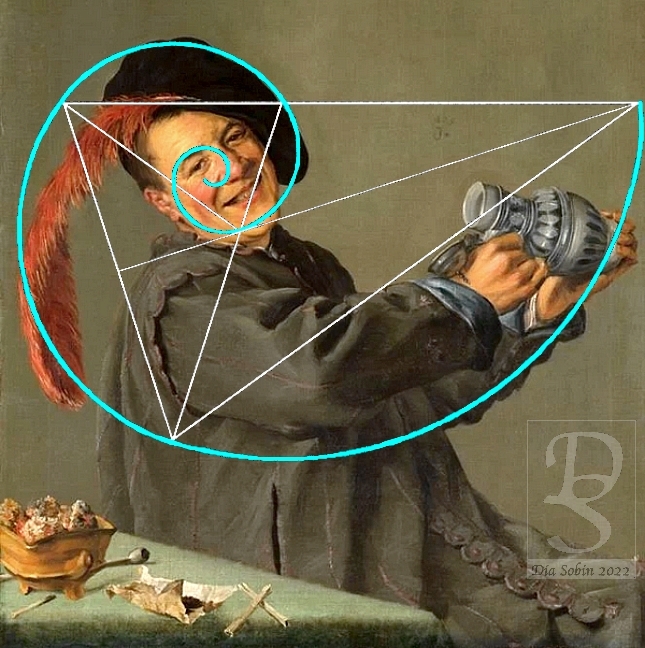
Judith Leyster Saves the Day (An Addendum of Sorts)

The Cheerful Drinker (or Jolly Toper), 1629, Judith Leyster. Geometry: 2022, DS.


"One perk is that I keep finding golden spirals in paintings... specifically from the Netherlands (in recent weeks)... and all of them from the 1600s (amongst some real Plague Years). Judith Leyster was a painter from an earlier part of that century, however, and one I didn't expect to find as it's unlikely that she and the other artists (who may be theoretically involved) ever crossed paths. While they were just blooming, Judith Leyster had already been cut down and claimed by matrimony, children, and, at the age of 50, death.

(Update 4/11/22) Note: Due to new information regarding the Italian painter, Caravaggio (1571-1610), Judith Leyster's involvement with pentagonal geometry becomes increasingly feasible.)"

- Quoting myself from the post: Judith Leyster and a Double Golden Spiral. (Added: 8/27/22Inset right: Another spiral position for the Jolly Toper (above).  Also, Leyster is known for her puns using graphic symbols. Question: does the line-up of objects in the foreground (lying diagonally across the table) represent a word?

***

It's an odd thing, but whenever I find myself deeply involved in a specific subject, very often certain books will synchronistically fall into my hands which, upon opening, just happen to address the things I had recently been researching. The latest book - which appeared one day this week in the library's "Free Books" bin - was this gem: The Age of Rembrandt and Vermeer by J.M. Nash, 1972... that is, a book about the Dutch Golden Age!

But, there's another book, too, a novel - The Last Painting of Sara De Vos by Dominic Smith - which also fell into my hands in the same way. "Sara Vos" is a fictional character based on an actual artist from the Dutch Golden Age, Sara van Baalbergen, who, according to Wiki, was the first female member of the Haarlem Guild of St. Luke (Judith Leyster came a little later). As for her artwork, tragically: "No known works survive."

Anyway, so, while researching Sara I found an amazing spiral by Leyster - in this article - which has been posted above. And, really, finding this perfect spiral made my day. It immediately struck me as a confirmation: yes, Judith Leyster did know of the GTS... and (via the J.M. Nash book) I may have picked up a clue as to her source of knowledge...
 

Sunday, August 14, 2022

In the Shadows of a Golden Age: the Bentvueghels - Part II

Boy Blowing Soap Bubbles, 1663, Karel Dujardin. Geometry: 2022, DS.


"Drawn to the eternal city for its reputation as the birthplace of the Baroque movement, the ragtag group quickly earned a reputation for their drinking and brawling, as much as for their art. A print in the British Museum depicts one of their raucous initiation ceremonies: the newcomer with a candle up his backside. The names of the group’s members can still be seen hacked into the walls of the fourth-century Church of Santa Costanza in Rome, which used to be known as the Temple of Bacchus.

Despite their wine-sodden reputation, many of the Bentvueghels became successful artists in Rome. Fusing Dutch Golden Age influence with the revolutionary, realist style of painting that Caravaggio had championed in Italy at the beginning of the century won them many important patrons and commissions, often from the ecclesiastical elite.

Similarly, when they returned to their homelands in northern Europe, they exploited the Italian influences they had acquired with great success."

- From the Christies' page: Who were the Bentvueghels?  The painting (inset left) documents an alleged Bentvueghel initiation and has been reposted (see Part I).

“'There was a tavern nearby and the artists would come in the early hours after a night of drinking and pray to what they believed was Bacchus’ tomb. They often carved out the name of a new arrival in Rome, as a form of homage.”

Adrift in the big city, the young arrivals formed communities or fraternities, rather like medieval brotherhoods. Only while their predecessors went to church in procession to escape hell or avoid purgatory, these young men dedicated themselves to Bacchus, revelling in their vices and spending their time in brothels and taverns rather than churches. The Dutch artist Pieter van Laer, nicknamed Il Bamboccio, combined business with pleasure by running a tavern. With other Flemish artists, he was a member of the Bentvueghels or birds of a feather.

After being “baptised” – with wine rather than holy water – the new entrant received a nickname, usually a descriptive one. Cornelius Van Poelenburgh became the Satyr, and Dirck van Baburen was Beer Fly. Sometimes imagination failed and poor Gerard van der Kuijl was simply dubbed Arse. Van Laer founded a rival brotherhood named Bamboccianti after his own nickname, meaning puppet or clumsy in reference to his disability.

The artists, despite their love of drink and debauchery, were educated. They would have read Terence and knew that, Sine Cerere et Bacco Venus friget (without food or wine, love cannot flourish). When they were arrested for being drunk and disorderly, they would explain that their excesses were part of their education. “I only wanted to improve my Italian,” pleaded the French painter Jean Ducamps when accused of practicing forbidden sports with native Romans..."

- From the Guardian article: The Baroque Underworld: Vice and Destitution in Rome review – high art and low life in the Eternal City. Note: according to Wiki, Jean Ducamps was Flemish, not French, as is stated in the quote.

Inset right is another spiral position in the Manfredi painting shown previously, Bacchus and a Drinker.  Again, see Part I. Strangely enough, in this spiral placement, the spiral terminates into the mouth of Bacchus as opposed to the mouth of the drinker, as one might expect; possibly implying that, in the act of imbibing, the drinker inadvertently satiates the god, Bacchus, also referred to as Dionysus.

________________________________________________________________

Karel Dujardin (1626 - 1678)


Karel Dujardin  - code name: "Barba di Becco" (goat-beard) - was born in Amsterdam. At some point between his first trip to Venice and his second trip (when and where he "unexpectedly" died), he married an older woman in France to help pay debts he accrued there. Needless to say, she was abandoned when he returned to Italy. His self-portrait is inset right.

I think Boy Blowing Soap Bubbles is possibly one of the most charming spiral designs I've used in this post and I've featured two other spiral placements below.

Beneath the Boy... is another Dujardin painting: Tobias and the Angel. I have two spirals for this image as well, but, as I think the one shown is the better one (and this post is fat with images), I'll place it aside.

Incidentally, in the large painting (seen inset above) - the Bentvueghel initiation - there are not one but two men, one on each side of the painting, who seem to resemble Dujardin's self-portrait... to which I have no explanation!


The two spirals (above) really need no explanation, but note the triangle in the one on the left; it connects the positions of the boy's hands with the top of his swirling mantle. It is a golden measurement.

Tobias and the Angel, 17th century, Karel Dujardin. Geometry: 2022, DS.


Above are two spiral placements in Dujardin's Hagar and Ishmael in the Wilderness, circa 1662. Take your pick! While I realize that some of you may feel that several spirals in one painting weakens my argument, the reality is that multiple spirals - while it is unlikely the artist planned them - are really artifacts of one spiral... proving that the "gold" in a painting really is distributed evenly throughout the image... as the pentagram is, in a sense, always a fractal of an entire golden field of pentagrams.

Below the jump: a few of Nicolas Régnier's amazing spiral paintings.

Friday, August 5, 2022

In the Shadows of a Golden Age: the Bentvueghels - Part I

Young man singing, 1622, Dirck Jaspersz van Baburen. Geometry: 2022, DS.


(Well, cats and kitties, I'm back... bringing to you what is probably my last post featuring spirals in paintings from the long past. It was a wonderful rabbit-hole-journey, but I think I've finally come to the end of this particular tunnel... and that's the good news! There are a number of images and bits of info to document though, and experience tells me that it will take 2-3 parts to cover them all, but, I feel pretty confident about this material, so, well, I'm just aiming for a "job well done" and hoping some of you, at least, will find it worth the bumpy ride!)


"Rome’s artists’ guild, the Accademia di San Luca (of which Cardinal Del Monte became patron in 1596), dates to the late 15th century, but the diverse, cosmopolitan nature of Rome’s artistic population gave rise to other more informal groups. Most prominent of these was the Bentvueghels (Birds of a Feather), whose Flemish name reflected the fact that it was dominated by Flemish and Dutch artists, but there were also members and associates of other nationalities, such as Valentin de Boulogne and Nicolas Régnier, as well as local Italian artists who contributed to the group’s often unruly activities.

Indeed, the so-called Bent became a bohemian epicenter of drunkenness and debauchery. Their presiding deity was Bacchus, inventor of wine and god of both liquid and artistic inspiration. The exhibition opens with several celebratory images of Bacchus, including the Caravaggesque “Bacchus and a Drinker” by Bartolomeo Manfredi and Dirck van Baburen’s “Pan,” almost certainly a self-portrait of the artist in the guise of this Greek deity famed for both his music and sexual prowess.

These works are accompanied by lively sketches of contemporary Bent artists, attributed to Leonaert Bramer and another — anonymous — Dutchman. Their subjects included Claude Lorrain, capacious wine glass in hand, and the Italian Caravaggesque painter Artemisia Gentileschi, dressed as a male and sporting a false mustache.

...Despite being rewarded with substantial sums for their work, both Guido Reni, who was addicted to gambling, and de Boulogne ended up in paupers’ graves. Giovanni Baglione, Lorrain and Manfredi all fathered illegitimate children, and Giovanni Lanfranco, Nicolas Poussin and van Laer were to die of syphilis. These artists spent their everyday lives in close proximity to the poor, the marginalized and the criminal, rubbing shoulders with them in cheap lodging-houses, taverns, dark drinking dives, gambling dens and prisons. This not only gave them an intimate knowledge of Rome’s underworld but, evidently, fostered in them a sense of fellow feeling, even respect, for its inhabitants."

- Excerpts from an enlightening NY Times article: Painters of the Dark Side of Rome. The painting inset left is (the slightly unsettling) Bacchus and the Drinker by Bartolomeo Manfredi.

***

I suspect that, after all is said and done, to discover the actual source of all the mysterious "gold" present in Dutch Golden Age paintings, one needn't look any further than that underground society of bohemian artists living in Italy - those odd "birds of a feather" - the Bentvueghels. Back in the days of Lachtropius, when I first discovered mention of them, I intuited they might be an important clue - especially in light of their connections with Italy (possibly the "home" of the golden triangle spiral) (GTS) - but after taking some time to analyze a number of the Bentvueghel painters and their images, I now think its possible to draw some conclusions. (!)

At first glance, the Bentvueghels seem like no more than a rowdy bunch of a decadent, male artists who enjoyed an exclusive fraternity... more or less a parody of a masonic lodge (before the latter even formally existed). So, ones first impression is that it was a boy's club for men set in post-Renaissance Italy; doubtlessly a sunny artist's playground for those journeying from northern Europe.


Initiation of a new Member of the Bentvueghels in Rome, 1660, Artist unknown.

But, perhaps, the Bentvueghels' theatrical flamboyancy - see painting above (and engraving to your right) - was a smoke screen... hiding activities of a more serious nature. We will never know. If their activities were a ruse, certainly a number of critics fell for it and regarded them as anything but serious artists or even members of an authentic art movement.

Regarding the golden ratio and my own analysis, however, well, the evidence is kind of intriguing. While there were group members who (seemingly) used the pentagonaI spiral (either knowingly or unconsciously) - I have, thus far, counted 12  - there were others who apparently did not.  Of those who did, some were also Caravaggisti... and, as we've seen, Caravaggio was the go-to "golden" expert of his time. And, yet, not all of the Bentvueghel Caravaggisti seemed to use the spiral. So, there's that mystery.

And, then, there are further complications. At least 6 of the artists left no surviving work, so, those artists are, for the most part, lost to us. Moreover, it seems, for whatever reason, the Bentvueghels themselves were not exactly "survivors", most dying in early middle age and a number - at least seven - dying much younger. A few made it past 60 and led fairly normal lives, but these, apparently, were the exception and not the rule...

Wednesday, July 20, 2022

Albrecht Dürer and the Divine Ratio (Part II) - Dürer Reconsidered

Melencolia I - copper engraving - Albrecht Dürer. Geometry: 2022, DS.


"Since this knowledge is very useful to workers, and since (it) has been kept hidden and in great secret by the erudite, I propose to bring it in the open and teach it."

- A quote from Albrecht Dürer found in this interesting article by Karel Vereycken: Albrecht Dürer’s fight against “neoplatonic” melancholy.

***

"...but, after reviewing the two other prints involved, it seemed all three might have what I (now) refer to as hidden, occulted, or passive GTS. Unlike the more outrageously active spirals - e.g., those of Caravaggio, which seem as if they were deliberately designed - the passive spirals almost seem to creep into an image with the artist unaware. The thing is, it is logical to assume Albrecht Dürer did know about the golden ratio. Alas, the jury is still out."

The quote above is my own - via my first Dürer post. As it happened, the "jury" eventually just walked through the door, and informed me I was wrong on two counts: Dürer's spiral is unlikely passive... and passive spirals are never occulted (deliberately hidden)... they merely occur without conscious intention.

And, what brought me to these conclusions? Well, the story went something like this:

The night after I (finally) finished Albrecht Dürer and the Divine Ratio (Part I), I fell into one of those peculiar, delirious dream-states which, after a day of continuous and repetitious physical and/or mental activity, seem to reflect and extend a similar activity into your sleep. In this case, after spending the day pondering over Dürer, I dreamt of having a chance to speak with the man himself (!) who, I was informed, was not merely alive, but in my general vicinity. But, of course, Albrecht Dürer has been dead for hundreds of years, so, it couldn't have been a corporeal Dürer... but, apparently, this did not make a difference to my dreaming mind. Now, what is especially weird about these labor-induced dreams is that one can wake up numerous times and, yet, each and every time fall back to sleep and return to the very same dream... continuing ones "labor" in a place of no-space and no-time.

And, so it was. But, did I ever actually communicate with the incorporeal artist? Not that I remember. However, when I awoke, this much was apparent to me: I had missed something in the Dürer "dig" and it was something important; my Dürer work was not yet done. 

Now, this could've proved to be a research mine-field but, as it turned out, later that day, I had an epiphany: yes, that ladder in Melencolia is golden, but, it isn't a one-trick-pony; there might be (at least) 2 more triangles tucked inside of it. And, of course, there were. The drawing of the ladder is actually composed of 4 main diagonals (6 if you're a stickler). And, coiling around the diagonal on the inside of the ladder (see above, and inset right) were spirals orientated in the opposite direction of my first (inside left below). Each spiral initially intercepts the comet, then, coils around the polyhedron before passing under the dog's snout, around the edge of the robe, and, finally, over the angel's knee and elbow before terminating around the end of one of the large compasses. (Yes, technically a "compass" is actually composed of a pair of compasses.)

Which is, certainly, quite a different story from the first spiral... (again, inset left) which (ingloriously) terminated somewhere up the dog's... posterior.(!)

Or is it a different story? Maybe its the same one... which begins from the creative point of a compass... but ends up... well, we know where it eventually ends up; hence, melancholy.

Then again, maybe Albrecht was just having his little joke...or, maybe just having a bad day. But, whatever his motives were, I think we can conclude that Dürer consciously knew what he was doing... and that all three spirals are (very likely) active ones... i.e., deliberate.


So, regarding the "Divine" ratio and its GTS, does this mean Dürer was finally informed by the Italian painters and/or Pacioli ?  No, actually, I don't think that was the case. The Italian painters and mathematicians were notoriously secretive and unlikely to hand over their knowledge to a foreign rival. Ultimately, he figured it out all by himself...

...because that's how great a geometer he was.

Note the drawing directly above. It is a detail of one of the diagrams from his book on human proportions, although I'm at a loss to explain exactly how and what he was measuring. But, here's a description from the British Museum page (on which it was found):

 "There is also a foreshortened section of a circle on the recto, with Dürer's notes on its construction written alongside. The drawing on the verso is accompanied by manuscript notes, in which Dürer gives extensive details of his method of construction with the use of compasses. This is based on the system of human proportion, with the body made up of eight head lengths, outlined by Vitruvius in his treatise 'On Architecture', whereby architects of antiquity were encouraged to follow an ideal human proportion in their planning of temples."

 The numerically-sectioned ellipse around the figure's uplifted arm is interesting... an example of Dürer's unusual and innovative techniques. (Below the jump) is the full figure upon which I've positioned a GTS...

Tuesday, July 5, 2022

Interlude


Got angst? I do. I'm coming to the table after a long (unwanted) holiday weekend and cannot pick up where I left off.

Can't do it. 

Meanwhile, I've just found this performance of Ball & Chain by Janis Joplin from Hamburg, Germany (1969) I'd never seen before... and felt it was necessary to share it.

Of all the possessed performers of the 1960s, I think Janis comes in at about #1.

Think she was kidding?

No, she wasn't kidding.

If you're in the mood for more live Janis: try her covers of Summertime and (that great old Chantels doo-wop tune) Maybe.

(Musings 7/27/22: You know you're getting old when Janis suddenly looks like what she really was - just a kid... She died one year after this concert took place. She was 27... or somewhere between 45 and 200. Which is just how extraordinary she was.... an explosive shamanistic force in the body of a self-conscious, perplexed young singer... who just happened to be a girl.)


Monday, June 27, 2022

Albrecht Dürer and the Divine Ratio (Part I)

Melencolia I - copper engraving - 1514, Albrecht Dürer. Geometry: 2022, DS


"Melencolia I is a large 1514 engraving by the German Renaissance artist Albrecht Dürer. The print's central subject is an enigmatic and gloomy winged female figure thought to be a personification of melancholia – melancholy. Holding her head in her hand, she stares past the busy scene in front of her. The area is strewn with symbols and tools associated with craft and carpentry, including an hourglass, weighing scales, a hand plane, a claw hammer, and a saw. Other objects relate to alchemy, geometry or numerology. Behind the figure is a structure with an embedded magic square, and a ladder leading beyond the frame. The sky contains a rainbow, a comet or planet, and a bat-like creature bearing the text that has become the print's title.

The art historian Erwin Panofsky... wrote that 'the influence of Dürer's Melencolia I—the first representation in which the concept of melancholy was transplanted from the plane of scientific and pseudo-scientific folklore to the level of art—extended all over the European continent and lasted for more than three centuries.'"

- Excerpt from Wiki's entry for Dürer's Melencolia 1 (shown above). While many art historians seem to unanimously assume the robed, angelic figure is of the female gender, the figure is most assuredly male, and, judging by its facial expression, Dürer himself. Inset right: an early self-portrait (executed in 1498 at age 26) of the fashionable - but seriously introspective - young dude.

Regarding the central "ladder leading beyond the frame," note that it forms the apex of a large golden triangle.

Note: To give an example of how deeply this image continues to resonate over the years, Wiki mentions Peter-Klaus Schuster's 1991 publication, Melencolia I: Dürers Denkbild, an exhaustive history of the print's interpretation in two volumes.


"It should be noted that even Leonardo was unable to apply his own proportion and anatomical studies to his work given he painted little, or not at all, during the last decade of his life. Hence, the applicability of the study of proportion to practicing artists was still unclear. Dürer would spend nearly three decades working to remedy this ambiguity. He completed two treatises that would be the dominant basis for art theory in Renaissance Germany; their popularity and influence spreading with their subsequent translations. In 1525, Underweysung der Messung, or Four Books on Measurement, was published as a practical guide to geometric perspective for students of the arts; and, in 1528, Vier Bücher von Menschlicher, or Four Books on Human Proportion, appeared a few months after his death. Taken together, the studies illustrated the Renaissance belief that mathematics formed the firm basis and grounding for the arts."

- Excerpt from an commentary regarding Dürer's Vier Bücher von Menschlicher by Giovanni Paolo Gallucci found here. Inset left is one of Dürer's diagrams - a construction of a spiral - found in his Four Books on Measurement.


"There is much speculation as to why Dürer chose this construction rather than Euclid's construction which uses the 'golden ratio' proportion. The speculation stems from the fact that Dürer makes no mention of the golden ratio, although he was no doubt aware of its use in Italian art. It may be that Dürer simply did not feel comfortable with the precepts of the 'divine' ratio. The German architects had their own 'divine' ratio which was the vesica piscis ratio of  1:3. In addition Ptolemy's construction is simpler than Euclid's and these constructions were just a preliminary step in his program."

- Excerpt - along with Dürer's diagram (inset left) - from The Polygons of Albrecht Dürer by G.H. Hughes. (.pdf)

Regarding the diagram, the pentagon is constructed within the mason's "Sacred" tradition utilizing the Vesica Piscis as its generative source.


"Divine truth alone, and no other, contains the secret of what the most beautiful form and measure may be."

- Albrecht Dürer, from his essay Discourse on A
esthetics
 published as a conclusion to the Third Book of his proportion studies. (See the Giovanni Paolo Gallucci link for the full quote.)


"The greatest miracle that I have seen in all my days, happened in the year 1503, when crosses fell on many people, especially on children more than on other people. Among them all, I once saw one in the shape which I have drawn here; it fell on the linen blouse of Eyer's maid, who was in the Pirckheimer's back-house. And she was so upset about it that she cried and wailed; for she thought she was going to die of it.

Also, I saw a comet in the heavens."

 - Albrecht Dürer from the last page of his 1503 Gedenkbuch regarding an episode of a phenomenon known as Red (or Blood) RainDürer's drawing can be found on this page.

***

(Note: Originally, the title of this post and the title of the URL were one and the same. That is, till I realized that Melancolia I was one of three designated Master Prints. I am not quite sure who did the designation, but, after reviewing the two other prints involved, it seemed all three might have what I (now) refer to as hidden, occulted, or passive GTS. Unlike the more outrageously active spirals - e.g., those of Caravaggio, which seem as if they were deliberately designed - the passive spirals almost seem to creep into an image with the artist unaware. The thing is, it is logical to assume Albrecht Dürer did know about the golden ratio. Alas, the jury is still out.)

Albrecht Dürer (May 21,1471 - April 6 1528) is, in his own quiet way, possibly one of the most popular artists of the Renaissance period; certainly one of the most prominent. (You know you've arrived when there's a conspiracy blog written about your life!) After all, unlike many other artists, he kept a meticulously written record of his daily affairs. And, then, there were those self portraits... even while he was ill and nearing the end of his life, he sketched his ravaged body for posterity. Perhaps, he just desperately needed to be remembered. But, why is it that all of his self-exposure seems, in the end, superficial? Because, regardless of what we learn, Dürer remains as firmly screwed into his shell as the most resistant of mollusks; he is an enigma even unto himself. In fact, his vital nature seems very much like another cryptic element found in one of his most popular images: Melencolia I (below the jump). Observe...

Tuesday, June 21, 2022

The Golden Series - Contents (Updated 10/3/24)


 The Golden Series

Phi, the Pentagram & the Golden Spiral

(An informal investigation regarding the role of the pentagonal golden spiral in art history from the ancient, classical period till the present day... observations and discoveries recorded in real time.)


Posts are listed from earliest to most recent.


Reflections on Water

Fractal Unit 5

Botticelli & the Spiral

2022 - A Tentative New Year

The Power of Love

Nicolaes Lachtropius & the Golden Spiral

Five of One, One of Five

Judith Leyster and a Double Golden Spiral

Carlo Crivelli and the "Queen of Heaven"

Caravaggio's "Golden" Boy(s)

The Golden Egg

"Da Vinci" and Other Codes - Part 1

"Da Vinci" and Other Codes - Part 2

A Virtual "Can of Worms"

Albrecht Dürer and the Divine Ratio (Part I)

Albrecht Dürer and the Divine Ratio (Part II) - Dürer Reconsidered

In the Shadows of a Golden Age: the Bentvueghels (Part I)

In the Shadows of a Golden Age: the Bentvueghels (Part II)

Judith Leyster Saves the Day (An Addendum of Sorts)

In the Shadows of a Golden Age: the Bentvueghels - Part III

The Gentileschi Spirals... and a series Afterword

Chasing Ancient Pentagrams: the Roman Dodecahedrons

Samhain, 2022; Leonora Carrington and the Philosophic Egg

Chasing Ancient Pentagrams Part II: The Quintessence: The Egyptian Duat

Chasing Ancient Pentagrams Part III: The Quintessence -The Fellowship of Pentalpha

Hygeia & the Pentalpha (post abandoned)

Venus in the Dovecote (Part I)

Venus in the Dovecote (Part II): The Ancient Sanctuary

Pentagonal Venus: the φ (phi) in Αφροδίτη (Aphrodite)

Gustave Moreau's Golden Venus

Five Spirals for December - #1 "Night Flight" by Michael Parkes

Five Spirals for December - #2   "Princenza Hyacinta" by Alphonse Mucha

Five Spirals for December - #3 One Winter's Night... by Erté

Five Spirals for December - #4 The Vision of St. Cecelia by Orazio Gentileschi

Five Spirals for December - #5 Song of the Morning by Nicholas Roerich

A Belated Christmas Spiral: The Annunciation by "Juan de Flandes"

The Heart Nebula & the Flaming Heart of Venus

The Universe in a Phi Shell

The Paisley Pattern & the Golden Meme

An Auspicious Day

The First of May

The Mirror of Venus: 5 Keys

The Dürer Files: A Series Introduction

The Dürer Files: 1. "Melencolia I" & The Golden Egg

Interlude with a Fallen Angel

The Dürer Files: 1b. Hendrick Goltzius & The Gods of the Golden Egg

The Dürer Files: 1c. The Bees & Keys of House Barberini


The above list is ever-changing... updated with live links as the intended posts are published.