(Formerly Trans-D Digital Art, a blog investigating - & creating - artistic anomalies since 2011.)
Sunday, June 12, 2022
100 Degrees in the Shade
Sunday, May 22, 2022
"Da Vinci" and Other Codes - Part 2
![]() |
| Saviour of the World - 16th century, Giampietrino. Geometry: 2022, DS. |
Saturday, May 7, 2022
"Da Vinci" and Other Codes - Part 1
In a previous post, I mentioned never having read The Da Vinci Code, which was true at the time, however, two weeks ago - and almost 20 years after it was written - I finally did get around to it! And, (surprise, surprise), it wasn't a half-bad story; a well-researched stew of speculation melding numerous, esoteric symbols - many of which have appeared on this blog - into one cohesive action-tale with enough suspense, espionage, counter-espionage and bloodshed to satiate the most demanding of audiences. And, yes, the hero gets the girl; what more could one ask for?
The thing is, the bulk of Brown's ingredients have been hashed and re-hashed by a number of (speculative) non-fiction authors in the past and will continue to bubble away on the back-burner. Alchemy, Freemasonry, the Rosicrucians, the Templar Knights, Rosslyn Chapel, the Cathars, the Black Madonnas, The Holy Grail, etc., are subjects that various researchers seem compelled to cobble together into one vaporous, homogenized form or another... as if all things of an esoteric nature must be intimately connected. Dan Brown attempted to accomplish the same feat with his fictional tale by adding several more symbols to the mix - the pentagram, the rose, the Fibonacci series, and the anomalous presence of (what appears to be) a female figure amid the disciples in Leonardo da Vinci's The Last Supper - all in support of the tale's major premise: the clandestine marriage of Christ and his "womb," Mary Magdalene, the alleged progenitors of the French Merovingian dynasty. And, to show his heart was in the right place (that is, the 21st century) Brown added a healthy pinch of Goddess-worship to the mix. In other words, even feminists could climb on board his train of thought.The problem is, while Brown didn't actually invent his own symbolic definitions, he tailored the existing ones to fit his tale. While attempting to somewhat mitigate the (wrongfully) tarnished reputation of the pentagram - and it's about time someone did - he also referred to it as an exclusively pagan symbol which represented the Sacred Feminine. What he fails to mention is that it was an early Christian symbol as well, and, in a former incarnation, was (metaphorically) indicative of both genders (as was the triangle); in it's upright position it represented masculine (aggressive) qualities and forces and in its "inverted" position represented the feminine (passive) counterparts. Inset left (above) is the stunningly beautiful (north) rose window at Amien's cathedral in France featuring an inverted pentagram.
The larger problem, however, rests with the enigmatic feminine figure in Leonardo da Vinci's The Last Supper; a figure (shown below the jump) which a number of speculators assume is a woman and Mary Magdalene the logical choice. As for Brown, his novel's entire theme is hinged on the womanhood of this figure, all interpretations to the contrary are ignored...
Wednesday, April 27, 2022
The Traveler Takes a Dive
"Kill the headlights and put it in neutral
Stock car flamin' with a loser and the cruise control
Baby's in Reno with the vitamin D
Got a couple of couches sleep on the love seat
Someone keeps sayin I'm insane to complain
About a shotgun wedding and a stain on my shirt
Don't believe everything that you breathe
You get a parking violation and a maggot on your sleeve
So shave your face with some mace in the dark
Savin' all your food stamps and burnin' down the trailer park
(Yo, cut it.)
Soy un perdedor
I'm a loser baby, so why don't you kill me?"
- Lyrics from I'm a Loser (Soy un perdedor) - 1993, Beck, Carl Stephenson.
"Forces of evil in a bozo nightmare"
I haven't listened to this song by Beck in a long time. And, then, about 2 days ago - like a bolt from the blue - it started running through my head non-stop.
So, as these (spontaneously emerging) tunes are generally the kinds of tunes I tend to post, I put it up. But, first, I listened to it on YouTube because I did wonder about it. Usually, an unconsciously inspired tune relates to some aspect of my life I haven't really expressed as of late... and, as is also usual with these tunes, they don't stop running through my head until I pin them down and decipher the message.
"Loser" was always an ironic video (and it has a good back-beat), but, now, in 2022, I detected a darker aspect I hadn't really noticed in 1994. Oddly enough, the first thing I surmised was that Beck had once been homeless. My second idea was that I was merely projecting. But, as it turns out, I was right the first time. According to Wiki, he had become homeless just before he wrote the song, "Loser."
"(In 1989...) daunted by the prospect of another homeless New York
winter, Beck returned to his home of Los Angeles in early 1991. 'I was
tired of being cold, tired of getting beat up,' he later remarked. 'It
was hard to be in New York with no money, no place... I kinda used up
all the friends I had. Everyone on the scene got sick of me.'
...By
1993, Beck was living in a rat-infested shed near a Los Angeles alleyway
with little money. Bong Load issued 'Loser' as a single in March 1993
on 12" vinyl with only 500 copies pressed. Beck felt that 'Loser' was
mediocre, and only agreed to its release at Rothrock's insistence."
Of course, this may just be something out of a press kit, but I think it's quite possibly true. I think I recognized this song and, for a homeless person, it's actually a very powerful song. In fact, I would say it's a Traveler's song... conveying the sort of attitude that, perhaps, the world's refugees should share: if you imagine I am a lesser person because of my present fate, then, wake up. Bad luck is like a car crash... a flood... a tornado... or being struck by lightening; you're in the wrong place at the wrong time; there's no reasoning with it and it's impersonal. Or, as my friend, Moo, once planned to use as her epitaph: "But, whatever was good... didn't happen."
And, it's not happening to a lot of people these days. Including me.
Welcome to the New Mexican Lottery...
Sunday, April 17, 2022
The Golden Egg
![]() |
| Original photo found here - Geometry: 2022, DS. |
If any day is for celebrating eggs, it'd have to be Easter. But, when you think about it, one of the first fundamental shapes we learn to recognize in childhood is that of an egg, and, when we do the math, the shape of an egg - that quintessential oval - is golden!
Some eggs are shaped more perfectly golden than others, but, it's probably safe to say that Phi - via the golden triangle - comes to us at the beginning of our lives in the most simple and primitive form we can imagine... and we never have to think about it.
It's also a beautiful marriage of symbols... the egg represents life itself... the spiral represents eternity... and Phi? Phi is a measure of perfection.
Have a great holiday!
Afterword
"The 'goose that lays the golden eggs' is a reference to a tale told in an Aesop fable. Aesop was a slave and a storyteller who lived in ancient Greece. He is famous for creating tales that illustrate timeless truths. These short stories remind us of simple lessons that everyone should know about life. For instance, in the story The Goose that Laid the Golden Eggs, a farmer comes into possession of a goose that literally lays one golden egg, everyday. Greed overcomes the farmer, and he becomes convinced that if he splits open the goose he will come upon an enormous sum of gold that he may have all at once, rather than waiting to receive a smaller amount of gold everyday in the form of golden eggs. He slaughters the goose and finds nothing inside except the usual entrails common to all geese. The moral of the story is: Those who have plenty want more and so lose all they have."- An excerpt taken from this Grammarist page regarding a fable allegedly penned by the ancient Greek writer known only as Aesop (620–564 BC) - who may have been the first black author of the western world. Inset right is a lovely little goose named Lucy who lives at the Secret Gardens of Helgian in Cornwall, England. You can read about her here (but don't be April-fooled; that egg is golden, and we have proof...)
Tuesday, April 5, 2022
Caravaggio's "Golden" Boy(s)
![]() |
| Amor Vincit Omnia - 1602, Caravaggio. Geometry: 2022, DS. |
"Caravaggio employed close physical observation with a dramatic use of chiaroscuro that came to be known as tenebrism. He made the technique a dominant stylistic element, transfixing subjects in bright shafts of light and darkening shadows. Caravaggio vividly expressed crucial moments and scenes, often featuring violent struggles, torture, and death. He worked rapidly, with live models, preferring to forgo drawings and work directly onto the canvas. His inspiring effect on the new Baroque style that emerged from Mannerism was profound. His influence can be seen directly or indirectly in the work of Peter Paul Rubens, Jusepe de Ribera, Gian Lorenzo Bernini, and Rembrandt. Artists heavily under his influence were called the "Caravaggisti" (or "Caravagesques"), as well as tenebrists or tenebrosi ("shadowists")."
"Caravaggio displayed bizarre behavior from very early in his career. Mancini describes him as 'extremely crazy', a letter of Del Monte notes his strangeness, and Minniti's 1724 biographer says that Mario left Caravaggio because of his behavior. The strangeness seems to have increased after Malta. Susinno's early-18th-century Le vite de' pittori Messinesi ("Lives of the Painters of Messina") provides several colourful anecdotes of Caravaggio's erratic behavior in Sicily, and these are reproduced in modern full-length biographies such as Langdon and Robb."
- Two separate quotes from Caravaggio's Wiki entries (linked to in the image caption above) from which all images in this post have been sourced. Inset right is Caravaggio's Narcissus at the Source, 1599... another "golden" boy, as we shall see... which begs the question: Did Caravaggio actually "forgo drawings and work directly into the canvas" or was that merely another element of the mythology which surrounded the tragic life of this artist?
***
By most accounts, "tragedy" is not the operative word in Michelangelo da Caravaggio's life story. He was a swaggering, brawling, hot-tempered man, but he also happened to be the most celebrated artist of his time. His violent nature was, if not celebrated, accepted. After all, isn't knocking a few heads around - and other forms of assault - a manly thing to do? That his police record was as long as his right arm (or longer) and included several homicides shouldn't deter us; we love our dark heroes.
Inset left is a pastel portrait of Caravaggio (1621, Ottavio Leoni).
He was said to have created art in much the same way as he lived: spontaneously... as if he just splashed his paint on the canvas with nary a plan - nor a preliminary drawing - in mind; once again, a very manly, masterful approach. And, yet, he managed to create a number of exceptionally vibrant, cohesive images that dazzled the public of his time and continue to impress us to this day; by all accounts, his should have been a brilliant success story.
The downside is this: he spent the last years of his short life as a paranoid refugee... running scared, as a result of the murder and mayhem he had created previously. Karma caught up with him in the form of family members of one of his victims - I might add that his crime involved a "botched" castration (but, try not to dwell on this) - and, due to an infected wound he died at age 38.*
As if that wasn't bad enough, his sworn-enemy, worse critic and arch-rival - fellow artist, Giovanni Baglione - somehow - and, most likely, by nefarious means - became the author of Caravaggio's first official biography(!). Of this Wiki tells us: "Baglione, his first biographer, played a considerable part in creating the legend of Caravaggio's unstable and violent character, as well as his inability to draw."
So, keep this in mind (and make no mistake) when reading about Caravaggio: in some insidious way, Baglione's poison ink still flows...
...a matter I will attempt to circumvent.
__________________________________
* Other possible causes of death include lead poisoning and syphilis... but, then again, well, there was that Knight of Malta...! (See this Smithsonian article.)
Love Conquers All
I may as well tell you now that since the time I first posted Amor Vincit Omnia (Love Conquers All), and, presently, as I write these words, I made an important discovery. And, it is due to this discovery that I can state, without any hesitation, that the spiral in this painting was no accident.* That is, Caravaggio was well-informed of the pentagonal Divina Proportione and deliberately used its spiral to design this painting. Moreover, amongst his contemporaries, he wasn't the only painter to do so.. nor was he the only painter to use the spiral in this context. That being said, of all the golden spirals I have found, this one (inset right) is quite possibly my favorite. Really, what's not to love? Caravaggio almost challenges us to contemplate the mechanics of his design.
Once again, we merely have to look at Cupid's physically impossible posture; it is only through the spiral that his stance is made clear. He has become the golden triangle and its spiral... poised precariously on an area no larger than a dime. And, Caravaggio has neglected no detail: even the fret-board of the lute in the background aligns with Cupid's triangle.
As might be expected, much has been made of the eroticism in this image, but, with this, I can't quite agree. Judging by Cupid's expression - as he bends his head down and grins at us through his triangle - Caravaggio may have been celebrating the joy and playfulness love brings to human lives... and/or possibly his own love for the boy who was his model for Cupid - the diminutive, child-like form of Eros - a boy named Cecci with whom Caravaggio lived. As Caravaggio is generally considered bisexual, they may have been lovers... but they may have, instead, shared a different sort of love. As it so happened, Caravaggio was left an orphan at age 6 when his entire family was lost to the Black Death and, let's face it, an orphan of age 6 has to grow up painfully fast. Maybe Caravaggio, remembering his own past, felt protective of a boy like Cecci.
Cecci, on the other hand, as audacious, bodacious and jovial as he may be, has a certain gleam in his eye. Possibly it represents the Catch-22 of any variety of love. Can we ever fully trust another person? On the other hand, Cupid was known to be a trickster, and Cecci may have been merely modeling "in character."
In any case, utilizing Cupid/Eros, son of Venus, is a classical way to feature a GTS and this was not Caravaggio's last nod to the classical usage of the pentagonal Divina Proportione. Behold the spiral of Narcissus...
Tuesday, March 29, 2022
Carlo Crivelli and the "Queen of Heaven"
![]() |
| Madonna with Saints Francis and Sebastian - 1491, Carlo Crivelli. Geometry: 2022, DS. |
" Pacioli wrote Divina Proportione which is his name for the golden ratio...There is little new in Pacioli's book which merely restates (usually without proof) results which had been published by other authors. Of course the title is interesting and Pacioli writes:
'... it seems to me that the proper title for this treatise must be Divine Proportion. This is because there are very many similar attributes which I find in our proportion - all befitting God himself - which is the subject of our very useful discourse...
... just like God cannot be properly defined, nor can be understood through words, likewise this proportion of ours cannot ever be designated through intelligible numbers, nor can it be expressed through any rational quantity, but always remains occult and secret, and is called irrational by the mathematicians.''
- Via this Golden Ratio page from St. Andrew's University in Scotland. Luca Pacioli (1445-1517) was an Italian mathematician who was contemporary with a number of key artists... up to, and including Carlo Crivelli and Sandro Botticelli (whose Annunciation was created in the same year as Crivelli's Madonna, above). As it was, Pacioli chose his friend, Leonardo da Vinci, to illustrate Divina Proportione... (But, if you're thinking "da Vinci Code" - which, I confess, I've never read and only saw portions of the film - the actual pentagonal "code" in art and architecture predated Christianity by, at least, several hundred years.) (And nobody had to die to keep it secret.)
***
The Golden Harp
Thus far, it seems we have two different time periods and two different countries in which a handful of artists were using the golden ratio - and predominately the pentagonal expression - in their work. There were the Dutch artists from the Baroque period (17th century) and the Italian artists from the (earlier) High Renaissance period (15th century). Of all the artists presented on this blog, however, Carlos Crivelli took pentagonal geometry to new heights with his Madonna with Saints Francis and Sebastian in that, he didn't merely use the geometry for structure in his design, he used it to encrypt information. He wasn't alone in this, but he was, perhaps, the most thorough and concise, as we shall see. But, we might not know any of this, if he didn't supply us with one important clue... a clue which other like-minded painters might also eventually use: the snail... which crawls enigmatically beneath St. Francis, and which has been the subject of debate over the years (detail, inset left).
We will begin our analysis with a large golden triangle... and immediately we see the "point" of Crivelli's exercise... and, by this, I mean literally: she is positioned - with her son - at the apex of the triangle; a triangle which intercepts our lowly snail. When we begin connecting the dots of the painting to the triangle, however - that is, finding correspondences between the vertical and horizontal elements of the design - we discover a device I refer to as a "harp" (see here).
Is my harp perfect? No, it is not. If you look closely, the correspondences I made could've been tightened a tad. Then again, it's important to realize that while digital geometry is adequate, it can never be as spot-on as one might wish; circles and diagonals are not accurately supported by square pixels. On the other hand, without the advantage of digital tools I would never have discovered the pentagonal relationships presented here. So it goes.
That being said, note the basic correspondences between points on the harp and key elements of the overall image. It's as if the golden ratio - specifically based on the golden triangle - translates into visual art as elegantly - almost mystically - as it can in musical composition or architectural plans. Moreover, it gives the artist the benefit of encryption. For example, if one designates the harp as representing a musical scale, one might even encrypt sound into a visual image. How cool is that?
But, let's move on to Crivelli's next pentagonal manipulation - the harp is merely one of three - and I'm saving the best till last...
Thursday, March 17, 2022
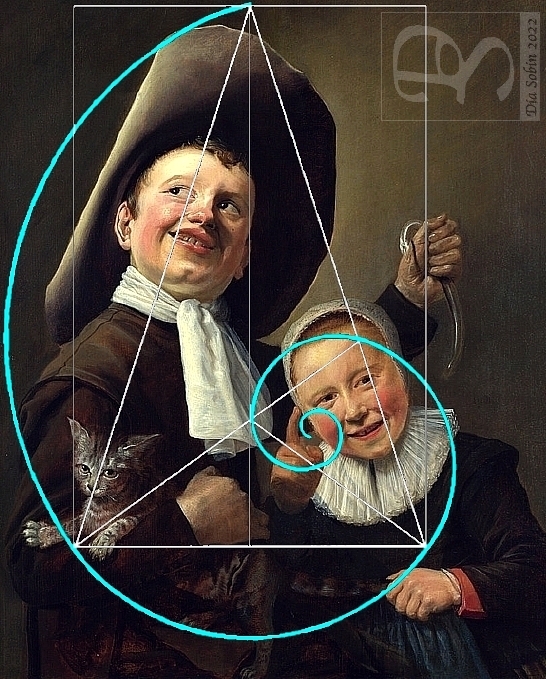
Judith Leyster and a Double Golden Spiral
| A Boy and a Girl with a Cat and an Eel, 1635, Judith Leyster. Geometry: 2022, DS. |
"Artist Judith Leyster wanted to follow her star as a painter.
Her name even spelled it out - Leystar means "lodestar" or guiding star
in Dutch. When she signed a painting, Judith made a visual pun, adding a
JL monogram and attaching a star to it.
Born in 1609 in Haarlem,
Judith won wide acclaim in her time - a reputation that went into
eclipse at her marriage and, by her death (around 1668), had vanished
almost completely. Funny, just like many of her paintings..."
- Via Uppity Women of the Renaissance,
1999, Vicki Leon. Leon is referring to the fact that after Leyster's
death her paintings were not identified for 200 years - and attributed
to a male artist instead - despite the fact that her signature was
present. In other words, that story... and we've heard it before.
"A Boy and a Girl with a Cat and an Eel is a 1635 oil painting by Judith Leyster that is now in the National Gallery, London.
Academic interpretation
There have been various interpretations of Judith Leyster's A Boy and a Girl with a Cat and an Eel by different scholars. Some, such as Neil McLaren, have argued that it represents the Dutch proverb "Een aal bij de staart hebben" (or "to hold an eel by the tail") meaning that you do not get to hold onto something just because you have it. This moralistic interpretation is supported, Cynthia Kortenhorst-Von Bogendorff Rupprath says, by the eye contact with the viewer made by the little girl in the painting as she wags her finger."
- Via the Wiki entry for the painting by Judith Leyster ((July 28, 1609 – February 10, 1660) above. Of course, this interpretation doesn't really fly... that is, if anyone (who isn't blind-folded) actually looks at the painting. For instance, does the woman (inset right) look remotely like a little girl? True, she is quite small and Leyster refers to her as a "girl," but if you look at the skin on her face and hands, you soon realize she can't be a day under 50. And you'll also notice that she is not looking directly at the viewer, but slightly off to the right side... as if she's pointing to something else - also to the viewer's right - and possibly out of the frame.
Then, there's the glass eel... held up - by it's neck (upper body), not it's tail (lower body) - by a "boy" who may be her son... or grandson, although he doesn't look like a child either (note his teeth and hands). All in all, this painting may be another "pun" by Leyster... something about deceiving the eye... but it has nothing to do with morality... or with brutality towards cats (another academic theory). So much for expert opinions... similar to the expertise which somehow missed Leyster's signature on paintings for 200 years!
***
Wow, this is my 3rd (intensive) post this month; it must be the first time this has happened in 2 years (also known as the "plague" years). And, I'm back sooner than I expected... but, not because this is an ideal time for a new post. Hardly. The order of the day seems to be a strange chaotic brew - cooked up by trolls and served-up by artificially intelligent clowns - under the Big Top. In other words, I seem to have my own personal Circus-from-Hell thing going on these days which defies all non-metaphorical description. The weird thing is, this existential maelstrom has it's perks. Perks that just happen to work in my creative life... but, not at all in my corporeal existence.
One perk is that I keep finding golden spirals in paintings... specifically from the Netherlands (in recent weeks)... and all of them from the 1600s (amongst some real Plague Years). Judith Leyster was a painter from an earlier part of that century, however, and one I didn't expect to find as it's unlikely that she and the other artists (who may be theoretically involved) ever crossed paths. While they were just blooming, Judith Leyster had already been cut down and claimed by matrimony, children, and, at the age of 50, death.
(Update 4/11/22) Note: Due to new information regarding the Italian painter, Caravaggio (1571-1610), Judith Leyster's involvement with pentagonal geometry becomes increasingly feasible. See here.)
She sometimes signed her paintings with a star. The reason given is that her surname means the "lode" or pole star. But don't you bet she loved stars anyway? A lot of people love star symbols and rarely think about their geometry, but I think Leyster may have...if the GTS in her painting (above) means anything.
Or, perhaps, I'm referring to the GTS below...
| Same painting, flipped GTS. (Click to enlarge.) |
Yes, it looks like there might be a double spiral thing happening - and its the first of its kind I've seen - a mirror spiral!
But, I wouldn't be convinced unless I found the correct spiral; one that could "mirror" itself. It'd have to be of identical size and level of placement in the painting to do so...
Thursday, March 10, 2022
Five of One, One of Five
| 5 Golden Snails = 1 Star - 2021, DS |
I haven't yet perfected my "golden" diagrams... which are not supposed to represent true gold metal, but more of a sheet of old brass... with color enameling. I think I'm coming closer, but I've no way of knowing how these images appear on anyone else's computer. I only know that they suffer at a lower resolution and smaller size.
Ultimately, I may have to rethink the whole concept. Perhaps, the Golden series isn't a digital enterprise. Or, perhaps, it isn't blog material.
Anyway, I'm probably going to be away from this blog for several weeks. My lifestyle (or, my excuse for one) doesn't allow me time for calm, careful contemplation... unless I check into a motel.*
I check out tomorrow.
Till next time, then!
Music: Alt-J (Adeline) Film: Andy Hardy.
(3/24/22) I've just posted lyrics for Adeline after the jump...
Tuesday, March 1, 2022
Nicolaes Lachtropius & the Golden Spiral
| Still Life with Flowers, Nicolaes Lachtropius, 1667 (Geometry: DS, 2022) |
"In the Rijksmuseum Amsterdam, this flower still life is one of the paintings made by Nicolaes Lachtropius. This painter was active from 1656-1700 in Amsterdam, and Alphen aan den Rijn. The description says “On a marble plinth a vase with a bouquet of roses and poppies. Between the flowers some butterflies, on the [edge of the] plinth a snail.” This oil-painting is signed “N. Lachtropius Anº 1667.″
The snail is very naturalistically painted, and is a dextral specimen of Cepaea nemoralis (L., 1758)."
- Via this page from a wonderful blog by a Dutch Malacologist entitled "Hunting for Snails" which charts the extensive history of snail images going back as far as the Roman Empire. In other words, it is the PERFECT blog! It was also one of my early influences when charting the course of this "golden" journey (so, Bram, I thank you).
"According to the RKD he was a flower still life painter who followed Otto Marseus van Schrieck.. He worked in Amsterdam, The Hague and in Leiden and was last registered in Alphen aan den Rijn."
- The sum total of Wiki's entry for Nicoleas Lachtropius.
***
Well, three's the charm (as I've said in the past) and, between the time I uploaded the image (above) and finished this third attempt at the accompanying text, I made another possible discovery. That is, it seems that several Dutch artists from this period (17th century)- and each of them (historically) in contact with the other - were not using the Golden Rectangle Spiral (GRS) as I had first concluded, but were utilizing the Golden Triangle Spiral (GTS) which I had neglected to substantially test because, at the time, I did not have an accurate GTS template.* Afterwards, when I finally did, I did a quick analysis but, after much labor with the GRS, I almost didn't want to know. Anyway, the "big reveal" will take place later in the finished series. This post exists just to give you an idea of what I'm aiming for, and to show another way in which the GTS can be utilized. See the (Botticelli spiral). (Don't worry, there won't be a quiz.)
That being said, the image above has been modified from the original: I gave it more space at the top.** But, don't be alarmed. Below is the actual .jpg of Nicolaes Lachtropius's painting from the museum's collection. And, as you see, there is no deception; the GTS still stands and in a very similar relationship. In fact, it's a gem. It connects almost every major element of the painting - excluding one red poppy (possibly an imitation) and a yellow snail - and it even curls through the artist's decorative signature. And, yet, it is the presence of the lowly snail which - if my hypothesis is correct - gives the game away... and is the key to the artist's ulterior motive. Its ornate shell is, in fact, the symbol of the artist's modus operandi: "I have followed the spiral" or, what Albrecht Dürer referred to - two hundred years previously and in the "craftsmen language" - as the "Schneckenlinie" (the "snail-line"). (Via Dürer's Wiki entry.) (And, yes, I'll be discussing Dürer later, too.)
Inset right is a reduced version of the spiral (in the original painting). Note that it's innermost coil no longer winds around the pale pink rose but wraps around the small inset bud.
Which is the beauty of the Golden Spiral. You can size it and shift it, but the porportions, and its relationship to the image and design stays the same. Apparently, when the design is Golden, it's always Golden and the gold is found evenly distributed throughout the painting.
And, yet, it must be said, one might not find Lachtropius's design particularly harmonious or pleasing to the eye. Instead it might seem oddly unsettling, although intriguing (and somewhat kinetic)... but, if we can agree the artist did utilize the spiral, we might still question: why?
First of all, try not to see this as a contrived, mechanical design. It isn't. But, it might be in code... a code which impresses upon certain viewers - those in "the know" (specifically other artists) - the expertise of the artist in achieving an almost arcane and "sacred" harmony with a secret, embedded spiral.
Can we test this?