Thursday, November 28, 2013

The Magic of Art & The Art of Magic


"Personaje Astral" - oil on board - 1961 - Remedios Varo


"Behind the veil of all the hieratic and mystical allegories of ancient doctrines, behind the shadows and the strange ordeals of all initiations, under the seal of all sacred writings, in the ruins of Nineveh or Thebes, on the crumbling stones of the old temples, and on the blackened visage of the Assyrian or Egyptian sphinx, in the monstrous or marvelous paintings which interpret to the faithful of India the inspired pages of the Vedas, in the strange emblems of our old books of alchemy, in the ceremonies at reception practiced by all mysterious societies, traces are found of a doctrine which is everywhere the same, and everywhere carefully concealed. Occult philosophy seems to have been the nurse or god-mother of all intellectual forces, the key of all divine obscurities, and the absolute queen of society in those ages when it was reserved exclusively for the education of priests and of kings. It reigned in Persia with the magi, who at length perished, as perish all masters of the world, because they abused their power..."


"Actually, art and magic are pretty much synonymous. I would imagine that this all goes back to the phenomenon of representation, when, in our primordial past, some genius or other actually flirted upon the winning formula of “This means that.” Whether “this” was a voice or “that” was a mark upon a dry wall or “that” was a guttural sound, it was that moment of representation. That actually transformed us from what we were into what we would be. It gave us the possibility, all of a sudden, of language. And when you have language, you can describe pictorially or verbally the strange and mystifying world that you see around you, and it’s probably not long before you also realize that, hey, you can just make stuff up. The central art of enchantment is weaving a web of words around somebody. And we would’ve noticed very early on that the words we are listening to alter our consciousness, and using the way they can transform it, take it to places we’ve never dreamed of, places that don’t exist."

- Alan Moore via a 2013 interview found here.


“In Mexico City they somehow wandered into an exhibition of paintings by the beautiful Spanish exile Remedios Varo: in the central painting of a triptych, titled “Bordando el Manto Terrestre,” were a number of frail girls with heart-shaped faces, huge eyes, spun-gold hair, prisoners in the top room of a circular tower, embroidering a kind of tapestry which spilled out the slit windows and into a void, seeking hopelessly to fill the void: for all the other buildings and creatures, all the waves, ships and forests of the earth were contained in the tapestry, and the tapestry was the world."

- excerpt from Thomas Pynchon's "The Crying of Lot 49" (full quote)


Remedios, I told you that I am making you a spell against [the evil eye]. There it is. Last night I had a fever of 38, auto-suggestion perhaps—I do not feel well enough to go out—Come to see me if you can? Can both of you come to drink your tequila? … Leonora.

- Alleged Note from Leonora Carrington to Remedios Varo written on a drawing - found here.


***


Alan Moore, described as "the greatest graphic novel writer in history" - and, a self-professed magician - has been constellating on the web in recent weeks, beginning with the Mysterious Universe article: Artists Manipulate Minds Using Powerful Magic. Well, that's an attention grabber for sure, but, In the article, Lee Arnold is, for the most part, referring to graphic art; pulling examples from the advertising world, and the slick shlock found on television. But, then, the ways and means by which we're manipulated via the televised world is a given; it goes without saying. In reference to magic however, advertising and commercial iconography is the lowest common denominator - the bottom feeder - of the creative spectrum. It represents mere tricks of the trade, a practiced sleight of hand, and not the workings of the "Magus."
But, it got me to thinking about art and magic, and, although Moore was elucidating specifically on the written word - he is, after all, a writer - my thoughts turned to line and form... as they would, in my perennial investigation of a form language.

Friday, November 22, 2013

The Jewel - Image and Premonition


The Jewel - Digital - 2006, Dia Sobin


She looks like some exotic, tattooed, Middle-Eastern cat-woman - possibly a court card from the Tarot of the Cat People - and was the first of my enigmatic hybrid creatures; but, I have a strange amnesia about this image, and how it emerged. And, it's difficult to talk about, because it's emergence coincided with the death of my mother in 2006; a harrowing, catastrophic period in my life (and hers), which I'd give anything to forget.

But, the point of this post - and the one which will follow it - is an attempt to discuss the paranormal aspects of art, specifically, art as imagery. Which is not to say the word "paranormal" appeals to me, because it doesn't. I prefer to refer to all of the weirder, inexplicable, and/or misunderstood varieties of human experience as transdimensional* - precognition, telepathy, ghosts, aliens, UFOs, faeries, the whole lot. In other words, I feel that all these human experiences are very real, and valid. Why we fail to understand them is because, in spite of all we think we "know", we don't "know" enough. We may never know enough.

Tuesday, November 19, 2013

Thoth... and/or, Why it is That Artists Die in Art School


(Color translation of) An Automatic drawing - pastel on paper - 1973, Dia Sobin
(original drawing at the bottom of the post)


I came upon a scrapbook of old drawings of mine recently - very old, pre-art school drawings - of which the above is an example. It was a colored version (executed in pastels) of a black and white automatic drawing I did around the same time. I did a lot of automatic drawing in my pre-art school days. I liked this one because it was less abstract than the others... it was a recognizable symbol and I knew it meant something, although, at the time, I was unable to identify it. Years later I would come to the conclusion that it was a representation of Thoth, the ibis-headed Egyptian moon god of knowledge and wisdom, who was both patron of the arts and sciences as well as an important occult symbol. My teen-aged self had dipped into the collective unconscious and Thoth is what emerged.

The drawing is obviously not an example of high art. It is primitive, at best, looking like something pried off a cave wall. And, yet, therein lies its power... a vitality and immediacy that I've somehow lost along the way, and will never again recapture. But, why is this?

Because, shortly thereafter, I went to art school.

Thursday, November 14, 2013

The Transdimensional Landscapes of San Base


There are numerous new artists out there - too many, in a sense, to wrap ones head around - and new artists jumping into the digital arena every day. But, every now and then, I'm introduced to new art (this time via MOCA) that really resonates with me, and art that fulfills the purpose of what I believe art should ideally be; that is: a visual language which has the ability to both illuminate and transform. And when I find the art, the artist, I am moved to feature them here... and so, I present to you San Base, a Russian artist now living in Canada.

San Base, as in the case of many digital artists, though artistically inclined, was initially trained in the science of mathematics, becoming a cybernetics engineer before fully devoting his efforts to his true passion, painting. What he refers to as "Dynamic Painting" - both the images and the program he developed to generate them - represents the marriage of his painting skills and his digital expertise, and the result... well, as you can see from the example above, the result is amazing.

All too often digital creations are too slick - lacking integrity, emotion, and poetry - but, San Base's transdimensional landscapes breathe, shift and transform as naturally and aesthetically pleasing as running water and drifting clouds. One recognizes something... maybe it's the way we dream... or the organic composition of our thoughts and memories. But, no description is ever necessary with successful art. It simply is, and, intuitively, we know it's precise.

Bravo, San Base!

Incidentally, after you've viewed this "painting", you might want to try this one!

For more of San Base's work, including imagery for sale, more videos (even a few Mandelbulb fractals), visit his website, and his online studio.


***

PS: And, here's two new articles in cyberspace that may interest you... "Art + Technology = New Art Forms, Not Just New Art", and "What is New Media Art?"


Friday, October 11, 2013

The Paleolithic Artist


Ancient handprints from a Borneo cave


"An archaeologist’s analysis of ancient handprints could overturn decades of male bias regarding the origin of cave paintings.

Prehistoric hand stencils have been found with cave paintings across the world, but, because the art mainly features game animals such as bison and mammoths, the weight of scholarly opinion is that they were made by male hunters as a record of their kills.

However, Dean Snow of Pennsylvania State University studied hundreds of hand stencils in 8 cave art sites in France and Spain and, based on their finger length, determined that three-quarters of them were made by women."

- Sandra Rimmer via an October 9th, 2013 article found here


No, Trans-D is not becoming a news site... but, I couldn't resist posting this tidbit!


:-)

***


Photo of Moche pottery found here


...And, while I'm at it, for new tidbits illuminating a slightly more "contemporary" time in ancient herstory, see these articles about the recent archaeological discoveries regarding the Moche civilization, and the Lady of CaoTomb find confirms women ruled ancient Peru and Girl power in ancient Peru confirmed.


Friday, September 6, 2013

Patron Saint #10: Deborah Remington - The Future Looks Back


Ackia -  color screenprint - 1975, Deborah Remington


“My work concerns the paradoxes of visual perception, the enigmas and quirks, and how it all forms the basis for our realities. The impact, excitement, and energies created by incongruity, juxtaposition and opposites all interest me.

The images are couched in paradoxical terms and must challenge the mind’s eye, must invoke opposites and hold them in tension. The work at times seems to refer to something in reality, but then the reference is denied. Identity; the fusion of so many experiences, so many inquiries, so many intuitions is also a primary issue.”

- Deborah Remington, from a quote found here.

"...Drawing doesn’t have to have color for me. The Japanese would always say, ‘Can’t you see the color there in the black and white?’ It’s implied, and if you’re a really good artist and if the paintings are wonderful enough and if they really sing, then the viewer gets a sense of color. That influenced my work a lot, mostly the philosophy of calligraphy.”
(via a 2008 interview with Nancy M. Grace)

"Anyway I followed the whole gang of howling poets to the reading at Gallery Six that night, which was, among other important things, the night of the birth of the San Francisco Poetry Renaissance. Everyone was there. It was a mad night. And I was the one who got things jumping by going around collecting dimes and quarters from the rather stiff audience standing around in the gallery and coming back with three huge gallon jugs of California Burgundy and getting them all piffed so that by eleven o'clock when Alvah Goldbook was reading his, wailing his poem "Wail" drunk with arms outspread everybody was yelling "Go! Go! Go!" (like a jam session) and old Rheinhold Cacoethes the father of the Frisco poetry scene was wiping his tears in gladness."

- Excerpt from The Dharma Bums by Jack Kerouac, 1958


"I saw the best minds of my generation destroyed by 
              madness, starving hysterical naked, 
       dragging themselves through the negro streets at dawn 
              looking for an angry fix, 
       angelheaded hipsters burning for the ancient heavenly 
              connection to the starry dynamo in the
machinery of night, 
       who poverty and tatters and hollow-eyed and high sat 
              up smoking in the supernatural darkness of 
              cold-water flats floating across the tops of cities 
              contemplating jazz, 
       who bared their brains to Heaven under the El and 
              saw Mohammedan angels staggering on
tenement roofs illuminated, 
       who passed through universities with radiant cool eyes 
              hallucinating Arkansas and Blake-light tragedy 
              among the scholars of war..."

- The initial lines of Howl by Allen Ginsberg, 1955, found here (with audio).

“This was the time of the Rosenbergs and the [Estes] Kefauver hearings, the Hollywood blacklisting. It was horrible. The police were everywhere, and it was kind of a fascist country. This was the climate within which and against which we were working. We were trying to break all the rules. It didn’t matter: you just broke the rules. You rarely got anything substantial out of it, but by hit and miss we did.”

Deborah Remington, from Inside and Around the 6 Gallery with Co-Founder Deborah Remington (via a 2008 interview with Nancy M. Grace)


***

"It was a great night, a historic night in more ways than one..." wrote Jack Kerouac in 1958, for his semi-autobiographical Beat novel, "The Dharma Bums." He was referring to an actual event, a poetry reading that took place in a San Francisco art gallery - the 6 Gallery - October 7, 1955. 

In his thinly veiled account, Kerouac mentions a number of Beat luminaries on the scene that night.  Alvah Goldbook was, of course, the poet, Allen Ginsberg, who astounded the crowd with an impassioned reading of his definitive poem "Howl". "Old Rheinhold Cacoethes", on the other hand, was Kenneth Rexroth, while Kerouac's close friend friend, Gary Snyder, appears as Japhy Ryder. Earlier, he mentions a "delicate pale handsome" poet, Ike O'Shay, referring to a very young Michael McClure*. Of that night, McClure would later write: "Ginsberg read on to the end of the poem, which left us standing in wonder, or cheering and wondering, but knowing at the deepest level that a barrier had been broken, that a human voice and body had been hurled against the harsh wall of America..."


Deborah Remington as an art student in the 1950s - Photo credit: unknown
Currently found: Remington's NYT (2010) obituary (click to enlarge)

Oddly enough, one figure who does not enter into Kerouac's fictional account - although, certainly worthy of a mention - was a six-foot tall, redheaded woman** - and one of the six Beats who owned the gallery - artist, Deborah Remington. (Her co-owners were artists, Wally Hedrick, Hayward King and David Simpson, and the poets, John Ryan and Jack Spicer.) Granted, Kerouac was loaded on California Burgundy - Dionysus being the god of lost histories - and focused on the Beat literati, but, it's hard to imagine that such a strikingly beautiful young woman would've fallen outside his radar. Then again, judging by her own brief account (via an interview excerpt included in this .pdf file), Remington fails to recall the presence of Kerouac and several members of his poetic posse that night. Go figure.

Monday, July 22, 2013

A Cosmic Nest (w/ footnote) (& A Restored Musical Link)


A Cosmic Nest - digital - 2013, DS
(Click to enlarge.)


"... I also realized (in the dream) that the universe was not infinite, but, was like a round area bordered by a ring of space which was a different dimension bordered by other dimensions. (?) The Saturn-shape comes to mind.

Also, there are other universes next to this one... as there are other galaxies and solar systems. The pattern of eternity (this universe arrangement) would look like a field w/ all these Saturn-shapes polka-dotting it."

- quote (recounting an actual dream) from a 1975 personal journal, via an excerpt from: "Temp L (The Temple Drawings)" - unpublished project record -1982, Dia Sobin


"Many modern theories of fundamental physics predict that our universe is contained inside a bubble. In addition to our bubble, this `multiverse' will contain others, each of which can be thought of as containing a universe. In the other 'pocket universes' the fundamental constants, and even the basic laws of nature, might be different.

Stephen Feeney, a PhD student at UCL who created the powerful computer algorithm to search for the tell-tale signatures of collisions between "bubble universes," and co-author of the research papers, said: "The work represents an opportunity to test a theory that is truly mind-blowing: that we exist within a vast multiverse, where other universes are constantly popping into existence."

- via this Science Daily article, dated August 3, 2011


***


Flat Disks vs. Bubbles

Everybody dreams, and dreams come in a variety of flavors: mundane, romantic, other-worldly, prescient, wish-fulfilling, historical, etc.  The truly transpersonal "cosmic" dreams are rare, but, when you have one, you tend to want to share it. It took me over 30 years to "share" this one of mine... and then, only because it inspired an image, "A Cosmic Nest" (above).

Sunday, July 7, 2013

Flatbed Scan of a Summer Flower


Begonia blossom scan - 2013, DS
(click to enlarge)


As an artist, despite all the scientifically-documented neurological, psychological & pathologlogical excuses for my existence, isn't the need for beauty the real bottom line?

And, in the event that every living organism has consciousness and sentience to some degree, isn't it possible that the expression of beauty - and the appreciation thereof - is as innate, inherent and essential to life, as any scientifically-accepted, well-documented mechanism to survive?

I scanned this begonia into the computer today, because I wanted to record it exactly as it was. I suppose that's what my scanning exercises amount to lately... along with a sort of subliminal attempt to understand transdimensionalism, albeit in reverse... that is, translating higher (3) dimensions into lower (2).

But, that's not the reason I posted it.

I posted it because it's beautiful.

Enjoy your summer.


***


Tech Note: Concerning flatbed scans of 3-D objects (also referred to, on this blog, as "live scans"). There's a plethora of info on the web describing the ways and means to perfect this type of image document, if you're interested. The most important factor in taking a good scan is having a scanner capable of copying 3-D objects... not all of them can. The ones which can, generally indicate this on the box description. Also, they often have a fluorescent light bar, which captures a greater depth of field than LEDs. And, by "scanner" I'm not referring to expensive equipment or anything having to do with the new 3-D printing technology. A dedicated scanner is imperative, however - forget "all-in-one's"!


Tech Note 2: To avoid a "pressed flower" look to a scanned flower image, leave a stem on your flower, and then try constructing a truncated cone around the flower head that will separate the flatbed glass from the flower petals. I used black paper for this - black is generally the best ground - with some degree of success. But, the contours of the cone are key, as well as the depth. The flower has to fit exactly and its petals should just brush the glass. Best bet? A fairly flat, rigid flower.


Tech Note 3: Except in the instance of a very flat object (like a house key, for example), you will either be leaving the scanner cover open, or taking it off altogether. Back-lighting may be an interesting effect on occasion, but I find it helpful to have a several boxes - lined in black - of various depths on hand to cover the scanner bed while shooting. Another possibility is a blanket of fabric, normally cut to the dimensions of the scanner bed, unless the "draped fabric" effect is a desirable background. Fabric, incidentally, scans fabulously!


Begonia blossom - 2016, 2013, DS


Thursday, July 4, 2013

Anthracite Coal & Graphite


2 scans of a small slab of anthracite - 2013, DS
(click to enlarge)


I guess I feel obligated to finish my "Black Rock" series (started here & continued here). So, here's the "big reveal".

Well, it's like this: one can't write on a hard, granulated surface with obsidian... however, with anthracite coal you can. Which is how I now know that all my mysterious black rocks - despite how iridescent and pretty they may be - are, in the last analysis, anthracite coal. The ones with a more silvery sheen, however, make finer, more pencil-like lines, which sent me on a google search for graphite; apart from being pencil lead, I never did know exactly what it was.

Actually, the game was really given away when I found the anthracite slab above... which is glassy in the center, but, the surface of which is similar to a shimmery black poster board. Whatever it was, it wasn't obsidian.

(Note: It was also easy to pry apart in layers... and, though I still hadn't concluded it was coal, I still half-expected to find a fossil. In reality, one can find fossils in slabs of coal... and, two things on my "bucket-list" are: finding a meteorite, and finding a fossil!)

Anyway, I now know that anthracite coal is a mineral and the high-carbon metamorphic state of bituminous - ordinary household - coal. Interestingly, anthracite may be considered to be a transitional stage between ordinary bituminous coal and graphite, the latter often considered to be meta-anthracite and/or the last - and purist - metamorphic stage of coal.


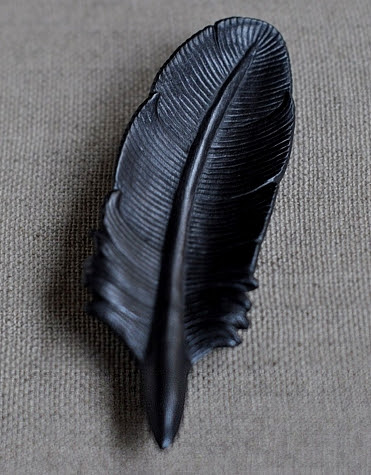
Well, yeah, I guess I had hoped my mystery rocks were obsidian... but, anthracite and graphite are not the lowly, mere utilitarian minerals one might expect. Anthracite was a common replacement for jet in all that wonderful Victorian mourning jewelry... and it's been carved into sculptures as well. And, the same goes for graphite! The two beautiful figures above - the hand and shell (above, left) - were carved from graphite by Angelio Batle, found here, along with a number of others. And the graphite quill (above, right) is just one example of a whole series of really cool, carved graphite pencils (one can write with!) for sale here.

And, so ends the tale of the mysterious black rocks... ;-)


***


Restore the 4th (& steal this banner!)


Monday, July 1, 2013

Obsidian Glass (& a "moon rock") (?)


2 scans of the latest found object - 2013, DS
(click to enlarge)


"Seek and ye shall find"! 

Actually, this is rarely true in my experience... but, I did find what I was looking for at the beach yesterday (see previous post): obsidian glass. Of course, it's so glass-like, it's practically impossible to scan, but, this should give you some idea. It has a slight rainbow flash, but nothing like in the scan - more like the colors one sees in a crow's feather.

And, I also found a lunar rock! Okay, so, it's not really a lunar rock - just another specimen of volcanic rock with a lot of obsidian. It's blacker than it appears in the scan, though; it also has a very silvery sheen to it... 


Scan of the "moon rock" - 2013, DS
(click to enlarge)


Later note: Actually, the true identity of these rocks is still in doubt. I suppose virtually anything can be found on a shoreline, but, we are talking about a Connecticut shoreline... (see the comment section of this post). So, ladies & gentlemen, the jury is still out.


The jury's in... see: Anthracite & Graphite.