Friday, February 12, 2016

A Music Box - Series Introduction & Menu


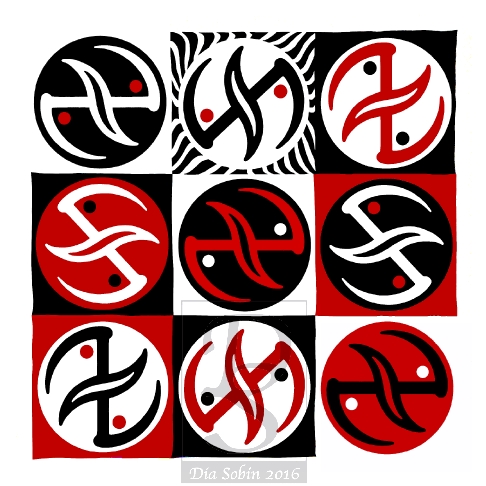
A Music Box (Lid) - Digital (Revised) - © 2016, DS
(click on images  for enlarged views)


"But, then, I had my answer. As I had maintained to myself from the beginning, love is love. Or, if you prefer, all love is Love. Add to this the Language of the Birds - a mystical language, wherein love is a fundamental force as well as an emotion - and we are presented with a new landscape, a new equation. And, in this alchemical Land of Love, all experiences are authentic, and all activities of the psyche are allowed."

- Quoting myself from text which previously appeared here (under the title: The Language of Birds and the Alchemy of Love: A Music Box).


***

Well, it's official: this post has now formally been divorced from its original purpose. But, don't fret, because the series it was meant to introduce has survived and, in fact, has been expanded (!).

You'll note I've updated the music box panel images here. This to reflect the virtual object's present state, which will be revealed shortly in my next post. Also, I'm going to repurpose this post by adding a some music box miscellanea... specifically a video which explores a unique phenomenon created by music box tunes punched into a paper tape as opposed to the steel pins, combs and discs used in vintage music boxes...

Tuesday, January 19, 2016

Vale, Man from Mars (...)


Rolling Stone February cover - photo credit: Anton Corbijn/Getty Images
Article: David Bowie's Final Years
(click to enlarge)
For more recent Rolling Stone articles about DB click here.


At your newsstand: this recent TIME publication.
(Click to enlarge.)


Along with so many people, I've been grappling with the death of David Bowie - America's resident alien - since Monday of last week. I think it's amazing just how many of us, all over the world, were not merely saddened or surprised by his death, but truly devastated. That is, we took it personally.

For the past few days I've been struggling to put into words the various ideas that have begun running through my head regarding this transformative event in our collective consciousness, but "words" seem increasingly inadequate. If a miracle occurs and I can finally gather my thoughts into something comprehensible, I'll post again. But, don't hold your breath(s). Meanwhile, I found this charming little video clip from Charlie Rose's 1998 interview with David, that I'll post here... and I'll be replacing the Bowie tunes on the sidebar with some others. At this moment, it's the best I could do.

Bliss to David, and peace to you all.


___________________________


"A pair of wings, a different respiratory system, which enabled us to travel through space, would in no way help us, for if we visited Mars or Venus while keeping the same senses, they would clothe everything we could see in the same aspect as the things of the Earth. The only true voyage, the only bath in the Fountain of Youth, would be not to visit strange lands but to possess other eyes, to see the universe through the eyes of another, of a hundred others, to see the hundred universes that each of them sees, that each of them is; and this we do, with great artists; with artists like these we do really fly from star to star."

- Marcel Proust. Quote lifted off yesterday's Daily Grail news page, along with this announcement.


As it happens, I've just located a number of applicable quotes by Proust on the Goodreads pages. Here's another:

“Everything great in the world is done by neurotics; they alone founded our religions and created our masterpieces.”


"Barnbrook loved working with David Bowie, he was simply one of the most inspirational, kind people we have met. So in the spirit of openness and in remembrance of David we are releasing the artwork elements of his last album ★ (Blackstar) to download here free under a Creative Commons non-commercial share alike licence. That means you can make t-shirts for yourself, use them for tattoos, put them up in your house to remember David by and adapt them too, but we would ask that you do not in any way create or sell commercial products with them or based on them.
Any questions or commercial licence usage please contact us
."


(The Blackstar image above is my own modification of the download. Click to enlarge, and feel free to grab it for your personal, non-commercial use.)

***

For those interested, DB's natal astrology chart is online (link repaired 1/6/2026). Interestingly, he, like myself, was born with his Capricorn sun in the 12th house. Unlike myself, he had a lot of fire and air in his chart, which is reflected by his incredible charisma and success as a performer.

***


(May 4, 2016) This just in: Apparently a fan discovered that the Black Star gatefold inside the interior of the DB's (vinyl) Blackstar album is not solid black after all. When held in the sunlight, a starry view of the night sky appears. I wonder if it's a real photo, and what area of the galaxy it is. Maybe he was trying to tell us something... ;-)


Sunday, January 3, 2016

A Mojo Magic Square (with update)


Mojo Magic Square - digital - © 1981, 2014, DS
(click to enlarge)


"Mojo is magic, magical ability, and the power to get things done. "Mojo" first appeared in the 1920s in the southern United States from the Gullah word "moco" (magic), Gullah being Creole spoken by some groups of African-Americans.  The ultimate root of "mojo" was the word "moco'o," which means "shaman or medicine man" in the African language Fulani.  "Mojo" spread first into mainstream Black English and then general usage primarily through the popularity of jazz and blues music.  Muddy Waters got his 'Mojo working' and Jim Morrison of The Doors called for the Mojo Risin'."
- Quote found here.

"Think joie de vivre, that sense of being alive, joyful, and fully present in the moment. The path to finding your mojo differs for everyone. For some, mojo is a sense of purpose and meaning in your life. For others, it’s reclaiming optimal health or sparking their creativity. Some seekers find mojo by getting in touch with the divine, while others get their mojo by getting in touch with their sexual prowess. For many, it’s all of the above."
- Quote found here.

"So what is a mojo? It is, in short, the staple amulet of African-American hoodoo practice, a flannel bag containing one or more magical items. The word is thought by some to be a corruption of the English word "magic." Others state that it is related to the West African word "mojuba," meaning a prayer of praise and homage, as it is a "prayer in a bag" - a spell you can carry. A third possible derivation is from the Bantu/Kongo word "mooyoo," the magically-charged ashes and ground up bones of an ancestor that are encased in the front of a nkisi ndoki - a fetish-statue made in the form of a human being or animal. This connection with the bones of the dead is interesting, because historically, many mojo hands have indeed contained small bones, either of animals or of humans.

Some root workers top off their mojo bags with parchments upon which are printed medieval European grimoire seals and sigils of talismanic import, particularly the Jewish-derived seals from the Greater Key of Solomon and The 6th and 7th Books of Moses, both of which are sold as sets of seals printed on parchment paper, and are used without reference to the rituals given in the texts of the original grimoire books.

These last items surprise many Caucasians, who are unaware that a strong vein of Germanic and Ashenazi Jewish folklore runs through traditional African-American hoodoo. Still, however strange it may seem to cultural anthropologists in search of "African survivals" in hoodoo practice, it is a fact that John George Hohman's "Pow-Wows or the Long Lost Friend" - first published in America in 1820 and translated into English in 1856 - has long been a staple source of inspiration for conjure-workers in both the African-American and European-American Appalachian traditions, and many a black hoodoo practitioner can cite chapter and verse of "Albertus Magnus," "The Black Pullet," "Secrets of the Psalms," "The 6th and 7th Books of Moses," "8th, 9th, and 10th Books of Moses," and other occult books of European origin."
- From an article found on Lucky Mojo.


A Sator Magic Square in Oppède, France.


"The earliest dateable Sator Square was found in the ruins of Pompeii, which was buried in the ash of Mount Vesuvius in 79 AD. Examples may be found carved on stone tablets or pressed into clay before being fired. Its translation has been the subject of speculation with no clear consensus.

It seems that, in all early examples, it is a Rotas Square that reads "ROTAS OPERA TENET AREPO SATOR" from top to bottom, and from left to right.

The Sator Square is a four-times palindrome, and some people have attributed magical properties to it, considering it one of the broadest magical formulas in the Occident. An article on the square from The Saint Louis Medical and Surgical Journal, vol. 76, reports that palindromes were viewed as being immune to tampering by the devil, who would become confused by the repetition of the letters, and hence their popularity in magical use....

The square has reportedly been used in folk magic for various purposes, including putting out fires (the spell is "TO EXTINGUISH FIRE WITHOUT WATER" in John George Hohman's Long Lost Friend), removing jinxes and fevers, to protect cattle from witchcraft, and against fatigue when traveling. It is sometimes claimed it must be written upon a certain material, or else with a certain type of ink to achieve its magical effect."
- From the Wiki Sator Square entry.


***

Well, it's officially a new year in the western world, but, in the Far East, the lunar new year doesn't occur till February 2nd. (More about that later...) So, it's a relative thing, and if your "mojo" isn't quite working the way you'd like it to, you've got a whole month to get yourself in gear. Now, while "gear" isn't necessarily the operative term when defining the word mojo, dynamo, or dynamic kind of is; so, in the last analysis, you know your mojo is working when your inner world is moving seamlessly in synch with the outer world. My guess is, if one can get that down, then, regardless of all the circumstances beyond one's control, he or she will be A-OK... and as much of a contender in this game of life as anyone else is.

As it happens, mojo is a word that's been used - in various corrupted forms - quite a lot in recent years. Originally it was Hoodoo charm (although not to be confused with this hoodoo) bringing good luck and psychic protection to its bearer. Now, it's a catchword most commonly utilized by motivational speakers, executive coaches, "life" coaches, and self-help gurus when describing formulas for increasing ones productivity*, particularly in the workforce.

But, just exactly what do I mean by the word Mojo?

Mojo is animism... the dynamic energy fluctuation that makes an organism tick. If ones wiring is in top form, ones inner force pulls back and then moves forward in sync with ones conscious desires and motivations. In other words, ones Mojo is "working". On the other hand, if ones wiring has gone awry - for instance, in the case of a series of set-backs, intense trauma or injury of any kind, or just plain chronic disappointment - then ones Mojo is thrown off its game. It isn't as if you've lost it... it's that it's blocked from true expression; in other words, it's broken.

Case in point: the magic square (first image above) is something I've had on my desktop for the past 2 years. Why is this? Well, that's a good question! Before this period, I had just gone through a series of unfortunate events, and was holed up in an unfamiliar town with absolutely no clue - and no hope - for a "brighter future." Without going into details, my mojo was, in fact, at the lowest point of its existence...

Friday, December 11, 2015

Wild Orchids; The Tribal Green Woman (& Two Triangulations)

Wild Orchids - Digital - © 2016 (revised), 2015, Dia Sobin
(Newest version uploaded 2017)
(Click to enlarge)


"The genus name Cypripedium is derived from the Greek words "Cypris" an early reference in Greek myth to Aphrodite, and “pedilon” for sandal. This is because the fused petals that form the orchid’s pouch or modified lip (labellum) resemble a slipper or shoe. The staminode (sterile stamen) is often showy and seems to welcome the insect into the pouch where it makes its way to a back-door exit and in so doing transfers pollen to the stigma.

...The Cypripedium orchids of North America are hardy terrestrial plants that can grow in cold climates and flower in early to mid-spring when there is plentiful moisture and cool temperatures. Species such as Cypripedium guttatum and C. passerinum that grow in Alaska are so well adapted to cold their shoots sprout up under the snow in the spring.

For centuries Cypripedium species have been sought after and collected not only for their unique beauty but also for the medicinal trade. Widespread collection, attempts at transplantation, and loss of habitat have drastically reduced their numbers. Wild lady’s slippers have special requirements that make them difficult to cultivate, and rarely survive transplanting from the wild. Because of that, on federal lands it is illegal to dig or pick the orchids."


- From the U.S. Department of Agriculture cypripedium page: Meet the Ladies, the Slipper Orchids 


***

Way back when - roughly about twenty years ago - there used to be a small, hidden patch of pink wild orchids in the woods behind (what was then) my parent's house. Mysteriously, one day, the lovely flowers vanished, and were never to be seen again. Perhaps, someone picked the blossoms; along with transplanting them, it's a sure way to kill the plant.

Popularly known as the Lady Slipper, or Moccasin flower, this orchid is one of the more strangely secretive denizens of the forest... blatantly wild, deceptively fragile, quietly erotic, it's always a pleasant, somewhat magical experience to happen upon them. Although I've always considered the plant a primarily North American flower, it's actually found in Europe and Asia as well; the ones illustrated in the image above, however, are a North American variety.

About the illustration: well, I did previously mention designing my own versions of a Green Woman and Three-Hare symbol (at the end of this post), predominately for carved reliefs. As it happens - and it always does regarding ones creative plans - while I was designing the Green Woman, I suddenly had the overwhelming epiphany that my Green Woman called for - no, demanded - tattoos. Perhaps, this was because I had recently considered getting a tattoo myself. As to why I'm suddenly drawn to illuminating my torso at this time in my life - well, that's another story. But, regarding the Green Woman, suffice to say, the tattoo idea changed the playing field, and, for good or ill, a full color digital image was required.

Moreover, as the tattooed person began to emerge, I had another inspiration. For whatever reason, Art Nouveau posters* by the Czech illustrator Alphonse Mucha (24 July 1860 – 14 July 1939) resurfaced in my middle eye. And, whatever your artistic taste dictates, poster art in the days of Mucha were phenomenal expressions of the marriage between art and commerce, and Mucha's images, in particular (see examples below), were awesomely designed and elegantly executed.

Saturday, November 14, 2015

Vive La France!


"Paris is our capital. We love music, drunkenness, joy."
 - from a series of cartoons by Joann Sfar


... and we love La Ville-Lumière (the city of enlightenment)!

From Libération:  some much-needed humor (in both French and English). For a listing of other Parisian news sources (in both French and English), try here.


Hawkwood writes: "So why, of all the major European cities, did Islamic State last month choose to target Paris?"

- Read the rest of the quote here (above the Afterword), or from the original source.*


Monday, November 9, 2015

Leonora Carrington...

Untitled, Leonora Carrington painting found here.
(6/14/24: New - replaced the previous, inferior digital reproduction again!)


... on PBS's "Antiques Roadshow"!

Caught this show on the tube a couple of weeks ago... and just had to post about it. (Click to enlarge.)

Here's a transcript from the show (found here):


"GUEST:
I know there's an artist by the name of Leonora Carrington and that she lived in Mexico. Originally she came from Europe, but she came to Mexico after the Second World War. Much more than that I don't know, except I know that she was a surrealist.

APPRAISER:
Surrealism is understood most prominently by the work of Salvador DalÌ, someone like that, these images of the imagination and dreams and in some cases nightmares, which may apply to what we have here. Do you know about her background at all?

GUEST:
I believe she was born in England. I read somewhere that she painted in her early 20s and that she was the mistress of Max Ernst.

APPRAISER:
Right. She did run off with Max Ernst. She's a student and then ran off to France, and after the war, she suffered a nervous breakdown, and I think these pieces are very personal. I think that's part of it, is her coming to grips with the nightmares and the imagery in her life. And you look at this piece, it's all very macabre and surreal. The central piece here is this large sort of wolf-like figure with multiple arms and legs all around it. And then distributed throughout the bushes are figures. You see this wolf-like face here and bats sort of looming. And then down at the bottom, you have these creepy fellows with a spider. Overall, she had a fairly normal life, it seemed, but she was haunted by these visions. You mention she did go to Mexico, and that's where she did most of her work.

GUEST:
Not until after the war, she had her first showing down here.

APPRAISER:
She signed "Leonora Carrington" in 1961. Now, where did you get this?

GUEST:
It was originally my parents', and they had a large house, and they had a rather extensive collection of art. When they got this, I fell in love with it, and finally when they downsized, they knew that it was the one piece of all their artwork that I really adored, and so they gave it to me, and that was about 40 years ago.

APPRAISER:
That's great. Obviously, this was '61, so this is over 50 years old, and it was probably purchased around the time it was painted. Did they go to Mexico, or...?

GUEST:
I believe so. I believe they had friends in Mexico City who knew collectors. They were able to go to people's homes who had more paintings than they needed, literally warehousing them, from Mexican artists. And this came out, and my father dug deep and he bought it.

APPRAISER:
Right, well, it's a fabulous example of her work, and really relates that personal angst that she had. Now, she painted in a variety of different mediums. This is a piece on canvas, so it looks like it's primarily oil. Recently, her value has come up a bit because she has passed away. She died in 2011. She lived to be 94, I believe. Her works are sold mainly in Latin American sales. There's a lot of interest in those. Have you had it appraised?

GUEST:
I have not. I do know what my parents paid for it. I believe they said they bought it somewhere around $7,000 to $10,000, which was a big price to pay for a painting. I'm sure my father had to think twice about it when he did it.

APPRAISER:
Right now, I would expect an auction estimate of $200,000 to $300,000 these days.

GUEST:
They bought well. Amazing."

***


To view this portion of the show, go to this PBS page.

What a fabulous painting!


Saturday, October 31, 2015

The Witches


Maria Germanova of the Moscow Arts Theatre, costumed for her role [as the fairy] in the 1908 premiere of Maeterlinck’s Blue Bird, produced by Stanislavsky. From: Lost Marvels of Revolution-Era Russian Theater.


"Shall I see tonight sister, bathed in magic greet?
Shall we meet on the hilltop where the two roads meet?
We will form the circle, hold our hands and chant
Let the great one know what it is we want

Danger is great joy, dark is bright as fire
Happy is our family, lonely is the ward."
 

- From "Witches' Song" by Marianne Faithfull, Joe Mavety, Stephen York, Barry Reynolds, and Terence Stannard, introduced on Faithfull's 1979 album, Broken English.


"I think that all women are witches, in the sense that a witch is a magical being. And a wizard, which is a male version of a witch, is kind of revered, and people respect wizards. But a witch, my god, we have to burn them. It’s the male chauvinistic society that we’re living in for the longest time, 3,000 years or whatever. And so I just wanted to point out the fact that men and women are magical beings. We are very blessed that way, so I’m just bringing that out. Don’t be scared of witches, because we are good witches, and you should appreciate our magical power." 

- A quote from Yoko Ono found here.


“Witches never existed, except in people’s minds. All there was in the olden days was women and some men who believed in herbal cures and in folklore and in the wish to fly. Witches? We’re all witches in one way or another. Witches was the invention of mankind, son. We’re all witches beneath the skin.”

- A quote from The Flood, by Ian Rankin, found here.


"I'll get you my pretty, and your little dog, too!"

- The Wicked Witch of the West (Margaret Hamilton) from The Wizard of Oz (film clip).


***

I had a much different post planned for this day, featuring my latest digital image. Alas, this was not meant to be. I also had a very different sort of post intended for "The Witches", but it was, by no means, holiday fare. 

Witches, witches... so much to say, so little time. "Are you a good witch, or a bad witch?" the ethereal Glinda asks Dorothy in the Wizard of Oz film clip (linked to above). Now, there's a loaded question... perhaps one we should be asking our potential candidates for higher office... all of them.

In the end, I decided this Halloween post is for fun... think: "Samantha" in Bewitched. Or, better yet, the delightful Kim Novak in my all-time favorite vintage flick: Bell, Book and Candle (clip below)...


... and have yourself a Happy Halloween! ;-)

PS...


Saturday, October 10, 2015

Found Outside my Window...


Shot from my back porch, 9 AM, October 10, 2015...
(click to enlarge)


It's a beautiful day in New Mexico; the first of its kind this week. I'd been feeling badly about not yet visiting the Balloon Fiesta, which has been going on since October 3. But, as it happens, as I was passing by the patio window overlooking my backyard this morning, it almost seemed the Balloon Fiesta had come to me! Rising over the wall behind my house, so close I could see its human navigators and hear the gas jets firing, was the balloon shown above.

Thanks, guys, you made my day!

Searching around YouTube for some Fiesta videos, I came upon this one, downloaded yesterday by "Dirt Rancher", featuring a neighborhood somewhat similar to mine, but, with a whole lot more activity.


Sunday, September 6, 2015

Black Key #19


Black Key #19 - virtual (digital) assemblage - © 2015, DS
(click to enlarge)


“The unborn work in the psyche of the artist is a force of nature that achieves its end either with tyrannical might or with the subtle cunning of nature herself, quite regardless of the man who is its vehicle.  The creative urge lives and grows in him/her like a tree in the earth from which it draws its nourishment.  We would do well, then, to think of the creative process as a living thing implanted in the human psyche.”
- from The Spirit in Man, Art and Literature, Collected Works, 1966, Carl Jung


I'll be away from the "Land of Blog" for the next couple of months, attending to various "unborn works in the psyche".

Before I go, I just wanted to address some elements I deleted from the sidebar... namely my "Followers" section, the pageview-count widget, and the "Search" widget; all three seem to have picked up glitches in the past couple of months, and aren't working - on my computer, at any rate - so, I took them down. I especially wanted my followers to know that this was no reflection on them, and when and if the widgets lose their glitches, I'll put them back up.

My plan is to return around the end of October... till then, adios!

D

PS  Following the trail of the Black Key: Where the Key was Found. But, the question remains, was the key found before, or after #19? ;-)


Wednesday, September 2, 2015

Patron Saint #11: Frida Kahlo: Portraits of La Santa Muerte


Autorretrato con collar de espinas (Self Portrait with Necklace of Thorns) - oil on canvas - 1940, Frida Kahlo
(Apart from this image which is posted at its maximum size, all others on this page
 can be clicked to enlarge.)

“I used to think I was the strangest person in the world but then I thought there are so many people in the world, there must be someone just like me who feels bizarre and flawed in the same ways I do. I would imagine her, and imagine that she must be out there thinking of me too. Well, I hope that if you are out there and read this and know that, yes, it's true I'm here, and I'm just as strange as you.”

- Frida Kahlo; quote found here.

__________________________________________


I've not been a huge fan of most film and television fare in recent years, so I tend to miss a lot of things. And, when Julie Taymor's Frida (2002) appeared on the tube several months ago, I was a liitle hesitant; not convinced that Selma Hayek (or, anyone, for that matter) could pull off the heavy title role. Happily, I was wrong, and, for the most part, I enjoyed the film. And, it renewed my interest in possibly one of the most celebrated, venerated - and, possibly least understood - artists of the past century, Frida Kahlo (July 6, 1907 - July 13, 1954).

As it was, Frida Kahlo's story came up a few times in the autumn of last year, during research for "Dia(s) de Los Muertos". At first, I thought it was amusing that, while googling "The Day(s) of the Dead," Kahlo's imagery - and photos of Kahlo herself - kept popping up on my computer monitor, but, after exploring some of these links, and doing a little investigation of my own, an intriguing picture began to emerge. Ultimately, Frida Kahlo might not be associated with the Days of the Dead for superficial reasons. As it was, I begin to suspect, in many ways, not only was she aware of La Santa Muerte (or Santisima Muerte) the patron Saint of Death - in spite of the fact that she had not come from, nor lived in the lower class barrios - she, in many ways, identified with her and, possibly, even paid tribute to her, along with the Saint's Mesoamerican forebear, the goddess of death, Mictecacihuatl. Moreover, as documentation of contemporary Santa Muerte worship just happened to originate around the middle of the 20th century - anywhere from the 1940s to the 1960s (Kahlo herself died in 1954) - I suspect that, not only was Frida Kahlo an early contributor (albeit unwittingly) to the religion's more recent form (see here and here), she has become, in a sense, one of the saint's corporeal embodiments...