Tuesday, March 29, 2022

Carlo Crivelli and the "Queen of Heaven"


Madonna with Saints Francis and Sebastian - 1491, Carlo Crivelli. Geometry: 2022, DS.
 

" Pacioli wrote Divina Proportione which is his name for the golden ratio...There is little new in Pacioli's book which merely restates (usually without proof) results which had been published by other authors. Of course the title is interesting and Pacioli writes:
'... it seems to me that the proper title for this treatise must be Divine Proportion. This is because there are very many similar attributes which I find in our proportion - all befitting God himself - which is the subject of our very useful discourse...

... just like God cannot be properly defined, nor can be understood through words, likewise this proportion of ours cannot ever be designated through intelligible numbers, nor can it be expressed through any rational quantity, but always remains occult and secret, and is called irrational by the mathematicians.''

- Via this Golden Ratio page from St. Andrew's University in Scotland. Luca Pacioli (1445-1517) was an Italian mathematician who was contemporary with a number of key artists... up to, and including Carlo Crivelli and Sandro Botticelli (whose Annunciation was created in the same year as Crivelli's Madonna, above). As it was, Pacioli chose his friend, Leonardo da Vinci, to illustrate Divina Proportione... (But, if you're thinking "da Vinci Code" - which, I confess, I've never read and only saw portions of the film - the actual pentagonal "code" in art and architecture  predated Christianity by, at least, several hundred years.) (And nobody had to die to keep it secret.)

 ***

The Golden Harp

Thus far, it seems we have two different time periods and two different countries in which a handful of artists were using the golden ratio - and predominately the pentagonal expression - in their work. There were the Dutch artists from the Baroque period (17th century) and the Italian artists from the (earlier) High Renaissance period (15th century). Of all the artists presented on this blog, however, Carlos Crivelli took pentagonal geometry to new heights with his Madonna with Saints Francis and Sebastian in that, he didn't merely use the geometry for structure in his design, he used it to encrypt information. He wasn't alone in this, but he was, perhaps, the most thorough and concise, as we shall see. But, we might not know any of this, if he didn't supply us with one important clue... a clue which other like-minded painters might also eventually use: the snail... which crawls enigmatically beneath St. Francis, and which has been the subject of debate over the years (detail, inset left).

We will begin our analysis with a large golden triangle... and immediately we see the "point" of Crivelli's exercise... and, by this, I mean literally: she is positioned - with her son - at the apex of the triangle; a triangle which intercepts our lowly snail. When we begin connecting the dots of the painting to the triangle, however - that is, finding  correspondences between the vertical and horizontal elements of the design - we discover a device I refer to as a "harp" (see here).

Is my harp perfect? No, it is not. If you look closely, the correspondences I made could've been tightened a tad. Then again, it's important to realize that while digital geometry is adequate, it can never be as spot-on as one might wish; circles and diagonals are not accurately supported by square pixels. On the other hand, without the advantage of digital tools I would never have discovered the pentagonal relationships presented here. So it goes.

That being said, note the basic correspondences between points on the harp and key elements of the overall image. It's as if the golden ratio - specifically based on the golden triangle - translates into visual art as elegantly - almost mystically - as it can in musical composition or architectural plans. Moreover, it gives the artist the benefit of encryption. For example, if one designates the harp as representing a musical scale, one might even encrypt sound into a visual image. How cool is that?

But, let's move on to Crivelli's next pentagonal manipulation - the harp is merely one of three - and I'm saving the best till last...

Thursday, March 17, 2022

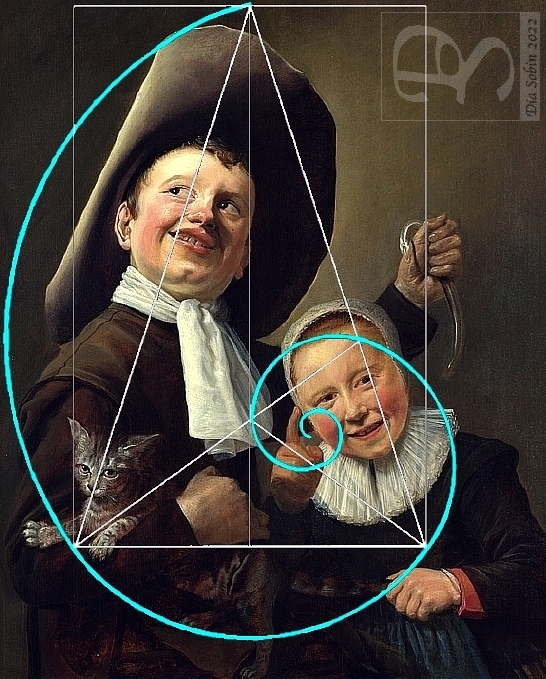
Judith Leyster and a Double Golden Spiral


A Boy and a Girl with a Cat and an Eel, 1635, Judith Leyster. Geometry: 2022, DS.


"Artist Judith Leyster wanted to follow her star as a painter. Her name even spelled it out - Leystar means "lodestar" or guiding star in Dutch. When she signed a painting, Judith made a visual pun, adding a JL monogram and attaching a star to it.

Born in 1609 in Haarlem, Judith won wide acclaim in her time - a reputation that went into eclipse at her marriage and, by her death (around 1668), had vanished almost completely. Funny, just like many of her paintings..."

- Via Uppity Women of the Renaissance, 1999, Vicki Leon.  Leon is referring to the fact that after Leyster's death her paintings were not identified for 200 years - and attributed to a male artist instead - despite the fact that her signature was present. In other words, that story... and we've heard it before.


"A Boy and a Girl with a Cat and an Eel is a 1635 oil painting by Judith Leyster that is now in the National Gallery, London.

Academic interpretation
There have been various interpretations of Judith Leyster's A Boy and a Girl with a Cat and an Eel by different scholars. Some, such as Neil McLaren, have argued that it represents the Dutch proverb "Een aal bij de staart hebben" (or "to hold an eel by the tail") meaning that you do not get to hold onto something just because you have it. This moralistic interpretation is supported, Cynthia Kortenhorst-Von Bogendorff Rupprath says, by the eye contact with the viewer made by the little girl in the painting as she wags her finger."

- Via the Wiki entry for the painting by Judith Leyster ((July 28, 1609 – February 10, 1660) above. Of course, this interpretation doesn't really fly... that is, if anyone (who isn't blind-folded) actually looks at the painting. For instance, does the woman (inset right) look remotely like a little girl? True, she is quite small and Leyster refers to her as a "girl," but if you look at the skin on her face and hands, you soon realize she can't be a day under 50. And you'll also notice that she is not looking directly at the viewer, but slightly off to the right side... as if she's pointing to something else - also to the viewer's right - and possibly out of the frame.

Then, there's the glass eel... held up - by it's neck (upper body), not it's tail (lower body) -  by a "boy" who may be her son... or grandson, although he doesn't look like a child either (note his teeth and hands). All in all, this painting may be another "pun" by Leyster... something about deceiving the eye... but it has nothing to do with morality... or with brutality towards cats (another academic theory). So much for expert opinions... similar to the expertise which somehow missed Leyster's signature on paintings for 200 years!

***

Wow, this is my 3rd (intensive) post this month; it must be the first time this has happened in 2 years (also known as the "plague" years). And, I'm back sooner than I expected... but, not because this is an ideal time for a new post. Hardly. The order of the day seems to be a strange chaotic brew - cooked up by trolls and served-up by artificially intelligent clowns -  under the Big Top. In other words, I seem to have my own personal Circus-from-Hell thing going on these days which defies all non-metaphorical description. The weird thing is, this existential maelstrom has it's perks. Perks that just happen to work in my creative life... but, not at all in my corporeal existence.

One perk is that I keep finding golden spirals in paintings... specifically from the Netherlands (in recent weeks)... and all of them from the 1600s (amongst some real Plague Years). Judith Leyster was a painter from an earlier part of that century, however, and one I didn't expect to find as it's unlikely that she and the other artists (who may be theoretically involved) ever crossed paths. While they were just blooming, Judith Leyster had already been cut down and claimed by matrimony, children, and, at the age of 50, death.

(Update 4/11/22) Note: Due to new information regarding the Italian painter, Caravaggio (1571-1610), Judith Leyster's involvement with pentagonal geometry becomes increasingly feasible. See here.)

She sometimes signed her paintings with a star. The reason given is that her surname means the "lode" or pole star. But don't you bet she loved stars anyway? A lot of people love star symbols and rarely think about their geometry, but I think Leyster may have...if the GTS in her painting (above) means anything.

Or, perhaps, I'm referring to the GTS below...


Same painting, flipped GTS. (Click to enlarge.)


Yes, it looks like there might be a double spiral thing happening - and its the first of its kind I've seen - a mirror spiral!

But, I wouldn't be convinced unless I found the correct spiral; one that could "mirror" itself. It'd have to be of identical size and level of placement in the painting to do so...

Thursday, March 10, 2022

Five of One, One of Five


5 Golden Snails = 1 Star - 2021, DS


I haven't yet perfected my "golden" diagrams... which are not supposed to represent true gold metal, but more of a sheet of old brass... with color enameling. I think I'm coming closer, but I've no way of knowing how these images appear on anyone else's computer. I only know that they suffer at a lower resolution and smaller size.

Ultimately, I may have to rethink the whole concept. Perhaps, the Golden series isn't a digital enterprise. Or, perhaps, it isn't blog material.

Anyway, I'm probably going to be away from this blog for several weeks. My lifestyle (or, my excuse for one) doesn't allow me time for calm, careful contemplation... unless I check into a motel.*

I check out tomorrow.

Till next time, then!


Music: Alt-J (Adeline)  Film: Andy Hardy.

(3/24/22) I've just posted lyrics for Adeline after the jump...

Tuesday, March 1, 2022

Nicolaes Lachtropius & the Golden Spiral


Still Life with Flowers, Nicolaes Lachtropius, 1667   (Geometry: DS, 2022)


"In the Rijksmuseum Amsterdam, this flower still life is one of the paintings made by Nicolaes Lachtropius. This painter was active from 1656-1700 in Amsterdam, and Alphen aan den Rijn. The description says “On a marble plinth a vase with a bouquet of roses and poppies. Between the flowers some butterflies, on the [edge of the] plinth a snail.” This oil-painting is signed “N. Lachtropius Anº 1667.″

The snail is very naturalistically painted, and is a dextral specimen of Cepaea nemoralis (L., 1758)."

- Via this page from a wonderful blog by a Dutch Malacologist entitled "Hunting for Snails" which charts the extensive history of snail images going back as far as the Roman Empire. In other words, it is the PERFECT blog! It was also one of my early influences when charting the course of this "golden" journey (so, Bram, I thank you).


"According to the RKD he was a flower still life painter who followed Otto Marseus van Schrieck.. He worked in Amsterdam, The Hague and in Leiden and was last registered in Alphen aan den Rijn."

- The sum total of Wiki's entry for Nicoleas Lachtropius.


 ***


Well, three's the charm (as I've said in the past) and, between the time I uploaded the image (above) and finished this third attempt at the accompanying text, I made another possible discovery. That is, it seems that several Dutch artists from this period (17th century)- and each of them (historically) in contact with the other - were not using the Golden Rectangle Spiral (GRS) as I had first concluded, but were utilizing the Golden Triangle Spiral (GTS) which I had neglected to substantially test because, at the time, I did not have an accurate GTS template.* Afterwards, when I finally did, I did a quick analysis but, after much labor with the GRS, I almost didn't want to know. Anyway, the "big reveal" will take place later in the finished series. This post exists just to give you an idea of what I'm aiming for, and to show another way in which the GTS can be utilized. See the (Botticelli spiral). (Don't worry, there won't be a quiz.)

That being said, the image above has been modified from the original: I gave it more space at the top.** But, don't be alarmed. Below is the actual .jpg of Nicolaes Lachtropius's painting from the museum's collection. And, as you see, there is no deception; the GTS still stands and in a very similar relationship. In fact, it's a gem. It connects almost every major element of the painting - excluding one red poppy (possibly an imitation) and a yellow snail - and it even curls through the artist's decorative signature. And, yet, it is the presence of the lowly snail which - if my hypothesis  is correct - gives the game away... and is the key to the artist's ulterior motive. Its ornate shell is, in fact, the symbol of the artist's modus operandi: "I have followed the spiral" or, what Albrecht Dürer referred to - two hundred years previously and in the "craftsmen language" - as the "Schneckenlinie" (the "snail-line"). (Via Dürer's Wiki entry.) (And, yes, I'll be discussing Dürer later, too.)


Inset right is a reduced version of the spiral (in the original painting). Note that it's innermost coil no longer winds around the pale pink rose but wraps around the small inset bud.

Which is the beauty of the Golden Spiral. You can size it and shift it, but the porportions, and its relationship to the image and design stays the same. Apparently, when the design is Golden, it's always Golden and the gold is found evenly distributed throughout the painting.

And, yet, it must be said, one might not find Lachtropius's design particularly harmonious or pleasing to the eye. Instead it might seem oddly unsettling, although intriguing (and somewhat kinetic)... but, if we can agree the artist did utilize the spiral, we might still question: why?

First of all, try not to see this as a contrived, mechanical design. It isn't. But, it might be in code... a code which impresses upon certain viewers - those in "the know" (specifically other artists) - the expertise of the artist in achieving an almost arcane and "sacred" harmony with a secret, embedded spiral.

Can we test this?

Monday, February 14, 2022

The Power of Love

Diagramming a Force: the Rose Pentagram - 2022, DS


“The transformative power of love is not fully embraced in our society because we often wrongly believe that torment and anguish are our ‘natural’ condition.”

“When angels speak of love they tell us it is only by loving that we enter an earthly paradise. They tell us paradise is our home and love our true destiny.” 

 “Knowing how to be solitary is central to the art of loving. When we can be alone, we can be with others without using them as a means of escape.”

 “If I were really asked to define myself, I wouldn’t start with race; I wouldn’t start with blackness; I wouldn’t start with gender; I wouldn’t start with feminism. I would start with stripping down to what fundamentally informs my life, which is that I’m a seeker on the path. I think of feminism, and I think of anti-racist struggles as part of it. But where I stand spiritually is, steadfastly, on a path about love.”

- Four quotes by the great feminist writer, bell hooks, who passed away recently but whose insight and lucidity regarding the world and its people has, in my opinion, not been matched by anyone in the past 50 years. For more of bell's wisdom see this Trans-D post, or this Goodreads page.

Vale, bell hooks. You are not alone on your path. We wish you well.

 ***

I'm having an almost impossible time writing these days. Pictures and music - specifically those involving Phi and the pentagram (snails & stars) - are the best I could do.

Meaning: my original plan for a golden ratio series has stalled. And, whatever appears on this blog from this point on is... well, is whatever appears on this blog from this point on.

Call it: metaphysical, existential overload.

Meanwhile, I hope you've had a Love-ly day.💕

And, failing that - and you are allowed to fail, you know - there is always the power of love... and the power of love - which costs nothing - takes (only) one heart and not necessarily (or physically) two (or more).


For your listening pleasure: a Phi-based tune... brought to you by Michael Blake:


Friday, December 31, 2021

2022 - A Tentative New Year


Alas, it's that dreadful day again... that is, my birthday. A day in which everyone basically celebrates the next day... which can never come soon enough. A day in which everybody gets inebriated, gets maudlin about the past and unrealistic about the future... while doing and saying regrettable things they will, in time, forget. This was the world I entered many moons ago, and mostly, it suited me just fine... except the weather; I still hate the cold.

I would love to toast the future. After 2 very creepy years I would be most happy to experience a New Day... a New Year. Wouldn't you? But it remains to be seen. There seems to a conflict of interest across the globe today. The Fear-Mongers*, Dope-Peddlers**, and Bad News Boys*** of this world seemed as pleased as punch when a 14th Covid variant reared its ugly little microscopic head. After all - and it doesn't take a Conspiracy Theorist to follow the money trail - the Pandemic has been very lucrative for them. Not so for you, me, and everybody else in the world... specifically those who have lost jobs, homes, businesses (and loved ones)... not to mention autonomy, mobility, sanity and a joy of life.

So, Bad News Boys, you can keep your New (abnormal) Normal. I need a New Year which is nothing like the previous 2. I want to see people's faces again when I talk to them; I want to see mine. I want to see different parts of the world before I die. I want to align myself with a creative culture, not a Disease Culture. In short, I want my life back. And that (dear readers) is my only Birthday wish (and New Years resolution). Oh, and this: I wish the same for you.

HAPPY NEW YEAR!

__________________________

 * The Covid PR group.

** The Covid R&D Group.

*** The Media.

 ___________________________


Note on the image which proceeds the text (also inset left): this diagram was the result of laying a pentagonal Golden Triangle over the nested lunes of a Lune Spiral. Each horizontal line in the triangle represent points where the triangle and the lunes met. It looks like a harp and that is it's name: A Golden Harp, or, just "harp."

Of interest: as you can see from the diagram, no matter where you slice off the base of a Golden Triangle, a Golden Triangle remains. The rectangles you see, however, are not Golden. The ratio of the side to the base of these pentagonal rectangles is this: 1.54545454545454... which is in keeping with the plethora of other embedded 9s in the pentagon's (and pentagram's) numerical structure. (For instance, the pentagram's angles: 36, 72 and 108 degrees; each adds up to 9.)

Inset right is a lune, also referred to as a crescent, although, in this species, the grand circle and the inner (lesser) circle are touching but not overlapping.

Theoretically, there are almost as many lunes within a circle as there are circles, and therefore, an almost infinite variety of lunes, lune spirals and harps. I will eventually document a few of them later in the "Golden" series.

But, getting back to the harp, I've been thinking "musical instrument" from the day I first devised it. In  reality, an actual harp, is a musical instrument built on a very strong angle.  Although I don't think any are built upon the very acute golden angle, I wonder if it's possible and what it might sound like.

(Later note:  There's a possibility a Renaissance harp used the golden angle!

For your listening pleasure: virtuoso harpist, Hanna Rabe beautifully performs Eric Satie's eerie, melodic tone poems, Gnossienes 1, 2 &3.


Saturday, December 25, 2021

Botticelli & the Spiral


Cestello Annunciation, 1489–90, Sandro Botticelli, Geometry: 2021, DS.


Above is a Christmas greeting card of sorts, composed of Sandro Botticelli's enigmatic Annunciation* and my own minor embellishment (meant to dazzle you, of course). And, while I'm not saying Botticelli actually used the pentagonal Golden Spiral to design his masterpiece, it does somewhat explain Mary's unusual posture.  She seems to be holding the geometrical apparatus up with both hands!

It doesn't explain the most important relationship in the image, however... that is, the odd relationship between Gabriel's and Mary's hands... but, perhaps an additional spiral might tell us something.


Put the two together and we have this:


Note the diagonal the two triangles have in common; when extended, it pierces Mary's hand. It's as if Gabriel was throwing her a curve-ball and she caught it!

Hmmm... but is that the end of the analysis....?

Alas, no...

Sunday, October 31, 2021

Halloween 2021 - The White Fallow Deer


"They chase me through the forest green with hounds and hunting men,
and it is my own brother dear that rides with them.
Oh beg him now to stay his hand and hold his hounds at bay,
for I can break this curse if I can make midday.

Oh son , will you not stay inside and will you leash your hounds ?
For that white hind you hunt each night is your own blood.
I will ride the forest green and I will not stay my hand
and I will claim the finest hind that roams the land.

Three times they chased her down, three times she's run away.
The fourth time that they chased her down, the white hind they did slay.

Oh son of mine I beg of you , where's my daughter dear ?
I hear a young girls voice ring out sweet and clear.
My heart is on the table and my blood is on the floor.
My bones are roasting on the coals, I'll return no more."


- Lyrics from The White Hind... a ballad which is based upon the traditional French song, La Biche Blanche (a video appears after the jump) which tells the tale of a young girl who uncontrollably transforms into a white doe (or hind) - due to a curse - and is eventually slain (in deer form) by her brother. Versions of this story seem to have emerged world-wide over the centuries: For instance, here's one from North Carolina.   (Note: for a visual treat see The White Hind - on this page - by sculptor, Beth Cavner.)


"In Celtic cultures, the white stag traditionally symbolizes the world of the dead or the Otherworld. As a matter of fact, many other cultures also see the white stag in the same way.

In Arthurian mythology, pursuing the white stag was a symbol of our yearning for immortality or the next life."

- Via an article found here. 


" SIR – Something terrible will befall us if we shoot a white deer (report, March 9).

Take a lesson from the legend of Herne the Hunter, who was said to have saved Richard II from a white hart while the king was hunting in Windsor Forest. Mortally wounded, Herne had the deer's antlers bound to his head by a wizard to keep him alive. Herne was later found, hanging from an oak tree...

Clearly Herne is of much greater mythical antiquity than Richard II, but the king did bear a white hart as his heraldic badge. To kill a white deer is more foolhardy than brave."

- Excerpt from a letter via an article found here as was the source of the medieval painting above. 


"The tale comes from Kilmersdon, in the eastern Mendip Hills in Somerset. It concerns a lord who was weighed down with the woes of the world: there was a great pestilence among his people, and despite all his efforts, nothing the lord could do would stop the death and pain and sorrow from spreading across the land.

He was riding through the woods one evening with a heavy heart, when through the trees he saw a flash of pale fur, and a white hind bounded across the path in front of his horse. The lord followed the deer through the trees, picking his way through the ferns and brambles as quick as his horse would allow, but after a few minutes it had disappeared.

After that time, though, the lord was filled with inspiration and hope. His chance encounter with a white deer in the woods had refreshed his spirit, and allowed him to look at the situation in a new way. Following the lord’s directions, the people around him soon started to pull together, make plans, and work to improve the situation as best they could. Slowly at first, but then more and more under his lead, the community of that place found fresh energy to deal with the illness facing them, and to find a way through to the other side and renewal ahead."

- An excerpt from a folktale found here.


"A rare white deer was shot dead by police after it was spotted running through the streets of a town.

The RSPCA said it had advised police to 'leave the deer as it would make its own way back home' eventually.

But Merseyside Police said officers decided to euthanize the deer after growing concerns it might be dangerous for motorists and pedestrians.

A spokeswoman for the RSPCA said that while the deer could have been sedated 'this needs to be done with caution in a public area such as this one, as the deer could startle and run when hit by the dart'.

- From this BBC 2021 news article.


***


My Halloween post this year was inspired by an actual event that occurred in the UK recently (see article excerpt directly above). The sort of story - animal gets stranded in traffic and then is shot for the public good - that would quickly slip through the cracks and no one would be the wiser for it... but, I couldn't let that happen. Instead, I thought I'd honor the death of this particular white stag, although many of its kind continue to be slaughtered by hunters all over the world (despite its protection in some areas). Its head apparently makes a valuable trophy... although "trophy" for what I can't imagine. Surely it takes no real skill to kill an animal with a high-powered rifle. Worse still - and to highlight the depravity of this particular enterprise - one stag was stolen from a zoo in Germany and then beheaded (article link)!

Another disconcerting element of the BBC news article, however - along with the fact that all human parties involved were incompetent - was that there was no mention of the history of this particular animal. That a white deer is a relative anomaly never seemed to enter the equation, let alone the ancient folklore which surrounds it... which is odd; a great deal of white deer mythology originated in the UK!

Question: is actual progress being made when we lose touch with the roots of our narratives? Are we evolving when we subtract emotional content and mythological meaning from existential fact... or are we more profoundly floundering in the dark?

Sunday, October 17, 2021

Fractal Unit 5


Fractal Unit Five - 2020, DS.


It's fundamental.

  ***

 (Note: The bulk of the content which originally appeared in this post (under the title "Forever Young") has been deleted after YouTube deleted one of the two featured videos. Sorry, but I wasn't up to repairing the post. If fact, I'm certain that there are many links, videos, etc, which  need my attention - especially on the sidebar -but time is in short supply these days.

I have a holiday post which will hopefully go up in a couple of days but, if, for some unforeseen reason it doesn't, I'll leave you with the video below. It's by a (relatively) new band - yes, darlings, I've finally discovered a band created in the 21st century I actually like: Sea Power. Their 2021 video (Two Fingers) below can also be found on their website and YouTube channel.  Dia, 10/26/21)


Friday, September 24, 2021

Reflections on Water


 “'I’m touched by your impatience over the Images. What happened was this: the first piece, ‘Reflets dans l’eau,’ doesn’t satisfy me at all so I decided to write another based on different ideas and in accordance with the most recent discoveries of harmonic chemistry…My apologies for this slight delay—which in any case won’t last beyond the end of the week. I’m starting to see things clearly again in my imagination and my thinking machine is gradually getting back into gear.'

Nothing in the composition of the piece has been written without consideration for phi and Debussy is unconcerned whether or not anyone, aside from himself and Durand, listens for the ratio unpacking, building itself, and then deconstructing itself over 94 measures and 375 beats. The new Reflets dans l’eau is an andantino molto that is almost as quiet as a droplet of water falling into a silvery lake. The piece divides asymmetrically into a beginning that stretches to the climax at the fifty-eighth measure and a smaller stretch that ends the piece. The climax, marked double fortissimo, is at the exact point of phi in the song, the mathematical equivalent of the golden ratio."

- Excerpt of an article found here regarding Debussy's use of the Golden Ratio (Phi) in Reflets dans l'eau,

The video is a re-mix of Reflets dans L'eau, (Reflections on Water) from Images I by the French composer, Claude DeBussy. It was created for electronic media by CJ Images and designed by CJ (Christopher John) for the game Flowscape. I chose this video (from numerous others) because some of its electrical sounds actually bring to (my) mind the golden spiral. To your right is the pentagonal golden spiral constructed by its 2 golden triangles.

"Among the mysteries of the irrationals, one number holds a special place: the so-called golden ratio. The golden ratio’s value is about 1.618 (but not exactly 1.618, since then it would be the ratio 1,618/1,000, and therefore not irrational) and it’s also referred to by the Greek letter φ, which is pronounced “fee” if you’re a mathematician and “fie” if you are in a fraternity. If you want an exact description, the golden ratio can be expressed as (1/2)(1+√5.)

People have been making a fuss over this number for centuries. In Euclid, the proportion goes by the more mundane name of “division into the extreme and mean.” He needed it to construct a regular pentagon, since the golden ratio is the proportion between the diagonal of such a pentagon and its side. A golden rectangle is one whose length is φ times its width; it has the agreeable quality that if you cut it crosswise so that one of the two pieces is a square, the other one is a smaller golden rectangle."

- Via the Slate article: The Most Irrational Number. Inset left is a beautiful photograph (found online) of the chambered nautilus, featuring a spiral similar to the golden spiral.

 ***

Well, it took me long enough to write this post (!), but, then, I was somewhat intimidated by it. In terms of this blog, it's an important one; revealing just exactly where I've been at (creatively) for the past 2 years. Never mind that the past 2 years have been for myself and, I imagine, most people, a regular mind-f*ck. (After all, who amongst us did not in some fashion get sick?) However, the show must go on. And, for an artist, to create is to live... and to live is to create. Nothing changes this equation.

My creative journey began during 2019 and was referred to in this April interlude, upon the creation of the Rose Pentacle graphic. Later that year I began sculpting a 3-dimensional version of that image in clay for a ceramic casting (which is still in progress). I also began to envision a series of paintings which might bring the Night Garden to life while, at the same time developing a mythology relative to both the garden, the Rose Pentacle and the inherent mysteries I sensed were involved.  It's a big project.

But, as the Pandemic fell into place, I lost my place in the journey. The dream went on hold, and I turned, instead, to the one component of the Rose Pentacle that could be investigated in two dimensions on a computer monitor: the pentagram, its history, but, most importantly, its geometry... from which a series of diagrams eventually emerged (a few of which appear in this post.)*

(More after the jump...)