Showing posts with label Renaissance. Show all posts

Tuesday, June 25, 2024

The Dürer Files: A Series Introduction

Nemesis or The Great Fortuna, Albrecht Dürer - copper-plate engraving - 1502.
Geometry: 2024, DS.


"Precariously balanced on an unsteady sphere, Albrecht Dürer’s nude female figure of Fortuna conveys a sense of the instability and unpredictability of fortune. The artist’s treatment of the subject derives from a Latin poem by the Italian Renaissance poet and humanist Angelo Poliziano (1454–1494), who describes fortune as the “power to crush the arrogant minds and triumphs of men and to confound their too ambitious plans.” With her bridle and cup, Dürer’s figure—in contrast to misogynistic portrayals of her by a later generation of artists—also embodies the virtues and rewards of temperance."

- A nice assessment of Albrecht Dürer’s Nemesis image (inset left & above) via this NY Public Library page. It seems cynical that Dürer should symbolically combine the word nemesis - meaning rival, enemy or punisher - with the idea of fortune (fortuna) together in one image. Was he referring to the idea of fate as karma? In reality, the goddess Nemesis and the goddess Fortuna are mythologically and symbolically connected and it is more than likely he created his own hybrid.

It actually took me several days to see the spiral in Nemesis, the Greater Fortuna... which is astounding considering what an awesome spiral it is. It's a dialing spiral but of a slightly different kind than the one I'm familiar with. You can create a small animation with it growing in size and spreading over the image as it revolves around one central point (in the vicinity of her elbow). In the fuller image - shown above with the phi-shell - the spiral continues into the landscape.

As for the image itself, the figure of Nemesis/Fortuna exhibits a female body type humanity rarely sees anymore. We probably stopped seeing her around the same time Dürer created her, at the turn of the 16th century. She is an older woman; you can tell by her diminishing face and thinning hair... unlike Durer's (1496) Little (or Lesser) Fortuna - inset right - the younger Fortuna (with a lesser spiral) and an enigmatic image the size (and dimensions) of a Tarot card.*

But, the older Fortuna - who has in her maturity taken on the role of Nemesis, a "formidable and usually victorious rival or opponent" - reveals a body with contours which, while not aesthetically correct in our times, has retained its hard-bodied youthfulness. She has powerful wings and holds a large chalice. Traditionally, Fortuna, is shown holding a cornucopia but, as mentioned, Dürer has created his own Fortuna hybrid. But, then, it seems he rarely sticks with the "tried and true," preferring his own innovations. In any case, Nemesis/Fortuna is a force to be reckoned with. She may be offering the chalice - the cup of plenty - but, we are reminded that she is also carrying a horse's bridle. In other words, while we may succeed  above and beyond our wildest dreams, our egotistical aspirations are kept in check by this goddess. Either that, or she represents a stereotypical negative female archetype.

Incidentally, Nemesis is much more massive figure than she appears at first glance. An enlargement of the little Italian town which she overlooks (as she balances upon her sphere) can be found here.

___________________________________________________


By now, I should know better than to make promises regarding the future I can't keep... but, in regards to my previous projections made in my last post, when and where I envisioned one more addition to the Dürer series, I am now here to report that my plans have had to change.

Yes, while in the midst of feverishly writing the proposed post (Dürer Part III)  I initially had in mind, I was suddenly presented with far more bits of information than I could possibly process in one post.  An example would be the Nemesis image with it's astounding spiral (above). But, there were other images found as well, deserving some special consideration... such as Dürer's diagram of his 'Schneckenlinie' ('snail-line') or Logarithmic spiral - (inset left) - a spiral which, oddly, almost appears as if it's in perspective. Sadly, I cannot translate the text. (If you can, please inform us!)

In any case, after the shock wore off and my first attempts were put aside, I decided the new information required a new series... The Dürer Files, a new testament of sorts. Moreover, it would have to be broken up into bits... thereby requiring shorter posts and less time, or, seriously, I would never get any of it online. So, this is the Introduction. The series contents will (tentatively) include  the following sections:


The Dürer Files: 2. Soli Deo Gloria (Glory only to God)

The Dürer Files: 3. Maximillian & The Bauhütte

The Dürer Files: 4. Dürer & the Phi Goddess

The Dürer Files: 5. Dürer & the Black Madonna

The Dürer Files: 6. Dürer & the Whale


(Note: This Intro will also serve as the Dürer Files series Table of Contents page with links becoming active as the posts appear. The links will also appear in the Golden Series content post (click the Golden Snail on the sidebar.) (Know, however, that the titles and order in which they appear may change.)

(Note 2: I have already added an extra section... and 2 more - regarding phi ovoids - are likely to follow.)

___________________________________________________


(More below the jump break...)

Wednesday, January 10, 2024

A Belated Christmas Spiral: The Annunciation by "Juan de Flandes" (Revised 1/19/24)


The Annunciation, 1508, Juan de Flandes. Geometry: 2024, DS.


"Juan de Flandes ("John of Flanders") was a Flemish painter active in Spain from 1496 to 1519. His actual name is unknown, although an inscription Juan Astrat on the back of one work suggests a name such as "Jan van der Straat". Jan Sallaert, who became a master in Ghent in 1480, has also been suggested. He worked in the Early Netherlandish style.

He may have been born around 1460 somewhere in Flanders, Flandes in Spanish, which encompassed modern Belgium, Netherlands, Luxembourg and bordering regions of France. He evidently trained in his home country, most likely in Ghent, as his work shows similarities to that of Joos van Wassenhove, Hugo van der Goes and other Ghent artists. He is only documented after he became an artist at the court of Queen Isabella I of Castile, where he is first mentioned in the accounts in October 1496. He is described as "court painter" by 1498 and continued in the queen's service until her death in 1504..."

- Via Wiki's entry for Juan de Flandes.

"In a list of 23 February 1505, thirty-two of them, including the Last Supper, were acquired by Margaret of Austria, Regent of the Netherlands and sister of Isabella’s son-in-law (in whose collection they were seen by Albrecht Dürer). Dürer noted in his diary: ‘And on Friday Lady Margaret showed me all her beautiful things, and among them I saw about forty small pictures in oils, the like of which for cleanness and excellence I have never seen’."

- Although not applicable to The Annunciation,  the quote was sourced from this page in which a full account of Juan de Flandes' mysterious collection of small paintings is given.

(Update:1/19/2024) I'm adding a new spiral to the mix (inset left). While not the "magic act" posted above it still has 2 things going for it: it terminates on the "holy spirit," and it begins to form a pentagram over Mary. There's a third thing. Gabriel conjures up an important golden relationship with his wand. What is it?

(Correction: Gabriel conjures up (at least) 3 golden relationships with his wand. What are they?)

***

I had a different post in mind for the first post of the year, but, as it happened I had the image (above) on file as a possible Christmas alternative, but, it needed research and I didn't have the time for it last year.

As it was, the trail grew cold fairly early on in my search for information, and there doesn't seem to be any clear cyberspace description of who the artist actually was, although we do know he was fairly successful, especially in Spain. (See: Juan de Flandes and His Financial Success in Castile.)

But, Juan de Flandes' Annunciation is possibly one of the most unique of all the many paintings in that genre produced in the late Renaissance, another being Botticelli's Cestello Annunciation (1489), the first spiral painting I documented on this blog... and, still, to this day, one of the best spiral paintings.

The spiral in this somewhat odder Annunciation painted by the Flemish painter, however, has one special feature. It's spiral presents us with a little conjuring effect, a magic act. (Why, it even has a dove!)

I've inset the unembellished original so you can witness it for yourself. Click on the image, and when the "slideshow" pops up, click on the spiral version. Jockey back and forth.  Do you see it?

Abracadabra! the angel performs a magic-trick with his staff... as if it was (an overly long) wand. (Presto! Mary is now with child.)

(Now, there's a mixed metaphor...)

Monday, January 29, 2018

Qualifying Feminism: Empowerment and the Arts (Part I)


Gal Gadot in her 2017 film role as Wonder Woman.

"But it was within this busy, unorthodox household, where (William Moulton) Marston upheld a "hodgepodge of Aquarianism and psychology and feminism," that Wonder Woman began to take shape. Marston proudly claimed that his most famous creation was meant to be "psychological propaganda for the new type of woman who ... should rule the world." The superhero made her debut in December 1941, the same month the United States entered World War II. With her mandate to fight "evil, intolerance, destruction, injustice, suffering, and even sorrow, on behalf of democracy, freedom, justice, and equal rights for women," Wonder Woman not only battles Nazis but also aids (in the guise of her alter ego, Diana Prince) female department-store workers on strike over meager wages."

- Melissa Anderson from her Newsday book review of The Secret History of Wonder Woman by Jill Lepore. Inset left is a Wonder Woman comic book panel (possibly from the 1970s) featuring an explosive rant which begins: "Men! It was you who did this, with your weapons and your war, and your mad need for confrontation..."

"This perception shifted over the years, however, as demonstrated in December 2016 when the United Nations decided to drop the title of "honorary ambassador for the empowerment of women and girls" which it had given to the comic book character Wonder Woman a few months prior, in a ceremony attended by the actors who had portrayed her (Lynda Carter and Gal Gadot). The title was eliminated in response to a petition signed by 44,000 people which argued that Wonder Woman undermines female empowerment due to her costume, described as a "shimmery, thigh-baring bodysuit with an American flag motif and knee-high boots". The petition stated that "it is alarming that the United Nations would consider using a character with an overtly sexualised image at a time when the headline news in United States and the world is the objectification of women and girls"...

The debate continued with the release of Jenkins' 2017 film, Wonder Woman, which according to the BBC had "some thinking it's too feminist and others thinking it's not feminist enough". Kyle Killian found an inherent contradiction in the construction of Wonder Woman as "a warrior" whom, she states, is also highly sexualized. Killian thus suggests that these elements "should not be the focus of a kickass heroine—her beauty, bone structure, and sexiness—if she is to be a feminist icon..."

- Excerpt from the Wiki entry for Wonder Woman, the 2017 film directed by Patty Jenkins. Inset right, Wonder Woman and her controversial costume.

"Spartan women, of the citizenry class, enjoyed a status, power, and respect that was unknown in the rest of the classical world. The higher status of females in Spartan society started at birth; unlike Athens, Spartan girls were fed the same food as their brothers. Nor were they confined to their father's house and prevented from exercising or getting fresh air as in Athens, but exercised and even competed in sports. Most important, rather than being married off at the age of 12 or 13, Spartan law forbade the marriage of a girl until she was in her late teens or early 20s. The reasons for delaying marriage were to ensure the birth of healthy children, but the effect was to spare Spartan women the hazards and lasting health damage associated with pregnancy among adolescents. Spartan women, better fed from childhood and fit from exercise, stood a far better chance of reaching old age than their sisters in other Greek cities, where the median age for death was 34.6 years or roughly 10 years below that of men."

- Excerpt from the Wiki entry for the ancient Greek city of  Sparta. Note that, in the ancient world, the life span of a woman was shorter than that of her male counterpart. Inset left is a bust of Helen (Helénē) of Troy (or Sparta) by the artist Antonio Canova. She was that famous swan daughter of (Spartan) Leda and the god, Zeus.

"Girls with guns, big guns - what fun! Even the most pacifistic woman - and really, I am - experiences a certain vicarious release when, with a gun in each hand, a superwoman blows away a flock of her opponents, without so much as blinking her eyes. Hell, I have a hard time swatting a fly, but when I watch Kate Beckensale blast her way through a bevy of creeps, I get to share a certain heady sense of power...

So, you go Kate, and Charlize, and Carrie-Anne... and you go Milla, and Sigourney, and anybody I may have left out. There are no underdogs quite so "under" as women, so, when you shine, all of our repressed warrior instincts finally get to kick some ass!"

- Excerpt from my (2011) PMB post "The New Superheroines Girls With Guns." Inset right is
Kate Beckinsale as the Vampire (and Death Dealer), Selene.

***

From 1987.
The word "superheroine" isn't even an official word according to my computer system's 2009 dictionary... (and maybe it isn't now, either, judging by the way it's being underlined in red as I write this post). But, considering that the comic book character, Wonder Woman, made her debut over 70 years ago (in December of 1941), and noting, too, the plethora of female warrior-types who've invigorated the film, television and comic book industries since that time, well, one would think the word would have surfaced in the English language by now.

But, as it happens, the official world transforms very, very slowly... and, in certain areas of the globe, almost not at all; and in regards to the subordination of the female gender, well, despite several "waves" of feminists - and thousands upon thousands of years spent pushing the world's population out of their (collective) wombs - women are still essentially the underdogs. The odd thing is, even when a woman is the boldest, most attractive, most ingenious person she can be, chances are she still fears she is never quite good enough and her accomplishments are trivial, often driving her to overcompensate for a deficiency she never really had. Inwardly, regardless of her accomplishments, she still feels as if she's treading water, or as if some undefinable force continues to hold her back or drag her down. This is not a delusion. Metaphorically, society - under the spell of a pervasive patriarchal zeitgeist - clipped her wings many ages ago. And this legacy - this insidious mutation - was genetically* passed down to her in such a way, that she needs no outside force to enslave her - the trappings of her prison exist at all times embedded within her own psychology.

So, the question becomes: how can a maimed bird fly?


Monday, January 1, 2018

"Keep Going" (Featuring the Work of Jada Fabrizio)


"keep going" - diorama, mixed media - 2017, Jada Fabrizio
(All images can be clicked on for enlargements.)

"I believe that art should make you feel something, it should touch you, make you think, laugh, cry. I consider myself an alternative reality photographer. I sculpt my own characters, build dioramas, and light the scene to create surreal visual fables or freshly minted fairy tales for adults... Each image is purposely unresolved. They are, in essence, stories in need of an ending."

- Jada Fabrizio, quoted from the Monmouth Museum Journal.

***

Once upon a time... (in 1979... which seems like a lifetime ago because, relatively speaking, it was) two young, punked-out, female artists recently transplanted from the east coast (USA) met in a warm, sunny place called San Diego, California. As it so happened, they met in an art supply store where one girl was a cashier. She (Jada, then a painter) was a striking, dark-haired girl with a tiny - but fashionable - peculiarity... something the second girl (me, then a cartoonist) picked up on from the get-go. (Inset right, from 1980, my cartoon alter ego Rude Girl.)

Looking down at her hands, I noticed she had only one of her fingernails painted... I think it was on her left pinky - at least that's how I remember it - but it wouldn't have mattered anyway, nor even the color (blue?). That one fingernail was like a code word... a subliminal prompt... and immediately we struck up a conversation. We found we had a great deal in common... up to and including a certain alienation from the overwhelming "whiteness" of the west coast.


Girls - color photograph - 2013, Jada Fabrizio

Less than a year later, Jada high-tailed it back to New York... myself following soon after. We found ourselves on the Isle of Manhattan involved in all sorts of mad (and often pointless) (but, always fun) adventures. In time - and not very long - I (at least) would look back and say: "Gee, why did I ever leave California?"

Jada, however, was in exactly the right place. Some people are lucky that way. They never regret the past nor lose sight of themselves...

They just keep going...

Saturday, March 4, 2017

For the Angels - 3:01; Three's the Charm (annotated)


Angel of Death Victorious - bronze (distressed) - 1923, Herman Matzen.
Also known as the "Haserot Angel," this monument is located in Lakeview Cemetery, Cleveland, Ohio. Above is my B/W version of a photograph found here, credited to Steven Jupina.
(All images within this post can be clicked to enlarge)

"Who, if I cried out, would hear me among the hierarchies of angels?
Even if one of them pressed me suddenly against his heart,
I would be consumed in that overwhelming existence.
For beauty is nothing but the beginning of terror, which we are still just able to endure,
and we are so awed because it serenely disdains to annihilate us.
Every angel is terrifying."

"Every angel is terrifying. And yet, alas, I invoke you,
almost deadly birds of the soul, knowing about you.
Where are the days of Tobias, when one of you, veiling his radiance,
stood at the front door, slightly disguised for the journey, no longer appalling;
(a young man like the one who curiously peeked through the window).
But if the archangel now, perilous, from behind the stars took even one step down toward us
our own hearts, beating higher and higher, would beat us to death.
Who are you?"

- First stanzas from the First and Second Elegies of the Duino Elegies (Duineser Elegien), by Rainer Maria Rilke, 1923. The full English translations by Stephen Mitchell of the first two Elegies can be found here. However, I can't hardily recommend any of the other translations found online. Ideally, it should be read the way Rilke wrote it: in its original German form. Incidentally, Rilke's question "where are the days of Tobias" refers to an enigmatic scripture of ancient origin which relates the story of the youth, Tobias. and the archangel Raphael (See the "A Brief History of Angels" section).


"I turned my sight back to the angel when, suddenly, I noticed his hands - particularly his right hand which was reaching out to me. In English, he said, “Come into my world.” I was wondering why he was speaking to me in English when, suddenly, I heard the translation: “Entre dans mon monde,” and even in German: “Komm in meinem Welt.”

Then, through the music and the angel, I entered into that other world, which exists inside the painting. The whole time, the figures had been calling me there.

The angel changed my appearance, and I became just like one of the little people in the painting. I received a long cape, and I was crowned with coral (just like the woman in profile with the elaborate headdress). It was like a ceremony, initiating me into paradise... I became an angel..."

- Excerpt from Un Autre Monde by Myrette St. Ange (possibly a fictional character) (?) "translated" by Visionary artist, L. Caruna. The painting referred to is an actual painting by Visionary artist Robert Venosa. (inset, above, is a detail from the painting.)


"For painter and philosopher Robert Venosa, art and spirituality were simultaneous. Venosa was a visionary in the most real sense of the word: much of his artistic expression was deeply connected to visions that he had of higher dimensional beings whom he perceived as angels, although a different sort of angel than you might see in popular religious art. At several crucial moments in Venosa's life he was visited by an entity that seemed transcendent of time and space, yet was partially visible in the third dimension. These experiences affected Robert deeply and he attempted for the rest of his life to paint them (example, inset left). Many of his well known works were inspired by these visions, including twin angels Castor and Pollux, and Seraphim."

"Spirit energy, like all universal energy, must manifest itself in form and texture at its own vibratory level. We, in our present stage of time-space evolution are unfortunately limited in our perception of these transcendent substances. But the visionary, in his creative expression, must overstep these limits if he is to resolve his task of bridging the gulf between accepted reality and spiritual postulation”."

- Two quoted paragraphs from Reality Sandwich's article on Robert Venosa {1936 - 2011}: Viva Venosa. The second quote is from the artist and was excerpted from his 1978 publication "Manas Manna." All three paintings posted here can be found on his website.

***

Sorry for the delay, comrades, but my mental engine decided to stall last week just at the crucial moment... possibly flooded by too much angelology! Then again, maybe I've just been wrestling with my own angels lately... or maybe I've been wrestling with yours; it's difficult to say. Understanding the Language of Angels is a little like understanding the Language of Birds - and maybe they're one and the same - but, one thing I've learned: it's impossible to pin down an angel. Moreover, angels are not always "nice."  But, whether you "believe" in them or not - and, very possibly, they couldn't care less -  it is always they who have the advantage. Like birds - up to an including Rilke's "deadly birds of the soul" - they can merely fly away. (Or, even worse, tamper with your mental engine!)

Of course, there are angels and then there are angels. For some people angels are guised as beneficent strangers; those enigmatic humans who seemingly come to us out of thin air (and just in the nick of time) to save the day. For an artist, the Muse is a kind of angel. For a child, a guardian angel is sensed as a protective force. And, as for mystics, well, they seem to be able to experience them firsthand.

As a matter of fact, it is often artists, mystics and children* who actually see angels. William Blake saw angels... especially as a child, and specifically in trees. The American artist Robert Venosa spent his lifetime attempting to represent the "higher dimensional entities" he saw (inset, right).** And, while the poet Rainer Maria Rilke devoted his Duino Elegies to angels, it is also said that his initial inspiration - and the first line of his poem - came from an angel whose voice was carried to him on the wind. The Swiss scientist (and mystic) Emanuel Swedenborg not only saw angels***, but wrote extensively about his conversations with them in a book entitled Heaven and Hell. He writes (found here):

"On the grounds of all my experience, which has lasted for several years now, I can say with full confidence that in their form, angels are completely human. They have faces, eyes, ears, chests, arms, hands, and feet. They see each other, hear each other, and talk to each other. In short, they lack nothing that belongs to humans except that they are not clothed with a material body."

As for the Christian mystics, Saint Francesca comes to mind. She even convinced Church authorities that her guardian angel was a true, substantial entity. In fact, she was formally declared the Patron Saint of Automobile Drivers, because her alleged angel was said to appear with a lantern to guide her whenever she travelled.

And, then there's the matter of Saint Teresa (of Ávila) - not to be confused with Thérèse of Lisieux - and her "ecstasy," but that's so juicy, I'm saving it for later...

Tuesday, August 18, 2015

In the Company of Green Women (V): The Renaissance & Baroque Painters


Susanna and the Elders - oil painting - 1610, Artemisia Gentileschi

(Apart from this image, which has been posted in full, the remainder of the images of this post
 can be clicked to enlarge.)

"If Artemisia had not been a virgin before Tassi raped her, the Gentileschis would not have been able to press charges. During the ensuing seven-month trial, it was discovered that Tassi had planned to murder his wife, had engaged in adultery with his sister-in-law, and planned to steal some of Orazio’s paintings. During the trial, Artemisia was subjected to a gynecological examination and torture using thumbscrews to verify her testimony. At the end of the trial Tassi was sentenced to imprisonment for one year, although he never served the time..."
- Via the Wiki entry for Artemisia Gentileschi. (Note: Ah, but do not cry for Artemisia; as we will see, she, indeed, has her metaphorical revenge!)

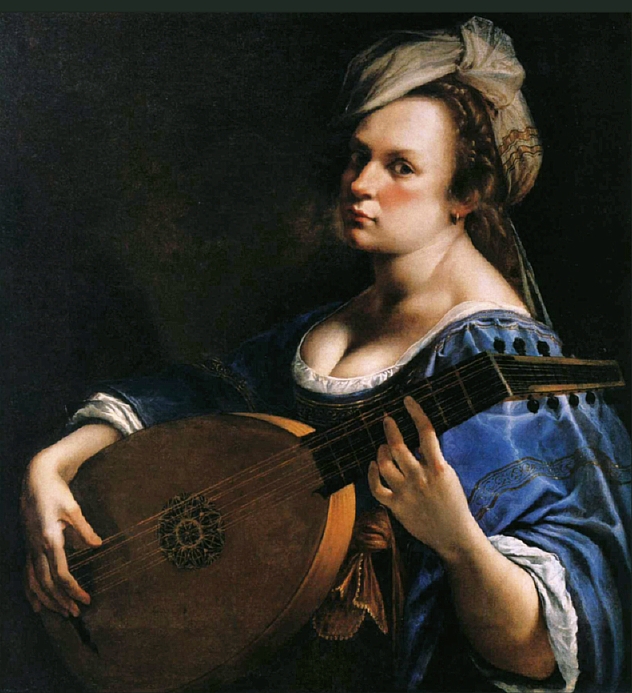
Self Portrait as a Lute Player - oil on canvas - 1615-1617, Artemisia Gentileschi

"It is not easy to explain why the Italian towns and universities gave so much encouragement to the higher aspirations of girls. In poetry, in art, in learning, that encouragement was equally remarkable, and I am tempted to assign its origin to the martial temper of the Middle Ages, which drew many young men from the universities to take part in the exercises of the tilt-yard or in the perils of the battlefield, leaving the fields of learning in need of zealous labourers. Women, on the other hand, exposed their hearts, but not their lives, to the hazards of duels, tournaments and wars; they lived longer than men, as a rule, and hence it was worth while to encourage publicly those gifts of the female mind and spirit which had long been cultivated privately for the benefit of peaceful nunneries."
- Walter Shaw Sparrow from Women Painters of the World, 1905. (Full text)


"A number of obstacles stood in the way of contemporary women who wished to become painters. Their training would involve both the dissection of cadavers and the study of the nude male form, while the system of apprenticeship meant that the aspiring artist would need to live with an older artist for 4–5 years, often beginning from the age of 9-15. For these reasons, female artists were extremely rare, and those that did make it through were typically trained by a close relative..."
- Via the Wiki entry for Flemish artist Caterina van Henessen (1528 – after 1587).


Self Portrait Seated at an Easel - oil on wood panel - 1548, Caterina van Hemessen 

"Occasional doubt has been raised as to the authenticity and provenance of the work. Some have speculated that it was created by her father Jan Sanders van Hemessen (1500–c 1566); he tended to portray women with the same large round, dark, eyes and reduced chin. However these theories are not given much weight by art historians, and the prominence of the signature is taken as evidence of Caterina's intention to mark the work as by her own hand."
- Via the Wiki entry for Caterina van Henessen. (Note: The actual inscription on the painting is: "I Caterina van Hemessen have painted myself / 1548 / Her aged 20.") (!)

***

(Note: As of this post, all links will now open up in new pages.)

Well, finally, after following the exploits of medieval women who, despite their unfortunate invisibility, we now know were active in many fields of visual art, we come to the end of our medieval journey.  We are now entering the High Renaissance and Baroque periods, and, somehow, with no prior evidence or warning, a most curious thing occurs: women artists have suddenly multiplied like rabbits! Not only that, we now have names, faces, and dates to conjure with; yes, actual flesh & blood people. In short, there's enough official data to utterly dispel the falsehood that women have no artistic legacy. Because, yes, there most certainly were great woman artists in the long past, whether certain small, indoctrinated, and biased minds recognize this or not.

But, if any or all of the woman painters I feature (or mention) in this post - an incomplete listing of about thirty-five* - come as a surprise to you, do not feel alone. You and I are sharing the same process of discovery. I can attest to the fact that, as recent as thirty-five years ago, little was known - or, at least shared with the general public - about any of these women outside of Europe, and (possibly) only marginally there, with few exceptions. Moreover, they were known mainly amongst scholars and academics who, for whatever reason, couldn't estimate the importance of the work these dedicated women had produced. And, let's face it, the women had to be dedicated, considering the immense obstacles that stood before them...