|
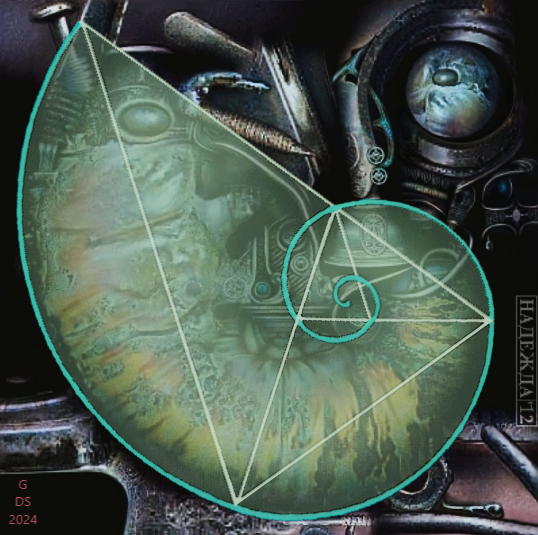
Phi shells served up on a modern paisley fabric (sourced here).
Geometry: 2024, DS.
|
"meme - n. a unit of practice or belief through which a society or culture evolves and that passes from one generation (or even one person) to the next. In this sense, the term — coined in 1976 by British biologist Richard Dawkins (1941– ) and derived from the Greek word for “imitation”— is a kind of metaphorical parallel to the term gene."
- An interesting definition of "meme" found in the online American Psychological Association's
Dictionary. As a "metaphorical" gene, in lieu of its lack of actual physicality, we can expect a meme to operate in a manner similar to the gene: subconsciously and/or subliminally. Unlike the gene, it is transferred from one mind to the other... often in the form of a symbol, although not necessarily a visual symbol.
The images posted above, and inset right, and inset left and right below are the result of a new 2-dimensional toy I developed last year and introduced in The Universe in a Phi Shell: phi shells. I can't remember what inspired me to make phi spirals into phi shells, but it was probably pretty elementary. However, once I saw the effect the shells produced on some images, I was astounded. In so many cases the phi shell was like an envelope - die-cut to fit a golden spiral - or a custom-made template... with maybe a little wiggle room.
Sometimes, working with a phi shell leads to repositioning the original spiral. Inset right is a prime example:
Boy Blowing Soap Bubbles by 17th century Dutch painter (and Bentvueghel
), Karel Dujardin. (See the post for the former spirals.) As concise as this spiral appears, it could be larger and better... but, As we see time and time again, some portion of the necessary image area is missing. What sold me on the orientation of this spiral, however, is the way the boy's right arm - holding the bubble pipe - falls so neatly into the small triangle. It's as if the boy is drawing the spiral in the air.

- A cautionary quote from the Wiki entry for "meme," and one that might make a certain amount of sense to those acquainted with what I've come to refer to as the "Golden Meme." I could even go so far as to says this might be reflected in my own experience... including the
"detrimental to their hosts" bit, but, I try not to entertain fantastical innuendos that accelerate my level of paranoia.
"When Pacioli (the Renaissance mathematician) wrote in his
Divina Proportione: '..
just like God cannot be properly defined, nor can be understood through words, likewise this proportion of ours cannot ever be designated through intelligible numbers, nor can it be expressed through any rational quantity, but always remains occult and secret, and is called irrational by the mathematicians'... he seemed to be equating the golden ratio with a variety of magical formula. That is, through his recognition and understanding of "this proportion of ours" he was attempting a marriage between several disciplines: science, art and mysticism. And, this wasn't unusual for the early Western scientists, many who dabbled in astrology, numerology and alchemy side by side with astronomy, mathematics, botany... and the arts. The scientific field was wide open - the hard lines were still blurred...
The "new scientists" were seeking enlightenment, autonomy, discovery, truth. And, it was into this slowly reawakening world that the pentagonal spiral made its appearance... and not necessarily for the first time. Similar to the sign of the pentagram - by which the followers of Pythagoras "knew each other" - perhaps, the "sign" of the pentagonal spiral enabled the Baroque artists to identify like-minded artists... kindred spirits in a world in which freedom did not, yet, ring."
"Keep in mind that the spiral was also present in Baroque ornamentation... and possibly somewhere in Baroque music, too. So, were the artists, artisans, and musicians completely aware of its proportions and using it as a measure of perfection and beauty? Or, was the proliferation of golden spirals (at that time) an almost paranormal thing... or a variety of subliminal meme... an unconsciously recognized icon which was possibly a symbolic presentiment on the part of an artistic community who were, without noticing it, heralding an evolutionary phase of a whole society?"
 |
| A Baroque flourish (w/ phi shells). G-DS-2024. |
- Two quotes via my blogpost:
The Gentilischi Spirals and a Series Afterword. One painting appearing in that post is the image reposted (
inset right) above the flourish: Orazio Gentileschi's
Young Woman with a Violin. It's phi shell is looser than the original spiral I gave it, which, resting on her lap like a humongous sea shell, gives the image a somewhat comical appeal... but the spiral and triangle intercepts the young woman's bow perfectly, so, we have to admire its cleverness.
The flower painting,
inset left, above her, however, was the work of Dutch Baroque artist, Willem Van Aelst and can be found in
Part III of the Bentvueghel series, where we become acquainted with the curious appearance of the garden snail in flower paintings. And, really, if the Dutch flower painters used the snail as a clue indicating that a larger spiral was deliberately embedded in their paintings, well, all I can say is, what a brilliant idea!
Directly above is a portion of a Baroque ornament recently found (now decorated with phi shells). Not all Baroque flourishes were as golden as this one, but, considering the quantity of spirals appearing on furniture, architecture and textiles, the golden meme was alive and well.
***
For the past few years, I've spent a lot of quality time pondering the meaning of the appearance of the pentagonal golden ratio in works of art, artifacts and in architecture. I can't say for sure why this is so anymore, but, once upon a time, there seemed to be a point. I had a plan. Nowadays, I have to ask myself, why in the world would anyone actually sit down and spend a great deal of quality time blogging about obscure topics to an evaporating audience while everything in the surrounding area (the world, that is) seems to be either rapidly going down the tubes, or up in flames?
And, this isn't the first time I've asked myself this question!
On the other hand, blogging about obscure topics to an evaporating audience - in view of the tubes and flames - presently encourages my survival. Perhaps, blogging is kind of a therapy after all. Or, perhaps, in an absurd world, doing nonsensical things in response to
Armageddon is appropriate.
And, it is in this state of mind I will reveal my latest pentagonal phi epiphany... which just happens to regard a description I've used previously:
subliminal meme. The kind of meme that just might slip into an image while the artist was totally unaware of it, as it did in 2012, when I created
Metamorphosis Interrupted, reposted (
inset left), with a phi shell that fits the unfortunate worm like a chrysalis! (See:
A Virtual Can of Worms.)
Generally speaking, the unconsciously produced spirals in the images referred to in the
Worms post were not all that strong. However, the worm's proportions in
Metamorphosis is very close to perfect. But, while I was aware that I was being very finicky about the shape of the worm's body while creating it, in reality, at the time of its creation, I had never even heard of the pentagonal golden spiral!
So, is this an indication of phi "on the brain"? Are our brains somehow wired to its aesthetic or does it go deeper than that? Is this why the ratio was referred to as "divine" - in that it is embedded so deeply in our consciousness we assume it is an outer force? Or, when we find it in organic life, is it merely the imprinted diagram of actual physical forces science is already aware of?
Or, taking into consideration the nature of a meme, can you actually "catch it" like the common cold?*
Speaking of brains, I was delighted to find an image of one that seamlessly fits into a phi shell (inset right). Of course, humans tend to have rounded skulls, so it should come as no total surprise. But, then again, the image is an illustration and not an MRI, so, this is an artistic interpretation (and a very nice one) by
Hank Grebe.
I didn't notice this till I was adding my geometry "stamp" to the image, but what lies at (a very important) 3-cornered junction of the spiral nearest to the coil - technically, the apex of the smallest golden triangle (and its spiral) - is that notorious pine-cone-shaped brain element, the mysterious
pineal gland or "third eye." Oddly enough, it is depicted here as another tiny golden triangle (click for enlargement.)
(Continued below the jump...)