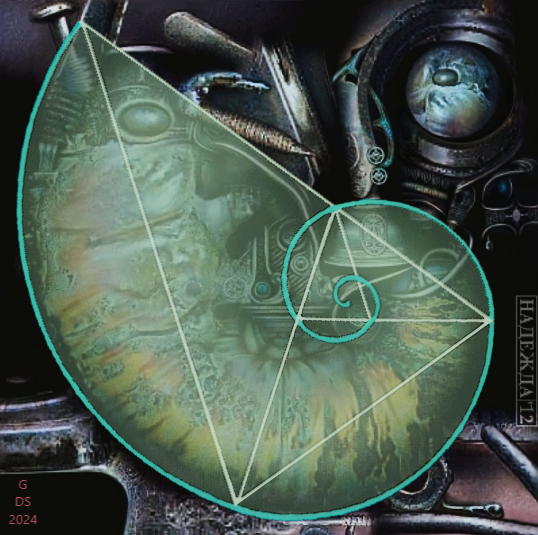
Thursday, August 29, 2024

The Dürer Files: 1b. Hendrick Goltzius & The Gods of the Golden Egg (Completed 9/14/24)


Sine Cerere et Libero friget Venus (Without Ceres and Bacchus, Venus Would Freeze),
1600-1603, Hendrick Goltzius. Geometry: 2024, DS.


"When Goltzius created this so-called "pen painting," which combines pen and ink and brush with oil color, it caused a sensation in Europe and was immediately purchased by Emperor Rudolf II for his collection in Prague. Without Ceres and Bacchus, Venus Would Freeze, c. 1600-1603, marks the critical moment when Goltzius, the most famous draftsman and printmaker in Europe, turned to large-scale painting."

- Via the Philadelphia Museum of Art page: A Masterpiece in Focus, a short article describing the unusual painting featured above and inset left which the museum acquired in 1992. Apparently, after the Dutch artist, Hendrick Goltzius (1558-1617), completed it - and Goltzius was so secretive about his methods he never allowed anyone to see his work at an incomplete stage - it was snatched up by Emperor Rudolph, the "Mad Alchemist" of Prague. There's more to add to this post regarding Rudolph, but, suffice to say, he was also an avid collector of works by Albrecht Dürer. Meanwhile, Dürer was an artist that Goltzius felt motivated to "surpass," with the same competitive enthusiasm the old Master, himself, expressed regarding the Masters of his own time. 

So, did Goltzius surpass Dürer? Well, we shall investigate. But, before we go much further, allow me to mention that my first golden egg was found in Goltzius's odd Venus painting. Of the four golden eggs I've found, this appears to have the most perfect - albeit static - form. Interestingly, it is configured with the same arrangement of pentagrams as the former golden egg found in my previous file. But, note the star's differing orientation  (inset right).

The two ovoids are very similar; in some images they are almost interchangeable. The difference is shown inset right and below with phi-shells. I favor Ovoid 1 as superior in the Venus... image, but Ovoid 2 has a few things going for it, too.

So, which is the true ovoid in this painting?

Ovoids 1 & 2


In the last analysis, it doesn't matter. For Europeans living at the turn of the 16th/17th centuries, Without Ceres and Bacchus, Venus Would Freeze caused "a sensation." It seemed to possess a kind of mojo. And one thing I'm going to be asking throughout this post - the bottom line - is whether or not the presence of phi in art, specifically via the pentagram, lends the work in question a certain kind of indelible magic... and why that might be. Keep in mind Dürer's iconic Melencolia I, Botticelli's Venus, Caravaggio's Amor, or that mysterious Italian lady painted by Leonardo da Vinci.*

Without Ceres and Bacchus, Venus Would Freeze is a weird (but charming) image, but it might be helpful to know something about the gods involved in this oddly luminous, intimate scene... thereby, learning a few things about Goltzius (& Dürer) as well...

Saturday, August 17, 2024

Interlude with a Fallen Angel (Completed 8/26/24)


L'Ange déchu (The Fallen Angel), 1847,  Alexandre Cabanel. Geometry: 2024, DS.


"The L’Ange Dechu, or Fallen Angel, may be one of the hottest artworks ever made. A winged nude shields his face behind flexed arms. His mane of hair snaps in the wind, and brows curl over red-rimmed eyes and a tear of anger. His body is perfect. His posture appears reposed, but each muscle is flexed with potential energy. Cast from heaven—this is the moment before he rises again..."

"After his previous rejection by the salon, Cabanel submitted the Fallen Angel, the first depiction of the devil submitted by a student. If he had aimed to cause some drama, he succeeded. The salon judges were first shocked, and then displeased... “…The movement is wrong, the draughtsmanship imprecise, the execution deficient…” and on top of that, it was considered too romanticist in its style. “…That’s my reward for all the trouble I gave myself not to submit an average piece of work…” wrote Cabanel in a letter to his friend and patron Alfred Bruyas."

- Two quotes from the Obelisk article, Fallen Angel. In it we learn that while we may admire Cabanel's sexy demon today, initially the painting was trashed by exhibition authorities. The "movement" was inexplicably considered "wrong;" the rest "imprecise" and "deficient" proving that beauty (to a large degree) really does lie in the "eye of the beholder." Meanwhile, just for fun, behold this geometrical interpretation.

***

I'm not sure what inspired Alexandre Cabanel's use of the golden triangle in the image above, but, it does seem as if he had the compulsion to confine his rogue angel within the confines of one. The spiral here is almost incidental; an artifact. Moreover, the largest lunette has been left almost entirely outside of the canvas and this is very unusual.

One might deduce that this was a happy accident and the golden meme slipped into his image - as it often does - spontaneously and without the artist's notice. And, yes, it may have. But, something about the angel's posture seems slightly contrived; perhaps, this is what bothered the judges at the salon. On the other hand, Cabanel created a unique tension... as if, at any moment, the angel will spring out of his invisible enclosure. This is an illusion of action made possible by the spiral, and we can see it in the curve of the angel's wing and around his wrists and elbows and the smaller golden gnomons formed. (See diagram inset right). (Note: generally, my spirals are limited to 4 gnomons, but 6 or 7 are possible to display in the average web image.)

However, the question remains: why is the strangely vacant lunette merely implied? It's as if someone cut off a large portion of the image. Was L’Ange Dechu originally a detail of a larger painting?

In any case, I've never come across anything like it. Well, that is, until I tested another Cabanel painting... (below the jump)!


Friday, August 9, 2024

The Dürer Files: 1. "Melencolia I" & The Golden Egg (Updated 8/11/2024)


"For the alchemists the vessel is something truly marvelous: a vas mirabile. Maria Prophetissa says that the whole secret lies in knowing about the Hermetic vessel. “Unum est vas” (the vessel is one) is emphasized again and again. It must be completely round, in imitation of the spherical cosmos, so that the influence of the stars may contribute to the success of the operation. It is a kind of matrix or uterus from which the filius philosophorum, the miraculous Stone, is to be born. Hence it is required that the vessel be not only round but egg-shaped."

- Sourced from a quote found here, we are introduced to the ancient alchemist Maria Prophetissa, also known as Maria the Jewess,* who had a thing or two to say about the golden egg, as did I in a Samhain post (featuring Leonora Carrington's eggs) a year or two ago!

Prescience? At that time, apart from this fundamental (Easter egg) relationship, I didn't realize that there was actually a phi configuration - using two identical spirals - which, when combined, form a perfect ovoid. But, in the past month I have found two perfect varieties of phi ovoids - both varieties discovered in paintings - which comprise a new phi spiral category: the Golden Eggs.

If anyone knew about Golden Eggs, you might suppose it'd be Albrecht Dürer. And, it goes without saying, that if a golden egg was to be found in any of his major works, Melencolia I - one of his most iconic images... and an image saturated with phi - would be the logical place to search. I've previously devoted 2 posts to the spirals found in this melancholy baby (1 & 2). But, until this past week, I had not incorporated the corresponding pentagram... and, when I did, I was astounded. The big surprise (the easter egg) was the perfect relationship between the ladder and his famous, enigmatic polyhedron. Can't touch that!

As for the golden egg? Well, observe...


Tuesday, June 25, 2024

The Dürer Files: A Series Introduction

Nemesis or The Great Fortuna, Albrecht Dürer - copper-plate engraving - 1502.
Geometry: 2024, DS.


"Precariously balanced on an unsteady sphere, Albrecht Dürer’s nude female figure of Fortuna conveys a sense of the instability and unpredictability of fortune. The artist’s treatment of the subject derives from a Latin poem by the Italian Renaissance poet and humanist Angelo Poliziano (1454–1494), who describes fortune as the “power to crush the arrogant minds and triumphs of men and to confound their too ambitious plans.” With her bridle and cup, Dürer’s figure—in contrast to misogynistic portrayals of her by a later generation of artists—also embodies the virtues and rewards of temperance."

- A nice assessment of Albrecht Dürer’s Nemesis image (inset left & above) via this NY Public Library page. It seems cynical that Dürer should symbolically combine the word nemesis - meaning rival, enemy or punisher - with the idea of fortune (fortuna) together in one image. Was he referring to the idea of fate as karma? In reality, the goddess Nemesis and the goddess Fortuna are mythologically and symbolically connected and it is more than likely he created his own hybrid.

It actually took me several days to see the spiral in Nemesis, the Greater Fortuna... which is astounding considering what an awesome spiral it is. It's a dialing spiral but of a slightly different kind than the one I'm familiar with. You can create a small animation with it growing in size and spreading over the image as it revolves around one central point (in the vicinity of her elbow). In the fuller image - shown above with the phi-shell - the spiral continues into the landscape.

As for the image itself, the figure of Nemesis/Fortuna exhibits a female body type humanity rarely sees anymore. We probably stopped seeing her around the same time Dürer created her, at the turn of the 16th century. She is an older woman; you can tell by her diminishing face and thinning hair... unlike Durer's (1496) Little (or Lesser) Fortuna - inset right - the younger Fortuna (with a lesser spiral) and an enigmatic image the size (and dimensions) of a Tarot card.*

But, the older Fortuna - who has in her maturity taken on the role of Nemesis, a "formidable and usually victorious rival or opponent" - reveals a body with contours which, while not aesthetically correct in our times, has retained its hard-bodied youthfulness. She has powerful wings and holds a large chalice. Traditionally, Fortuna, is shown holding a cornucopia but, as mentioned, Dürer has created his own Fortuna hybrid. But, then, it seems he rarely sticks with the "tried and true," preferring his own innovations. In any case, Nemesis/Fortuna is a force to be reckoned with. She may be offering the chalice - the cup of plenty - but, we are reminded that she is also carrying a horse's bridle. In other words, while we may succeed  above and beyond our wildest dreams, our egotistical aspirations are kept in check by this goddess. Either that, or she represents a stereotypical negative female archetype.

Incidentally, Nemesis is much more massive figure than she appears at first glance. An enlargement of the little Italian town which she overlooks (as she balances upon her sphere) can be found here.

___________________________________________________


By now, I should know better than to make promises regarding the future I can't keep... but, in regards to my previous projections made in my last post, when and where I envisioned one more addition to the Dürer series, I am now here to report that my plans have had to change.

Yes, while in the midst of feverishly writing the proposed post (Dürer Part III)  I initially had in mind, I was suddenly presented with far more bits of information than I could possibly process in one post.  An example would be the Nemesis image with it's astounding spiral (above). But, there were other images found as well, deserving some special consideration... such as Dürer's diagram of his 'Schneckenlinie' ('snail-line') or Logarithmic spiral - (inset left) - a spiral which, oddly, almost appears as if it's in perspective. Sadly, I cannot translate the text. (If you can, please inform us!)

In any case, after the shock wore off and my first attempts were put aside, I decided the new information required a new series... The Dürer Files, a new testament of sorts. Moreover, it would have to be broken up into bits... thereby requiring shorter posts and less time, or, seriously, I would never get any of it online. So, this is the Introduction. The series contents will (tentatively) include  the following sections:


The Dürer Files: 2. Soli Deo Gloria (Glory only to God)

The Dürer Files: 3. Maximillian & The Bauhütte

The Dürer Files: 4. Dürer & the Phi Goddess

The Dürer Files: 5. Dürer & the Black Madonna

The Dürer Files: 6. Dürer & the Whale


(Note: This Intro will also serve as the Dürer Files series Table of Contents page with links becoming active as the posts appear. The links will also appear in the Golden Series content post (click the Golden Snail on the sidebar.) (Know, however, that the titles and order in which they appear may change.)

(Note 2: I have already added an extra section... and 2 more - regarding phi ovoids - are likely to follow.)

___________________________________________________


(More below the jump break...)

Saturday, May 18, 2024

The Mirror of Venus: 5 Keys

The Mirror of Venus: The 5 Keys - 2023, DS.


"Moving now from the decad to its half - we meet one of the most brilliant personalities of the 'society of numbers;' the pentad and the characteristics of the number five. In arithmology or number mysticism the number five partially pertains to the essence and importance of the decad as being its half and its condensed image, but it is also the
gamos, Aphrodite's number as goddess of the fruitful union, the generatrix of love, and the abstract archetype of reproduction."

- From the 1931 investigation of phi and the pentagram: The Golden Number: Pythagorean Rites and Rhythms in the Development of Western Civilization, written by Matila Ghyka, a book I've just read recently. The above quote is the first of five similar brief references to Aphrodite and the pentagram found throughout the book; three of which combine Aphrodite with the Egyptian goddess Hathor.*

But, while Ghyka acknowledges an ancient connection between Venus/Aphrodite and the pentagram, it seems to rest upon the idea of marriage, a "fruitful" union... conjugal bliss. He calls this incarnation of Aphrodite "Gamelia," that is, "of the wedding." But, Gamelia was a name given to many, if not all the Olympian gods; specifically Hera, wife of Zeus; it wasn't amongst Aphrodite's major titles, and, regarding the pentagram, is too literal a translation of the "love goddess" and is, ultimately, a red herring.
__________________________________________

Inset left, above: the contemplative Venus of Arles... (seemingly) holding an apple up to her broken-off, handheld mirror. Inset right,  is an actual bronze mirror (Greek, circa 460 BC) supported by the figure of Aphrodite who is holding a dove, while 2 winged erotes stretch their hands towards a point centered above her head. If you connect the point at the top of the goddess's head with the two doves perched above on the mirror, you'll have an inverted golden triangle. Below, inset left, is another similar bronze mirror from the same period, currently in the Met Museum. This one features dogs chasing hares; the hare is another Aphrodite symbol. Hint: we've seen the dogs and the hares before.**
__________________________________________

So, mythologically speaking, marriage was never known to be Aphrodite's strong point... although love, both carnal and celestial, was. The Venus of the pentagram, however, is significantly more complex, and we have to approach her from a higher ground, so to speak. From Theoi we have:

"According to the cosmogonic views of the nature of Aphrodite, she was the personification of the generative powers of nature, and the mother of all living beings. A trace of this notion seems to be contained in the tradition that in the contest of Typhon with the gods, Aphrodite metamorphosed herself into a fish, which animal was considered to possess the greatest generative powers." 

And, there is so much more. One might say, Ghyka was trivializing the Venus/Aphrodite connection. While he inserts the word gamos in his brief comment, he neglects the word heiros (sacred). Nor does he infer in any way that the "wedding" is, in essence, chymical. So, my strongest impression of the book is that the deliberate omissions Ghyka (amusingly) accused other writers of making - including Vitruvius - might've been tip-offs to those of his own. That being said, he probably connects more esoteric "dots" in the pentagram's long journey within the pages of this book than you'll find anywhere else. But, keep in mind, the author may be sticking to traditional "fraternal" codes of secrecy all the while... something also mentioned quite often in his book.

"The mirror also, in turn, symbolizes revelation and truth: the mirror often shows the face, and the eyes, as shown in the painting Venus At Her Mirror or Rokeby Venus or Venus-Aphrodite by Diego Rodriguez de Silva y Velazquez, in which the goddess gazes into the mirror with only her face revealed. The eyes, in turn, are the paths to truth: they are the “window to the soul”, or, ever-more interestingly, the “mirror of the soul.” Aphrodite, in gazing into the mirror, is therefore not merely enjoying the sight of her own beauty, but is acknowledging the truth of all that resides within her – for, as Aphrodite Ourania, she is that which keeps together the entire cosmos and continues the survival of all."

- A quote found here, introducing us to to the most important facet of Aphrodite: Aphrodite Ourania or Urania, the celestial Aphrodite, and the Venus/Aphrodite who will concern us most in upcoming posts. She shares some of the attributes of Urania, the Greek muse of astronomy and the stars, in some cases mistakenly,  but, in others, possibly an indication of the evolution of Pentagonal Venus and the golden meme.

***

The diagram above, a sort of gateway into the Venus subset of the golden meme, is already somewhat obsolete regarding the pentagonal journey I unintentionally began taking around Thursday, April 4, 2019, after my vision of the rose pentacle. I wrote at the time that I anticipated something "larger." But, really, I had no idea of the many roads left to travel. Needless to say, Venus/Aphrodite had her foot in the door from Day 1.

I have since learned that the Venus pentagram, in its entirety, is not merely one arrangement of five symbols but, possibly, an arrangement of 10. Moreover, each of first five symbols composing the "mirror" represent metaphorical hallways with numerous doors. In other words, the Venus pentagram remains true to the pentagram's nature - it's a fractal - very possibly as colorfully layered as (what appears to be) a phi-based Julia set, inset right. Additionally, Venus/Aphrodite is not merely 2 goddesses in one... she's worn many hats over the course of her very long career and has several hybrid forms as well, so, it's a very tangled web, indeed. 

In spite of all of the above, the first five symbols I'd originally chosen for the diagram still stand, but, while I had hoped to address each of them briefly here, I've come to realize it isn't presently feasible. There is no "brief" in this discussion. 

As for now, I will include in this post some bits which have already been written regarding several symbols in the diagram.

(Note: I was originally going to conclude this post with one more bit of information via Prince Ghyka which might interest us, and it concerns Albrecht Dürer. This "bit of information" was eventually accompanied by other bits of information to necessitate adding a dedicated Part III to Albrecht Dürer and the Divine Ratio Parts 1 & II. As I said, there is no "brief" in this discussion. Stay tuned.)

(Continued after the jump...)

Wednesday, May 1, 2024

The First of May

Fetal Venus & Her First Dove (sketch #1) - digital - 2024, DS.


I am sorry for the delay with posting. I must have totally revised the intended post several times this past month, but it is still stalled; it may never be published on this blog. Meanwhile, in the real world... well, let's face it, if it's not one existential crisis, it's another... or, perhaps, one on top of the other... a parfait of stress factors.

As I write, however, it is May Day... which means two very different things, depending upon who you are and where you live. For some it is International Worker's Day. For others its a banking holiday. But, for many of us, it's the daytime leg of the ancient Celtic holiday of Beltane/May Day... specifically those of us in the Northern hemisphere. In the Southern hemisphere, Samhain is celebrated, (if  I'm reading this correctly). And, this provides us with an interesting symmetry.

For some reason, things always seem a bit more peculiar around the April/May cusp for me, and I don't think it's an astrological phenomenon. Beltane and the Germanic Walpurgis Night (see St. Walpurga) are very much like Samhain (or Halloween) in that the veil between the living and the dead is at its thinnest; the difference being that the dead who walk on Beltane night are seeking rebirth. Perhaps, they're hoping they'll be conceived on May Day... a very Venus/Aphrodite day, due to the planet's astrological rulership over the sign of Taurus the Bull, and Aphrodite's role as fertility goddess. However, while May Day evokes chaplets of spring flowers and circling around maypoles, Beltane, the nocturnal leg of the holiday, is a fire festival. The following quote was sourced from James Frazier's classic, The Golden Bough:

"The people believed that on that evening and night the witches were abroad and busy casting spells on cattle and stealing cows’ milk. To counteract their machinations, pieces of rowan-tree and woodbine, but especially of rowan-tree, were placed over the doors of the cow-houses, and fires were kindled by every farmer and cottar. Old thatch, straw, furze, or broom was piled in a heap and set on fire a little after sunset. While some of the bystanders kept tossing the blazing mass, others hoisted portions of it on pitchforks or poles and ran hither and thither, holding them as high as they could. Meantime the young people danced round the fire or ran through the smoke shouting, 'Fire! blaze and burn the witches; fire! fire! burn the witches.' In some districts a large round cake of oat or barley meal was rolled through the ashes. When all the fuel was consumed, the people scattered the ashes far and wide, and till the night grew quite dark they continued to run through them, crying, 'Fire! burn the witches'."

Apparently, in the 18th century, the Beltane fires were meant to metaphorically burn witches. Possibly, in previous centuries Beltane fires literally did burn witches. It's not really clear to me. But, it is ironic that it is the Wiccans and "heathens" (of the future) who've essentially revived the bonfire tradition... and ran with it!

However, we've moved past the night into the prettier and more benign May Day. Wiki, in the Beltane entry, describes the traditional May Tree or May Bough as being a: " a small tree or branch - typically hawthorn, rowan, holly or sycamore - decorated with bright flowers, ribbons, painted shells or eggshells from Easter Sunday... The tree would either be decorated where it stood, or branches would be decorated and placed inside or outside the house... the tree would remain up until May 31st. The tree would also be decorated with candles or rushlights."

Lovely.

Enjoy your holiday!
***

Regarding the two images above - Fetal Venus With Her First Dove (above), and Fetal Dove with the Planet Venus (inset right) - both are sketches I made earlier this year when I possessed a more competent graphics program. I no longer do and am not sure when I will, so, these images will have to stand for the originals; I just wish they were the images I originally had in mind. (Note: Phi shells look as if they were designed for the embryonic; don't you think?)

What I failed to mention in this post, however, is that my "fetal" images had an actual precedent, and my original idea was to post my embryonic Venus images along with the image that inspired them (posted after the jump). It's interesting to juxtapose spiral images of Venus from various periods. And, considering she's been an artistic subject for almost 3000 years, there's a lot of images to cover; I may as well start now!

(Continued...)

Sunday, March 31, 2024

Apple Blossoms

Apple Blossoms in Hopewell's Orchard - Photo credit: NPS/A. Kane.

"It is remarkable how closely the history of the Apple-tree is connected with that of man. The geologist tells us that the order of the Rosaceæ, which includes the Apple, also the true Grasses, and the Labiatæ, or Mints, were introduced only a short time previous to the appearance of man on the globe.

...Pliny, adopting the distinction of Theophrastus, says, “Of trees there are some which are altogether wild, some more civilized.” Theophrastus includes the apple among the last; and, indeed, it is in this sense the most civilized of all trees. It is as harmless as a dove, as beautiful as a rose, and as valuable as flocks and herds. It has been longer cultivated than any other, and so is more humanized; and who knows but, like the dog, it will at length be no longer traceable to its wild original? It migrates with man, like the dog and horse and cow; first, perchance, from Greece to Italy, thence to England, thence to America; and our Western emigrant is still marching steadily toward the setting sun with the seeds of the apple in his pocket, or perhaps a few young trees strapped to his load.

...Men could afford then to stick a tree by every wall-side and let it take its chance. I see nobody planting trees to-day in such out-of-the-way places, along the lonely roads and lanes, and at the bottom of dells in the wood. Now that they have grafted trees, and pay a price for them, they collect them into a plat by their houses, and fence them in,—and the end of it all will be that we shall be compelled to look for our apples in a barrel."

- Via the entertaining 1862 essay, Wild Apples, by American naturalist, Henry David Thoreau, available for free on Project Guttenberg. Note his Venus/Aphrodite-related description of the apple tree: "It is as harmless as a dove, as beautiful as a rose..."*  Biologically, the apple and the rose belong to the same family.**

Thoreau concludes his essay with the biblical quote (JOEL, Chapter I, Verse 12): “The vine is dried up, and the fig-tree languisheth; the pomegranate-tree, the palm tree also, and the apple-tree, even all the trees of the field, are withered: because joy is withered away from the sons of men.”


"But the first verdict seemed the worst verdict
When Adam and Eve were expelled from Eden;
Yet when the bitter gates clanged to
The sky beyond was just as blue.

For the next ocean is the first ocean
And the last ocean is the first ocean
And, however often the sun may rise,
A new thing dawns upon our eyes.

For the last blossom is the first blossom
And the first blossom is the best blossom
And when from Eden we take our way
The morning after is the first day."

- An excerpt from the poem Apple Blossom, by Belfast poet, Louis MacNeice. For another poem by MacNeice, see my latest post on PMB, A Lost History Retrieved.

***

I'm not a terribly nostalgic person, but as the years go by, holidays are increasingly becoming "remembered" things... belonging to experiences in the past-tense; belonging to childhood only; a time of wonder.

My earliest memory of Easter is posing with my little brother in front of an immense apple tree, one of two, in our - or, rather, the landlord's - backyard, while my dad snapped B/W photographs of us decked out in our annual Easter outfits. We both wore coats or jackets and "bonnets"; spring was very chilly in New England in those days. My coat had a lavender and white checkered pattern. My brother's jacket had a black and white pattern known as houndstooth.

Funny, the things you remember... while the rest you'd' rather forget. But, today I will go no further down memory lane beyond the grandeur of those two immense apple trees in the landlord's backyard, the like of which I'll probably never see again. The like of which only a few of us will ever see at all. Privilege is a relative thing.

The apple tree is an icon; it is also a meme and/or an element of a meme. It speaks of the beginning of new things and the continuous cycles of life - a "tree of life" - and the processes of growth. On an apparent (logical) level, living things grow and eventually decay. But, on a mythical (mythos) level, the life force is in perpetual expression; it can be transformed or modified, but never annihilated.***

But, I am no sage. I merely observe.

And, what I presently observe is that it's a rabbit, egg and apple sort of holiday for some of us - even if only in memory. And, yet, at its core (pun intended) it is a celebration of spring and a renewal of vitality.

Coincidentally, it just happens to be a beautiful spring day in NM. I hope it is wherever you are, too.

____________________________________________________

* "Harmless as a dove" is not exactly an accurate phrase and, as a naturalist, Thoreau would've known this. He was quite possibly referring to domesticated doves, which we might expect to be more submissive. Wild doves, however, in spite of their elegant appearance, will gladly take out any creature threatening their nests. I once saw a mourning dove throttle a blue jay - a more belligerent bird - holding it by it's neck.

** Interestingly, in our eventual (future) back yard, we had a small apple tree which grew close by a wild rose bush with clusters of small, 5-petaled blossoms, resembling those of the apple tree. The apple tree eventually withered, but the rosebush retained an apple-like fragrance.

As it happens, cherries are also part of the Rosaceae family... and, like the apple and the rose, are celebrated with parades and festivals in the states and abroad.

*** (Regarding the revision): my original statement here was, for the most part, unintelligible. I must've dropped the thread and then, unsuccessfully, attempted to patch it up. I've since revised the statement, but, I'm afraid the original "thread" was lost. And, it's probably just as well!


Tuesday, March 19, 2024

An Auspicious Day

The Three Golden Eggs of Happiness, G-DS-2024
Alternative title: 3 Sleeping Doves


We seem to be experiencing a grand trine of celebratory days today: the first day of spring, the neo-pagan and Wiccan holiday of Ostara, and the first day of the Persian new year! So, put aside your woe and despair and knock yourself out with the pleasure of impractical things - we've hit the jackpot!

I found three (pretty-much) perfect golden eggs (sourced here)... and, now, you have!

Smile. You'll feel better. It's a known fact. :-)


Sunday, March 17, 2024

The Paisley Pattern & the Golden Meme


Phi shells served up on a modern paisley fabric (sourced here).
Geometry: 2024, DS.


"meme - n. a unit of practice or belief through which a society or culture evolves and that passes from one generation (or even one person) to the next. In this sense, the term — coined in 1976 by British  biologist Richard Dawkins (1941–  ) and derived from the Greek word for “imitation”— is a kind of metaphorical parallel to the term gene."

-  An interesting definition of "meme" found in the online American Psychological Association's Dictionary. As a "metaphorical" gene, in lieu of its lack of actual physicality, we can expect a meme to operate in a manner similar to the gene: subconsciously and/or subliminally. Unlike the gene, it is transferred from one mind to the other... often in the form of a symbol, although not necessarily a visual symbol.

The images posted above, and inset right, and inset left and right below are the result of a new 2-dimensional toy I developed last year and introduced in The Universe in a Phi Shell: phi shells. I can't remember what inspired me to make phi spirals into phi shells, but it was probably pretty elementary. However, once I saw the effect the shells produced on some images, I was astounded. In so many cases the phi shell was like an envelope - die-cut to fit a golden spiral - or a custom-made template... with maybe a little wiggle room.

Sometimes, working with a phi shell leads to repositioning the original spiral. Inset right is a prime example: Boy Blowing Soap Bubbles by 17th century Dutch painter (and Bentvueghel), Karel Dujardin. (See the post for the former spirals.) As concise as this spiral appears, it could be larger and better... but, As we see time and time again, some portion of the necessary image area is missing. What sold me on the orientation of this spiral, however, is the way the boy's right arm - holding the bubble pipe - falls so neatly into the small triangle. It's as if the boy is drawing the spiral in the air.

"Proponents theorize that memes are a viral phenomenon that may evolve by natural selection in a manner analogous to that of biological evolution. Memes do this through the processes of variation, mutation, competition, and inheritance, each of which influences a meme's reproductive success. Memes spread through the behavior that they generate in their hosts. Memes that propagate less prolifically may become extinct, while others may survive, spread, and (for better or for worse) mutate. Memes that replicate most effectively enjoy more success, and some may replicate effectively even when they prove to be detrimental to the welfare of their hosts."

- A cautionary quote from the Wiki entry for "meme," and one that might make a certain amount of sense to those acquainted with what I've come to refer to as the "Golden Meme." I could even go so far as to says this might be reflected in my own experience... including the "detrimental to their hosts" bit, but, I try not to entertain fantastical innuendos that accelerate my level of paranoia.

"When Pacioli (the Renaissance mathematician) wrote in his Divina Proportione: '.. just like God cannot be properly defined, nor can be understood through words, likewise this proportion of ours cannot ever be designated through intelligible numbers, nor can it be expressed through any rational quantity, but always remains occult and secret, and is called irrational by the mathematicians'... he seemed to be equating the golden ratio with a variety of magical formula. That is, through his recognition and understanding of "this proportion of ours" he was attempting a marriage between several disciplines: science, art and mysticism. And, this wasn't unusual for the early Western scientists, many who dabbled in astrology, numerology and alchemy side by side with astronomy, mathematics, botany... and the arts. The scientific field was wide open - the hard lines were still blurred...

The "new scientists" were seeking enlightenment, autonomy, discovery, truth. And, it was into this slowly reawakening world that the pentagonal spiral made its appearance... and not necessarily for the first time. Similar to the sign of the pentagram - by which the followers of Pythagoras "knew each other" - perhaps, the "sign" of the pentagonal spiral enabled the Baroque artists to identify like-minded artists... kindred spirits in a world in which freedom did not, yet, ring."

"Keep in mind that the spiral was also present in Baroque ornamentation... and possibly somewhere in Baroque music, too.  So, were the artists, artisans, and musicians completely aware of its proportions and using it as a measure of perfection and beauty? Or, was the proliferation of golden spirals (at that time) an almost paranormal thing... or a variety of subliminal meme... an unconsciously recognized icon which was possibly a symbolic presentiment on the part of an artistic community who were, without noticing it, heralding an evolutionary phase of a whole society?"

A Baroque flourish (w/ phi shells). G-DS-2024.

- Two quotes via my blogpost: The Gentilischi Spirals and a Series Afterword. One painting appearing in that post is the image reposted (inset right) above the flourish: Orazio Gentileschi's Young Woman with a Violin. It's phi shell is looser than the original spiral I gave it, which, resting on her lap like a humongous sea shell, gives the image a somewhat comical appeal... but the spiral and triangle intercepts the young woman's bow perfectly, so, we have to admire its cleverness.

The flower painting, inset left, above her, however, was the work of Dutch Baroque artist, Willem Van Aelst and can be found in Part III of the Bentvueghel series, where we become acquainted with the curious appearance of the garden snail in flower paintings. And, really, if the Dutch flower painters used the snail as a clue indicating that a larger spiral was deliberately embedded in their paintings, well, all I can say is, what a brilliant idea!

Directly above is a portion of a Baroque ornament recently found (now decorated with phi shells). Not all Baroque flourishes were as golden as this one, but, considering the quantity of spirals appearing on furniture, architecture and textiles, the golden meme was alive and well.

***


For the past few years, I've spent a lot of quality time pondering the meaning of the appearance of the pentagonal golden ratio in works of art, artifacts and in architecture. I can't say for sure why this is so anymore, but, once upon a time, there seemed to be a point. I had a plan. Nowadays, I have to ask myself, why in the world would anyone actually sit down and spend a great deal of quality time blogging about obscure topics to an evaporating audience while everything in the surrounding area (the world, that is) seems to be either rapidly going down the tubes, or up in flames?

And, this isn't the first time I've asked myself this question!

On the other hand, blogging about obscure topics to an evaporating audience - in view of the tubes and flames - presently encourages my survival. Perhaps, blogging is kind of a therapy after all. Or, perhaps, in an absurd world, doing nonsensical things in response to Armageddon is appropriate.

And, it is in this state of mind I will reveal my latest pentagonal phi epiphany... which just happens to regard a description I've used previously: subliminal meme. The kind of meme that just might slip into an image while the artist was totally unaware of it, as it did in 2012, when I created Metamorphosis Interrupted, reposted (inset left), with a phi shell that fits the unfortunate worm like a chrysalis! (See: A Virtual Can of Worms.) 

Generally speaking, the unconsciously produced spirals in the images referred to in the Worms post were not all that strong. However, the worm's proportions in Metamorphosis is very close to perfect. But, while I was aware that I was being very finicky about the shape of the worm's body while creating it, in reality, at the time of its creation, I had never even heard of the pentagonal golden spiral!
 
So, is this an indication of phi "on the brain"? Are our brains somehow wired to its aesthetic or does it go deeper than that? Is this why the ratio was referred to as "divine" - in that it is embedded so deeply in our consciousness we assume it is an outer force? Or, when we find it in organic life, is it merely the imprinted diagram of actual physical forces science is already aware of?

Or, taking into consideration the nature of a meme, can you actually "catch it" like the common cold?*

Speaking of brains, I was delighted to find an image of one that seamlessly fits into a phi shell (inset right). Of course, humans tend to have rounded skulls, so it should come as no total surprise. But, then again, the image is an illustration and not an MRI, so, this is an artistic interpretation (and a very nice one) by Hank Grebe.

I didn't notice this till I was adding my geometry "stamp" to the image, but what lies at (a very important) 3-cornered junction of the spiral nearest to the coil - technically, the apex of the smallest golden triangle (and its spiral) - is that notorious pine-cone-shaped brain element, the mysterious pineal gland or "third eye." Oddly enough, it is depicted here as another tiny golden triangle (click for enlargement.)

(Continued below the jump...)

Monday, March 4, 2024

The Universe in a Phi Shell

M74, or the Phantom galaxy... embellished with a phi shell. (G-DS-2024).


'The most merciful thing in the world, I think, is the inability of the human mind to correlate all its contents. We live on a placid island of ignorance in the midst of black seas of infinity, and it was not meant that we should voyage far. The sciences, each straining in its own direction, have hitherto harmed us little; but some day the piecing together of dissociated knowledge will open up such terrifying vistas of reality, and of our frightful position therein, that we shall either go mad from the revelation or flee from the light into the peace and safety of a new dark age."

- H. P. Lovecraft, The Call of Cthulhu, 1926.

"Messier 74, also called NGC 628, is a stunning example of a "grand-design" spiral galaxy that is viewed by Earth observers nearly face-on. Its perfectly symmetrical spiral arms emanate from the central nucleus and are dotted with clusters of young blue stars and glowing pink regions of ionized hydrogen (hydrogen atoms that have lost their electrons). These regions of star formation show an excess of light at ultraviolet wavelengths. Tracing along the spiral arms are winding dust lanes that also begin very near the galaxy's nucleus and follow along the length of the spiral arms.

M74 is located roughly 32 million light-years away in the direction of the constellation Pisces, the Fish... In its entirety, it is estimated that M74 is home to about 100 billion stars, making it slightly smaller than our Milky Way."

- Via this Hubble page, we are introduced to the M74 galaxy discovered by the French astronomer Pierre Méchain in 1780. It is a kind of go-to spiral galaxy for those seeking spiral perfection. Of course, for the golden (pentagonal) spiral hunter, gazing at it's sinuous, twisting, mollusk-like proportions is sheer bliss... as, if there were a God and It had a face, this would be it. (God the mollusk! The Mollusk god. So, burn me at the stake. See if I care.)

"Messier 74 (also known as NGC 628 and Phantom Galaxy) is a large spiral galaxy in the equatorial constellation Pisces. It is about 32 million light-years away from Earth. The galaxy contains two clearly defined spiral arms and is therefore used as an archetypal example of a grand design spiral galaxy. The galaxy's low surface brightness makes it the most difficult Messier object for amateur astronomers to observe. Its relatively large angular (that is, apparent) size and the galaxy's face-on orientation make it an ideal object for professional astronomers who want to study spiral arm structure and spiral density waves. It is estimated that M74 hosts about 100 billion stars."

- This quote was sourced from the Wiki entry for M 74, along with the galaxy image used in this post (inset left). That the Phantom is considered an "archetypal example" of a "grand design spiral galaxy" is kind of interesting... in light of the fact that it is composed of 2 near-perfect pentagonal golden spirals. (And, when discussing massive deep-space objects, "close" is about as good as it gets.)

"This Hubble Space Telescope photo of Messier 74 reminds us that spiral galaxies are some of the most beautiful and photogenic residents of the universe. Nearly 70 percent of the galaxies closest to the Milky Way are spirals. New research finds that spiral arms are self-perpetuating, persistent, and surprisingly long lived."

"How the spiral arms form continues to puzzle scientists. One theory suggests the galaxy arms could be the result of density waves traveling through the outer disk. Encounters between galaxies could cause such waves as the mass of the smaller galaxy could affect the structure of the larger galaxy as the two combine."

- Two quotes from this Space.com article... reminding us of how little is known - and how much there is to know - about our cosmos.

***

I'm a busy woman these days, and I hate it. All it amounts to is more stress. But, tell that to an artist's muse. Time perplexes muses. They simply don't get it.

So, I currently have five posts sitting on the back burner, an unfinished digital image - my first formal digital image since my 2022 car accident - a ceramic project that MUST go into production this month, and a number of tedious life issues to deal with... and deal with, and deal with. But, then, last night I came across this photograph (inset right) of M74, the Phantom galaxy and, within minutes, I found myself absorbed in playing with my latest graphic toy, a phi shell (rhymes with seashell)... trying to decide which color to use from my ever-growing palette. In the end, only the white shell did the Phantom any justice, and even this had to be almost transparent... to endow it with that certain marine life appeal which, for whatever reason, seemed appropriate.

Anyway, I decided to post 2 images to the blog for the (freakish) enjoyment of those who, like myself, delight in this sort of thing. (Yes, in case you haven't noticed it, we constitute a minority.)

Oh, and incidentally, the "phi shell" - my attempt to give the common mathematical diagram a little extra-dimensional pizazz - will be appearing quite often in the coming days. I confess; I'm hooked on phi shells now, and there's no help for it!

Adieu, till next time... :-)

Via the ESA: a multi-observatory view of the Phantom.