Saturday, March 24, 2018

A Day For the Little Ladies (Updated 3/28/18)


Suffragette Sylvia Pankhurst in action circa 1914.
(All images: click to enlarge.)

"After the Socialist Party of America organised a Women's Day on February 28, 1909 in New York, the 1910 International Socialist Woman's Conference suggested a Women's Day be held annually. After women gained suffrage in Soviet Russia in 1917, March 8 became a national holiday there. The day was then predominantly celebrated by the socialist movement and communist countries until it was adopted in 1975 by the United Nations.

In August 1910, an International Socialist Women's Conference was organized to precede the general meeting of the Socialist Second International in Copenhagen, Denmark. Inspired in part by the American socialists, German Socialist Luise Zietz proposed the establishment of an annual Women's Day and was seconded by fellow socialist and later communist leader Clara Zetkin, supported by Käte Duncker, although no date was specified at that conference. Delegates (100 women from 17 countries) agreed with the idea as a strategy to promote equal rights including suffrage for women. The following year on March 19, 1911, IWD was marked for the first time, by over a million people in Austria, Denmark, Germany and Switzerland. In the Austro-Hungarian Empire alone, there were 300 demonstrations. In Vienna, women paraded on the Ringstrasse and carried banners honouring the martyrs of the Paris Commune."
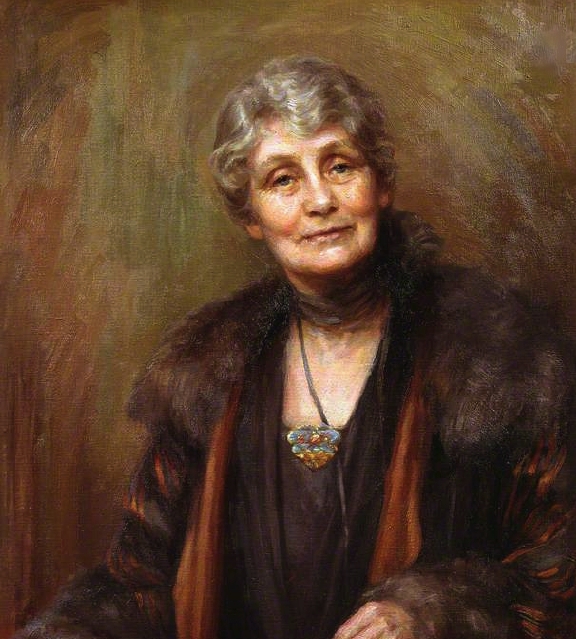
- Excerpt from the Wiki entry for International Women's Day. Images: uppermost, Sylvia Pankhurst, activist and artist, and one of three daughters belonging to British suffragette Emmeline Pankhurst (her portrait - inset left - was painted by daughter Sylvia. Another example of S.P.'s artwork appears later in the post.) For more information about the Paris Commune,* see the foot-note section.

Regarding the German poster (inset right, above, and found in the Wiki article) - which, by the way, was banned in Germany at the time - reads: "Give Us Women's Suffrage. Women's Day, March 8, 1914. Until now, prejudice and reactionary attitudes have denied full civic rights to women, who as, mothers, and citizens wholly fulfill their duty, who must pay their taxes to the state as well as the municipality. Fighting for this natural human right must be the firm, unwavering intention of every woman, every female worker. In this, no pause for rest, no respite is allowed. Come all, you women and girls, to the 9th public women's assembly on Sunday, March 8, 1914, at 3 pm."

"The most dramatic celebration of International Woman's Day was in 1917 in Russia. Led by feminist Alexandra Kollontai. Central to their protest in 1917 were complaints over deteriorating living conditions. Rents had more than doubled in St. Petersburg, renamed Petrograd, between 1905 and 1915. Food prices, particularly the cost of fIour and bread, rose between 80 and 120 percent in most European cities. The price per pound of rye bread, the staple of working-class diets in Petrograd, rose from three kopeks in 1913 to eighteen kopeks in 1916. Even soap rose 245 percent in 1917 Petrograd. Merchants speculated in grain, fuel, and meat, while factories closed for lack of energy to run the plants. Female and male wage earners who faced layoffs often went on strike. Between January and February 1917, more than half a million Russian workers, mostly in Petrograd, went out. Taking the occasion of International Woman's Day March 8th in the West, but February 23d on the Gregorian calendar), women led a demonstration from the factories and the breadlines."


Soviet Women's Day poster.

- An excerpt from On the Socialist Origins of International Woman's Day (.pdf) by Temma Kaplan (1985). Inset right (above) is a photo of Russian feminist Alexandra Kollontai (1872-1952). It was the demonstrations and protests which occurred on and around March 8th, 1917, that signaled the beginning of the Russian Revolution! In the Wiki entry for the February Revolution we find:

"Women, in particular, were passionate in showing their dissatisfaction with the implemented rationing system, and the female workers marched to nearby factories to recruit over 50,000 workers for strike. Both men and women flooded the streets of Petrograd, demanding an end to Russian food shortages, the end of World War I  and the end of autocracy. By the following day 24 February O.S. (March 9 N.S), nearly 200,000 protesters filled the streets, demanding the replacement of the Tsar with a more progressive political leader."

"Fast forward to March 8, 1908: 15,000 women marched in New York City for shorter work hours, better pay, voting rights, and an end to child labor. The slogan “Bread and Roses” emerged, with bread symbolizing economic security and roses for better living standards.

Many of those who protested for working rights were young immigrants from Europe who came to the United States seeking better opportunities, says Carol Rosenblatt of the Coalition of Labor Union Women... “They had a much different expectation than when they got here. They were exploited.”

That May 1908, the Socialist Party of America declared that the last Sunday in February would be National Women’s Day." 

- Photo (inset right) and text borrowed from the 2013 article: Where Did International Women’s Day Come From? by Stephanie Solis. The photograph depicts workers at the Reliance Waist Company and is credited to the Kheel Center, Cornell University.

"Due to its ties with socialism and communism, perhaps it’s not surprising that International Women’s Day didn’t catch on here in the United States the way it did in other countries. Recently, however, international digital marketing campaigns have brought the holiday (in its less-political form) further into American culture, complete with corporate support from PepsiCo and other brands. In 2017, the official theme for International Women’s Day is #BeBoldforChange, a campaign that calls on its supporters “to help forge a better working world—a more gender inclusive world.”

- From the 2017 article The Surprising History of International Women’s Day via the History channel site. Regarding Women's Day 2018, well, the hashtag is: How will you continue to #PressforProgress? Inset left: McDonald's gives on a nod to IWD.

***


(Yes, it's finally Spring! And, yes, I'm finally back... after a weird, chaotic, confusing month. The operative question is: will I be spared a fourth "saison en enfer"? We shall see.

Meanwhile, as we know, International Women's Day fell on March 8th... which, of course, was weeks ago. But, believe it or not, I  began (diligently) constructing this post on that day. Alas, it had a lot of competition... I was already working on three others!

So, an entire month went by with utter silence on my part. Sorry, comrades. But, if it means anything, this post - for what it's worth - is finally presentable and, fingers crossed, 2 more should follow it fairly closely.)

Honestly, I generally ignored International Woman's Day in the past, figuring it was mostly a superficial, patronizing token of a holiday (as in, "here's a day for the little ladies" kind of thing). But, as it turns out, I was wrong. The day has a rich political history, and as we can see by the German poster from 1932 (inset right) - and the other posters featured above and below the jump - often a militant one!

Wednesday, February 14, 2018

A (totally unprecedented) Valentine's Day Interlude...


My Lady Greensleeves - oil on canvas - 1863, Dante Gabriel Rossetti


Lovesight

When do I see thee most, beloved one?
When in the light the spirits of mine eyes
Before thy face, their altar, solemnize
The worship of that Love through thee made known?
Or when in the dusk hours, (we two alone,)
Close-kissed and eloquent of still replies
Thy twilight-hidden glimmering visage lies,
And my soul only sees thy soul its own?
O love, my love! if I no more should see
Thyself, nor on the earth the shadow of thee,
Nor image of thine eyes in any spring,—
How then should sound upon Life's darkening slope
The ground-whirl of the perished leaves of Hope,
The wind of Death's imperishable wing?


Severed Selves

Two separate divided silences,
Which, brought together, would find loving voice;
Two glances which together would rejoice
In love, now lost like stars beyond dark trees;
Two hands apart whose touch alone gives ease;
Two bosoms which, heart-shrined with mutual flame,
Would, meeting in one clasp, be made the same;
Two souls, the shores wave-mocked of sundering seas:—
Such are we now. Ah! may our hope forecast
Indeed one hour again, when on this stream
Of darkened love once more the light shall gleam?—
An hour how slow to come, how quickly past,—
Which blooms and fades, and only leaves at last,
Faint as shed flowers, the attenuated dream.


Sudden Light

I have been here before,
But when or how I cannot tell:
I know the grass beyond the door,
The sweet keen smell,
The sighing sound, the lights around the shore.

You have been mine before,--
How long ago I may not know:
But just when at that swallow's soar
Your neck turn'd so,
Some veil did fall,--I knew it all of yore.

Has this been thus before?
And shall not thus time's eddying flight
Still with our lives our love restore
In death's despite,
And day and night yield one delight once more?


***

... just for love.

______________________


All poems and images are by Pre-Raphaelite artist and poet, Dante Gabriel Rossetti (12 May, 1828 - 9 April, 1882). His poetry can be found here. The images (inset) from first to last:

  • Bocca baciata (1859) - The title of the painting translates to "mouth that has been kissed" from an Italian proverb Rossetti had written on the back of this painting: Bocca baciata non perde ventura, anzi rinnova come fa la luna. (The mouth that has been kissed does not lose its savour, indeed it renews itself just as the moon does).
  • Beata Beatrix (1870) - Rossetti was said to have modeled the subject of this painting after his deceased wife, Elizabeth Siddal (1829 -1862).
  • How They Met Themselves (1851-1860) - a pen and ink version. There are also two watercolors of the same image (found on the linked page).


Monday, January 29, 2018

Qualifying Feminism: Empowerment and the Arts (Part I)


Gal Gadot in her 2017 film role as Wonder Woman.

"But it was within this busy, unorthodox household, where (William Moulton) Marston upheld a "hodgepodge of Aquarianism and psychology and feminism," that Wonder Woman began to take shape. Marston proudly claimed that his most famous creation was meant to be "psychological propaganda for the new type of woman who ... should rule the world." The superhero made her debut in December 1941, the same month the United States entered World War II. With her mandate to fight "evil, intolerance, destruction, injustice, suffering, and even sorrow, on behalf of democracy, freedom, justice, and equal rights for women," Wonder Woman not only battles Nazis but also aids (in the guise of her alter ego, Diana Prince) female department-store workers on strike over meager wages."

- Melissa Anderson from her Newsday book review of The Secret History of Wonder Woman by Jill Lepore. Inset left is a Wonder Woman comic book panel (possibly from the 1970s) featuring an explosive rant which begins: "Men! It was you who did this, with your weapons and your war, and your mad need for confrontation..."

"This perception shifted over the years, however, as demonstrated in December 2016 when the United Nations decided to drop the title of "honorary ambassador for the empowerment of women and girls" which it had given to the comic book character Wonder Woman a few months prior, in a ceremony attended by the actors who had portrayed her (Lynda Carter and Gal Gadot). The title was eliminated in response to a petition signed by 44,000 people which argued that Wonder Woman undermines female empowerment due to her costume, described as a "shimmery, thigh-baring bodysuit with an American flag motif and knee-high boots". The petition stated that "it is alarming that the United Nations would consider using a character with an overtly sexualised image at a time when the headline news in United States and the world is the objectification of women and girls"...

The debate continued with the release of Jenkins' 2017 film, Wonder Woman, which according to the BBC had "some thinking it's too feminist and others thinking it's not feminist enough". Kyle Killian found an inherent contradiction in the construction of Wonder Woman as "a warrior" whom, she states, is also highly sexualized. Killian thus suggests that these elements "should not be the focus of a kickass heroine—her beauty, bone structure, and sexiness—if she is to be a feminist icon..."

- Excerpt from the Wiki entry for Wonder Woman, the 2017 film directed by Patty Jenkins. Inset right, Wonder Woman and her controversial costume.

"Spartan women, of the citizenry class, enjoyed a status, power, and respect that was unknown in the rest of the classical world. The higher status of females in Spartan society started at birth; unlike Athens, Spartan girls were fed the same food as their brothers. Nor were they confined to their father's house and prevented from exercising or getting fresh air as in Athens, but exercised and even competed in sports. Most important, rather than being married off at the age of 12 or 13, Spartan law forbade the marriage of a girl until she was in her late teens or early 20s. The reasons for delaying marriage were to ensure the birth of healthy children, but the effect was to spare Spartan women the hazards and lasting health damage associated with pregnancy among adolescents. Spartan women, better fed from childhood and fit from exercise, stood a far better chance of reaching old age than their sisters in other Greek cities, where the median age for death was 34.6 years or roughly 10 years below that of men."

- Excerpt from the Wiki entry for the ancient Greek city of  Sparta. Note that, in the ancient world, the life span of a woman was shorter than that of her male counterpart. Inset left is a bust of Helen (Helénē) of Troy (or Sparta) by the artist Antonio Canova. She was that famous swan daughter of (Spartan) Leda and the god, Zeus.

"Girls with guns, big guns - what fun! Even the most pacifistic woman - and really, I am - experiences a certain vicarious release when, with a gun in each hand, a superwoman blows away a flock of her opponents, without so much as blinking her eyes. Hell, I have a hard time swatting a fly, but when I watch Kate Beckensale blast her way through a bevy of creeps, I get to share a certain heady sense of power...

So, you go Kate, and Charlize, and Carrie-Anne... and you go Milla, and Sigourney, and anybody I may have left out. There are no underdogs quite so "under" as women, so, when you shine, all of our repressed warrior instincts finally get to kick some ass!"

- Excerpt from my (2011) PMB post "The New Superheroines - Girls With Guns." Inset right is
Kate Beckinsale as the Vampire (and Death Dealer), Selene.

***

From 1987.
The word "superheroine" isn't even an official word according to my computer system's 2009 dictionary... (and maybe it isn't now, either, judging by the way it's being underlined in red as I write this post). But, considering that the comic book character, Wonder Woman, made her debut over 70 years ago (in December of 1941), and noting, too, the plethora of female warrior-types who've invigorated the film, television and comic book industries since that time, well, one would think the word would have surfaced in the English language by now.

But, as it happens, the official world transforms very, very slowly... and, in certain areas of the globe, almost not at all; and in regards to the subordination of the female gender, well, despite several "waves" of feminists - and thousands upon thousands of years spent pushing the world's population out of their (collective) wombs - women are still essentially the underdogs. The odd thing is, even when a woman is the boldest, most attractive, most ingenious person she can be, chances are she still fears she is never quite good enough and her accomplishments are trivial, often driving her to overcompensate for a deficiency she never really had. Inwardly, regardless of her accomplishments, she still feels as if she's treading water, or as if some undefinable force continues to hold her back or drag her down. This is not a delusion. Metaphorically, society - under the spell of a pervasive patriarchal zeitgeist - clipped her wings many ages ago. And this legacy - this insidious mutation - was genetically* passed down to her in such a way, that she needs no outside force to enslave her - the trappings of her prison exist at all times embedded within her own psychology.

So, the question becomes: how can a maimed bird fly?


Sunday, January 21, 2018

Girl Power


"Fight Like a Girl!!!"
(and, on the shirt in the background: "Love is Love")

Women's March, January 20, 2018


"New York marchers said they felt empowered: ‘I feel like the revolution is now.’ That’s what Vanessa Medina, a 32-year-old nurse, said prompted her to participate this year, even though she didn’t march last January. Ms. Medina, of Clifton, N.J., cited the Time’s Up campaign against sexual harassment and Republicans’ attempts to defund Planned Parenthood as her reasons for protesting.

'I want equal pay,' her 11-year-old daughter, Xenaya, chimed in. 'And equal rights.'"

- From the New York Times article: Women’s March 2018: Thousands of Protesters Take to the Streets.


"Feminism is the radical notion that women are human beings."
Women's March, 2018.

"There are many skeptical questions that tend to get lobbed at events like this: What’s the point? Is this a theatrical distraction? If someone spends all day marching, will she ignore the more pragmatic and immediate work of calling her representatives the next morning? These questions are valid only insomuch as they presume that the goal of protest is merely to facilitate immediate change. But what if it isn’t? For me, marching on Saturday was a way to reënergize and to find strength and fortitude in the strength and fortitude of others, to let them hold me up now with the hope that someday, I might be able to do the same for them. Feelings of solidarity aren’t inconsequential or fruitless. To minimize the power of that experience—to reduce protest to its quantifiable returns—feels both irresponsible and naïve. I started the March feeling hopeless and ended it feeling tougher, more present."

- Amanda Petrusich from her New Yorker article (January 20, 2018) The Women's March Returns to New York City.


"Girls Rule!"
Women's March, January 20, 2018

"I am a feminist because I dislike everything that feminism implies. I desire an end to the whole business, the demands for equality, the suggestion of sex warfare, the very name feminist. I want to be about the work in which my real interests lie, the writing of novels and so forth. But while the inequality exists, while injustice is done and opportunity denied to the great majority of women, I shall have to be a feminist."

- Quoted from a 1922 letter by writer and activist Winifred Holtby found on this 2018 Myth and Moor Women's March tribute.


"Girl Power"
Women's March, January 21, 2018
(Because it's never too early to learn...)

"I think women have an opportunity to say we don't just want to be at the top of this world, we want to change the world [and] the way it is designed," says Huffington." Because let's face it, right now this world is not working for women [and] it's not working for men."

- Arianna Huffington, found here.


***

Look Back, March Forward.

Well, here we are, a year later and coming to the end of another anniversary: the international Women's March of 2018. In terms of this blog, the initial event which took place last year seems as if it took place merely a week ago. But, there are some differences. Notably (in 2017), Donald Trump had just been sworn into office the previous day. This year the office is closed due to the latest "government shutdown." You must admit, there's a sort of satisfying symmetry in all of that.

As for me, well, no, I wasn't out there marching or showing solidarity. As I mentioned in my last post, I'm still trying to rid my self of the latest flu bug. The good news is that I'm living indoors for the moment, and I'll tell you why.

It's like this: regarding the novel "The Traveler" (also mentioned in the previous post), well,  I'm about halfway through it now. But, as I read more about Maya, the female assassin, I began to note a strange, inward transformation taking place. That is, in a very subtle (and unexpected) way, I began to feel renewed and empowered. Say what? you might ask... can just reading about a fictional character actually transform one? Well, I'm here to tell you: yes, it can.


"He 4 She"
Women's March, January 20, 2018

Halifax, Nova Scotia, WM 2018
And with my new feeling of empowerment (and what money I had), I decided I'd better make it a priority to take better care of myself because - although this rarely occurs to me - my life is important... something (I'm guessing) more women than just myself forget.

Taking care of oneself (i.e., realizing ones own worth), then, is a kind of empowerment, and, as you might have guessed, empowerment is what this post is all about. It is, however, merely under construction and there will be a great deal more added in the next 48 hours.* Meanwhile, I want to thank all of the women and men who did manage to attend the Marches across the globe. Your dedication is both inspiring and... well, empowering.


* Update (January 25): As is usual with this blog, plans often get altered when new material emerges, and I'm afraid my original plan to supplement this post has changed. A separate post is currently in the works, tentatively entitled Qualifying Feminism: Empowerment and the Arts. The minute the post is finished, this title will serve as a link.

Thank you for your patience! ;-)


Sunday, January 14, 2018

Back to the Mountain


It snowed in the Sandias the other day for the first time this season - you might say my third "saison en enfer" - and, although I had just shot some mountain photos over the weekend (above and after the jump) well, I had to drive back. It is, after all, both my mission and my pleasure (emphasis on pleasure).

Speaking of which, and for the record, I'm holed up in a motel again... attempting to recuperate from a respiratory infection that's been going around as of late. It's one of the hazards of the road. More human contact = more human contagions. Can't get around it. 

The good news is that I'm sleeping in a real bed again. (Ah, the luxury!) And, for this brief respite, I have a benevolent cousin and her husband to thank, who (graciously) contributed to the "cause" (i.e., my survival) this Christmas; thereby prompting me to amend this statement from my previous post: "because, quite literally, it is my friends, and only my friends, who are currently keeping me alive." In reality, family members, too, are a portion of our human equation. You'll have to forgive me; no longer having an immediate family, I forget this at times.


On the other hand, for the sake of accuracy, perfect strangers sometimes arrive out of the blue, too, lending a helping hand when least expected. For instance, at one of my lowest points earlier in the survival game, a man I never met nor even saw before suddenly approached me while I sat in my vehicle in a department store parking lot, handing me $40 (!) and saying: "Homelessness can happen to anybody." I wouldn't take his money at first, but he wouldn't take no for an answer, briskly getting in his car and driving away before any of this could register. Later, I wondered, could this have been an angelic encounter? But, no, I'm fairly certain now - despite his timely (but unwarranted) generosity - he was, indeed, a human. It took some time for me to process the information, but, well, there you have it. Humans can be unbelievably kind with no ulterior motives at all. File that in your memory banks for a rainy day...

Monday, January 1, 2018

"Keep Going" (Featuring the Work of Jada Fabrizio)


"keep going" - diorama, mixed media - 2017, Jada Fabrizio
(All images can be clicked on for enlargements.)

"I believe that art should make you feel something, it should touch you, make you think, laugh, cry. I consider myself an alternative reality photographer. I sculpt my own characters, build dioramas, and light the scene to create surreal visual fables or freshly minted fairy tales for adults... Each image is purposely unresolved. They are, in essence, stories in need of an ending."

- Jada Fabrizio, quoted from the Monmouth Museum Journal.

***

Once upon a time... (in 1979... which seems like a lifetime ago because, relatively speaking, it was) two young, punked-out, female artists recently transplanted from the east coast (USA) met in a warm, sunny place called San Diego, California. As it so happened, they met in an art supply store where one girl was a cashier. She (Jada, then a painter) was a striking, dark-haired girl with a tiny - but fashionable - peculiarity... something the second girl (me, then a cartoonist) picked up on from the get-go. (Inset right, from 1980, my cartoon alter ego Rude Girl.)

Looking down at her hands, I noticed she had only one of her fingernails painted... I think it was on her left pinky - at least that's how I remember it - but it wouldn't have mattered anyway, nor even the color (blue?). That one fingernail was like a code word... a subliminal prompt... and immediately we struck up a conversation. We found we had a great deal in common... up to and including a certain alienation from the overwhelming "whiteness" of the west coast.


Girls - color photograph - 2013, Jada Fabrizio

Less than a year later, Jada high-tailed it back to New York... myself following soon after. We found ourselves on the Isle of Manhattan involved in all sorts of mad (and often pointless) (but, always fun) adventures. In time - and not very long - I (at least) would look back and say: "Gee, why did I ever leave California?"

Jada, however, was in exactly the right place. Some people are lucky that way. They never regret the past nor lose sight of themselves...

They just keep going...

Monday, December 11, 2017

The Mountain and the Traveler (w/ addendum - 1/1/2018)


Sandia Crest in a morning mist.
(Click on photos - above and below the jump -  for enlarged views.)

"Every morning, thousands of Pueblo people in New Mexico offer their prayers to Sandia Mountain, which towers over the Rio Grande valley. "It has been very difficult to get the outside world to understand what Sandia Mountain means to our people," says Sandia Pueblo governor Stuwart Paisano. "It is central to our identity, religion, oral history, and songs. It is a source of life and healing to us, and we have a sacred duty to protect and preserve it."

- From an article found here.

"This is the secret. And this is the power symbolized by the mountain, which grasps and gives shape to the Creative. The Chinese consider the mountain a cosmic phenomenon; not merely an accumulation of earth and stones, but a center - we might say a center of magnetic and electric forces.. Something happens in and around a mountain. Life congregates, vapors rising from the earth condense there; from the hood of the fog that covers the mountain rains dash down to earth to make earth fruitful... A living organism covers the mountain like a thin green skin... All life rejoices in the mountains solidity, and the great power of the mountain nourishes all life."

- Excerpt from Richard Wilhelm's Lectures on the I Ching.

"Throughout history, mountains have symbolized constancy, eternity, firmness and stillness. Mountain tops, notes J.C. Cooper, "are associated with sun, rain and thunder gods and, in early traditions of the feminine godhead, the mountain was the earth and female, with the sky, clouds, thunder and lightning as the fecundating male." On the spiritual level, observes Cooper, "mountain tops represent the state of full consciousness." Cooper notes that pilgrimmages up sacred mountains symbolize aspiration and renunciation of worldly desires."

"Mircea Eliade in Images And Symbols, emphasizes the mountain as the center of the earth. He says that the "peak of the cosmic mountain is not only the highest point on earth, it is also the earth's navel, the point where creation had its beginning." This mystic sense of the peak, writes Cirlot, "also comes from the fact that it is the point of contact between heaven and earth, or the center through which the world-axis passes."

- Two quotes found on this page.

***

Most days I wake up just before dawn in a kind of amnesia. Where am I? Then slowly it comes to me that I am not in my bedroom... nor any room at all.

I look up at the fading stars. How did I get here? But, then, I reach up my hand and touch the windshield of my car... and remember. This is my home. I'm a nomad now... a traveler.

I sit up, gathering myself around me... tissues of lives both past and present as palpable as the blanket and garments which are wound around my altered frame. I take one look at my face in the rear-view mirror - haggard but presentable -  and then tilt it back in place. A rose-colored dawn is beginning to suffuse the rear window. I turn the key in the ignition... the engine hums. Time to move on.


Most mornings it's just me and the ravens. They've become accustomed to me now and they know, despite the larger size of my black vehicle, I am really somewhat like them. Road-runners, hares, coyotes... I imagine they all realize that the human they've encountered is likewise wild, solitary... and merely bent on surviving. They have nothing to fear. Not even the small rectangular weapon this human carries is deadly. Well, it doesn't shoot bullets at any rate.

But, it goes without saying, that the minute I lift my camera, the birds and animals scatter. Anything in the hands of a human is suspect...


Saturday, November 25, 2017

Inolvidables Mariposas (Unforgettable Butterflies)


Three of the four Mirabal sisters (Patria, Dedé, Minerva, María Teresa)
who opposed the dictatorship of Rafael Trujillo of the Dominican Republic
and were assassinated in 1961. Painting found here.

"The United Nations Honors the Butterflies:

After their death the United Nations declared November 25th as the International Day for the Elimination of Violence against Women.  The official document states the following "The date was chosen to commemorate the lives of the Mirabal sisters. It originally marked the day that the three Mirabal sisters from the Dominican Republic were violently assassinated in 1960 during the Trujillo dictatorship (Rafael Trujillo 1930-1961). The day was used to pay tribute to the Mirabal sisters, as well as global recognition of gender violence.  The sisters, referred to as the "Inolvidables Mariposas", the "Unforgettable Butterflies" have become a symbol against victimization of women. They have become the symbol of both popular and feminist resistance. They have been commemorated in poems, songs and books. The memory of the Mirabal sisters and their struggle for freedom and respect for human rights for all has transformed them into symbols of dignity and inspiration. They are symbols against prejudice and stereotypes, and their lives raised the spirits of all those they encountered and later, after their death, not only those in the Dominican Republic but others around the world."

- Regarding the International Day for the Elimination of Violence against Women (November 25th) and the related Sixteen Days of Activism Against Gender Violence Campaign (November 25 - December 10).

***

I had planned to post about another subject this past weekend... that is,  until I discovered that the United Nation's International Day for the Elimination of Violence against Women was Saturday (the 25th). Of course, here in the states, we are presently inundated with a spate of celebrity sexual harassment "news-breaks" on a daily basis, but I think these just tend to numb us to the more serious atrocities that women face in other locations around the world. While I can understand how sexual harassment is certainly part of the equation, somehow - barring rape - it strikes me as a lesser evil than, lets say, murder, mutilation and disfigurement. Tragically, the latter comprise the (daily) "news-breaks" in other countries. The Dominican Republic is a prime example; sadly, the Mirabal sisters were not its last female victims. Related to its absolute ban on abortion for any reason (up to and including the health of the mother) 90,000 illegal abortions are performed every year and, consequently, botched abortions are the third leading cause of maternal death in that country. Inset right is a photo of a suitcase... one which, unfortunately, contains the remains of  a 16 year old (pregnant) girl, Emely Piguero. The suitcase was found this past October on a roadside in the Dominican Republic (see here). It is unclear whether she was the victim of her boyfriend, the system, or a combination of the two, but, it goes without saying that she is, yet, another "unforgettable butterfly"... one amongst (too) many across the globe...

Tuesday, October 31, 2017

A Little Holiday Cheer...


“Be silent in that solitude,
Which is not loneliness—for then
The spirits of the dead, who stood
In life before thee, are again
In death around thee, and their will
Shall overshadow thee; be still.”

- From Spirits of the Dead by Edgar Allan Poe


"This is the light of the mind, cold and planetary
The trees of the mind are black. The light is blue.
The grasses unload their griefs on my feet as if I were God
Prickling my ankles and murmuring of their humility
Fumy, spiritous mists inhabit this place.
Separated from my house by a row of headstones.
I simply cannot see where there is to get to.

... I have fallen a long way. Clouds are flowering
Blue and mystical over the face of the stars
Inside the church, the saints will all be blue,
Floating on their delicate feet over the cold pews,
Their hands and faces stiff with holiness.
The moon sees nothing of this. She is bald and wild.
And the message of the yew tree is blackness - blackness and silence."

- From The Moon and the Yew Tree by Sylvia Plath.


... from Remedios, Edgar, Sylvia (and I).  ;-)


Saturday, October 21, 2017

The Starman and the Swan People (Part III): The Second Dream


The lid of a second (smaller) music box... (virtually) composed
of mother-of-pearl fragments inlaid into black stone, 2017, DS.
(Click to enlarge)

"I was visiting a strange city... and although I can't recollect having been there before, it wasn't totally unfamiliar to me. I was looking out a hotel window at the city lights and making plans to go out a bit later. David Bowie would be performing at a venue nearby and I planned on being there. The thing is, I was aware he had died the previous year, but somehow seeing him "live" in the present didn't seem unusual to me... it's as if it wasn't merely possible in this place I had come, but, to be expected.

The next thing I remember is that I was at an airport again... walking down a long sort of corridor from which passengers either board a plane or disembark. Suddenly, I thought I saw someone who looked like David Bowie moving towards me, but, he wasn't alone. Although I have no recollection of his companions, they seemed to be walking on either side of him and supporting him as he walked. He seemed unsteady and appeared to be in pain. His face - which was red as if sunburnt  - seemed somewhat distorted. In fact, my impression now is that he may possibly have been in the process shape-shifting, but, this didn't occur to me then, and, by the time we came face to face, he looked younger - in his thirties (?) - but perfectly normal.

We had a conversation then. I don't remember what it was about but DB was very charming and endearing, He came across as a kindred spirit but, ultimately, I felt somewhat sad and remorseful. I impulsively kissed and embraced him, saying "I'm so sorry I never met you while you were still alive."

At which point he looked at me and said: 'There are other lives.'

This so astounded me I woke up."

- The second dream recollection, February 10, 2017, DS. The lovely man with sax (inset left) can be found here.

“Being imbued with a vividly active imagination still, I have brilliantly Technicolor dreams. They’re very, very strong. The ‘what if?’ approach to life has always been such a part of my personal mythology, and it’s always been easy for me to fantasise a parallel existence with whatever’s going on. I suspect that dreams are an integral part of existence, with far more use for us than we’ve made of them, really. I’m quite Jungian about that. The dream state is a strong, active, potent force in our lives.

The fine line between the dream state and reality is at times, for me, quite grey. Combining the two, the place where the two worlds come together, has been important in some of the things I’ve written, yes.

That other life, that doppelganger life, is actually a dark thing for me. I don’t find a sense of freedom in dreams; they’re not an escape mechanism. In there, I’m usually, ‘Oh, I gotta get outta this place!’ The darker place. So that’s why I much, much prefer to stay awake.”

- David Bowie, from a 4-part 2013 interview: "I'm Hungry for Reality".
Inset left is Leonora Carrington's And Then We Saw the Daughter of the Minotaur, 1953. Note: All Carrington paintings used in the body of this post can be found on this page.

"Another dream-determinent that deserves mention is telepathy. The authenticity of this phenomenon can no longer be disputed today. It is of course, very simple to deny its existence without examining the evidence, but that is an unscientific procedure which is unworthy of notice. I have found by experience that telepathy does in fact influence dreams, as has been asserted since ancient times. Certain people are particularly sensitive in this respect and often have telepathically influenced dreams."

- Carl Jung from his 1974 publication: Dreams.

"The Chinese also developed interesting theories regarding how mental and psychic functioning depends upon different energy forms. They considered the dreamer's soul to be one of the principle agencies of dream production but made a distinction between the material soul or p'o, which regulated body functioning and ceased with its death, and the spiritual soul or hun, which left the body at death and carried the appearance of the body with it. It was the hun that was involved in dreams, because it could separate temporarily from the body for nighttime excursions to the land of the dead. There it would communicate with spirits or souls of the dead and return to the body with impressions from these visits."

- Excerpt from Our Dreaming Mind by Robert L. Van de Castle, Ph.D. (1927-2014). Inset right is the painting Dervault by Leonora Carrington.

"Reveal thyself to me
and let me behold a favorable dream.
May the dream that I dream be favorable;
may the dream that I dream be true.
May Makhir, the goddess of dreams, stand at my head;
let me enter the temple of the gods and the house of life."

- Prayer of a Mesopotamian "incubant" or dream-seeker.* Note: Dream incubation is the ancient ritual of going to sleep in a sacred place in anticipation of receiving a helpful or precognitive dream from a divine benefactor. It was common in ancient Mesopotamia, Egypt, Greece, Rome and amongst the earliest Christians.

***

Well, finally, after stalling for so long, I decided to cut-to-the-chase and post both the second dream and the new music box lid right at the beginning of Part III (the last part) of this series. I can only hope they were worth waiting for.

It's funny, but when I read over my dream recollection above, a track from Bowie's Low - A New Career in a New Town - started going through my head. Which was kind of appropriate. One (unmentioned) element of Bowie's performance in the strange city of my dream is that it was to take place in a small, intimate venue. And, you might say, that for Bowie to be performing in small, intimate venues would (indeed) be a "new career"...