Monday, July 22, 2013

A Cosmic Nest (w/ footnote) (& A Restored Musical Link)


A Cosmic Nest - digital - 2013, DS
(Click to enlarge.)


"... I also realized (in the dream) that the universe was not infinite, but, was like a round area bordered by a ring of space which was a different dimension bordered by other dimensions. (?) The Saturn-shape comes to mind.

Also, there are other universes next to this one... as there are other galaxies and solar systems. The pattern of eternity (this universe arrangement) would look like a field w/ all these Saturn-shapes polka-dotting it."

- quote (recounting an actual dream) from a 1975 personal journal, via an excerpt from: "Temp L (The Temple Drawings)" - unpublished project record -1982, Dia Sobin


"Many modern theories of fundamental physics predict that our universe is contained inside a bubble. In addition to our bubble, this `multiverse' will contain others, each of which can be thought of as containing a universe. In the other 'pocket universes' the fundamental constants, and even the basic laws of nature, might be different.

Stephen Feeney, a PhD student at UCL who created the powerful computer algorithm to search for the tell-tale signatures of collisions between "bubble universes," and co-author of the research papers, said: "The work represents an opportunity to test a theory that is truly mind-blowing: that we exist within a vast multiverse, where other universes are constantly popping into existence."

- via this Science Daily article, dated August 3, 2011


***


Flat Disks vs. Bubbles

Everybody dreams, and dreams come in a variety of flavors: mundane, romantic, other-worldly, prescient, wish-fulfilling, historical, etc.  The truly transpersonal "cosmic" dreams are rare, but, when you have one, you tend to want to share it. It took me over 30 years to "share" this one of mine... and then, only because it inspired an image, "A Cosmic Nest" (above).

Sunday, July 7, 2013

Flatbed Scan of a Summer Flower


Begonia blossom scan - 2013, DS
(click to enlarge)


As an artist, despite all the scientifically-documented neurological, psychological & pathologlogical excuses for my existence, isn't the need for beauty the real bottom line?

And, in the event that every living organism has consciousness and sentience to some degree, isn't it possible that the expression of beauty - and the appreciation thereof - is as innate, inherent and essential to life, as any scientifically-accepted, well-documented mechanism to survive?

I scanned this begonia into the computer today, because I wanted to record it exactly as it was. I suppose that's what my scanning exercises amount to lately... along with a sort of subliminal attempt to understand transdimensionalism, albeit in reverse... that is, translating higher (3) dimensions into lower (2).

But, that's not the reason I posted it.

I posted it because it's beautiful.

Enjoy your summer.


***


Tech Note: Concerning flatbed scans of 3-D objects (also referred to, on this blog, as "live scans"). There's a plethora of info on the web describing the ways and means to perfect this type of image document, if you're interested. The most important factor in taking a good scan is having a scanner capable of copying 3-D objects... not all of them can. The ones which can, generally indicate this on the box description. Also, they often have a fluorescent light bar, which captures a greater depth of field than LEDs. And, by "scanner" I'm not referring to expensive equipment or anything having to do with the new 3-D printing technology. A dedicated scanner is imperative, however - forget "all-in-one's"!


Tech Note 2: To avoid a "pressed flower" look to a scanned flower image, leave a stem on your flower, and then try constructing a truncated cone around the flower head that will separate the flatbed glass from the flower petals. I used black paper for this - black is generally the best ground - with some degree of success. But, the contours of the cone are key, as well as the depth. The flower has to fit exactly and its petals should just brush the glass. Best bet? A fairly flat, rigid flower.


Tech Note 3: Except in the instance of a very flat object (like a house key, for example), you will either be leaving the scanner cover open, or taking it off altogether. Back-lighting may be an interesting effect on occasion, but I find it helpful to have a several boxes - lined in black - of various depths on hand to cover the scanner bed while shooting. Another possibility is a blanket of fabric, normally cut to the dimensions of the scanner bed, unless the "draped fabric" effect is a desirable background. Fabric, incidentally, scans fabulously!


Begonia blossom - 2016, 2013, DS


Thursday, July 4, 2013

Anthracite Coal & Graphite


2 scans of a small slab of anthracite - 2013, DS
(click to enlarge)


I guess I feel obligated to finish my "Black Rock" series (started here & continued here). So, here's the "big reveal".

Well, it's like this: one can't write on a hard, granulated surface with obsidian... however, with anthracite coal you can. Which is how I now know that all my mysterious black rocks - despite how iridescent and pretty they may be - are, in the last analysis, anthracite coal. The ones with a more silvery sheen, however, make finer, more pencil-like lines, which sent me on a google search for graphite; apart from being pencil lead, I never did know exactly what it was.

Actually, the game was really given away when I found the anthracite slab above... which is glassy in the center, but, the surface of which is similar to a shimmery black poster board. Whatever it was, it wasn't obsidian.

(Note: It was also easy to pry apart in layers... and, though I still hadn't concluded it was coal, I still half-expected to find a fossil. In reality, one can find fossils in slabs of coal... and, two things on my "bucket-list" are: finding a meteorite, and finding a fossil!)

Anyway, I now know that anthracite coal is a mineral and the high-carbon metamorphic state of bituminous - ordinary household - coal. Interestingly, anthracite may be considered to be a transitional stage between ordinary bituminous coal and graphite, the latter often considered to be meta-anthracite and/or the last - and purist - metamorphic stage of coal.


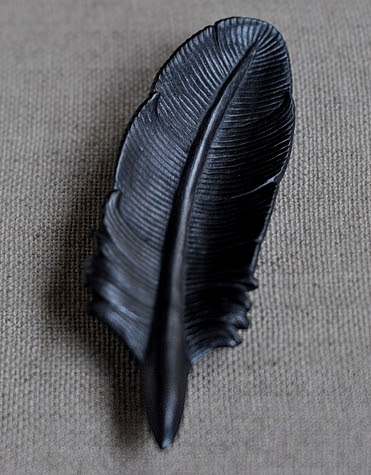
Well, yeah, I guess I had hoped my mystery rocks were obsidian... but, anthracite and graphite are not the lowly, mere utilitarian minerals one might expect. Anthracite was a common replacement for jet in all that wonderful Victorian mourning jewelry... and it's been carved into sculptures as well. And, the same goes for graphite! The two beautiful figures above - the hand and shell (above, left) - were carved from graphite by Angelio Batle, found here, along with a number of others. And the graphite quill (above, right) is just one example of a whole series of really cool, carved graphite pencils (one can write with!) for sale here.

And, so ends the tale of the mysterious black rocks... ;-)


***


Restore the 4th (& steal this banner!)


Monday, July 1, 2013

Obsidian Glass (& a "moon rock") (?)


2 scans of the latest found object - 2013, DS
(click to enlarge)


"Seek and ye shall find"! 

Actually, this is rarely true in my experience... but, I did find what I was looking for at the beach yesterday (see previous post): obsidian glass. Of course, it's so glass-like, it's practically impossible to scan, but, this should give you some idea. It has a slight rainbow flash, but nothing like in the scan - more like the colors one sees in a crow's feather.

And, I also found a lunar rock! Okay, so, it's not really a lunar rock - just another specimen of volcanic rock with a lot of obsidian. It's blacker than it appears in the scan, though; it also has a very silvery sheen to it... 


Scan of the "moon rock" - 2013, DS
(click to enlarge)


Later note: Actually, the true identity of these rocks is still in doubt. I suppose virtually anything can be found on a shoreline, but, we are talking about a Connecticut shoreline... (see the comment section of this post). So, ladies & gentlemen, the jury is still out.


The jury's in... see: Anthracite & Graphite.


Saturday, June 29, 2013

Found Object: A Mysterious Black Stone


2 scans of the same black beach stone - 2013, DS
(click to enlarge)


I actually found two stones on the coastline today, made of the same mineral... but, the one shown is the most photogenic, and this is it's best side... scanned at 200%, and then blown-up another 200%. For the top one, I used the "light adaption" scanning feature, but, both scans exhibit the same peculiar chromatic artifacts that are created when a glassy object is scanned: there's a distinct polarization of red and blue which is impossible to modify... but, in this case, actually enhances the image.

I've no idea what sort of mineral it is. Some surface areas are glassy, but, the rougher areas have zillions of tiny flecks of what is probably silica, and which reflect a rainbow of colors...

In any case, it's a keeper! :-)


***


The other volcanic rock - 2013, DS
(click to enlarge)


Update (6/30):  My friend, Moo, has just informed me, that yesterday's found objects are bits of volcanic rock known as rainbow obsidian. (Thanks, Moo!)

I've googled it, and, while it surely is an igneous rock, I'm not sure it's wholly obsidian - certainly not gem quality - and might be the combination of basalt and obsidian known as a tachylite.

In any case, it's pretty cool to have some volcanic rock, and it's really quite handsome, (though not in the bismuth crystal league). Also, it probably has bits of plagioclase feldspar, and, if you remember, that's the family labradorite belongs to.

Judging by the lack of saltwater erosion, my specimens may have originated from one of the more recent volcanic eruptions... though, how they arrived on a Connecticut shoreline is, yet, another mystery... but, you can bet I'll be looking for more! (For the sequel to this story, see: Obsidian Glass (& a "moon rock").

(Note: obsidian is an anagram of my name...)


Wednesday, June 26, 2013

Hungry Mouths To Feed: The Mesembs from Little Karoo


Today's scan - a nest of Gibbaeum Heathii - 2013, DS
(click to enlarge)


They resemble a nest of baby parrots... or, maybe, something from the Pac-Man family, but, as a fan of weird plants - and weird things in general - this little pot of succulents, Gibbaeum Heathii, always makes me smile. But, I'm not alone in my fascination for mesembs, also known as mimicry plants, living stones, or Lithops (a pretty example is shown here); there are whole blogs devoted to them, organizations developed around them, and, regarding our featured specimen, it's even been YouTubed.

And, yes, Little Karoo is a real place in South Africa... where wild Gibbaeum Heathii is exclusively found, growing amid patches of quartz. Apart from being an amazingly beautiful part of the world, Karoo might also be considered the home of the first humans, the San people.

By the way, the little plant actually seemed to enjoy being scanned - a feat managed by dropping the potted plant in a snug styrofoam cup before placing it upside-down on the scanner bed. My guess? Gibbaeum Heathii loves light so much, it positively devours it... (hence, the voracious, gaping jaws). ;-)

(Note: Don't bother trying this at home -  better results would probably be obtained with your garden variety digital camera.)

And, oh yeah, members of the Gibbaeum tribe bloom!


Thursday, June 13, 2013

We're Sorry...


(Click to Enlarge)


...for this interruption. But, an unarmed (and wholly disarming) sand cat has just taken over this station.

Our regular programming will resume shortly... we think.

(Hat-tip to RPJ at the Daily Grail.)


Important News Update:  However, it has come to our attention that we may have to consult the Sad Cat Diary before any further action can be taken. Stay tuned.

And, now, for a word from our sponsors...


***


(Update 6/9/13) Photo Credit Correction: Tibor Jäger


Tuesday, June 11, 2013

Sand & Cymatics: The Patterns of Sound


Apparently, the video above has gone viral since it was posted a few days ago (according to an article found here), but I didn't see it till today (Thanks, Moo!). I've seen photographs of resonance patterns in the past - patterns which emerge when metal plates containing various substances are vibrated with sound frequencies - but, this video is pretty cool. So, for those of you who have an interest in pattern, form and structure - and my discussions of them, and/or their esoteric aspects - you might find this video illuminating.

Cymatics - the study of wave or modal phenomena - is a word that was coined by Hans Jenny in 1967. Regarding the discovery of the ability of sound frequencies to produce patterns, however, in the West, Galileo first mentions the phenomena in "Dialogue Concerning the Two Chief World Systems" in 1632. (Then again, in the Far East, the ancient Chinese had already developed sound-frequency toys!) Next in line came Robert Hooke, although it is through the repetitions of his experiments with sound, and the subsequent publication of "Discoveries in the Theory of Sound", that Ernst Chladni emerged as the name most identified with resonance imagery - specifically in the term "Chladni plates".

According to the Smithsonian page (linked to above): "Chladni patterns are still of scientific interest, although their analytical uses have been mostly replaced by other technologies. Today these figures are more likely to be produced by a virtual imaging program than by an actual vibrating plate."

Yeah, but I guess they never heard of Meara O'Reilly and her Chladni song, or, her work with Bjork... or, for that matter, the experiments of Alexander Lauterwasser!

For more cymatic info and images, try here and here.

Credit: The creator of the today's featured video is Brusspup at Illusions and Science.


Friday, June 7, 2013

A Day at the Beach


3 scans of a found object - 2013, DS (click to enlarge)


"Shinto teaches that everything contains a kami (神 "spiritual essence"),
commonly translated as god or spirit).

The kami reside in all things, but certain places are designated for the interface of people and kami (the common world and the sacred): sacred nature, shrines, and kamidana. There are natural places considered to have an unusually sacred spirit about them, and are objects of worship. They are frequently mountains, trees, unusual rocks, rivers, waterfalls, and other natural edifices. In most cases they are on or near a shrine grounds. The shrine is a building built in which to house the kami, with a separation from the "ordinary" world through sacred space with defined features based on the age and lineage of the shrine."

- excerpt from the Wiki entry for Shinto


High-tide is not the most excellent time for beachcombing, but, neither is the blistering heat of mid-day. So, for my first visit to the shore in a very long time, I chose the hour just before sunset for my foray by the water's edge. There were a few people milling about on the sand, but, like any dedicated beachcomber, I ignored them completely, aware only of their voices drifting around me in the air, in that peculiar way sound is both muffled, amplified and scattered by the ocean's waves.

I saw only one other person by the water - a woman, perhaps Muslim, swathed in black veils, hunched down in the encroaching waves. She was staring at the horizon, her hands folded under her chin in a way that may have been praying. But, as I approached, she stood up and slid off in the opposite direction.

Communing with the ocean is often - and needfully - a very private thing.

I found very little... the beach isn't what it used to be, or, maybe I'm not what I used to be, lacking the awe and raw enthusiasm I had as child, when everything still seemed new and mysterious.

But, I did find one thing... it was sitting in the sand in the path as I was leaving... a rock, but a special rock, in that it was a chunk of beach marble, my favorite sort of rock, and one that I had collected in the past; a collection I had to part with during the course of moving a few months ago. It was like greeting an old friend, but, before snatching it up, I looked around to make sure I wasn't stealing someone else's treasure.

Anyway, above are scans of three faces of the found object. It isn't as silky-textured as the specimens I've found in the past, those of which have been smoothed and sanded by the salt-water for a longer period of time... (and, an example of which is posted below... my only remaining touchstone of that species). But, it's easy to understand why marble is so often the choice of sculptors. Maybe it has something to do with metamorphic process that marble has to go through, it's physiological history, that speaks to the artist. Or, maybe some rocks just happen to "speak" a little more eloquently.

Interestingly, the grey, striated beach marble I find, tends to have one or more roughly pentagonal faces; the pentagon - along with the hexagon - being a favored shape in the organic world, and for the sacred geometer and mason, a symbol of sentient life.

In the Disneyland world of a child's mind and the "primitive", everything is alive, has consciousness, and is sentient to some degree, even inanimate objects. In other words, all is "animated". But, this is still true in many worldviews, up to and including that of Shintoism, an ancient set of spiritual beliefs and practices of which a large portion of the Japanese population, essentially, still adhere to.

Animism is defined as the worldview in which "natural physical entities - including animals, plants, and often even inanimate objects or phenomena - possess a spiritual essence". I suppose, how one defines "spiritual essence" is where a lot of people get tripped up.

But, to the child, the primitive, the artist, the naturalist, the mystic, and even a quantum physicist or two, that quality we call "life" permeates existence... either it's everywhere... or nowhere.

When in doubt, listen to an eloquent rock.


2 faces of an old friend - 2009, DS (click to enlarge)


***


Bonus link (re: how to house a kami): the shrines of friend and art shaman, B. G. Dodson. Guess which one I own? :-)

(Hint: Ever notice how the Shinto symbol, the Torii Gate, resembles a modified giant Pi symbol?)